Ahl al-Bayt and Islamic History
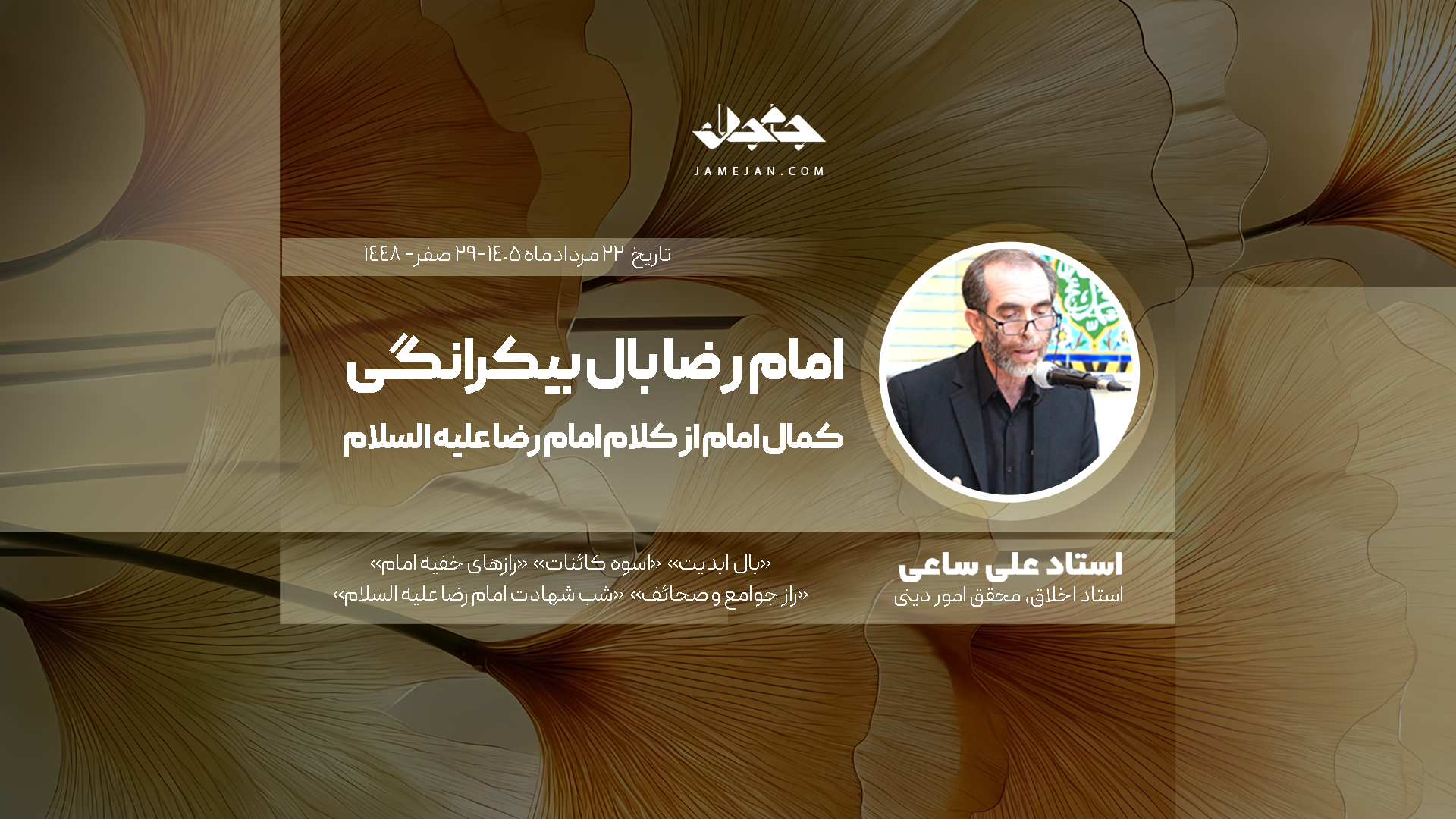
Imam Reza: Wings of Eternity
1405/05/22
114
notifications_active Weekly Meshkat-e Noor Session: Thursdays at 20:30 at Haj Reza Mosque
Tlost, [19.10.24 13:43]
🔹Replacing the Hereafter—a Satanic Drug
📅 Date: 1403/07/26 – 13 Rabiʿ al-Thani 1446
✨ Session: Meshkat-e Noor
📖 Weekly session on the explanation and commentary of al-Sahifa al-Sajjadiyya (Supplication 20)
🎤 Speaker: Master Ali Saei
📝 Some topics discussed in the session:
🌸 Can we remove God from the picture and still believe in the Hereafter or karma?
Do we not know that God is the source of all goodness? Without God, could goodness exist in this world?
Goodness is good, even if we do not believe in God, because God is the creator of all that is good. If—God forbid—we were to remove God from the picture, would any goodness remain in the world? 🌊 Water gives life because God has willed it so. If God did not will it, that same water could bring death.
🌿 Water: a means of life and a means of death
The very water that gives life can, by God’s will, become a cause of death. The same is true of oxygen. God has ordained that breathing should bring people comfort and meet their bodily needs. But if God did not will it, that same oxygen could ignite a fire and burn a person. 🌬
🍃 Goodness is the same: if God did not will it, even goodness could turn into evil.
Buddhists and followers of other schools imagine God as a limited being and believe in various gods, some good and others evil. Ideas such as reincarnation and karma have arisen from these ways of thinking. But what are the consequences of believing in karma?
🍁 Satanic drugs and deviation from our innate nature
Anything that goes against human nature is satanic, like drugs. Drugs initially bring a high and trigger the release of certain hormones in the body. At first, they create an artificial sense of calm, but ultimately they rob a person of all genuine peace. 🌺
🌻 The satanic drug: an attack on first principles
Satan also attacks first principles to begin with. If he can destroy belief in divine oneness, prophethood, divine justice, the Hereafter or imamate, he has succeeded. If not, he turns to secondary and peripheral matters, gradually drawing people away from the truth. 🌾
🌼 Deviation from our innate nature and distorted beliefs
Satan succeeds even with a slight deviation, because it takes a person one step further from the truth. Those who hold fast to their innate nature, however, are still vulnerable to his deception. He creates artificial versions of human nature to strip people of their true nature and distort it, leading them astray. One such deviation is belief in reincarnation and karma, which replaces belief in the Hereafter.
🌳 Karma: Satan’s lullaby to lull belief in the Hereafter
With its attractive veneer, karma captivates the mind and becomes the perfect tool for silencing belief in the Hereafter. In an age when false mysticisms emerge, true, God-centered mysticism is pushed to the margins. To eradicate true mysticism, ideas such as karma act like drugs. 🌺
🌸 Making the Hereafter seem illusory and the danger of false mysticisms
Karma may look like mysticism, but it is mysticism turned upside down, and more dangerous than disbelief. In this path, futile and frivolous pursuits may become widespread in place of prayer and supplication, with dancing and singing taking the place of worship. 🌼
🌼 Desire and worship: planting false ideas
What would happen if people were led to believe that indulging their desires was also a form of worship? Human nature is drawn to desire. So what happens if people are taught that these inclinations themselves count as worship? If someone tells a person, “Sin and go to Paradise,” what might that person do? 🌸
🌿 The recklessness that follows denying punishment in beliefs about the Hereafter
Those who believe in the Hereafter may become brazen and careless if they come to believe that there is no punishment. In the belief in reincarnation, people come to expect repeated births, until they imagine that one day they will attain liberation. 🌾 Once they become certain of this, they forget Paradise and rush toward worldly life. If they sin, they assume they can make up for it in future lives. Yet every contest has its own rules, and people are held to account according to those rules. ⚖️
🌻 Do Repeated Births Bring Liberation?
They seek to justify the means by appealing to a false goal. Yet attaining any goal requires the quantity and quality that the Creator of existence has ordained for it. 🌸 Karma, therefore, is one of the key concepts in Hindu beliefs, and is also called “the law of action and consequence.” This understanding is a mistaken interpretation of cause and effect.
🌳 Karma: The Hindu Understanding of Cause and Effect
This concept was first set out in Hindu religious texts. It rests on the principle that a person’s physical actions in this life and in lives to come produce consequences through rebirth or reincarnation. Hindus believe that each person will reap the fruit of their own deeds. But this raises a question:
🍂 Does Every Action Have a Reaction?
Will every action always bring an equal and opposite reaction? Or can an action go without a reaction? 🍁 These questions call for careful examination if we are to discover the truth. 🌺
🌼 The Absence of God in Karma
There is no place for God in karmic beliefs. Hindus believe that everything happens on its own—and, God forbid, that there is no God. 🌿
🌳 Actions as Their Own Consequence in Karma
In this view, actions themselves bring about their consequences and punishment. Both nature and the action play the decisive role. Whoever acts must face the result. 🌾 In Islam, however, Allah is All-Forgiving and Compassionate. If a person repents and feels remorse, God forgives them, and their action will not incur a reaction. Why? Because God created humanity and guides human actions Himself; He will not hold a servant to account if they have repented. 🌸
🌻 Imposing the Sins of Past Generations on New Ones
In some beliefs, later generations are held accountable for the deeds of those who came before them. In other words, we are the consequence of our ancestors’ actions. But what role do we have in all this? 🌿 Must we answer both for our own actions and be condemned for the sins of others?
🌼 Enduring Injustice in Karma, Resisting It in the Hereafter
One consequence of karmic beliefs is that people are taught to remain silent in the face of injustice, since, from a karmic perspective, oppressors are justified: they are simply the consequence of people’s own actions. People must endure injustice if they are to attain liberation. If they resist, they commit another wrong and must be punished. 🌾
🌸 The Difference Between Karma and the Hereafter in the Face of Injustice
Submitting to injustice is one of the principles of karma; standing against injustice, by contrast, is a belief rooted in Islam’s teachings on the Hereafter. 🌻
🌿 Using Karma to Justify Injustice and Poverty
The wealthy and powerful have used karma as a tool to mislead and subdue the people. Look at the vast Hindu lands and you can see how people have been made to accept poverty and injustice, believing them to be the consequence of their own actions. They do not merely fail to escape this condition; they regard it as justified.
🌺 A Mental Sedative to Justify Injustice
Belief in karma works like a powerful sedative, or a drug for the mind, keeping people calm and compliant in the face of injustice. 🌾 There are, however, also disbelievers among those who believe in karma and reincarnation. Fortunate are those who have rejected these karmic and reincarnation beliefs and freed themselves from such delusions. 🌸
🌼 Philosophical Belief and Islam’s Critique of Reincarnation
Karma and reincarnation have become philosophical and religious beliefs in some societies. Although these ideas are challenged even within physics itself, they have become “principles” in our minds. In this view, human beings are condemned to return and experience the consequences of their actions through repeated births. 🌿 But Islam teaches otherwise: after death, a person is not permitted to return. 🌸
When death comes to someone, they say:
“My Lord, send me back, so that I may do good in what I have left behind.”
But the answer comes: No; there is no return. It is only a wish they harbour, for after death a barrier stands between them and the Day of Resurrection. 🌅
🌿 The Misguidance of Belief in Karma
Those who believe in karma and imagine they will return, when they realise there is no return, will find that they have lost their eternity. Sadly, this belief has taken hold even among some believers, knowingly or unknowingly, without their knowing where this notion was planted in their minds. 🌸
🌼 The Spread of False Beliefs and the Rise of Sects
Step by step, such people are drawn towards Buddhism. Sects emerge that make karma appealing by dressing it up in attractive colours. Eventually, a person reaches a point where they perform actions without feeling attached to them. They regard this state as a stage of liberation—but liberation from what? 🌿 What attachment are they trying to free themselves from? Who laid down this law? Did nature establish these laws, or some other power?
🌻 Questions about the First Creation and the Meaning of Liberation
Another important question is:
What was the nature of the first creation?
Was humanity not already free at the very beginning? What was the first human being like, in their original, unformed state? 🌍 From the perspective of karma, there are no answers to these questions. This school of thought does not know where human beings came from, why they came, or where they are going.
🌳 An Endless Search for Liberation and Freedom from Suffering
In this way of thinking, human beings seek to experience repeated births in order to attain liberation and freedom from suffering. But what suffering are they talking about? Had humanity not reached its destination from the outset? This school of thought has no answer as to why human beings exist or what their ultimate destination is; it remains silent on these matters. 🌺
🌼 Karma’s Problem with Origin and the Hereafter
Those who believe in karma are confused at both ends: origin and the hereafter. 🌿 If later lives are the fruit of earlier ones, then which life was the first life the fruit of? To resolve this problem, they remove the Creator from the picture, while regarding the human spirit as eternal.
🌸 The Enigma of the Unformed Being and Its Errors
This view offers no explanation of humanity’s original, unformed state or of its errors. How can an unformed being fall into error? To resolve this contradiction, they invent imaginary gods—evil gods who compel human beings to do wrong. But if we suppose those gods are to blame, what fault lies with human beings? Is the sin not borne by the very gods who forced them to act this way?
🌿 Nature’s Vengeance in Karma-Based Beliefs
Karma offers no clear answer to these contradictions. Its adherents believe that nature is the avenger: nature takes revenge on the erring human being and condemns them to circle through this world. But how long, and how many times, must a person circle before attaining liberation? 🌱 This raises another question: Who or what is this vengeful nature? Is nature intelligent and conscious? Is it the Creator? 🌿
🌸 Different Interpretations of the Mystery of Nature and Karma
Different sects offer different interpretations of this mystery. But none provides a clear answer to these questions. 🌼
🌳 Karma: Denial of the Hereafter and the Destruction of Belief in God
From a karmic perspective, there is no hereafter. All reward and punishment take place in this world, and upon attaining perfection, human beings are freed from all suffering. In effect, karma is a means of denying the hereafter and destroying belief in God. 🌺
🌻 From Human to Animal in the Cycle of Reincarnation
According to the belief in reincarnation, the human spirit may reappear in this world in various forms:
it may descend from human form to animal form, 🌱 enter plants, or even pass into inanimate objects. This endless cycle continues until a person attains liberation. Sadly, this belief has also taken hold in some Islamic sects. 🌾
🌼 Repeated Cycles and the Ultimate Goal of Liberation
In reincarnationist and karmic beliefs, the transfer of the spirit continues through different cycles until the individual attains liberation and perfection.
🌸 Imam al-Rida (AS) on Reincarnation
Imam al-Rida (AS) said of those who believe in reincarnation:
“Whoever believes in reincarnation has disbelieved in Allah, the Almighty, and denied Paradise and Hell.”
These words are the final word on belief in karma and reincarnation. 🌿
A researcher specializing in religious studies and divine unity, with a particular focus on the Qur’an and Hadith (the Two Weighty Things). His research has centered primarily on the Qur’an and Hadith; in recent years, he has also explored divine unity and critiques of philosophical viewpoints.
If any part of this response is unclear, please submit your question so it may be addressed by the teacher after review.
No inquiries have been recorded regarding this response yet. Your perspective or question will be the first.
Research and Thematic Guidance within the Intellectual Framework and Inquiries of the Meshkat-e Noor School
Follow the latest Meshkat-e Noor sessions