Ahl al-Bayt and Islamic History
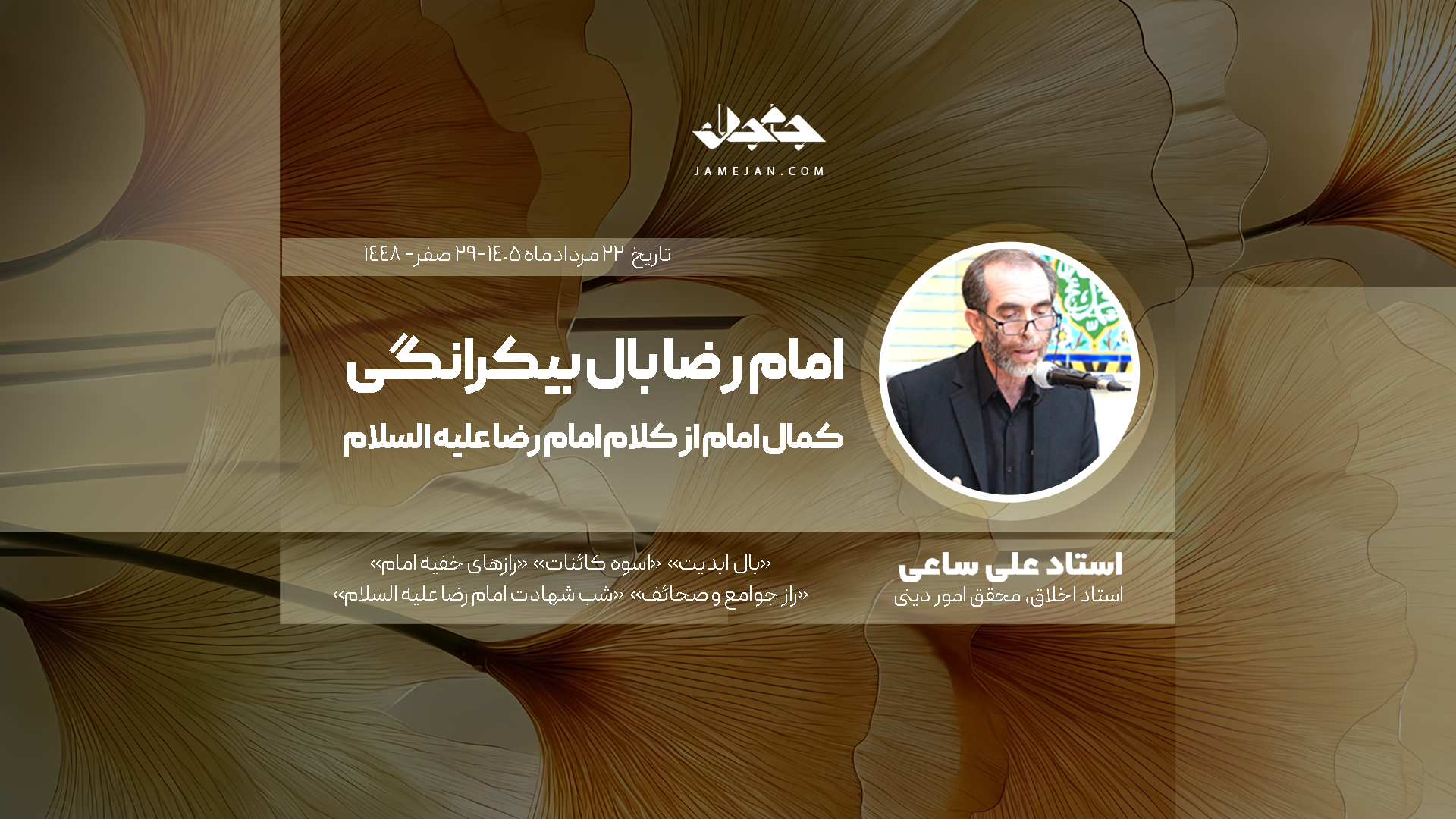
Imam Reza: Wings of Eternity
1405/05/22
114
notifications_active Weekly Meshkat-e Noor Session: Thursdays at 20:30 at Haj Reza Mosque
🔹 “Liqa Allah” Gathering Place
📅 Date: 1403/08/03 – 20 Rabiʿ al-Thani 1446
✨ Session: Meshkat-e Noor
📖 Weekly session on the explanation and interpretation of al-Sahifa al-Sajjadiyya (Supplication 20)
🎤 Speaker: Master Ali Saei
📝 Some points discussed during the session:
O God, how many ambushes and obstacles have stood in the way of reaching You. O God, some strive to obscure this path, so that we may forget our meeting with You.
The Hereafter means meeting God. Every human being, animal, and other creature will one day meet You—some with bright faces and dignity, others in disgrace and shame, and still others in all their majesty. This meeting will be either with perfect devotion or in utter abasement. Those who accept the substitution of the Hereafter seem to have forgotten the meeting with God, for forgetting the Hereafter is like forgetting that meeting.
If God so wills, He can bring creation about in whatever form He chooses. Nothing in this world can resist God’s will. He could transfer the human soul into any body or other creature, but He has not willed to do so. He has the power to transfer a human soul even into animals and insects, but He has not chosen this. Even in this world, if He wills, He can transform a person into something else while they remain in the same place and on the same path. At times, people are transformed into animals, as happened to the People of the Sabbath, who were turned into apes for their disobedience.
When the People of the Sabbath disregarded God’s command and defied what they had been forbidden, God said: “Become apes.” It was God’s will that, in an instant, human beings were turned into monkeys. If God wills, He can transform a person into anything—even stone or dust—for nothing can resist His power. But God’s will concerning the Hereafter cannot be thwarted.
Those who believe in reincarnation or something like it diminish humanity’s station and degrade the human being. Yet the human being is the greater and mightier world. This greatness speaks to humanity’s exalted place in the order of creation.
They regard this immense, greater world as no more than a speck of dust.
The human being has passed through various realms and stages: through different worlds, to the World of Particles, and from there into the material world. But those caught up in the substitution of the Hereafter do not know where humanity came from or what its origin is. Had they known its origin, their hearts would have been freed from the captivity of this world and they would have attained reflection and understanding. The Hereafter cannot be avoided.
Surely, God never fails to fulfil His promises. His appointed meeting will undoubtedly come to pass. Though those who believe in karma may be deceived by their base beliefs, in the end they too will reach that promise beyond all doubt. The Exalted Lord will call them to account. Are those who believe in karma the only ones who deny the Hereafter?
I, too, have forgotten the Hereafter. I should remember it at every moment, but I do not. Had I remembered it, I would not have become a captive of this world. My being captive to this world means that I have forgotten the Hereafter.
Without a doubt, the Resurrection is coming, and there is no uncertainty about it. Is there anyone more truthful than God? If God is the most truthful, why do I not believe His word? Why do I not remember the Hereafter and the meeting with God? If I did remember, I would prepare myself—with the refinement, revision, and adornment I have yet to undertake.
The Hour of Resurrection will surely come; there is no doubt or uncertainty about it. Yet most people do not believe.
We are as great as our faith. The greater our faith, the greater we will be. If we regard ourselves as insignificant and confined to this world, we will become low and small, like the world itself. Despite its injustices, this world is a place of trial—not a place for committing injustice, but for choosing between injustice and mercy. Human beings are being tested in this world, so that they may prove themselves.
According to the belief in karma, poverty and wealth are consequences of a person’s actions. In this view, the Hereafter means the soul passing from one body to another. If these transitions were to stop, the soul would be left wandering. Yet this belief has no account of deeds, no scales, no Heaven or Hell, and no meeting with God. In the karmic view, everything is confined to this world, and the cycle of life is limited to it alone.
The contradictions of reincarnation are, in effect, designed to conceal the truth of the Hereafter. But the Hereafter means an eternal life beyond this world and its limitations. In the karmic view, eternity is defined within the narrow bounds of this world, and no trial has any ultimate outcome. This view confines the universe to the world alone, whereas in the divine perspective, the horizon of human life encompasses all existence and extends beyond it.
In the belief in karma, there is no justice, judgment, or reckoning. A person afflicted by suffering and calamity is considered insignificant and of little worth, as though they were merely paying the price for their past actions. But in the divine perspective, that very suffering person may be God’s noblest servant. This fundamental difference between the two views shows that suffering in this world is not the end of the road; it may instead be a trial on the path to perfection.
In the karmic view, people worship their own deeds: their actions become idols to which they submit. But in the oneness-of-God perspective, people are servants of God, not of their own actions. Every good or bad deed does have consequences, which take different forms, but the way to forgiveness is always open through God. If God wills, He forgives. The karmic world is barren and lifeless, whereas God extinguishes every fire and transforms every ugliness into beauty. He transforms evil deeds into good ones and does not want human beings to be captives of the turning wheel of this world.
God not only forgives ugliness but transforms it many times over into beauty, for He is the possessor of abundant grace. God loves the pure and the repentant, and turns ugliness into the gardens of Paradise. He is “the Possessor of Great Bounty,” transforming evil deeds into good deeds many times over.
In the belief in karma, people become entangled in their own actions and enslaved by them. But in the monotheistic worldview, God encompasses both humanity and its actions. Our actions and their consequences alike depend on God. Everything that happens in the world—from cause and effect to action and what is acted upon—comes to pass by God’s will. All beings and actions are subject to His command and will; how much more, then, are our actions, all of which lie within His dominion.
Reincarnation and karma work like satanic narcotics, standing in opposition to belief in the Hereafter. In this worldview, God has no place, and it is unclear whether nature or human action is the true agent. This belief is a deadly distortion of belief in the Hereafter and in divine oneness, one that corrupts a person’s faith. In the monotheistic worldview, however, actions do not rule; God alone is sovereign, and His will is the only true agent.
In the belief in karma, even though those who suffer are regarded as sinners, this very belief smooths the way for people to sin. A person tells themselves, “If I don’t make amends this time, I’ll do so in another life.” This belief is like Satan’s lullaby, lulling the human nature into sleep and turning the Hereafter upside down. In truth, it is nothing more than imagination and a personal interpretation of the fallible events of the world.
In the karmic worldview, people are compelled to return and repeatedly witness their own actions. In the religious worldview, however, they must fulfil their duties properly in this very world, then, when their lives are over, enter another world.
These beliefs are like food laid out before the faithful, meant to steal their convictions and lead them away from the truth.
God is all-powerful, and human actions count for nothing against His will. We entrust all our actions to Him, for He knows best what He is doing.
In the karmic worldview, suffering is understood only as payment for past actions; there is no place for trial or spiritual elevation. But what goal would a person attain, according to this view, by freeing themselves from every constraint? There is no answer.
In the karmic worldview, nature seems to take revenge on people, trapping them in the repeated cycle of earthly life until they attain purity. But purity for what—to bring an end, or to make a beginning?
In the religious worldview, the Hereafter is not an ending but a new beginning: a life of servitude and passage into another realm of existence.
In the karmic view, there is no place for repentance or seeking forgiveness. Yet we know what fires repentance can put out. If the belief in karma is not corrected, it can lead a person to disbelief. This worldview is populated by colourful, superficial gods who are themselves more entangled than human beings. These gods are leaders in sin and disobedience. The first blow this belief deals is to a person’s faith in the oneness of God.
All suffering and calamities in this world are part of the divine trial. A worldly trial without suffering and hardship would have no meaning. Pain, suffering and even poverty are important elements of this test. If these hardships were removed from the world, the divine trial would be meaningless.
The karmic view regards those who suffer as low and contemptible, even though they may be the best of people. Conversely, those who live in comfort may be among the worst. It is not for us to judge people in this world. Both groups—those who suffer and those who prosper—are undergoing the divine trial. Yet the test of prosperity may be harder, because those who enjoy it are more at risk of heedlessness.
When an oppressor suffers, that suffering serves as a form of discipline. For a believer, however, suffering is a test and a sign of God’s love. The greater a believer’s suffering, the higher their rank before God; for His saints, such suffering is a source of honour.
A believer’s illness is not the result of their sinful deeds; it is a mercy from God. Through illness, God purifies them, cleansing them of the dust of sin. But for a disbeliever, illness is a divine punishment that afflicts them in this world. Even so, the punishment of the Hereafter will be more painful for the disbeliever. There is no need for a return to this world: punishment and damnation continue for the disbeliever. A believer’s illness, too, will not leave them until they are purified of sin and freed from it.
It may be that a person enduring suffering is the most beloved to God. These champions are at the forefront of the contest in worshipping God. Whoever professes faith enters this arena, and only its true champions make it to the end.
Imam Kazim (AS) says: Patience in times of trial and calamity is better and greater than the heedlessness that comfort can bring over a person.
Suffering and calamities serve as a means of warning and awakening. Among believers, the heaviest trials fall on the champions of faith. Who can pass beyond the heavens and attain the station of «قاب قوسین او ادنی»?
In this world, a believer is afflicted with calamity in proportion to their faith. The stronger their religion and faith, the harder their trials will be. Calamity is the measure of a believer’s faith.
The Noble Prophet (PBUH) said: “You are not true believers unless you regard hardship and adversity as blessings, and ease as a trial.” The trials of this world are blessings in the Hereafter. We should not set our hearts solely on worldly pleasures; this world is a proving ground and a means of trading for God’s good pleasure. The pleasures of this world may bring suffering in the Hereafter.
When God loves a servant, He immerses them in trials. But we need not fear, for God is with us in every circumstance. The heavier the trial, the greater the strength and power God grants us.
God sends trials upon the servant He loves. When that servant prays, God responds: “I can grant your request at once, for I have the power to do so. But if I delay the answer and keep it in store for you, it is because what is with Me is better and more excellent.”
🎥 Watch the full talk at the link below:
🔗 Jame Jan website
🌍 jamejan.com
🟠 Jame Jan Eitaa channel
🔗 https://eitaa.com/jamejan
A researcher specializing in religious studies and divine unity, with a particular focus on the Qur’an and Hadith (the Two Weighty Things). His research has centered primarily on the Qur’an and Hadith; in recent years, he has also explored divine unity and critiques of philosophical viewpoints.
If any part of this response is unclear, please submit your question so it may be addressed by the teacher after review.
No inquiries have been recorded regarding this response yet. Your perspective or question will be the first.
Research and Thematic Guidance within the Intellectual Framework and Inquiries of the Meshkat-e Noor School
Follow the latest Meshkat-e Noor sessions