Ahl al-Bayt and Islamic History
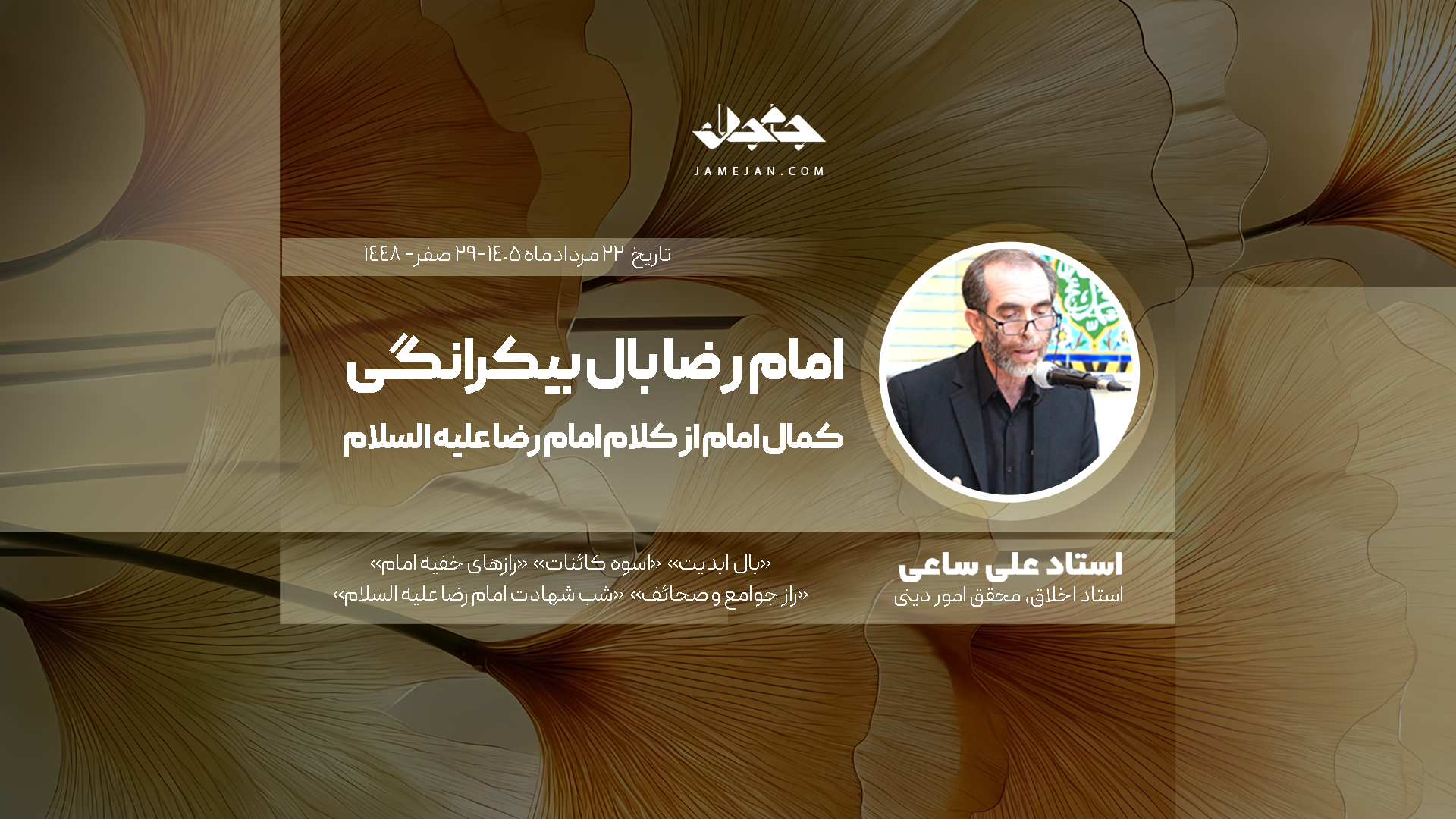
Imam Reza: Wings of Eternity
1405/05/22
116
notifications_active Weekly Meshkat-e Noor Session: Thursdays at 20:30 at Haj Reza Mosque
▫️Pure Sadr al-Din Shirazi Tawhid
🔘 The evening of the martyrdom of Imam Ja’far al-Sadiq, peace be upon him
📆 Date 1403,02,15 – 25 Shawwal 1445
📌 Meshkat-e Noor session
👤 Lecture by Master Ali Saei
🗒 Some points raised in the session:
🟨 The Imam is the Imam of tawhid, the Imam of knowledge, the Imam of wisdom, the Imam of eloquence, the Imam of the path, the Imam of bread, the Imam of water, the Imam of life, the Imam of life.
🟨 The Imam is the support of the universe; it is as though God created him as a staff for the universe.
Life, the Imam of life.
🟨 (Hadith) One day Mansur al-Dawaniqi had leaned on the Imam’s hands and would not let him go. A certain person named Reza noticed how firmly Mansur was holding the Imam’s hand. He asked himself, “Who is this person on whom the king of the age (Mansur) is leaning?” He asked Mansur, and Mansur replied, “He is Abu ‘Abdullah, Ja’far ibn Muhammad al-Sadiq.” Then he said, “I wished that my face might become the place of the Imam’s sandal.”
🟨 Mansur al-Dawaniqi says, “O Abu ‘Abdullah, we continually drink from your sea, sip by sip we satisfy our mouths and fill the bowls of our being, and we draw near to you so that you may grant us grace. You give sight to the blind; through your light the darknesses are dispelled (this is the speech of the Imam’s enemy concerning him). We stand before the radiance of your sacred light; we float in the sea of your being.”
🟨 The Imam is the sun of tawhid; by standing before this sun, our innate disposition of tawhid will be illumined.
🟨 What is the reason for the delay of the reappearance? The scarcity of monotheistic forces. If there were 313 sincerely devoted forces, the reappearance would not be delayed.
🟨 We seek tawhid in the alley of shirk; the cause of all the believers’ afflictions is shirk.
🟨 Whoever separates himself from tawhid will inevitably fall into the whirlpool of shirk.
🟨 Let us take a look at the tawhid of the Sadiqiyya and come to know tawhid.
🟩 The tawhid of tahleel: “لاالله الاالله”
🟨 If He is Allah, then none other than Him has any divinity.
🟨 To establish His divinity, we must negate divinity from all besides Him—both divinity and lordship. If it were not so, we would be polytheists and would have associated others with Him.
🟨 If existence belongs solely to Him, then no existence should be ascribed to any other. Even if we ascribe an illusory existence, we are polytheists and caught in illusory shirk. If existence is His, then others have no share in it whatsoever—not even an atom’s share. We must not concede even a ray to others.
🟨 No being has any partnership with Him in anything—whether real or figurative, concrete or illusory. Divinity belongs to Him alone.
🟨 If someone possesses beauty, that beauty is God’s creation, not God Himself. No one shares in God’s majesty and beauty.
🟨 If we affirm existence for God, no one shares in it in any way—neither through manifestation, nor through appearance, nor through a share. “لاالله الاالله” is absolute negation.
🟨 Whatever is affirmed of Him must be negated of all besides Him.
🟨 The negation of perfection from all besides Him: “لیس کمثله شیء”
🟨 When we make use of existence, we fall into verbal equivocation; let us beware lest we entangle ourselves in equivocation of meaning as well!
🟨 O Lord, I have not yet uttered “لاالله الاالله” in its true sense, for I have associated everything with You! From where and how has this affliction fallen upon our souls?
🟩 The tawhid of tanzih (transcendence)
🟨 Whatever we attribute to Him we must not attribute to any other, and whatever we have attributed to others we must separate from God.
🟨 “سبحان الله”
🟨 فَكُلُّ مَا فِي الْخَلْقِ لَا يُوجَدُ فِي خَالِقِهِ Whatever is produced in the creature is not in the Creator. Why? Because it is deficiency. God is the Agent, not the act; He is not His own act.
🟨 Why should I burden myself with the effort of comprehending God’s essence?! What is the relation between creature and Creator? If I wish to understand this relation, it means in fact I have tried to comprehend God’s essence. I will inevitably end up giving the Creator the form of a creature.
🟨 Beware lest we teach lessons of shirk in the garb of ethics!
🟨 Perhaps God will overlook many things, but He will not overlook shirk. إِنَّ اللَّهَ لَا يَغْفِرُ أَنْ يُشْرَكَ بِهِ
🟨 (Hadith) Shirk is more hidden than the movement of a black ant upon a black stone in the darkness of night.
🟩 The tawhid of tahmid (praise)
🟨 “انا لله و انا الیه راجعون”
🟨 Praise belongs to Him alone, and all are enamoured of Him, are from Him, and return to Him. From “الحمدالله رب العالمین” we must arrive at the tawhid of takbir.
🟩 The tawhid of tahleel, tanzih, and tahmid were a path to bring us to the tawhid of takbir.
🟨 So that I may confess that my God is beyond description.
🟨 Then, if so, why do I describe God? Has God not given permission? Why has He given permission? But this permission is by way of avoiding suspension of knowledge, lest this cause me to fall into the affliction of tashbih (likening Him to creation).
🟨 God has shown us love and has given permission that we may call upon Him—lest this cause us to fall into tashbih! This is God’s love, not that I am worthy to call upon Him. Not us—rather, not even any of the prophets, for the prophets themselves have confessed this.
🟨 So whatever description there is, it is a description of His acts; the welling of existence from the essence of God’s mashiyya (will).
🟨 Imam Reza said, “Both mashiyya and irada are attributes of God’s acts. Whoever imagines that God is continually willing is undoubtedly not a monotheist.”
🟨 Whatever manifestations there are, they come from the essence of God’s mashiyya and God’s irada; so whatever exists is the act of God.
🟨 So the only way to describe Him is to say: “My Lord, You are beyond description.” الله اکبر ان یوصف
🟨 لَطِيفٌ لَا يُوصَفُ بِالْخَفَاءِ، كَبِيرٌ لَا يُوصَفُ بِالْجَفَاءِ، بَصِيرٌ لَا يُوصَفُ بِالْحَاسَّةِ، رَحِيمٌ لَا يُوصَفُ بِالرِّقَّةِ، تَعْنُو الْوُجُوهُ لِعَظَمَتِهِ وَ تَجِبُ الْقُلُوبُ مِنْ مَخَافَتِهِ.
🟨 Thus, all description serves to avoid denying God’s attributes altogether.
🟨 When we come to describing the Lord, we see that He intends both to free us from denying His attributes and to spare us the painful error of likening Him to creation.
🟨 كَائِنٌ لاَ عَنْ حَدَثٍ مَوْجُودٌ لاَ عَنْ عَدَمٍ مَعَ كُلِّ شَيْءٍ لاَ بِمُقَارَنَةٍ وَ غَيْرُ كُلِّ شَيْءٍ لاَ بِمُزَايَلَةٍ
🟨 وَلِلَّهِ الْمَثَلُ الْأَعْلَىٰ ۚ If we wish to offer an example, only the highest of examples is fitting for God.
🟨 When we speak of the highest example, we mean that nothing resembles Him.
🟨 He is neither describable nor conceivable: this is the highest example.
🟥 Examining a Few Examples
🟧 Is the relationship between Creator and creation like that between the sea and a bubble?
🟩 Those who give this example either do not know the sea or do not understand the bubble. A bubble is made of water; in other words, it contains some share of being, however small. To apply this example to the relationship between God and things would be presumptuous. This is manifest shirk, not hidden shirk.
🟧 Is the relationship between Creator and creation like that between the sea and its waves?
🟩 No. Waves describe the sea in its turbulent state; they show how one part of the sea relates to another. We must not liken God to the sea. When these particles of water interact and change, and are affected by the air and other conditions, such as gravity and the earth’s rotation, waves arise. In reality, the sea displays itself in that place through the medium of time.
🟧 Is the relationship between Creator and creation like that between the sea and a mirage?
🟩 No. That too is wrong: we must not liken God to anything. Is a mirage nothing? No—it has some share in being. It is an appearance of water, though it is not water itself; it consists of light, dust and existing gases. Even if none of these were present, it would still be an image in my mind, and that imagined image has a kind of existence.
🟧 Is existence a matter of degrees? Does it admit of higher and lower levels? Does the lower level exist or not? Is it there or not? If it is not, then there is nothing to say. But if it is, then, however slight its existence, it still exists. It is a mistake to regard what is small as nothing. The greater mistake is to regard God’s existence as the highest degree of existence: whoever accepts a highest degree must also accept a lower one, and that would mean God had a beginning from which He rose to the highest degree.
🟧 To regard God as the highest means that He is free of every deficiency.
🟧 Is the relationship between Creator and creation like that between essence and manifestations (the relation of essence to its appearances)? Do not play games with words. Playing with words is a kind of trickery and deception. What is a manifestation? Explain what you mean. Is it a beam of light? Does God radiate? Do creatures appear through God’s radiance? Does God radiate like the sun? Why confuse people about God’s creation?
🟧 A ray is part of the sun; it is something that has separated from the sun.
🟨 God is the Creator of all existence, and the Creator has nothing in common with His creation. The Divine Essence cannot share a nature with anything, for He is One.
🟨 Let us proclaim God’s greatness in response to every description.
🟨 God brings things into being. What is the relationship between the One who brings into being and what is brought into being? When we say that all beings receive their existence from Him, we must mean that He grants existence to everything. If we claim that beings take their existence from Him in the way a drop separates from the sea, that is sheer shirk: it is to divide up the Creator.
🟨 سُبْحَانَهُ وَتَعَالَى عَمَّا يَقُولُونَ عُلُوًّا كَبِيرًا
🟨 If we regard beings as manifestations of God, we imagine the Divine Essence as something that displays itself—as though it were a screen. Manifestations are things conceived, but does the Creator conceive? No: He is the One who gives form, not one who conceives; He does not conceive. It is as if we had imagined creatures to be thoughts in the Creator’s mind—as though creatures were God’s thoughts, God forbid. God does not think or reason; He simply knows. I have no access to God’s knowledge, let alone to His Essence.
🟧 Is the relationship between Creator and creation like that between infinity and the finite?
🟩 Can infinity have parts? An infinity that has parts is no longer infinite; it has components. Those who ask this do not understand what infinity means. If infinity had an external existence, it would no longer be infinite. Why are those who, God forbid, seek to help God and make room for things alongside infinity so entangled in this problem? Because they imagine God as matter: matter occupies space, leaving nowhere that it is not. In other words, they imagine God to be both container and contained. This is to materialise God. Then they try to find a place for creatures. If He is infinite, where are creatures? Do they appear within Him? If they appear outside Him, then there is something outside infinity, and it is no longer infinite! They are forced to regard creatures as like God too, God forbid, and to say that God takes on different forms. He is able; He is the Creator, and He does not create within Himself.
🟨 لَمْ يَلِدْ وَلَمْ يُولَدْ وَلَمْ يَكُنْ لَهُ كُفُوًا أَحَدٌ
🟨 Have we not read Sūrat al-Tawḥīd? They treat the screen as three-dimensional and its images as ten-dimensional, then say that those other two dimensions have no dimension: compared with three dimensions, they are zero. But that is not so. They have dimension: even a thin layer has volume. It is nothing, yet it has existence.
🟨 They reduce the infinite to the finite and describe it.
🟨 If there were only one existence, then there would be nothing but Him, and there would be no creation. If created beings have existence and He too has existence, then there can be no created beings. If we were to entertain the impossible idea that He and His creatures both exist, we would in fact be taking the creatures for God. Where does the problem lie?
🟩 They do not know or understand what lies beyond existence, whereas existence itself is a beginning, not an end; it is neither the highest limit nor infinite. Existence has a beginning.
🟨 The clearest example we can offer to solve this age-old riddle is that the existence we know as existence is like time. When was time created? Time is not created within time! Time is not created in time. Time itself does not begin. When we say “before time,” I cannot find the words for it. When we say “before time,” it is as though we are asking, “What time was there before time?” If time was created, there was no time before it. I am limited; my vocabulary and knowledge are inadequate, my understanding falls short, and I lack the intellectual capacity. I cannot conceive of what lies outside time. That is the problem of my ignorance. So when I speak of existence, it is as though this existence is the first and the last. If we remove this existence, nothing remains—nothing, nothing—because I know of nothing beyond existence that exists, just as I know of nothing beyond time that exists. Time was not created within time; existence was not created within existence. The Creator of time did not create this time and its inhabitants within time; the Creator of time did not create it within time. The Creator of existence did not create existence within existence.
🟨إِنَّ اَللَّهَ كَانَ إِذْ لاَ كَانَ فَخَلَقَ اَلْكَانَ وَ اَلْمَكَانَ وَ خَلَقَ نُورَ اَلْأَنْوَارِ اَلَّذِي نُوِّرَتْ مِنْهُ اَلْأَنْوَارُ وَ أَجْرَى فِيهِ مِنْ نُورِهِ اَلَّذِي نُوِّرَتْ مِنْهُ اَلْأَنْوَارُ وَ هُوَ اَلنُّورُ اَلَّذِي خَلَقَ مِنْهُ مُحَمَّداً وَ عَلِيّاً فَلَمْ يَزَالاَ نُورَيْنِ أَوَّلَيْنِ إِذْ لاَ شَيْ ءَ كُوِّنَ قَبْلَهُمَا فَلَمْ يَزَالاَ يَجْرِيَانِ طَاهِرَيْنِ مُطَهَّرَيْنِ فِي اَلْأَصْلاَبِ اَلطَّاهِرَةِ حَتَّى اِفْتَرَقَا فِي أَطْهَرِ طَاهِرِينَ فِي عَبْدِ اَللَّهِ وَ أَبِي طَالِبٍ A.
When I say “was,” I have no choice but to risk denying God’s action altogether. He created; God brought the universe into being and gave it existence. What resemblance could there be beyond that?
🟨 More than this, the Qur’an is the speech of God, distinct from God—and we all know this. This very Qur’an was before existence. Saying “was” is a necessity forced upon us. The Qur’an is God’s speech, independent of existence, in accord with existence and beyond existence. When God’s speech is independent of time, space and existence, and transcends them, what is the One who speaks it like? We must not say what He is like; we can only say الله أكبر and ان يوصف
🟨 The Creator is beyond His creation; the One who brings into being is beyond what He brings into being; the Originator is beyond existence. To use rational argument to grasp the Divine Essence is irrational, since reason itself admits that it cannot know or comprehend the Divine Essence. Reason’s only task is to establish that He لا يوصف, and to bring us to complete certainty and the acknowledgment that the Divine Essence is beyond our grasp: it cannot be experienced or comprehended by reason. Let us beware of those who steal our innate nature, and be sure to doubt anything apart from the Two Weighty Things.
🟨 The most sacred doubt is doubt directed at anything apart from the Two Weighty Things.
🟨 The One who grants existence is therefore independent of existence; the One who brings things to an end is without end. His endlessness is no imperfection; it is the pinnacle of perfection. When we say that He has no need of existence, we are not denying His perfection, but affirming its highest degree.
🟨 Existence lies within the realm of God’s will. Knowledge transcends existence. The Creator of time transcends time and is independent of it. This independence is the pinnacle of perfection, not a deficiency.
🟨 The Initiator has no need of time. This independence is not a deficiency, but the highest perfection.
🟨 Thus, if we wish to avoid falling into the error of تعطیل, the relationship between the Divine Essence and things is simply that of Creator to created, Maker to made.
🟨 We have therefore understood that, as an object of thought, existence is like time: when we point to what lies beyond time, we can no longer use temporal expressions. If you are equal to the challenge, coin new terms so that we need not say “before time.”
🟨 “Before” and “after” belong to time. The realm beyond time admits neither, yet we know no word we can use in their place.
🟨 Knowledge, too, ranks above existence. In describing knowledge, we draw on the language of existence, when instead we ought to
use expressions other than those of existence. We have no apprehension of what lies beyond time, nor of what lies beyond existence. To confine God to existence is to diminish Him. Neither existence nor time existed; both came into being, both had a beginning, and both may come to an end. They depend on God to endure, and may continue only if He wills.
🟨 We have clear and ambiguous descriptions, and most descriptions are ambiguous. Their ambiguity must be resolved in light of the clear descriptions; otherwise, we will fall into error. Even descriptions of the Divine Essence as hearing and seeing are ambiguous.
So God is not a spectacle, and created things are not His thoughts or imaginings. They are not rays emanating from God; they are His creatures. We must not imagine God as space; God is not a container.
🟨 The relationship between container and contained leads us to think of the container as filled, and then we go searching for a place to hold created things.
🟠 Eitaa channel: Jam-e Jan
https://eitaa.com/jamejan
A researcher specializing in religious studies and divine unity, with a particular focus on the Qur’an and Hadith (the Two Weighty Things). His research has centered primarily on the Qur’an and Hadith; in recent years, he has also explored divine unity and critiques of philosophical viewpoints.
If any part of this response is unclear, please submit your question so it may be addressed by the teacher after review.
No inquiries have been recorded regarding this response yet. Your perspective or question will be the first.
Research and Thematic Guidance within the Intellectual Framework and Inquiries of the Meshkat-e Noor School
Follow the latest Meshkat-e Noor sessions