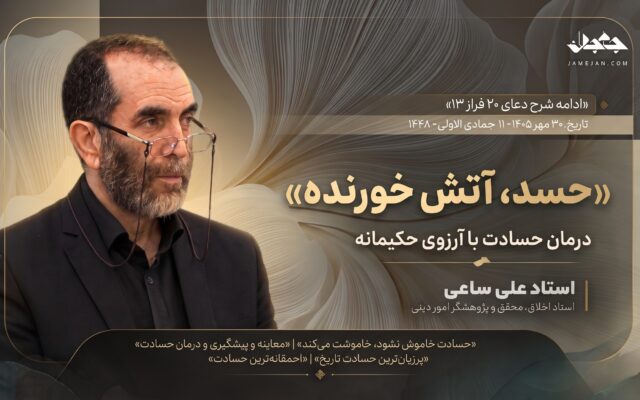
Written transcript of the lecture
The Meshkat-e Noor teachings series🌼🔆🌼Equipping and Honouring the Soul🌼🔆🌼
🔹Weekly sessions on the commentary and interpretation of al-Sahifa al-Sajjadiyya (Supplication 20)
📅 Date: 1404/06/07 – 07 Rabiʿ al-Awwal 1447
✨ Session: Meshkat-e Noor
🎤 Speaker: Master Ali Saei
📝 Some topics discussed in the session:
Please note that the text below was produced by transcribing a speech, so some Quranic verses or hadith may have been transcribed incorrectly. We therefore recommend consulting the audio or video recording of the lecture to verify them.
اللَّهُمَّ صَلِّ عَلَى مُحَمَّدٍ وَ آلِ مُحَمَّدٍ ، وَ أَبْدِلْنِي مِنْ بِغْضَةِ أَهْلِ الشَّنَآنِ الْمحَبَّةَ ، وَ مِنْ حَسَدِ أَهْلِ الْبَغْيِ الْمَوَدَّةَ ، وَ مِنْ ظِنَّةِ أَهْلِ الصَّلَاحِ الثِّقَةَ ، وَ مِنْ عَدَاوَةِ الْأَدْنَيْنَ الْوَلَايَةَ ، وَ مِنْ عُقُوقِ ذَوِي الْأَرْحَامِ الْمَبَرَّةَ ، وَ مِنْ خِذْلَانِ الْأَقْرَبِينَ النُّصْرَةَ، ، وَ مِنْ حُبِّ الْمُدَارِينَ تَصْحِيحَ الْمِقَةِ ، وَ مِنْ رَدِّ الْمُلَابِسِينَ كَرَمَ الْعِشْرَةِ ، وَ مِنْ مَرَارَةِ خَوْفِ الظَّالِمِينَ حَلَاوَةَ الْاَمَنَةِ الْاَمَنَةِ
( 8 ) اللَّهُمَّ صَلِّ عَلَى مُحَمَّدٍ وَ آلِهِ ، وَ اجْعَلْ لِي يَداً عَلَى مَنْ ظَلَمَنِي ، وَ لِسَاناً عَلَى مَنْ خَاصَمَنِي ، وَ ظَفَراً بِمَنْ عَانَدَنِي ، وَ هَبْ لِي مَكْراً عَلَى مَنْ كَايَدَنِي ، وَ قُدْرَةً عَلَى مَنِ اضْطَهَدَنِي ، وَ تَكْذِيباً لِمَنْ قَصَبَنِي ، وَ سَلَامَةً مِمَّنْ تَوَعَّدَنِي ، وَ وَفِّقْنِي لِطَاعَةِ مَنْ سَدَّدَنِي ، وَ مُتَابَعَةِ مَنْ أَرْشَدَنِي .
( 9 ) اللَّهُمَّ صَلِّ عَلَى مُحَمَّدٍ وَ آلِهِ ، وَ سَدِّدْنِي لِأَنْ أُعَارِضَ مَنْ غَشَّنِي بِالنُّصْحِ ، وَ أَجْزِيَ مَنْ هَجَرَنِي بِالْبِرِّ ، وَ أُثِيبَ مَنْ حَرَمَنِي بِالْبَذْلِ ، وَ أُكَافِيَ مَنْ قَطَعَنِي بِالصِّلَةِ ، وَ أُخَالِفَ مَنِ اغْتَابَنِي إِلَى حُسْنِ الذِّكْرِ ، وَ أَنْ أَشْكُرَ الْحَسَنَةَ ، وَ أُغْضِيَ عَنِ السَّيِّئَةِ .
Beginning the commentary on the twentieth supplication of al-Sahifa al-Sajjadiyya (passages 7, 8 and 9) 📜
In the blessed seventh and eighth passages, Imam Sajjad (peace be upon him) takes us from the Throne… and from leaping to the Throne of God. This is a complete spiritual journey on the path to God. First, in passage seven, he transforms the human being into one destined for the highest heaven. The supplication, and its fulfilment, make a person become one of the people of the highest paradise, drawing near to the garden of God’s good pleasure. Then, in the next passage—in passage nine—he equips the human being and makes him keen, transforming him into a mighty fortress. That is, if this supplication is answered, a person becomes an impregnable fortress—a fortress that is mighty, resilient, keen and surging with energy; alive, steadfast, yet also effective and action-oriented. It charges ahead, takes the initiative and presses forward, firmly overcoming every difficulty; and in passage nine, at the height of its power and strength, it becomes gentle and tender.
The Imam teaches us: Become a heavenly garden; then make yourself as steadfast as a mighty fortress and attain the height of power. And at the height of that power, become gentle and tender. The Imam teaches us the principles of “inner governance”—spiritual governance: how should I govern my soul? He teaches us the principles of heavenly governance so that we may bring heavenly governance to bear in this world and put it into practice in the souls of creation. These supplications hold the secrets of the qualities of the companions of our Master, the Proof of God, may my soul be sacrificed for him.
اللهم صلِّ علی محمد و آلِ محمد.
A loyal companion of the Imam: strategies for equipping the outward and the inward 🛡🌿
What qualities must a “true companion of the Imam” possess? We need only take a comprehensive look at sections seven, eight and nine: the strategy of the “honoured human being” lies in equipping the outer and inner self—a human being must be both equipped and honoured; one who possesses human virtues must be both strengthened and honoured. And, on the other hand, the Imam teaches us the secret of good prevailing over evil: How can I enjoin what is right, forbid what is wrong and see it have an effect? The answer is this: I must bring my strength to its peak and demonstrate it. Let people know that I am at the height of my power, and that my gentleness and humility stem not from weakness but from nobility and steadfastness. I want to show you the attributes of the Exalted Lord: the very One who is أشدّ المعاقبین, the All-Powerful and Mighty, is also أرحم الراحمین. I want to become both أشدّ المعاقبین and أرحم الراحمین. This is how I can make what is right take root in people’s hearts; attain both political power and social standing; and, through noble character, manage this entire world—its inner reality. This blessed supplication, Supplication 20 of al-Ṣaḥīfa al-Sajjādiyya, holds the secrets of managing the soul and the world. It is not about managing this “body,” but about managing this world—the soul.
A recap before turning to new topics: overcoming faults and adorning ourselves with virtues 🧭
Before moving on to new topics, let us review what we have covered so far.How can I attain those lofty stations? I am immersed in faults; how can I adorn, honour and equip myself? I cannot. First I must remove my faults; only then can I adorn my being. When I lie in the birthplace of faults within my soul, faults will be born from it. First I must remove myself from this birthplace; I must leave this bed—this field of faults—so that I can make a flower bloom in my soul. Where is that bed, that birthplace of faults? It is ignorance, of which we are unaware—the very ignorance of which we are ignorant! We must gain knowledge of this ignorance so that we can escape it. How can I flee from fault? By fleeing from ignorance, I have escaped every fault. Ignorance is a storehouse of ugliness. I want to become so beautiful that I dazzle the eyes of all creation, leaving them amazed—yet I do not realise that I am the cause of my own ugliness. When I am immersed in ignorance, I am welcoming ugliness. One who sinks into ignorance does not realise it; that is, that ignorance will reveal itself, and through every kind of ugliness and filth, it will become horrified by itself. In this world, my outward appearance is a veil that prevents me from witnessing my inner self. I must perform surgery on my soul and my character. If I remove ignorance from my heart and replace it with intellect, I will have escaped every fault; I will have been saved and reached the beginning of beauty—whose furthest reaches I will one day attain.
No excuse remains after the light of the Qur’an and the Prophet’s Household 📖
If I do not escape the power of ignorance, I am finished; «ولا عذر بعد البیان». Ignorance—to stand against the Qur’an and the Prophet’s Household is to stand against the sun of knowledge. Once the truth has been made clear, no one can claim ignorance as an excuse, saying it had overcome them. We do not realise that we are at fault for our own ignorance. I am at fault for my ignorance. I must not… I must flee; instead, I have embraced ignorance—the root of all evil. Every evil in this world emerges from the lair of ignorance; it grows from the tree of ignorance. الجهل أصلُ کلِّ شرّ. We must speak of this ignorance again and again, come to know it, and no longer be ignorant of it. We must understand that it is the source of all evil, the root of every wrong. This ignorance is a wellspring of evil. By God, where is ignorance? Where does it dwell, so that I may flee and not fall into its trap? Outside the Qur’an and the Prophet’s Household—that is where ignorance dwells. When I turn my face away from the Qur’an and the Prophet’s Household, I am, without knowing it, standing in ignorance’s trap. To wander beyond the precinct of the Two Weighty Things is to be within ignorance. الجهل معدنُ الشر; every vile element rises from the heart of this mine. Ignorance is both “pain” and “helplessness.” The most agonising pain in all existence is this very ignorance. It is the source of all evil; it is فسادُ کلِّ أمر, the corruption of every affair.
If this ignorance enters a person’s soul, the harm it causes is worse than cancer and leprosy. A tumour that takes hold of a person and devours their very spirit and soul is less harmful than this ignorance. It is أسوأُ السَّقَم, the most dreadful disease; it is عِظَمُ المصائب, the greatest calamity. Whoever is taken captive by ignorance has fallen into the greatest calamity. Whoever is taken captive by ignorance becomes poor—poorer than anyone. لا فقرَ أشدُّ من الجهل
The shame of ignorance in the presence of the Qur’an and the Prophet’s Household 🚫
God save us from ignorance after knowledge! When the sun has risen, what excuse can a person give for being blind? God save us from ignorance after knowledge; God save us from darkness after light; God save us from pretending not to know; God save us from… burying our heads in the sand, as I do when I bury my head in the sand and plunge myself into ignorance. What ignorance could be worse than this? To possess knowledge and yet die of extreme poverty—worse than a poor person who, despite being wealthy, dies of famine! Could there be any poverty worse than this? To be blind in the very heart of the sun—by God, it is shameful. We have the Qur’an; we have the Prophet’s Household; for ignorance to overcome us is shameful, a terrible disgrace.
The Master cries out: “Which ignorant person?” He laments the ignorant… the learned: «ربّ عالمٍ قد قَتَلَهُ الجهل»—the scholar whose ignorance led him to destruction. We possess immense wealth in the Qur’an; we possess immense wealth in the Prophet’s Household. Why, then, are we so poor? We do not venture into the ocean; we do not enter this vast sea of knowledge—we have no time! So when will we set about correcting our faults? When we have removed our faults, we will draw beauty into ourselves. God’s artistry will be inscribed upon my pure tablet. The Beautiful Creator will draw His perfect art upon the pure tablet; He will set His beautiful pen upon it. Let us look at ourselves, come to our senses, wake up, and open our eyes.
A few words from Imam Zayn al-Abidin, peace be upon him 🕊
Imam Sajjad (peace be upon him) says: «إنَّ أسرعَ الخیرِ ثوابًا البرُّ»—the reward for a good deed comes swiftly. Whoever does a good deed should know that its reward will soon embrace him. «و أسرعُ الشرِّ عقوبةً البَغْیُ»—and injustice is a particular evil whose punishment swiftly catches up with the one who commits it. The punishment for injustice will soon catch up with the wrongdoer. «كَفى بالمرءِ عیبًا…»—and this is fault enough for a person: to watch for the faults of others while being blind to his own; to see the faults of others, yet remain blind to his own. Worse than this fault is the fault itself: blindness to one’s own failings. And that a person hurts those close to him is a fault; worse still is when someone forbids others to do what he himself cannot disavow in himself: he enjoins what is right upon others, but himself does what is wrong.
When God wills good for a servant 🌟
In another blessed saying, His Eminence tells us that when Allah, Glorified and Exalted, wills good for a servant, He زَهَّدهُ فی الدنیا—makes him زاهد toward the world, makes him unattached to it, and removes love of the world from his heart; فَقَّهَهُ فی الدین—makes him a فقیه in religion, makes him deeply discerning; and بَصَّرَهُ بعیوبه—makes him clear-sighted and aware of his faults. I see my own faults; I am broken—but this is no illness; it is the very essence of healing. I have discovered my faults; God has granted me abundant good. I must seize this opportunity and remove my faults, so that beauty may blossom within me. “Whoever is granted this has been granted the good of this world and the Hereafter.”—whoever is granted this has been granted the good of this world and the Hereafter.
Thus, the good of this world and the Hereafter lies in becoming unattached to the world, being deeply discerning in one’s religion, and seeing one’s own faults.
How to divide your time, in the words of Imam رضا (peace be upon him) ⏳
I would like to share a hadith from our Imam رضا, so that our spirits may be imbued with the purity of رضا: «»
- An hour for communion with God: Be alone with God. Do not let anything enter the sanctuary of your heart except the remembrance of God.
- An hour for earning your livelihood: This does not mean forgetting God while earning your living. Rather, earning your livelihood itself should become an act of remembrance—every second spent mindful of God.
- An hour for keeping company with trustworthy friends: Those who know your faults, are experts in identifying them, and in their hearts are sincere toward you; they are your true, pure-hearted friends, who will sincerely point out your faults to you.
- An hour for lawful enjoyment: This hour will give you the strength for the other three.
Do not tell yourself a tale of poverty; do not convince yourself that you are poor. Nor should you convince yourself that you will live a long life. Why? Because «مَن حدَّثها بالفقر بَخِلَ»—whoever tells himself that he is poor becomes miserly; and «مَن حدَّثها بطولِ العُمر حرِصَ»—whoever tells himself that he will live a long life becomes greedy.
«اجعلوا لكم من الدنیا سَهمًا من الحلال»—set aside for yourselves a lawful share of this world and enjoy it. Satisfy your desires, without compromising your dignity or being extravagant.
And seek help from this world in the service of religion, for «مَن ترکَ دنیا لدینه أو ترکَ دینَه لدنیاه فلیس منا»—whoever gives up worldly life for the sake of religion, or gives up religion for the sake of worldly life, is not one of us.
Condemning Miserliness and Its Degrees 💎
I want to share a few hadiths about miserliness, lest we end up reciting the hadith of poverty for ourselves. Miserliness is an incurable affliction: whoever falls prey to it—God forbid—cannot escape its harm.
Can there be an affliction more impossible to cure than miserliness? No. إیاکم والبخل—Beware of miserliness, for it is an obvious failing, a mark of inferiority and disgrace. It has no place in a free and noble person, and a believer is never miserly, because miserliness is contrary to faith.
And here is a hadith that sets the heart aflame: «مَن بَخِلَ منكم بالنفقةِ و بالجهادِ و باللیلِ (قیامِ شب)…»—Miserliness is not just about wealth; it also encompasses a person’s abilities. Let us not be miserly with our knowledge, or in striving in the way of God, or in night prayer. Let us be generous with everyone, yet when it comes to God, hold back out of miserliness! If we are miserly in these things, then at least let us not be miserly in saying “Subḥān Allāh”. Let us not abandon الحمدلله, لا إله إلا الله, اللهاکبر, or لا حول و لا قوة إلا بالله.
So in the path of love for God, we must not be miserly. Let us give our whole selves to God—our strength, our abilities, all we have and all our possessions, our youth, our patience, our time, our status… Let us sacrifice everything we have for God.
«فَلَمّا آتاهُمُ اللهُ مِن فَضلِهِ بَخِلوا به و تَوَلَّوا»—when God bestowed on them from His bounty, they became miserly and turned away… «ها أنتم هؤلاء تُدعونَ لِتُنفِقوا فی سبیلِ الله فمنكم من یبخَل… و مَن یبخَل فإنما یبخَلُ عن نفسِه و الله الغنیّ و أنتم الفُقراء»—and a final message for the miserly: «سَنُیَسِّرُهُ للعُسرى»—Soon We shall make him ready for hardship.
The Traits of Worldly People and Warnings 🌍
God save us from worldly people:
they laugh too much, sleep too much, and get angry too often.
- قلیلُ الرضا—they are rarely content; they are always complaining; لا یقبلُ عُذرَ من اعتذر—they accept no one’s apology.
- كسلانُ عندَ الطاعة، شُجاعٌ عندَ المعصیة—sluggish when it comes to obedience, bold in sin.
- أَمَلُهُ بعیدٌ و أجلُهُ قریب—their hopes are long, their death near.
- لا یُحاسبُ نفسَه—they take no account of themselves; they are of little benefit; كثیرُ الكلام; قلیلُ الخوف of God; كثیرُ الفَرَحِ عند الطعام.
- لا یشكرونَ عند الرّخاء, and when adversity comes, لا یصبرون.
They seek out people’s faults and overlook their good qualities, just as a fly seeks out what is foul.
یا عبیدَ السوء! You condemn others on the basis of suspicion, even though you are certain of your own faults and do not condemn yourselves. O slaves of this world! You shave your heads, shorten your garments, and bow them low, yet you do not remove evil from your hearts. You are like adorned graves: beautiful on the outside, but within are decaying bones—مملوءةٌ بالخطایا—filled with sins, ugliness, and faults.