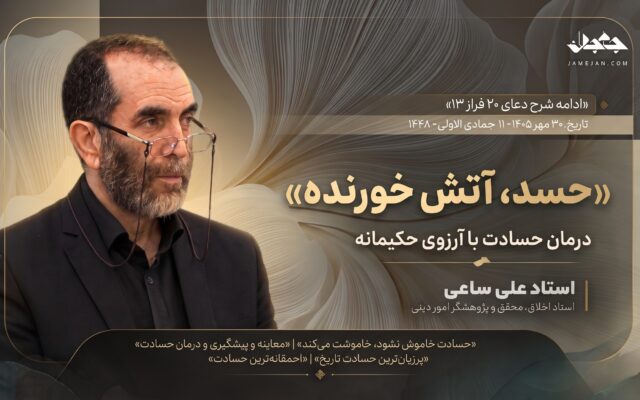
Written transcript of the lecture
The Meshkat-e Noor teachings series🌻🔆🔆🌻
🌼🔆🌼The Self-Infatuated, Envious Killer of Reason🌼🔆🌼
🌹🔅☘️ بِسْمِ اللَّهِ الرَّحْمنِ الرَّحيمِ ☘️🔅🌹
🔅🌹 “Self-Infatuation, Companion of Black Envy,” “The Self-Infatuated in the Prison of Their Own Envy,” “The Self-Infatuated Standard-Bearer of Envy,” “Envy from the Soul to the World,” “Supplication 20, Verse 13: *Tadbiran ‘ala ‘aduwwik*,” and so forth — A Compendium with an Addendum. 07/08/1405 [solar/Hijri] Ali Sa’i (Abdullah Meshkat) 110.141(903) 🌹🔅
🌼🌸☘️🌷🌹🌻 🕋 🤲 🌙 ✳️✅ ❇️ ✨🔆💫🔆
🌹
✨ ☀️ 🌟 اللَّهُمَّ اجْعَلْ مَا يُلْقِي الشَّيْطَانُ فِي رُوعِي🌟 ☀️ ✨
☘️🌹مِنَ التَّمَنِّي وَ التَّظَنِّي وَ الْحَسَدِ🌹☘️
🔆 🪴🌟🕋🌟 🪴🔆
🤲 🌟🌙 ذِكْراً لِعَظَمَتِكَ، وَ تَفَكُّراً فِي قُدْرَتِكَ، وَ تَدْبِيراً عَلَى عَدُوِّك 🌟🌙 🤲
🌟 🪴🌟
🌿🔆Transforming “Envy” into “*Tadbiran ‘ala ‘aduwwik*” (Plotting Against Your Enemy)🔆
🌻🔆 The Self-Infatuated, the Envious One Who Stings Himself 🔆🌻
🌼 The Self-Infatuated, Envious Killer of Reason 🌼
📜 Foreword
All praise and gratitude are due to the Exalted Lord, who placed humanity upon the path of trial and brought forth the adversary so that the arenas of the Greater and Lesser Jihad might be established. May peace and blessings be upon the Noble Prophet, sallallahu ‘alayhi wa alihi, and his pure household, who are beacons of guidance amidst the darkness of tribulations.
The treatise before you, titled *”The Self-Infatuated, the Envious One Who Stings Himself,”* is a continuation of the series of treatises including *”Plotting Against the Enemy of God,”* *”Recourse to the Court of Allah,”* *”Envy, the Crafty Scorpion,”* and *”Envy, the Consuming Fire.”* In the preceding treatises, the foundational principles, concepts, and overarching strategies for plotting against the enemy of God were elucidated. In the treatise *”Envy, the Consuming Fire,”* we addressed the healing of envy through wise aspiration. In the present treatise, we take a step further, addressing *’ujb* (self-infatuation) as the “companion of black envy” and the “killer of reason.”
What distinguishes this treatise from the previous ones is its “reason-centric” perspective on self-infatuation. From this viewpoint, self-infatuation is not merely a moral vice; it is an envious adversary of reason. *’Ujb*—much like an envious person who casts a covetous eye upon another’s blessings and seeks to destroy them—envies reason, the greatest divine blessing bestowed within the human soul, and strives to drive it from the field.
This treatise rests upon several fundamental pillars:
First: *’Ujb*, the Envious Adversary of Reason — The Commander of the Faithful, ‘alayhi s-salam, states: *”‘Ujb al-mar’i bi-nafsihi ahadu hussadi ‘aqlih”* (A person’s self-infatuation is one of the enviers of their own reason). *’Ujb* is the close enemy that targets reason from within the very walls of the home.
Second: *’Ujb*, the Killer of Reason — The self-infatuated person is a scorpion that stings its own reason. Through its envy of reason, it brings the attainments of reason to ruin and deprives itself of the blessings of Paradise.
Third: *’Ujb*, the Barrier to Monotheism (*Tawhid*) — The self-infatuated person strays far from the reality of *tawhid*. The word of *tawhid* possesses a root to which one may connect through sincerity (*ikhlas*); yet self-infatuation is the greatest blight upon sincerity.
With its enriching addendum, this treatise seeks to deepen concepts, mend shortcomings, provide illuminating expansions, and dispel potential ambiguities. Within this addendum, new semantic layers, more precise documentation, and deeper analyses are presented so that this treatise may blossom into a complete intellectual paradigm concerning the “self-infatuated, envious one who stings himself.”
It is hoped that this brief work finds acceptance in the divine court and serves as a step toward strengthening the camp of truth against the front of falsehood.
📝 Introduction
1. Elucidation of the Issue
*’Ujb* (self-infatuation) is one of the most pivotal concepts in the Holy Quran and Islamic traditions. The Exalted God states in the Quran:
“أَ لَمْ تَرَ إِلَى الَّذِينَ يُزَكُّونَ أَنْفُسَهُمْ بَلِ اللَّهُ يُزَكِّي مَنْ يَشاءُ” (نساء: ۴۹)
“Have you not seen those who claim purity for themselves? Rather, Allah purifies whom He wills.” (An-Nisa: 49)
And elsewhere:
“فَلا تُزَكُّوا أَنْفُسَكُمْ هُوَ أَعْلَمُ بِمَنِ اتَّقى” (نجم: ۳۲)
“So do not claim purity for yourselves; He is most knowing of who fears Him.” (An-Najm: 32)
The Commander of the Faithful, ‘alayhi s-salam, states in a brief yet profound phrase:
“عُجْبُ الْمَرْءِ بِنَفْسِهِ أَحَدُ حُسَّادِ عَقْلِه”
“A person’s self-infatuation is one of the enviers of their own reason.”
This statement serves as the key to entering our discussion. An “envier” is one who casts a covetous eye upon another’s blessing and seeks its destruction. *’Ujb* is precisely of this nature: it envies reason—this greatest of divine blessings within human existence—and strives to banish it from the arena.
The central question of this research is: What is “the self-infatuated, the envious one who stings himself,” and what are its dimensions, foundational principles, and remedies according to verses and traditions?
2. The Necessity of the Research
A) Creedal Necessity: Recognizing *’ujb* and the ways to cure it is a creedal obligation rooted in the Quran and traditions.
B) Social Necessity: *’Ujb* shatters the security, peace, and well-being of society. Personal *’ujb* remains confined to the individual, whereas social *’ujb* burdens society, and political *’ujb* burdens the world and history.
C) Scientific Necessity: To date, no research has specifically addressed *’ujb* as the “envier of reason.”
D) Practical Necessity: Believers stand in need of practical methods to cure *’ujb* within themselves and others.
3. Objectives of the Research
Primary Objective:
Elucidation and analysis of the “self-infatuated, self-stinged jealous person” and methods for treating it, relying on Quranic verses and narrations.
Secondary Objectives:
Elucidating the nature of *‘ujb* (self-admiration/conceit) and its relationship with envy (*hasad*).
Elucidating *‘ujb* as the “envier of the intellect.”
Elucidating the stages and degrees of *‘ujb*.
Elucidating the signs and effects of *‘ujb*.
Elucidating ways to prevent *‘ujb*.
Elucidating ways to treat *‘ujb*.
Elucidating the relationship between *‘ujb*, tawhid (Divine Oneness), and wilayah (Divine guardianship/authority).
4. Research Questions
Primary Question:
What is the “self-infatuated, self-stinged jealous person,” and what are its treatment methods?
Secondary Questions:
What is the nature of *‘ujb*, and what is its relationship with envy (*hasad*)?
How does *‘ujb* turn into the “envier of the intellect”?
What are the stages and degrees of *‘ujb*?
What are the signs and effects of *‘ujb*?
What are the ways to prevent *‘ujb*?
What are the ways to treat *‘ujb*?
What is the relationship between *‘ujb*, tawhid, and wilayah?
5. Research Hypotheses
Main Title:
The “self-infatuated, self-stinged jealous person” is a disease of the heart rooted in self-regard and heedlessness of the Divine origin of blessings; its treatment is possible through humility and recognizing one’s inability before God.
Secondary Titles:
*‘Ujb* is the envier of the intellect and destroys it.
*‘Ujb* is the killer of the intellect and drives human beings to foolishness.
*‘Ujb* is worse than sin, and in the presence of *‘ujb*, repentance is impossible.
*‘Ujb* is an impediment to tawhid and leads human beings to shirk (polytheism).
*‘Ujb* is an obstacle to progress and bars human beings from increase [in goodness].
*‘Ujb* is the farm of jealousy, from which envy sprouts.
*‘Ujb* is an obstacle to spiritual flight and reduces human deeds from the degree of acceptance.
6. Definition of Key Terms
*‘Ujb*: Self-infatuation, self-admiration, and exalting oneself; magnifying one’s righteous deeds, considering them to be abundant, rejoicing in them, and bestowing favor (minnat) through them, while viewing oneself as beyond the limit of shortcoming.
*Idlal*: Bestowing favor through one’s deeds; it is a stage beyond *‘ujb*.
*Hasad*: Wishing for the removal of a blessing from someone who is deserving of it.
*Intellect (‘Aql)*: That by which the Most Merciful God is worshipped and through which Paradises are attained.
*Universal Intellect (‘Aql al-Kull)*: Muhammad and the Family of Muhammad صلیاللهعلیهوآله.
*Tawadu‘*: Humility; the mount of the intellect.
*Tawhid*: The Oneness of God; the word whose inner reality (*ta’wil*) is sincerity (*ikhlas*).
📋 Systematic Summary
🔹 A) Research Identity
| Title | The Self-Infatuated, Self-Stinged Jealous Person — The Self-Infatuated Jealous Killer of the Intellect |
| Core Problem | What is the self-infatuated, self-stinged jealous person, and what are its treatment methods? |
| Methodology | Descriptive-analytical with a library-research approach |
| Primary Sources | The Holy Quran, Nahj al-Balagha, Al-Kafi, Bihar al-Anwar |
| Main Hypothesis | *‘Ujb* is the envier of the intellect, and its treatment is possible through humility and recognizing one’s powerlessness. |
🔹 B) Main Findings
Axis 1: The Nature of *‘Ujb*
| Element | Explanation | Documentation | |
| Definition | Magnifying the righteous deed, considering it abundant, rejoicing in it, and bestowing favor through it | «العجب استعظام العمل الصالح و استكثاره» | |
| Root | Self-regard and heedlessness of the Divine origin of blessings | «الْعُجْبُ أَصْلُهُ مِنْ عَمَى الْقَلْبِ» | |
| Ruling | Forbidden (haram) and among the destructive sins (muhlikat) | «مَنْ دَخَلَهُ الْعُجْبُ هَلَكَ» | |
Note: *‘Ujb* is a disease of the heart, not merely an emotion.
Axis 2: *‘Ujb* as the “Envier of the Intellect”
| Element | Explanation | Documentation |
| *‘Ujb*, the Envier of the Intellect | *‘Ujb* envies the intellect and destroys it | «عُجْبُ الْمَرْءِ بِنَفْسِهِ أَحَدُ حُسَّادِ عَقْلِه» |
| *‘Ujb*, the Killer of the Intellect | The self-infatuated person is like a scorpion that stings its own intellect | «الْمُعْجَبُ لَا عَقْلَ لَهُ» |
| *‘Ujb*, the Obstacle to the Intellect | *‘Ujb* prevents the increase of virtue | «الْإِعْجَابُ يَمْنَعُ مِنَ الِازْدِيَادِ» |
Note: *Ujb* (self-admiration) is an insidious enemy that targets reason from within the house.
Axis 3: Levels and Degrees of Enmity Toward Reason
| Level | Explanation |
| First Level | Enmity toward personal reason |
| Second Level | Enmity toward family reason |
| Third Level | Enmity toward community reason |
| Fourth Level | Enmity toward societal reason |
| Fifth Level | Enmity toward political and governmental reason |
| Sixth Level | Enmity toward the reason of the cosmos |
Note: The narcissist targets everything, from personal reason to the reason of the entire universe.
Axis 4: *Ujb* and Folly
| Element | Explanation | Source Reference |
| *Ujb*, Folly | *Ujb* is folly | «الْعُجْبُ حُمْقٌ» |
| *Ujb*, the Pinnacle of Folly | *Ujb* is the root and origin of folly | «الْعُجْبُ رَأْسُ الْحَمَاقَةِ» |
| *Ujb*, a Sign of Folly | *Ujb* lays folly bare | «الْعُجْبُ عُنْوَانُ الْحَمَاقَةِ» |
| *Ujb*, Exposer of Flaws | *Ujb* exposes one’s faults and shortcomings | «الْعُجْبُ يُظْهِرُ النَّقِيصَةَ» |
Note: How often the narcissist is a scholar who has been slain by his own ignorance!
Axis 5: *Ujb* and Sin
| Element | Explanation | Source Reference |
| *Ujb*, Worse than Sin | *Ujb* is among the gravest of sins—sinister and dark | «إِنَّ اللَّهَ عَلِمَ أَنَّ الذَّنْبَ خَيْرٌ لِلْمُؤْمِنِ مِنَ الْعُجْبِ» |
| *Ujb*, Destroyer of Good Deeds | A sin that brings grief is better before God than a good deed that fills one with self-admiration | «سَيِّئَةٌ تَسُوؤُكَ خَيْرٌ عِنْدَ اللَّهِ مِنْ حَسَنَةٍ تُعْجِبُكَ» |
| *Ujb*, Obstacle to Repentance | *Ujb* is a spiritual state of the soul that is exceedingly difficult to purge | « مَنْ دَخَلَهُ الْعُجْبُ هَلَكَ » |
Note: *Ujb* is the fertile ground for every sin!
Axis 6: *Ujb* and *Tawhid* (Divine Oneness)
| Element | Explanation | Source Reference |
| *Ujb*, Bane of Sincerity | Narcissism is the greatest bane to sincere devotion (*ikhlas*) | “Self-admiration is the scourge of sincerity.” |
| *Ujb*, Impediment to the Primordial Nature | Narcissism obstructs the functioning of one’s divine primordial nature (*fitrah*) | “Self-admiration obstructs the innate disposition.” |
| *Ujb*, Shatterer of the Lamp of *Tawhid* | The narcissist has shattered the lamp of Divine Oneness | “The self-admiring person has shattered the lamp of divine unity.” |
| *Ujb*, Captivity in Polytheism (*Shirk*) | The narcissist is a captive to his own polytheism and doubt | “The self-admiring person is captive to polytheism.” |
Note: The narcissist strays far from the reality of *tawhid* and falls captive to *shirk*.
Axis 7: *Ujb* and the Universal Intellect (*Aql-e Kull*)
| Element | Explanation | Source Reference |
| The Universal Intellect | Muhammad and the Family of Muhammad (peace be upon them) are the Universal Intellect of the cosmos | “Muhammad and the Family of Muhammad, peace be upon them, are the Universal Intellect of all existence.” |
| Connecting to the Universal Intellect | All people are capable of connecting to the Universal Intellect | «وَ اعْتَصِمُوا بِحَبْلِ اللَّهِ جَمِيعاً» |
| Envy toward the Universal Intellect | The narcissist envies his own intellect, which leads to envy of the Universal Intellect. | “Envy toward the Universal Intellect is the greatest loss.” |
Note: Envy toward Muhammad and the Family of Muhammad (ص) is the ultimate, irreparable loss.
Axis 8: Some Signs of Self-Infatuation (Ujb)
| Number | Sign |
| 1 | Arrogance (Kibr) |
| 2 | Pride |
| 3 | Narcissism |
| 4 | Self-praise |
| 5 | Self-satisfaction |
| 6 | Backbiting |
| 7 | Calumny |
| 8 | Mongering |
| 9 | Fault-finding |
| 10 | Sullen withdrawal (Qahr) |
| 11 | Blind worldly competitions |
| 12 | Ostentatious display (Tabarruj) |
| 13 | Boastfulness |
| 14 | Pretense |
| 15 | Seeking fame |
| 16 | Certain forms of depression |
| 17 | Certain forms of melancholic yearning |
| 18 | Certain forms of misanthropy |
| 19 | Certain forms of severing ties of kinship |
Note: To uncover self-infatuation within ourselves, we must recognize its signs.
Axis 9: The Consequences of Self-Infatuation
| Domain | Explanation | Documentation |
| Individual | Destruction of the intellect, foolishness, spiritual heart disease | «الْعُجْبُ حُمْقٌ» |
| Social | Destruction of community safety, peace, and well-being | “Social self-infatuation brings distress to society.” |
| Hereafter | Hellfire, eternal chastisement | «مَنْ دَخَلَهُ الْعُجْبُ هَلَكَ» |
Note: Self-infatuation is the termite of religion; it gnaws away at faith.
Axis 10: The Difference Between Self-Infatuation (Ujb) and Presumptuous Familiarity (Idlal)
| Subject | Ujb (Self-Infatuation) | Idlal (Presumptuousness) |
| Definition | Magnifying one’s deeds while forgetting the Divine blessing | Expecting reward and laying claim to a right over God |
| Rank | The primary stage | A higher stage |
| Sign | Self-admiration | Reminding God of one’s supposed favors (mann) |
| Documentation | «الْعُجْبُ حُمْقٌ» | «الْمُدِلُّ لَا يَصْعَدُ مِنْ عَمَلِهِ شَيْءٌ» |
Note: Idlal transcends ujb; every person characterized by idlal is also self-infatuated, but not every self-infatuated person has reached the stage of idlal.
Axis 11: Remedies for Self-Infatuation
| Remedy | Explanation | Documentation |
| Recognizing Incapacity | Recognizing one’s utter powerlessness before God | «لَا حَوْلَ وَ لَا قُوَّةَ إِلَّا بِاللَّهِ» |
| Humility | Humility is the mount of the intellect | «مَطِيَّةُ الْعَقْلِ التَّوَاضُعُ» |
| Comparison with the Ahl al-Bayt | Comparing one’s own deeds with the worship of the Ahl al-Bayt (a) | “We have not yet truly begun to worship” |
| Fear of Loss | Fear of the loss of blessings | «وَ يَخَافُونَ أَنْ يُسْلَبُوهُ» |
| Gratitude | Expressing gratitude for divine enabling grace (tawfiq) | «لَئِنْ شَكَرْتُمْ لَأَزِيدَنَّكُمْ» |
| Seeking Increase | Asking God for an increase | «وَ اسْتَزِدْ مِنْ فَضْلِهِ» |
| Supplication | Praying to repel self-infatuation (*ujb) | «اللَّهُمَّ لَا تَكِلْنِي إِلَى نَفْسِي» |
Note: The cure for *ujb lies in humility, recognizing one’s powerlessness, and the remembrance of God.
Axis 12: Final Conclusion
| Point | Explanation |
| Ujb, the Envy of Intellect | Ujb envies the intellect and destroys it |
| Ujb, the Slayer of Intellect | The self-infatuated person is like a scorpion that stings its own intellect |
| Ujb, Absolute Folly | Ujb is foolishness itself and the zenith of folly |
| Ujb, Worse than Sin | Ujb is the breeding ground for every sin! |
| Ujb, Barrier to Tawhid | The self-infatuated person grows distant from the reality of Tawhid |
| Cure through Humility | Humility is the mount of the intellect and the remedy for ujb |
🔹 C) Final Conclusion
“The self-infatuated one, the self-stinging envier” is a spiritual malady rooted in self-conceit and heedlessness of the divine source of all blessings. This disease destroys the intellect, drags humanity into folly, is worse than sin, and acts as a barrier to Tawhid.
The remedy for *ujb is not suppression, but humility and the recognition of one’s powerlessness:
1. Recognizing Powerlessness — Understanding that one’s actions, blessings, and enabling grace come entirely from God.
2. Humility — Humility is the mount of the intellect.
3. Comparison with the Ahl al-Bayt — Comparing one’s own deeds with the worship of the Ahl al-Bayt, peace be upon them.
4. Fear of Loss — Fearing the loss of blessings.
5. Gratitude — Being grateful for divine grace (tawfiq).
6. Supplication — Praying to ward off *ujb.
The Final Formula:
Repelling Ujb = Recognition + Humility + Comparison + Fear + Gratitude + Supplication
🔹 D) Practical Recommendations
| Number | Recommendation |
| 1 | Promoting the culture of “curing *ujb through humility” by holding educational courses |
| 2 | Reinforcing the “supplication for repelling *ujb” in the daily lives of believers |
| 3 | Teaching the “difference between *ujb and idlal (presuming upon God’s favor)” |
| 4 | Elucidating the “ways to prevent *ujb” to guard against falling into it |
| 5 | Drafting a “practical guideline” for the treatment of *ujb |
🔹 E) Concluding Remarks
«اللَّهُمَّ اجْعَلْ مَا يُلْقِي الشَّيْطَانُ فِي رُوعِي مِنَ التَّمَنِّي وَ التَّظَنِّي وَ الْحَسَدِ ذِكْراً لِعَظَمَتِكَ، وَ تَفَكُّراً فِي قُدْرَتِكَ، وَ تَدْبِيراً عَلَى عَدُوِّك»
Peace be upon those who follow guidance.
Introduction (Entering the Discussion)
In the Name of God, the Compassionate, the Merciful
Humanity, this wondrous masterpiece of creation, stands between two “selves”: the “true self,” which is aligned with the divine primordial nature (fitrah) and the luminous intellect, and the “illusory self,” which is born of vain imagination and self-conceit, keeping company with ignorance and baseness. All of man’s inner battles are, in truth, struggles between these two selves.
How beautifully the Master of the Faithful, Imam Ali (peace be upon him), stated: «قاتِلْ هَوَاكَ بِعَقْلِكَ» Fight your lower desires with your intellect.
*Ujb*—meaning self-infatuation, self-admiration, and self-aggrandizement—is one of man’s closest internal enemies, targeting the intellect from within the house of the soul. The Commander of the Faithful, Imam Ali (peace be upon him), expressed this profound truth in a brief yet deeply meaningful statement:
«عُجْبُ الْمَرْءِ بِنَفْسِهِ أَحَدُ حُسَّادِ عَقْلِِه»
A person’s self-infatuation is one of the enviers of his intellect.
This sentence is the key to entering our discussion. The “envious person” is someone who eyes another person’s blessing and seeks to destroy it. *Ujb* (self-admiration or vanity) is likewise: it envies the intellect—this greatest of divine blessings within human existence—and strives to drive it out of the field. From this very point, it becomes clear that the discussion of *ujb* is not merely an ethical discussion; it is a discussion concerning the survival of the intellect, and in its wake, the survival of human servitude and ultimate bliss.
In this writing, relying upon Quranic verses and traditions (*riwayat*), we intend first to clarify the nature of *ujb* and its relationship with envy, then to demonstrate how *ujb*, acting as the “envier of the intellect,” ruins intellectual blessings and servitude, and finally to seek out its remedies. May this discussion serve as a beacon for recognizing our inner enemy and a step along the path of “[تخففوا تلحقوا]”—lightening oneself of the burden of self-conceit and attaining nearness to the Truth.
Part One: General Overview
Continuation of the discussion: ” تدبیراً علی عدوک” (Strategizing against your enemy)!
Turning envy into a strategy against the enemy of God!
Continuation of the management of envy!
The relationship between *ujb* and envy!
The worst envy is envy directed at the intellect!
❇️The course of envy’s dark path
1. The envious person desires the cessation of others’ blessings and may even take practical steps to strip them away.
2. The envious person envies himself without even realizing it! Narcissism is the sign of this!
3. The narcissistic envious person envies that which is dearer to him than his own life—namely, his intellect! For the intellect is his origin, crown, and exalted station; without the intellect, he comes to a standstill, his path of evolution reverses, and ascent culminates in descent! He even resorts to practical action! Thus, he will strive to eradicate the highest blessing from his own being—the primordial and eternal blessing!
4. He envies the intellect of others!
❇️خودشیفته به کدامین عقل حسادت میورزد!
The levels and degrees of envy directed at the intellect:
Envy of personal intellect!
Envy of family intellect!
Envy of social intellect!
Envy of community intellect!
Envy of political and governmental intellect!
Envy of the intellect of the cosmos!
❇️Only the irrational rebel against reason
💫🔆وَ قَالَ ع عُجْبُ الْمَرْءِ بِنَفْسِهِ أَحَدُ حُسَّادِ عَقْلِه[1]
💫 And Imam Ali (AS) stated:
“A person’s self-admiration is one of the envier’s of his own intellect.”
Strategizing against the carnal soul (*hawa al-nafs*) is the finest strategy against the greatest enemy of God!
Until we break the backbone of *ujb*, we remain the bitterest enemies of our own souls!
Whoever falls in love with himself becomes the enemy of his own soul and of the entire cosmos!
*Ujb* is the breeding ground of envy! It first stings the soul’s intellect!
The ill-fortune of envy sprouts from the seedbed of *ujb*; starting with envy toward the intellect, it infects the entirety of truth!
The narcissist is a scorpion that stings its own intellect!
❇️Reason and self-conceit cannot coexist
💫🔆الْمُعْجَبُ لَا عَقْلَ لَهُ [2]
🔆 The self-admirer has no intellect.
💫🔆إِعْجَابُ الْمَرْءِ بِنَفْسِهِ بُرْهَانُ نَقْصِهِ وَ عُنْوَانُ ضَعْفِ عَقْلِهِ. [3]
🔆 A person’s self-admiration is proof of his deficiency and an emblem of the weakness of his intellect.
💫🔆مَنْ أَعْجَبَهُ قَوْلُهُ فَقَدْ غَرَبَ عَقْلُهُ. [4]
🔆 Whoever is charmed by his own words has surely seen his intellect depart [and become eclipsed].
💫🔆مَنْ أُعْجِبَ بِفِعْلِهِ أُصِيبَ بِعَقْلِهِ. [5]
🔆 Whoever becomes vain regarding his own deeds suffers affliction in his intellect.
💫🔆مَا أُعْجِبَ بِرَأْيِهِ إِلَّا جَاهِل[6]
🔆 None becomes vain regarding his own opinion save the ignorant.
💫🔆و قَالَ ع أَوَّلُ إِعْجَابِ الْمَرْءِ بِنَفْسِهِ فَسَادُ عَقْلِه[7]
🔆 And he (AS) stated: The very beginning of a person’s self-admiration is the corruption of his intellect.
❇️Self-admiration leads one’s servitude and paradise to ruin
By envying the intellect, the narcissist drives the blessings attained through the intellect to ruin, bringing magnificent and transcendent blessings to nought!
If the intellect is severed from man, servitude is severed from him, and he is likewise deprived of the blessing of Paradise—Paradise being the mine and center of all beauty, delight, and serenity!
💫🔆أَحْمَدُ بْنُ إِدْرِيسَ عَنْ مُحَمَّدِ بْنِ عَبْدِ الْجَبَّارِ عَنْ بَعْضِ أَصْحَابِنَا رَفَعَهُ إِلَى أَبِي عَبْدِ اللَّهِ ع قَالَ: قُلْتُ لَهُ مَا الْعَقْلُ قَالَ مَا عُبِدَ بِهِ الرَّحْمَنُ وَ اكْتُسِبَ بِهِ الْجِنَانُ قَالَ قُلْتُ فَالَّذِي كَانَ فِي مُعَاوِيَةَ فَقَالَ تِلْكَ النَّكْرَاءُ «!» تِلْكَ الشَّيْطَنَةُ وَ هِيَ شَبِيهَةٌ بِالْعَقْلِ وَ لَيْسَتْ بِالْعَقْلِ.[8]
🔆 Ahmad ibn Idris, from Muhammad ibn Abd al-Jabbar, from some of our companions, tracing the [narration] back to Abu Abdillah (AS), who said: I asked him, “What is the intellect?” He replied, “That through which the All-Merciful is worshipped and through which Gardens [of Paradise] are attained.” I said, “Then what was that which was in Mu’awiyah?” He replied, “That was craftiness [and devious understanding]! That was deviltry; it resembles the intellect, yet it is not the intellect.”
❇️The Most Wretched of the Envious
Only a foolish and ignorant person becomes his own enemy, becomes his own hunter, sets himself on fire, wrestles with himself, and destroys his own capital!
He who envies his own child is a fool! He who envies his own beauty is even more foolish! He who envies his own intellect is the most foolish of all!
❇️The Intellect is Manifest Beauty
💫🔆 وَ لَا جَمَالَ أَزْيَنُ مِنَ الْعَقْل[9]
🔆 “And there is no beauty more adorned than the intellect.”
💫🔆قَالَ أَمِيرُ الْمُؤْمِنِينَ ع الْعَقْلُ غِطَاءٌ سَتِيرٌ وَ الْفَضْلُ جَمَالٌ ظَاهِرٌ فَاسْتُرْ خَلَلَ خُلُقِكَ بِفَضْلِكَ وَ قَاتِلْ هَوَاكَ بِعَقْلِكَ تَسْلَمْ لَكَ الْمَوَدَّةُ وَ تَظْهَرْ لَكَ الْمَحَبَّةُ.[10]
🔆 The Commander of the Faithful, peace be upon him, said: “The intellect is a veiling cover, and virtue and nobility are manifest beauty. Therefore, conceal the flaws of your character with your virtue, and combat your base desires with your intellect, so that affection [and amity] may remain secure for you and the love [of the people] may become manifest to you.“
❇️There is No Wealth Higher Than the Intellect
💫🔆عَلِيُّ بْنُ مُحَمَّدٍ عَنْ بَعْضِ أَصْحَابِهِ عَنِ ابْنِ أَبِي عُمَيْرٍ عَنِ النَّضْرِ بْنِ سُوَيْدٍ عَنْ حُمْرَانَ وَ صَفْوَانَ بْنِ مِهْرَانَ الْجَمَّالِ قَالا سَمِعْنَا أَبَا عَبْدِ اللَّهِ ع يَقُولُ لَا غِنَى أَخْصَبُ مِنَ الْعَقْلِ وَ لَا فَقْرَ أَحَطُّ مِنَ الْحُمْقِ وَ لَا اسْتِظْهَارَ فِي أَمْرٍ بِأَكْثَرَ مِنَ الْمَشُورَةِ فِيهِ. [11]
🔆 Ali ibn Muhammad, from some of his companions, from Ibn Abi Umayr, from al-Nadr ibn Suwayd, from Humran and Safwan ibn Mihran al-Jammal, both of whom said: We heard Abu Abdillah, peace be upon him, saying: “No affluence is more luxuriant than the intellect, no poverty is more debased [and severe] than foolishness, and no backing in any matter is greater than consulting about it.“
The sickest person, the most deranged person, the most foolish person! is the narcissist who banishes his own intellect to isolation!
The narcissist is the worst enemy! The most criminal and yet the most wretched!
❇️In the Prison of Self-Infatuation (Ujb)
To be self-infatuated is sheer humiliation; it is to be imprisoned within oneself!
The intellect has many enviers, one of whom is the “narcissist”! The enemy is near! The sting of the narcissist strikes directly at the heart of the intellect!
❇️Self-Exaltation
Narcissism is the aggrandizement of the self! Self-exaltation, marveling at oneself, self-aggrandizement, being astonished by oneself! It is to become detached from the transcendent reality of the self! Most notably, it is to be deprived of the remembrance of God, as well as His graces, mercies, and blessings!
❇️Let Us Look Rightly at Our Own Stature
The narcissist is either infatuated with his outward merits or infatuated with his outward deeds!
If the narcissist were to compare his deeds and merits with the Ahl al-Bayt, peace be upon them, he would lose his bearings entirely!
We have not yet even begun worship!
We have not yet truly served!
Then what are we marveling at?
❇️Distance from the Beloved
To consider beauty a defect is the height of foolishness!
To flee from the light is sheer misguidance!
Whoever distances himself from the intellect becomes lost! He becomes lost within himself!
The fascinating thing is that the intellect is flawless, pure, unalloyed gold; thus, the envier has nothing left against this envied object save accusations and slander!
The distortion of the truth of the intellect! Bringing the intellect into disrepute! Forging counterfeits for the intellect!
Woe to the literate yet unlearned narcissists!
They are the ignorant who appear to be scholars, and worse still are the scholars who lack intellect!
Fleeing from the light is sheer misguidance and foolishness.
❇️Corrupt, False Pleasure Without the Intellect
With the presence of the intellect, one cannot derive pleasure from ignorance and foolishness!
Pus, filth, and impurity are the delights of the intellectless!
The person devoid of intellect is different from the purely ignorant person; the intellectless one may even be learned! Lacking intellect is ignorance upon ignorance.
The narcissist drives away the intellect in order to plunge into the trance of false narcissism.
With the presence of the intellect, narcissism is impossible!
The intellect distinguishes the mirage from water.
❇️Signs of Envy Toward the Intellect
Envy toward the knowledgeable and the more knowledgeable is envy toward the intellect!
Whoever assumes himself to be all-knowing means he has become a narcissist and has envied his own intellect!
The more one’s knowledge ascends, the more one’s ignorance [of the vastness of the unknown] increases, which ought to add to one’s humility rather than diminish it!
❇️Knowledge Shines Through the Intellect
💫🔆الْعِلْمُ مِصْبَاحُ الْعَقْلِ وَ يَنْبُوعُ الْفَضْل[12]
🔆 Knowledge is the lamp of the intellect and the fountainhead of virtue [and excellence].
❇️Knowledge Gains Momentum Through the Intellect
💫🔆الْعَقْلُ مَرْكَبُ الْعِلْم[13]
🔆 The intellect is the mount of knowledge.
❇️Self-Infatuation Breeds Foolishness
💫🔆 عَنْ عَلِيِّ بْنِ سُوَيْدٍ عَنْ أَبِي الْحَسَنِ ع قَالَ: سَأَلْتُهُ عَنِ الْعُجْبِ الَّذِي يُفْسِدُ الْعَمَلَ فَقَالَ الْعُجْبُ دَرَجَاتٌ مِنْهَا أَنْ يُزَيَّنَ لِلْعَبْدِ سُوءُ عَمَلِهِ فَيَرَاهُ حَسَناً فَيُعْجِبَهُ وَ يَحْسَبَ أَنَّهُ يُحْسِنُ صُنْعاً وَ مِنْهَا أَنْ يُؤْمِنَ الْعَبْدُ بِرَبِّهِ فَيَمُنَ عَلَى اللَّهِ عَزَّ وَ جَلَّ وَ لِلَّهِ عَلَيْهِ فِيهِ الْمَنُ[14]
🔆 Narrated from ‘Ali ibn Suwayd, from Abū al-Hasan (AS), who said: I asked him about self-infatuation (*‘ujb*) which ruins one’s deeds. He replied: Self-infatuation has various degrees. Among them is that a servant’s evil deeds are made to appear alluring to him, so he perceives them as good, becomes infatuated with them, and imagines that he is performing a fine work. Another degree is that a servant believes in his Lord and then holds it as a favor against Allah, the Almighty and Majestic, whereas the favor truly belongs to Allah over him regarding that very faith.
❇️He Who Praises Himself Finds No Praise from His Lord
✨🔆 النساء : 49 أَ لَمْ تَرَ إِلَى الَّذينَ يُزَكُّونَ أَنْفُسَهُمْ بَلِ اللَّهُ يُزَكِّي مَنْ يَشاءُ وَ لا يُظْلَمُونَ فَتيلاً
🔆 Have you not seen those who claim purity for themselves? Rather, Allah purifies whom He wills, and they will not be wronged by as much as a thread on a date stone.
❇️The Knower of the Soul Does Not Praise Himself
✨🔆 النجم : 32 الَّذينَ يَجْتَنِبُونَ كَبائِرَ الْإِثْمِ وَ الْفَواحِشَ إِلاَّ اللَّمَمَ إِنَّ رَبَّكَ واسِعُ الْمَغْفِرَةِ هُوَ أَعْلَمُ بِكُمْ إِذْ أَنْشَأَكُمْ مِنَ الْأَرْضِ وَ إذْ أَنْتُمْ أَجِنَّةٌ في بُطُونِ أُمَّهاتِكُمْ فَلا تُزَكُّوا أَنْفُسَكُمْ هُوَ أَعْلَمُ بِمَنِ اتَّقى
🔆 Those who avoid major sins and shameful deeds, save for minor lapses—indeed, your Lord is vast in forgiveness. He knows you best from when He produced you from the earth and when you were fetuses in the wombs of your mothers. So do not claim purity for yourselves; He knows best who is mindful of Him.
❇️Let Not Self-Infatuation Make Sin Appear Fair
💫🔆عَنْ أَبِي عَبْدِ اللَّهِ ع قَالَ: إِنَّ اللَّهَ عَلِمَ أَنَ الذَّنْبَ خَيْرٌ لِلْمُؤْمِنِ مِنَ الْعُجْبِ وَ لَوْ لَا ذَلِكَ مَا ابْتُلِيَ مُؤْمِنٌ بِذَنْبٍ أَبَدا. [15]
🔆 From Abū ‘Abdillāh (AS) who said: Verily, Allah knew that sin is better for the believer than self-infatuation; had it not been for that, a believer would never have been afflicted with a sin.
Exposition: *‘Ujb* (self-infatuation) is among the most perilous of sins! It is a sin whose taste appeals to the self-infatuated palate—a sin made sweet through psychological rationalization (*taswiyl*)! Compared to sins that evoke revulsion in a person’s taste, this is the worst of all! This hadith must not lead us to treat sin lightly, for doing so is itself a manifestation of self-infatuation!
*”‘Ujb”* means to regard one’s righteous deed as great, to deem it abundant, to take excessive delight in it, to hold it as a favor [bestowed upon God], and to view oneself as having transcended the bounds of shortcoming. However, taking joy in a deed accompanied by humility before Allah the Exalted, gratitude for being granted the capability to perform it, and praying to Him for an increase in goodness is noble and commendable.
Self-infatuation carries numerous blights, for it leads to arrogance… It also leads to the oblivion of one’s sins and negligence toward them… The infatuated person magnifies his acts of worship and deeds, boasts of them, holds them as a favor against God because he has performed them, and forgets God’s blessing of granting him the ability and capacity.
Then, having grown self-amused by his actions, he becomes blind to their flaws. He who does not scrutinize the flaws of his deeds sees most of his efforts go to waste… The self-infatuated person grows arrogant toward himself and his Lord, feels secure from God’s subtle plan and torment, and imagines that he holds a lofty status before God, claiming a right and favor over Him by virtue of deeds that are themselves among His blessings and gifts. Consequently, his self-infatuation with his own person, opinions, knowledge, and intellect prevents him from seeking benefit, consulting others, and asking questions…
❇️Assign No Price Tag to Your Worship
💫🔆عَنْ أَبِي عَبْدِ اللَّهِ ع قَالَ: أَتَى عَالِمٌ عَابِداً فَقَالَ لَهُ كَيْفَ صَلَاتُكَ فَقَالَ مِثْلِي يُسْأَلُ عَنْ صَلَاتِهِ وَ أَنَا أَعْبُدُ اللَّهَ مُنْذُ كَذَا وَ كَذَا قَالَ فَكَيْفَ بُكَاؤُكَ قَالَ أَبْكِي حَتَّى تَجْرِيَ دُمُوعِي فَقَالَ لَهُ الْعَالِمُ فَإِنَّ ضَحِكَكَ وَ أَنْتَ خَائِفٌ أَفْضَلُ مِنْ بُكَائِكَ وَ أَنْتَ مُدِلٌّ إِنَّ الْمُدِلَّ لَا يَصْعَدُ مِنْ عَمَلِهِ شَيْء[16]
🔆 It is narrated from Imam Sadiq (AS) that he said: A scholar once met an ascetic and asked him, “How is your prayer?” The ascetic replied, “Is someone like me asked about his worship?! I have been worshipping God for such and such a length of time.” The scholar asked, “How is your weeping?” He answered, “I weep until my tears flow.” The scholar said to him, “Yet your laughter while you are fearful [of God] is better than your weeping while you [thereby] confer a favor [through your action]; and indeed, nothing ascends [to God] from the deed of one who confers favors.”
Self-admiration goes hand in hand with heedlessness and the forgetfulness of God. Whoever recognizes the blessing of existence as coming from God and gives thanks for it, and likewise whoever does not consider his worship to be great but instead deems himself at fault, steps outside the circle of conceited self-regard (*ujb*). *Ujb* is accompanied by arrogance, pride, boasting, and ostentation!
Likewise, whoever takes joy in his worship, perceiving it as a divine grace (*tovfiq*) bestowed by God, and beseeches God for even greater grace, is free from *ujb*!
Narcissism is accompanied by self-admiration, self-sufficiency, and a sense of superiority!
Therefore, whoever attributes every good to God is not a narcissist!
Thus, narcissism (*ujb*) is precisely the grandification of oneself on account of a blessing and reliance upon it, coupled with the forgetfulness of attributing it back to the Bestower. And if this state intensifies to the point where it overpowers the soul—making one imagine that one possesses a right before God and holds a special station with Him, to the extent that, on account of one’s knowledge, one anticipates divine nobility in this world and deems it unlikely that any unpleasantness should befall one (deeming it more unlikely than what one would deem unlikely for transgressors)—this is termed “imposing upon one’s action” (*idlal bi’l-amal*, conferring a favor through one’s deeds); as though one sees oneself as having a claim and a status (*dalh*) before God.
💫 The tears of one who imposes upon God do not extinguish the fire; they are a volcano!
❇️ A Review of Some Traditions Related to Self-Admiration (*Ujb*)
| No. | Arabic Text (Summary) | Translation |
| 9 | لَوْ لَا ذَلِكَ مَا ابْتَلَى اللَّهُ مُؤْمِناً بِذَنْبٍ | Had this not been so, God would not have afflicted a believer with a sin. |
| 10 | إِنْ كَانَ الْمَمَرُّ عَلَى الصِّرَاطِ فَالْعُجْبُ لِمَا ذَا | If the passage is over the Sirat, then what is the reason for self-admiration? |
| 11 | لَا تُحَقِّرُوا شَيْئاً مِنَ الشَّرِّ… وَ لَا تَسْتَكْثِرُوا الْخَيْرَ… فَإِنَّهُ لَا كَبِيرَ مَعَ الِاسْتِغْفَارِ وَ لَا صَغِيرَ مَعَ الْإِصْرَارِ | Do not belittle any evil… and do not consider any good to be vast… for there is no major sin alongside seeking forgiveness, and no minor sin alongside persistent transgression. |
| 12 | مَنْ دَخَلَهُ الْعُجْبُ هَلَكَ | Whoever is entered by self-admiration is destroyed. |
| 13 | ثَلَاثٌ مُوبِقَاتٌ: شُحٌّ مُطَاعٌ وَ هَوًى مُتَّبَعٌ وَ إِعْجَابُ الْمَرْءِ بِنَفْسِهِ | Three things are destructive: obeyed greed, followed caprice, and a person’s self-admiration with himself. |
| 14 | ثَلَاثٌ هُنَّ قَاصِمَاتُ الظَّهْرِ: رَجُلٌ اسْتَكْثَرَ عَمَلَهُ وَ نَسِيَ ذُنُوبَهُ وَ أُعْجِبَ بِرَأْيِهِ | Three things break the spine: a man who considered his deed vast, forgot his sins, and became self-infatuated with his opinion. |
| 15 | قَالَ إِبْلِيسُ لِجُنُودِهِ: إِذَا اسْتَمْكَنْتُ مِنِ ابْنِ آدَمَ فِي ثَلَاثٍ لَمْ أُبَالِ مَا عَمِلَ… إِذَا اسْتَكْثَرَ عَمَلَهُ وَ نَسِيَ ذَنْبَهُ وَ دَخَلَهُ الْعُجْبُ | Iblis said to his soldiers: “When I gain mastery over the son of Adam in three things, I do not care what he does… when he considers his deed vast, forgets his sin, and self-admiration enters him.” |
| 16 | إِيَّاكَ وَ الْعُجْبَ وَ سُوءَ الْخُلُقِ وَ قِلَّةَ الصَّبْرِ فَإِنَّهُ لَا يَسْتَقِيمُ لَكَ عَلَى هَذِهِ الْخِصَالِ الثَّلَاثِ صَاحِبٌ | Beware of self-admiration, bad character, and lack of patience, for no companion will remain steadfast with you in these three traits. |
| 17 | الْعُجْبُ هَلَاكٌ وَ الصَّبْرُ مِلَاكٌ | Self-admiration is ruin, and patience is the foundation and restraint. |
| 18 | لَا وَحْدَةَ وَ لَا وَحْشَةَ أَوْحَشُ مِنَ الْعُجْبِ | Neither solitude nor desolation is more desolate than self-admiration. |
| 19 | لَا جَهْلَ أَضَرُّ مِنَ الْعُجْبِ | No ignorance is more harmful than self-admiration. |
| ۲۰ | عَلِمَ اللَّهُ أَنَّ الذَّنْبَ خَيْرٌ لِلْمُؤْمِنِ مِنَ الْعُجْبِ… | (Self-admiration is one of the worst possible sins; a sweet sin is worse than a bitter sin) In the divine knowledge of God… |
| ۲۱ | يَدْخُلُ رَجُلَانِ الْمَسْجِدَ أَحَدُهُمَا عَابِدٌ وَ الْآخَرُ فَاسِقٌ… | Two men enter the mosque: one is a devoted worshipper and the other a sinner… |
| ۲۲ | إِيَّاكُمْ أَنْ تَكُونُوا مَنَّانِينَ… | Beware of reminding others of your favors or bestowing charity with self-glorification… |
| ۲۳ | مَنْ لَا يَعْرِفُ لِأَحَدٍ الْفَضْلَ فَهُوَ الْمُعْجَبُ بِرَأْيِهِ | Whoever fails to acknowledge the virtue of others is infatuated with his own opinion. |
| ۲۴ | مَنْ رَضِيَ عَنْ نَفْسِهِ كَثُرَ السَّاخِطُونَ عَلَيْهِ | He who is pleased with himself shall have many who are displeased with him. |
| ۲۵ | سَيِّئَةٌ تَسُوؤُكَ خَيْرٌ عِنْدَ اللَّهِ مِنْ حَسَنَةٍ تُعْجِبُكَ | A sin that causes you grief is better in the sight of God than a good deed that fills you with self-admiration. |
| ۲۵ | أَوْحَشُ الْوَحْشَةِ الْعُجْبُ | The most desolate of desolations is self-admiration. |
| ۲۵ | الْإِعْجَابُ يَمْنَعُ مِنَ الِازْدِيَادِ | Self-admiration prevents increase [and spiritual growth]. |
| ۲۵ | عُجْبُ الْمَرْءِ بِنَفْسِهِ أَحَدُ حُسَّادِ عَقْلِهِ | A man’s self-admiration is one of the envious detractors of his intellect. |
| ۲۶ | الْعُجْبُ دَرَجَاتٌ… | Self-admiration has various degrees… |
| ۲۷ | إِنَّ اللَّهَ فَوَّضَ الْأَمْرَ إِلَى مَلَكٍ… فَلَمَّا رَأَى الْأَشْيَاءَ قَدِ انْقَادَتْ لَهُ قَالَ مَنْ مِثْلِي… | Indeed, God entrusted a matter to an angel… and when he saw that all things had become submissive to him, he said, “Who is like unto me?”… |
| ۲۸ | أَخْبِرْنِي بِالذَّنْبِ الَّذِي إِذَا أَذْنَبَهُ ابْنُ آدَمَ اسْتَحْوَذْتَ عَلَيْهِ… | Inform me of the sin which, when committed by the son of Adam, causes you to overcome him… |
| ۲۹ | مَرَّ عَالِمٌ بِعَابِدٍ… تَضْحَكُ وَ أَنْتَ خَائِفٌ… أَفْضَلُ مِنْ بُكَائِكَ وَ أَنْتَ مُدِلٌّ… | A scholar passed by a worshipper… Your laughter while in a state of fear… is better than your weeping while displaying self-righteous pride… |
| ۳۰ | أَيُّوبُ لَمَّا جَهَدَهُ الْبَلَاءُ قَالَ… فَنُودِيَ… فَلِمَنِ الْمَنُّ… | When Job was hard-pressed by affliction, he said… Thus a voice called out to him… To whom belongs the favor?… |
| ۳۱ | أَنَا أَعْلَمُ بِمَا يَصْلُحُ عَلَيْهِ دِينُ عِبَادِيَ الْمُؤْمِنِينَ… | I know best what rectifies the religion of My believing servants… |
| ۳۲ | لَوْ لَا أَنَّ الذَّنْبَ خَيْرٌ لِلْمُؤْمِنِ مِنَ الْعُجْبِ… | Had it not been that sin is better for the believer than self-admiration… |
| ۳۳ | الْمَغْرُورُ فِي الدُّنْيَا مِسْكِينٌ وَ فِي الْآخِرَةِ مَغْبُونٌ… | The deluded one is destitute in this world and at a loss in the hereafter… |
| ۳۴ | الْعَجَبُ كُلُّ الْعَجَبِ مِمَّنْ يُعْجَبُ بِعَمَلِهِ وَ لَا يَدْرِي بِمَا يُخْتَمُ لَهُ… | The greatest of all wonders is the one who admires his own deed yet does not know how his life will end… |
| ۳۵ | مَنْ أُعْجِبَ بِنَفْسِهِ هَلَكَ وَ مَنْ أُعْجِبَ بِرَأْيِهِ هَلَكَ… | Whoever becomes self-admiring is ruined, and whoever is infatuated with his own opinion is ruined… |
| 36 | أَيُّوبُ… مَا عَرَضَ لِي أَمْرَانِ قَطُّ كِلَاهُمَا لَكَ طَاعَةٌ إِلَّا عَمِلْتُ بِأَشَدِّهِمَا عَلَى بَدَنِي… | Job… Never were two matters presented to me, both being acts of obedience to You, except that I performed the one more taxing upon my body… |
| 37 | ثَلَاثٌ مُهْلِكَاتٌ: شُحٌّ مُطَاعٌ وَ هَوًى مُتَّبَعٌ وَ إِعْجَابُ الْمَرْءِ بِنَفْسِهِ… | Three things are ruinous: avarice that is obeyed, desire that is followed, and a person’s conceit regarding himself… |
| 37 | يَا دَاوُدُ بَشِّرِ الْمُذْنِبِينَ وَ أَنْذِرِ الصِّدِّيقِينَ… | O David! Give glad tidings to the sinners and warn the truthful… |
| 37 | أَنَا أَعْلَمُ بِمَا يَصْلُحُ بِهِ أَمْرُ عِبَادِي… | I know best that which sets right the affairs of My servants… |
| 37 | إِنَّ مِنْ عِبَادِيَ الْمُؤْمِنِينَ لَمَنْ يَسْأَلُنِي الشَّيْءَ مِنْ طَاعَتِي فَأَصْرِفُهُ عَنْهُ مَخَافَةَ الْإِعْجَابِ | Indeed, among My believing servants is he who asks Me for a certain act of obedience, but I turn him away from it for fear of him falling into self-conceit. |
| 37 | يَا مَعْشَرَ الْحَوَارِيِّينَ كَمْ مِنْ سِرَاجٍ أَطْفَأَتْهُ الرِّيحُ وَ كَمْ مِنْ عَابِدٍ أَفْسَدَهُ الْعُجْبُ | O assembly of disciples! How many a lamp has been extinguished by the wind, and how many a worshipper has been corrupted by self-conceit. |
| 37 | عَلَيْكَ بِالْجِدِّ وَ لَا تُخْرِجَنَّ نَفْسَكَ مِنْ حَدِّ التَّقْصِيرِ فِي عِبَادَةِ اللَّهِ… | Be diligent, and never consider yourself beyond the bounds of shortcoming in the worship of God… |
| 38 | لَا بَأْسَ أَنْ تُحَدِّثَ أَخَاكَ إِذَا رَجَوْتَ أَنْ تَنْفَعَهُ… | There is no harm in telling your brother [of your worship] if you hope to benefit him… |
❇️ Summary of the Comprehensive Meaning of “Self-Conceit” (Ujb) Based on This Chapter
| Theme | Explanation |
| Definition | To regard one’s righteous deeds as great and plentiful, to take pride in them, to hold them as a favor over others, and to view oneself as having moved beyond the state of shortcoming. |
| Difference from Praiseworthy Joy | Joy in a deed is not conceit if it stems from seeing it as a blessing and gift from God, accompanied by the fear of its loss, gratitude, and seeking its increase. |
| Distinction from Idlal (Presumption) | Idlal goes beyond conceit: conceit arises from magnifying the deed and forgetting the Divine blessing, whereas Idlal involves expecting a reward and feeling one has a right over God. |
| Degrees | 1. When one’s evil deeds are made to seem fair and are viewed as good; 2. To believe and then hold it as a favor over God. |
| Afflictions | Arrogance, forgetting one’s sins, blindness to the flaws in one’s actions, being deluded regarding oneself and God, feeling secure from God’s plan, being hindered from seeking counsel or asking questions, and the corruption of acts of worship, lowering them from the rank of acceptance. |
| Remedy | Recognizing that the deed is a blessing and success granted by God, fearing its loss, gratitude, seeking increase, and never regarding oneself as being beyond the state of shortcoming. |
| Relation to Sin | Self-conceit is more severe than sin, for sin is removed through repentance, whereas conceit is an internal trait of the soul that is difficult to eradicate. |
❇️ The Departure of Reason is the Arrival of Ignorance
Whatever reason departs from becomes hideous and detestable!
The departure of reason from life means the departure of life from life—a life worse than death!
The departure of reason from beauty means beauty without beauty—a beauty worse than ugliness!
The departure of reason from wealth means a burden and a curse!
The departure of reason from pleasure means the worst of pain, suffering, and toil!
The departure of reason from friendship is worse than enmity and hostility!
The departure of reason from home and family means a literal hell!
The departure of reason from worship makes worship worse than transgression!
❇️ Do Not Praise Yourself; Let God Almighty Praise You!
✨🔆 النساء : 49 أَ لَمْ تَرَ إِلَى الَّذينَ يُزَكُّونَ أَنْفُسَهُمْ بَلِ اللَّهُ يُزَكِّي مَنْ يَشاءُ وَ لا يُظْلَمُونَ فَتيلاً
🔆 Have you not seen those who praise themselves? (Such self-praise is worthless;) rather, God praises whosoever He wills, and they will not be wronged so much as the thread of a date-stone.
✨🔆 النجم : 32 الَّذينَ يَجْتَنِبُونَ كَبائِرَ الْإِثْمِ وَ الْفَواحِشَ إِلاَّ اللَّمَمَ إِنَّ رَبَّكَ واسِعُ الْمَغْفِرَةِ هُوَ أَعْلَمُ بِكُمْ إِذْ أَنْشَأَكُمْ مِنَ الْأَرْضِ وَ إِذْ أَنْتُمْ أَجِنَّةٌ في بُطُونِ أُمَّهاتِكُمْ فَلا تُزَكُّوا أَنْفُسَكُمْ هُوَ أَعْلَمُ بِمَنِ اتَّقى
🔆 Those who avoid major sins and shameful deeds, save minor offences. Indeed, your Lord is vast in forgiveness. He knows you best when He produced you from the earth and when you were fetuses in the wombs of your mothers. So do not claim yourselves to be pure; He knows best who is righteous!
“Have you not seen those who consider themselves pure? Rather, God purifies whosoever He wills, and they will not be wronged even by the breadth of a thread [fatīl].”
“He knows you best when He brought you forth from the earth and when you were fetuses in the wombs of your mothers. So do not consider yourselves pure; He knows best who is God-fearing (taqwā-conscious).”
❇️The Rhetorical Remedy for Conceit (ʻUjb) from Nahj al-Balāgha
💫🔆 فِي نَهْجِ الْبَلَاغَةِ مِنْ كَلَامٍ لَهُ عَلَيْهِ السَّلَامُ يَصِفُ فِيهِ الْمُتَّقِينَ لَا يَرْضَوْنَ مِنْ أَعْمَالِهِمُ الْقَلِيلَ وَ لَا يَسْتَكْثِرُونَ الْكَثِيرَ فَهُمْ لِأَنْفُسِهِمْ مُتَّهِمُونَ وَ مِنْ أَعْمَالِهِمْ مُشْفِقُونَ، إِذَا زُكِّيَ أَحَدٌ مِنْهُمْ خَافَ مِمَّا يُقَالُ لَهُ فَيَقُولُ. أَنَا أَعْلَمُ بِنَفْسِي مِنْ غَيْرِي، وَ رَبِّي أَعْلَمُ بِي مِنْ نَفْسِي، اللَّهُمَّ لَا تُؤَاخِذْنِي بِمَا يَقُولُونَ وَ اجْعَلْنِي أَفْضَلَ مِمَّا يَظُنُّونَ وَ اغْفِرْ لِي مَا لَا يَعْلَمُونَ.[17]
🔆In Nahj al-Balāgha, among the words of that noble Imam, peace be upon him, describing the God-fearing: “They are not content with a small amount of their deeds, nor do they deem much of it to be abundant. Thus, they hold themselves suspect and are apprehensive regarding their deeds. When one of them is praised, he fears what is said about him and says: ‘I know myself better than anyone else does, and my Lord knows me better than I know myself. O God, do not take me to task for what they say, make me better than what they think, and forgive me for what they do not know.'”
☘️A brief explanation of certain expressions:
Al-Muttaqīn: The God-fearing, those who are mindful of God; plural of muttaqī.
Lā yardawna min aʻmālihim al-qalīl: They are not satisfied with the smallness of their deeds; meaning that in worship, they do not consider a small amount to be sufficient.
Lā yastakthirūna al-kathīr: Nor do they consider the abundant amount to be great; meaning they do not view their extensive worship as something grand.
Li-anfushihim muttahamūn: They are suspicious of themselves, they deem themselves at fault, they watch over their souls, they hold themselves accountable, they cross-examine themselves!
Mushfiqūn: Apprehensive, anxious; derived from shafaq (fear mingled with tenderness/care).
Zukkī: Praised, purified, and commended.
Aʻlamu bi-nafsī min ghayrī: I know myself better than others do.
Lā tu’ākhidhnī: Do not take me to task and hold me accountable.
Afdal mimmā yaẓunnūn: Better than what they think.
Mā lā yaʻlamūn: What they do not know.
☘️The threefold supplication: Asking not to be taken to task on account of people’s praise, asking to become better than people’s perception, and asking for the forgiveness of what people do not know—the ultimate etiquette of a servant in the face of praise.
“Lā yardawna min aʻmālihim al-qalīl”: In worship, they do not deem shortcomings sufficient; meaning their utmost endeavor is directed toward fulfilling their duty completely.
“Wa lā yastakthirūنا al-kathīr”: They do not consider abundant worship as a favor or something grand, because they view worship as a duty rather than a virtue owed to God.
“Fahum li-anfushihim muttahamūn”: They suspect themselves; they harbor the possibility that their worship may not be sincere or may be flawed.
“Wa min aʻmālihim mushfiqūn”: They are apprehensive about their deeds, fearing they might not be accepted.
“Idhā zukkī aḥadun minhum khāfa mimmā yuqāla lahu”: When praised, they fear the words of the one who praises them; a fear of arrogance and of the praise being undeserved.
“Anā aʻlamu bi-nafsī min ghayrī”: I know myself better; meaning, your praise should not make me oblivious to my flaws.
“Wa rabbī aʻlamu bī min nafsī”: God knows me better than I know myself; an admission of one’s ignorance regarding the reality of one’s own self.
“Allāhumma lā tu’ākhidhnī bimā yaqūlūn”: O God, do not hold me accountable for their praise; meaning, if their praise is unwarranted, do not take me to task for it.
“Wa ajʻalnī afḍala mimmā yaẓunnūn”: Make me better than their assumption; a request for the grace to surpass people’s perception.
“Wa ighfir lī mā lā yaʻlamūn”: Forgive me for what they do not know; an appeal for the pardon of hidden flaws of which people are unaware.
☘️A short conclusion:
This passage from the Sermon of Hammam in Nahj al-Balagha presents a profound portrait of the moral psychology of the pious: in their worship, they are neither slack nor self-aggrandizing; they harbor suspicion toward themselves and fear for their deeds, dreading the praise of people. Acknowledging their own self-awareness—and God’s even greater awareness of them—they offer three instructive supplications: not to be taken to task on account of people’s praise, to be better than what people think, and to be forgiven for faults of which they are unaware. This expression embodies the pinnacle of humility and servitude, standing as one of the masterpieces of Alid eloquence and rhetoric.
❇️Being Infatuated with Ugliness is Pure Folly
The greatest self-conceit (‘ujb) and the supreme envy lie in a person ascribing to themselves a station of which they are unworthy. This is impossible unless they thrust aside the rightful holder of that station, and pushing aside [that holder] is none other than the embodiment of the intellect itself!
And worse still is usurping that station!
❇️Conceit is the Worse Sin
It is not that sin is better than self-conceit; rather, the intent is that self-conceit is worse, making it the worst of sins!
Conceit makes the face of sin look white! Not that it actually becomes white, but rather it is all the more black!
💫🔆عَنْ أَبِي عَبْدِ اللَّهِ ع قَالَ: إِنَّ اللَّهَ عَلِمَ أَنَ الذَّنْبَ خَيْرٌ لِلْمُؤْمِنِ مِنَ الْعُجْبِ وَ لَوْ لَا ذَلِكَ مَا ابْتُلِيَ مُؤْمِنٌ بِذَنْبٍ أَبَداً. [18]
🔆It is attributed to Imam Sadiq (AS), who said: “Indeed, God knew that sin is better for the believer than self-conceit, and had it not been for that, a believer would never have been afflicted with a sin at all.”
Explanation: “Self-conceit” is among the most perilous of sins! A sin whose taste appeals to the palate of the narcissist, it is the worst of sins precisely because it is sweetened by seduction, unlike sins that are repulsive to a person’s palate! This hadith must not lead us to belittle sin, for that very attitude stems from narcissism!
Explanation: “Self-conceit” consists of magnifying a righteous deed, viewing it as abundant, rejoicing over it, laying obligation for it [upon God or others], and seeing oneself as exempt from falling short. However, rejoicing in a deed accompanied by humility before God the Exalted, gratitude for being granted the success to perform it, and asking Him for an increase in it, is beautiful and commendable.
✨🔆الحجرات : 17 يَمُنُّونَ عَلَيْكَ أَنْ أَسْلَمُوا قُلْ لا تَمُنُّوا عَلَيَّ إِسْلامَكُمْ بَلِ اللَّهُ يَمُنُّ عَلَيْكُمْ أَنْ هَداكُمْ لِلْإيمانِ إِنْ كُنْتُمْ صادِقينَ
🔆They lay obligation upon you by having embraced Islam. Say: “Do not lay obligation upon me for your Islam; rather, it is God who lays an obligation upon you in that He has guided you to faith, if you are truthful!”
❇️With the Intellect, the “Heart” is God’s Throne; Without It, a Rubbish Heap
Self-conceit is the sin of the “heart and the core of the soul”—it is the mark of the intellect’s murder and its execution at the hands of the ego!
The slaying of the intellect is more severe than the slaying of the soul!
✨🔆ق : 37 إِنَّ في ذلِكَ لَذِكْرى لِمَنْ كانَ لَهُ قَلْبٌ أَوْ أَلْقَى السَّمْعَ وَ هُوَ شَهيدٌ
🔆Indeed, in that is a reminder for whoever has a heart or listens while being present [with their mind]!
The heart is a heart through the intellect; without the intellect, the heart is overturned into something other than a heart!
Human beings ascend through humility! They fall through self-conceit!
Lighten your load so you may catch up — humility is not merely the wings of flight, but flight itself!
Self-conceit is absolute paralysis! It is a barrier to soaring and flight!
❇️Conceit is a Barrier to Ascent, Speed, and Security
💫🔆وَ لِكُلِّ شَيْءٍ مَطِيَّةً وَ مَطِيَّةُ الْعَقْلِ التَّوَاضُعُ وَ كَفَى بِكَ جَهْلًا أَنْ تَرْكَبَ مَا نُهِيتَ عَنْهُ يَا هِشَامُ مَا بَعَثَ اللَّهُ أَنْبِيَاءَهُ وَ رُسُلَهُ إِلَى عِبَادِهِ إِلَّا لِيَعْقِلُوا عَنِ اللَّهِ فَأَحْسَنُهُمُ اسْتِجَابَةً أَحْسَنُهُمْ مَعْرِفَةً وَ أَعْلَمُهُمْ بِأَمْرِ اللَّهِ أَحْسَنُهُمْ عَقْلًا وَ أَكْمَلُهُمْ عَقْلًا أَرْفَعُهُمْ دَرَجَةً فِي الدُّنْيَا وَ الْآخِرَة[19]
🔆”And for everything there is a mount, and the mount of the intellect is humility. And it is enough of an ignorance for you that you ride what you have been forbidden to ride. O Hisham! God did not send His prophets and messengers to His servants except that they might reason concerning God. Thus, the best of them in response are the best of them in recognition; the most knowledgeable of them regarding God’s command are the best of them in intellect; and the most complete of them in intellect are the highest of them in rank in this world and the Hereafter.”
❇️Worship Accompanied by Obligation-Laying is Ignorance
Self-conceit that lays obligation is one of the worst forms of self-conceit!
More foolish than the fool is that fool who lays an obligation upon God, the Bestower of Favours!
How often the narcissist lays obligation upon their Lord with a worship that even their own peers would not approve of!
The narcissist deems themselves even superior to God; instead of offering service, they expect to be served!
They mistake their own place for that of the Creator!
❇️The Deeds of the Narcissist Lack the Power to Soar
…وَ أَنْتَ مُدِلٌّ وَ إِنَّ الْمُدِلَّ لَا يَصْعَدُ مِنْ عَمَلِهِ شَيْءٌ.
It is narrated from Imam Sadiq (AS) that: A scholar approached an ascetic and asked him, “How is your prayer?” He replied, “Does anyone like me need to be asked about his worship?! For such and such a period, I have been worshipping God.” The scholar asked, “How is your weeping?” He replied, “I weep until my tears flow.” The scholar said to him, “Your laughter while you are fearful [of God] is better than your weeping while you [are conscious of your deeds and] remind others of your acts of devotion; indeed, nothing ascends to God from one who is self-congratulatory about his deeds.”
Explanation: “Mudill” (one who acts with *dalal*, in the active participle form from the *if’al* stem): a cheerful person who feels no fear regarding his shortcomings in action… and *”dalah”*: that through which you display attachment and status before those close to you…
Guard your worship and your tears!
Showing off one’s acts of devotion, making a display of them, and constantly bringing them to mind are among the most prominent signs of self-admiration (*’ujb*)!
That you laugh while acknowledging your sin is better than that you weep while making a display of your deeds.
Part Two: Envy of the Intellect of the Cosmos
❇️From Personal Intellect to Cosmic Intellect
After envy toward the personal intellect, the turn comes for envy toward the cosmic intellect!
The cosmos is a single living body that possesses intellect and consciousness!
The cosmic intellect is the super-computer of the universe to which everyone can connect free of charge!
Muhammad and the Family of Muhammad (may peace be upon them) are the Universal Intellect of this cosmos!
Anyone can connect to this Universal Intellect! Connection to the First and Final Intellect!
The meaning of holding fast to the cord of God is precisely this!
✨🔆آلعمران : 103 وَ اعْتَصِمُوا بِحَبْلِ اللَّهِ جَميعاً وَ لا تَفَرَّقُوا وَ اذْكُرُوا نِعْمَتَ اللَّهِ عَلَيْكُمْ إِذْ كُنْتُمْ أَعْداءً فَأَلَّفَ بَيْنَ قُلُوبِكُمْ فَأَصْبَحْتُمْ بِنِعْمَتِهِ إِخْواناً وَ كُنْتُمْ عَلى شَفا حُفْرَةٍ مِنَ النَّارِ فَأَنْقَذَكُمْ مِنْها كَذلِكَ يُبَيِّنُ اللَّهُ لَكُمْ آياتِهِ لَعَلَّكُمْ تَهْتَدُونَ
🔆And hold fast, all together, by the rope which God (stretches out for you), and be not divided among yourselves; and remember with gratitude God’s favour on you; for ye were enemies and He joined your hearts in love, so that by His Grace, ye became brethren; and ye were on the brink of the pit of fire, and He saved you from it. Thus doth God make His Signs clear to you: That ye may be guided.
✨🔆آلعمران : 112 ضُرِبَتْ عَلَيْهِمُ الذِّلَّةُ أَيْنَ ما ثُقِفُوا إِلاَّ بِحَبْلٍ مِنَ اللَّهِ وَ حَبْلٍ مِنَ النَّاسِ وَ باؤُ بِغَضَبٍ مِنَ اللَّهِ وَ ضُرِبَتْ عَلَيْهِمُ الْمَسْكَنَةُ ذلِكَ بِأَنَّهُمْ كانُوا يَكْفُرُونَ بِآياتِ اللَّهِ وَ يَقْتُلُونَ الْأَنْبِياءَ بِغَيْرِ حَقٍّ ذلِكَ بِما عَصَوْا وَ كانُوا يَعْتَدُونَ
🔆Shame is pitched over them (like a tent) wherever they are found, except when they come under a covenant (of protection) from God and from men; they draw on themselves wrath from God and pitched over them is (the tent of) destitution. This because they rejected the Signs of God and slew the prophets in defiance of right; this because they rebelled and transgressed beyond bounds.
Envy toward Muhammad and the Family of Muhammad (peace be upon them) is the greatest, irreparable loss!
The narcissist envies his own intellect, which ultimately leads him to envy the Universal Intellect!
❇️From Personal and Social Self-Admiration to Political and Wilayah-Based Self-Admiration
Personal self-admiration rests with the individual, social self-admiration burdens society, and political self-admiration burdens the entire world and history!
💫🔆 فِي تَفْسِيرِ عَلِيِّ بْنِ إِبْرَاهِيمَ قَوْلُهُ: «أَ لَمْ تَرَ إِلَى الَّذِينَ يُزَكُّونَ أَنْفُسَهُمْ بَلِ اللَّهُ يُزَكِّي مَنْ يَشاءُ» قَالَ: هُمُ الَّذِينَ سَمَّوْا أَنْفُسَهُمْ بِالصِّدِّيقِ وَ الْفَارُوقِ وَ ذِي النُّورَيْنِ، وَ قَوْلُهُ. «وَ لا يُظْلَمُونَ فَتِيلًا» قَالَ: الْقِشْرَةُ الَّتِي تَكُونُ عَلَى النَّوَاةِ، ثُمَّ كَنَّى عَنْهُمْ فَقَالَ انْظُرْ كَيْفَ يَفْتَرُونَ عَلَى اللَّهِ الْكَذِبَ وَ كَفى بِهِ إِثْماً مُبِيناً وَ هُمْ هَؤُلَاءِ الثَّلَاثَةُ قَوْلُهُ:
أَ لَمْ تَرَ إِلَى الَّذِينَ أُوتُوا نَصِيباً مِنَ الْكِتابِ يُؤْمِنُونَ بِالْجِبْتِ وَ الطَّاغُوتِ وَ يَقُولُونَ لِلَّذِينَ كَفَرُوا هؤُلاءِ أَهْدى مِنَ الَّذِينَ آمَنُوا سَبِيلًا قَالَ: نَزَلَتْ فِي الْيَهُودِ حِينَ سَأَلَهُمْ مُشْرِكُو الْعَرَبِ فَقَالُوا أَ دِينُنُا أَفْضَلُ أَمْ دِينُ مُحَمَّدٍ؟ قَالُوا بَلْ دِينُكُمْ أَفْضَلُ وَ قَدْ رَوَى فِيهِ أَيْضاً أَنَّهَا نَزَلَتْ فِي الَّذِينَ غَصَبُوا آلَ مُحَمَّدٍ حَقَّهُمْ، وَ حَسَدُوا مَنْزِلَتَهُمْ، فَقَالَ اللَّهُ:
أُولئِكَ الَّذِينَ لَعَنَهُمُ اللَّهُ وَ مَنْ يَلْعَنِ اللَّهُ فَلَنْ تَجِدَ لَهُ نَصِيراً أَمْ لَهُمْ نَصِيبٌ مِنَ الْمُلْكِ فَإِذاً لا يُؤْتُونَ النَّاسَ نَقِيراً يَعْنِي النُّقْطَةَ الَّتِي فِي ظَهْرِ النَّوَاةِ ثُمَّ قَالَ: أَمْ يَحْسُدُونَ النَّاسَ يَعْنِي بِالنَّاسِ هَاهُنَا أَمِيرَ الْمُؤْمِنِينَ وَ الْأَئِمَّةَ عَلَيْهِمُ السَّلَامُ عَلى ما آتاهُمُ اللَّهُ مِنْ فَضْلِهِ فَقَدْ آتَيْنا آلَ إِبْراهِيمَ الْكِتابَ وَ الْحِكْمَةَ وَ آتَيْناهُمْ مُلْكاً عَظِيماً وَ هِيَ الْخِلَافَةُ بَعْدَ النُّبُوَّةِ وَ هُمُ الْأَئِمَّةُ عَلَيْهِمُ السَّلَامُ.[20]
💫🔆 In the commentary of Ali ibn Ibrahim, regarding the verse of God, أَلَمْ تَرَ إِلَى الَّذِينَ يُزَكُّونَ أَنْفُسَهُمْ بَلِ اللَّهُ يُزَكِّي مَنْ يَشاءُ (Have you not considered those who claim purity for themselves? Rather, God purifies whom He wills), it is stated: They are the ones who called themselves “Siddiq,” “Faruq,” and “Dhu al-Nurayn.” Regarding the verse, وَ لا يُظْلَمُونَ فَتِيلًا (And they will not be wronged, [even as much as] the thread [upon a date stone]), it is stated: It refers to the thin skin that is upon the [date] stone. Then, alluding to them, He said: انْظُرْ كَيْفَ يَفْتَرُونَ عَلَى اللَّهِ الْكَذِبَ وَ كَفى بِهِ إِثْماً مُبِيناً (Look how they invent falsehood about God, and sufficient is that as a manifest sin), and they are those three individuals. Regarding the verse: أَلَمْ تَرَ إِلَى الَّذِينَ أُوتُوا نَصِيباً مِنَ الْكِتابِ يُؤْمِنُونَ بِالْجِبْتِ وَ الطَّاغُوتِ وَ يَقُولُونَ لِلَّذِينَ كَفَرُوا هؤُلاءِ أَهْدى مِنَ الَّذِينَ آمَنُوا سَبِيلًا (Have you not considered those who were given a share of the Scripture, who believe in false deities and tyrants and say about the disbelievers, “These are better guided than the believers as to the way”?), it is stated: This verse was revealed concerning the Jews when the Arab polytheists asked them, saying, “Is our religion better or the religion of Muhammad?” They replied, “Rather, your religion is better.” It has also been narrated that this verse was revealed concerning those who usurped the right of the family of Muhammad and envied their station. Thus, God stated: أُولئِكَ الَّذِينَ لَعَنَهُمُ اللَّهُ وَ مَنْ يَلْعَنِ اللَّهُ فَلَنْ تَجِدَ لَهُ نَصِيراً (Those are the ones whom God has cursed; and whosoever God curses, you will never find for him a helper). أَمْ لَهُمْ نَصِيبٌ مِنَ الْمُلْكِ فَإِذاً لا يُؤْتُونَ النَّاسَ نَقِيراً (Or do they have a share of the dominion? Then [if they did], they would not give the people [even as much as] the speck on a date stone)—meaning that tiny dot on the back of a date stone. Then He said: أَمْ يَحْسُدُونَ النَّاسَ (Or do they envy the people?)—meaning by “the people” here, the Commander of the Faithful and the Imams, peace be upon them—عَلى ما آتاهُمُ اللَّهُ مِنْ فَضْلِهِ (for what God has given them of His bounty? فَقَدْ آتَيْنا آلَ إِبْراهِيمَ الْكِتابَ وَ الْحِكْمَةَ وَ آتَيْناهُمْ مُلْكاً عَظِيماً (For We had already given the family of Abraham the Scripture and wisdom and conferred upon them a great kingdom)—and that is the caliphate after prophecy, and they are the Imams, peace be upon them.
Section Three: Envy toward Monotheism
The narcissistic person distances themselves from the reality of monotheism!
Monotheism possesses a ta’wil (esoteric meaning), a connection (mawṣul), and a rational dimension (ma’qul)!
💫🔆وَ أَشْهَدُ أَنَّ لَا إِلَهَ إِلَّا اللَّهُ وَحْدَهُ لَا شَرِيكَ لَهُ، كَلِمَةٌ جُعِلَ الْإِخْلَاصُ تَأْوِيلَهَا، وَ ضُمِّنَ الْقُلُوبُ مَوْصُولَهَا، وَ أَنَارَ فِي الْفِكْرَةِ مَعْقُولُهَا[21]
🔆Fatima al-Zahra, peace be upon her: … And I bear witness that there is no god but Allah, alone without partner; a word whose ta’wil [esoteric reality] has been made sincerity, whose connection [profound bond] has been entrusted to hearts, and whose rational truth [comprehensible meaning] has cast light within thought.
The word of monotheism has a root through which one can attain connection via sincerity, and narcissism is the greatest affliction to sincerity!
The word of monotheism is connected to the heart through primordial nature (fitrah), yet narcissism prevents the activation of this fitrah!
The lamp of monotheism shines through the intellect, but the narcissistic person has shattered the lamp of monotheism!
❇️The narcissism of the envious one is directed at the word of monotheism!
Narcissism prevents the radiance of the word of monotheism!
The narcissistic person is a captive to their own polytheism (shirk) and doubt!
✨🔆النساء : 54 أَمْ يَحْسُدُونَ النَّاسَ عَلى ما آتاهُمُ اللَّهُ مِنْ فَضْلِهِ فَقَدْ آتَيْنا آلَ إِبْراهيمَ الْكِتابَ وَ الْحِكْمَةَ وَ آتَيْناهُمْ مُلْكاً عَظيماً
🔆Or do they envy people [the Prophet and his family] for what God has given them of His bounty? We had given the family of Abraham (from whom the Jews are also descended) the Scripture and wisdom, and conferred upon them a great kingdom [bestowed upon the prophets of the Children of Israel].
💫🔆نَحْنُ أَهْلُ كَلِمَةِ التَّوْحِيدِ وَ التَّقْوَى نَحْنُ أُمَّةُ مُحَمَّدٍ ص وَ نَحْنُ بَقِيَّةُ أَهْلِ الْحَق[22]
Adorning the “Self-Infatuated, Self-Stinging Envier”
🔹 Part One: Twenty Aphoristic Passages from the Text
| No. | Aphoristic Passage | Axis |
| ۱ | «عُجْبُ الْمَرْءِ بِنَفْسِهِ أَحَدُ حُسَّادِ عَقْلِه» — A person’s self-infatuation is one of the enviers of their intellect. | Conceit and Intellect |
| ۲ | «الْمُعْجَبُ لَا عَقْلَ لَهُ» — The conceited person has no intellect. | Conceit and Intellect |
| ۳ | «إِعْجَابُ الْمَرْءِ بِنَفْسِهِ بُرْهَانُ نَقْصِهِ وَ عُنْوَانُ ضَعْفِ عَقْلِهِ» — A person’s self-admiration is proof of their deficiency and a sign of the weakness of their intellect. | Conceit and Deficiency |
| ۴ | «مَنْ أَعْجَبَهُ قَوْلُهُ فَقَدْ غَرَبَ عَقْلُهُ» — Whoever is infatuated with their own speech has surely lost their intellect. | Conceit and Speech |
| ۵ | «مَنْ أُعْجِبَ بِفِعْلِهِ أُصِيبَ بِعَقْلِهِ» — Whoever becomes self-infatuated with their own deeds has suffered an injury to their intellect. | Conceit and Action |
| ۶ | «مَا أُعْجِبَ بِرَأْيِهِ إِلَّا جَاهِلٌ» — None becomes infatuated with their own opinion save the ignorant. | Conceit and Opinion |
| ۷ | «أَوَّلُ إِعْجَابِ الْمَرْءِ بِنَفْسِهِ فَسَادُ عَقْلِه» — The very onset of a person’s self-admiration is the corruption of their intellect. | Conceit and Corruption of Intellect |
| ۸ | «لَا جَمَالَ أَزْيَنُ مِنَ الْعَقْل» — There is no beauty more graceful than the intellect. | Beauty of the Intellect |
| ۹ | «الْعَقْلُ غِطَاءٌ سَتِيرٌ وَ الْفَضْلُ جَمَالٌ ظَاهِرٌ» — The intellect is a concealing veil, and virtue is an outward beauty. | Intellect and Virtue |
| ۱۰ | «لَا غِنَى أَخْصَبُ مِنَ الْعَقْلِ وَ لَا فَقْرَ أَحَطُّ مِنَ الْحُمْقِ» — There is no wealth more bountiful than the intellect, and no poverty lower than foolishness. | Intellect and Foolishness |
| ۱۱ | «الْعِلْمُ مِصْبَاحُ الْعَقْلِ وَ يَنْبُوعُ الْفَضْل» — Knowledge is the lamp of the intellect and the spring of virtue. | Knowledge and Intellect |
| ۱۲ | «الْعَقْلُ مَرْكَبُ الْعِلْم» — The intellect is the mount of knowledge. | Intellect and Knowledge |
| ۱۳ | «الْعُجْبُ حُمْقٌ» — Conceit is foolishness. | Conceit and Foolishness |
| ۱۴ | «الْعُجْبُ رَأْسُ الْحَمَاقَةِ» — Conceit is the pinnacle of foolishness. | Conceit and Foolishness |
| ۱۵ | «الْعُجْبُ عُنْوَانُ الْحَمَاقَةِ» — Conceit is the hallmark of foolishness. | Conceit and Foolishness |
| ۱۶ | «الْعُجْبُ يُظْهِرُ النَّقِيصَةَ» — Conceit lays bare one’s flaws and shortcomings. | Conceit and Deficiency |
| ۱۷ | «إِنَّ اللَّهَ عَلِمَ أَنَّ الذَّنْبَ خَيْرٌ لِلْمُؤْمِنِ مِنَ الْعُجْبِ» — (Conceit is among the worst of sins, worse than many sins) | Conceit and Sin |
| ۱۸ | «سَيِّئَةٌ تَسُوؤُكَ خَيْرٌ عِنْدَ اللَّهِ مِنْ حَسَنَةٍ تُعْجِبُكَ» — A sin that causes you grief is better before God than a good deed that fills you with conceit. | Conceit and Good Deeds |
| ۱۹ | «لَا وَحْدَةَ وَ لَا وَحْشَةَ أَوْحَشُ مِنَ الْعُجْبِ» — There is no solitude nor desolation more terrifying than conceit. | Conceit and Desolation |
| ۲۰ | «الْإِعْجَابُ يَمْنَعُ مِنَ الِازْدِيَادِ» — Self-infatuation prevents increase and advancement. | Self-infatuation and Advancement |
🔹 Part Two: Twenty Passages of the Golden Completion
| No. | Passage of the Golden Completion | Axis |
| ۱ | The self-infatuated person is like a scorpion that stings its own intellect, even though the intellect is the crown of its being. | Self-infatuation and Intellect |
| ۲ | ‘Ujb (conceit) is the breeding ground of envy; its first sting strikes the intellect of the soul, and then it spreads to the entire truth. | Self-infatuation and Envy |
| ۳ | Until we break the spine of ‘ujb, we remain the greatest enemy of our own souls. | Self-infatuation and the Greater Jihad |
| ۴ | Whoever falls in love with himself becomes an enemy to his own soul and to the world of existence. | Self-infatuation and Enmity |
| ۵ | Out of envy toward the intellect, the self-infatuated person destroys the blessings garnered by the intellect, thereby depriving himself of the blessings of Paradise as well. | Self-infatuation and Paradise |
| ۶ | If the intellect is severed from man, servitude is severed from him as well. | Intellect and Servitude |
| ۷ | The intellect is the most wronged and envied of all things in that realm; how strange it is that the self-infatuated person envies his own intellect! | The Wronged Intellect |
| ۸ | The self-infatuated person is the murderer of his own intellect; he plucks his own wings and feathers and extinguishes the light of the lamp within his heart. | Self-infatuation and Self-destruction |
| ۹ | He who envies Muhammad and the Family of Muhammad has, first and foremost, committed the greatest injustice against himself. | Self-infatuation and Wilayah |
| ۱۰ | The intellect of the cosmos is the supercomputer of the universe, to which all may connect freely. | The Universal Intellect |
| ۱۱ | Muhammad and the Family of Muhammad (PBUH) constitute the Universal Intellect of this universe, and connecting to the First and Final Intellect is the true meaning of holding fast to the cord of God. | Universal Intellect and the Cord of God |
| ۱۲ | The self-infatuated person envies his own intellect, which ultimately leads him to envy the Universal Intellect. | Self-infatuation and the Universal Intellect |
| ۱۳ | Personal ‘ujb is confined to the individual, social ‘ujb brings trouble to society, and political ‘ujb brings trouble to the world and history. | Self-infatuation and Society |
| ۱۴ | Self-infatuation is the greatest affliction to sincerity, and sincerity is the ta’wil (spiritual hermeneutic) of the testimony of divine oneness (Tawhid). | Self-infatuation and Tawhid |
| ۱۵ | The word of Tawhid is connected to the heart through the primordial nature (fitrah); self-infatuation prevents the activation of this primordial nature. | Self-infatuation and Fitrah |
| ۱۶ | The lamp of Tawhid shines through the intellect; the self-infatuated person has shattered the lamp of Tawhid. | Self-infatuation and Tawhid |
| ۱۷ | Self-infatuation prevents the radiance of the word of Tawhid; the self-infatuated person is a prisoner of his own polytheism (shirk) and doubt. | Self-infatuation and Shirk |
| ۱۸ | Whatever the intellect departs from becomes repulsive and odious; the departure of the intellect from worship turns worship into something worse than disobedience! | Intellect and Worship |
| ۱۹ | The heart is truly a heart through the intellect; without the intellect, the heart is overturned into something other than a heart. | Intellect and Heart |
| ۲۰ | Man ascends through humility and falls through ‘ujb; humility is not merely the wings of flight, but flight itself. | Self-infatuation and Humility |
🔹 Part Three: The Harmony of the Text
Harmonic Analysis Across Five Axes
| Axis | Primary Note | Complementary Note | Final Chord |
| First Theme: Ujb and Reason | «عُجْبُ الْمَرْءِ بِنَفْسِهِ أَحَدُ حُسَّادِ عَقْلِه» | «الْمُعْجَبُ لَا عَقْلَ لَهُ» | Ujb = Destroyer of Reason |
| Second Theme: Ujb and Envy | «عُجْب، مزرعه حسادت است» | «حسادت به عقل، شروع حسد است» | Ujb = Root of Envy |
| Third Theme: Ujb and Folly | «الْعُجْبُ حُمْقٌ» | «الْعُجْبُ رَأْسُ الْحَمَاقَةِ» | Ujb = Pure Folly |
| Fourth Theme: Ujb and Sin | «الذَّنْبَ خَيْرٌ لِلْمُؤْمِنِ مِنَ الْعُجْبِ» | «سَيِّئَةٌ تَسُوؤُكَ خَيْرٌ» | Ujb = One of the Worst Sins |
| Fifth Theme: Ujb and Tawhid | “Self-admiration is the scourge of sincerity.” | “The self-admiring person is captive to polytheism.” | Ujb = Obstacle to Tawhid |
🔹 Part Four: Subtle Reflections for Each Section
«Man stands between two selves: the true self, which is attuned to the divine nature, and the illusory self, born of delusion and self-conceit. All inner battles are conflicts between these very two selves.»
💫Subtle Reflection: The “two selves” within a single being are like two mirrors—one facing God, the other facing itself.
«Ujb is the companion of dark envy, and envy is the wayward child of ujb. These two are like two serpents in a single nest, who bite the master of the nest first.»
💫Subtle Reflection: Ujb unlocks the door to envy, and through that very door, envy attacks reason.
✅The Path of the Dark Way of Envy
«The envious person desires the decline of others’ blessings, unaware that the first blessing to decline is his own reason.»
💫Subtle Reflection: Envy is a sword whose hilt has been placed in the envious person’s hand while its blade is turned toward his own chest.
✅Whose Reason Does the Narcissist Envy?
«The narcissist targets everything from personal reason to the cosmic reason of the universe, unaware that the very first prey is his own intellect.»
💫Subtle Reflection: The narcissist is an archer who has aimed his bow at himself.
✅Only the Foolish Rebel Against Reason
«Only a fool rebels against reason; and the narcissist is a fool who wears the crown of reason without knowing it.»
Subtle Reflection: The narcissist is a king who wears his crown while having lost his head.
✅Reason Cannot Coexist with Self-Admiration
«Reason and self-admiration are two kings in a single realm who can never get along. Either reason remains and self-admiration departs, or self-admiration remains and reason departs.»
Subtle Reflection: Reason and ujb are like water and fire; they can never be gathered in the same vessel.
✅The Narcissist Destroys Servitude and Paradise
«Through his envy of reason, the narcissist ruins the blessings attained by reason, and deprives himself of the blessing of Paradise. Paradise is the mine and center of all beauty, delight, and serenity!»
💫Subtle Reflection: The narcissist holds the key to Paradise in his hand and throws it into the sea.
✅The Most Wretched of the Envious
«Whoever envies his own child is a fool! Whoever envies his own beauty is even more foolish! Whoever envies his own reason is the most foolish of all!»
💫Subtle Reflection: The narcissist is his own enemy; and being one’s own enemy is the most wretched form of hostility.
✅Reason is Manifest Beauty
«There is no beauty more adorned than reason. Reason is a concealing garment, and virtue and goodness are manifest beauty. Therefore, cover the flaws of your character with your virtue, and fight your base desires with your intellect.»
💫Subtle Reflection: Reason is the most beautiful of beauties, and the narcissist turns this ultimate beauty into ugliness.
✅There Is No Wealth Greater Than Reason
«There is no wealth more fruitful than reason, and no poverty lower than folly. The narcissist is a wealthy person who sets his treasure on fire.»
💫Subtle Reflection: Reason is infinite wealth, and the narcissist turns this wealth into poverty.
✅In the Prison of Ujb
«To be self-infatuated is sheer humiliation; it is to be imprisoned within oneself. Reason has many enemies, and one of them is the narcissist. The enemy is near! The narcissist’s sting strikes directly at the heart of reason!»
💫Subtle Reflection: The narcissist is a prisoner who has been given the key to his own cell by his own hands, yet does not know it.
✅Self-Exaltation
«Narcissism is the aggrandizement of the self: self-glorification, self-adulation, and being amazed by oneself! It is becoming detached from one’s transcendent source!»
💫Subtle Reflection: The narcissist looks at himself and fails to see God.
✅Let Us Look Fairly at Our Stature
«We have not yet begun our worship! We have not yet truly served! Then what are we amazed at?!»
💫Subtle Reflection: While still at the very beginning of the road, the narcissist sees himself upon the peak.
✅Distant from the Beloved
«To consider beauty a defect is the height of foolishness! To flee from the light is sheer misguidance! Whoever turns away from the intellect becomes lost; they are swallowed by the void within themselves!»
Subtlety: The narcissist flees from the light and takes refuge in darkness.
✅False, Corrupt Pleasure Lacking the Intellect
«In the presence of the intellect, one can take no pleasure in ignorance and folly! Filth, defilement, and impurity are delightful only to the mindless! The mindless person is different from the purely ignorant person; the mindless one may even be a scholar!»
Subtlety: More often than not, the narcissist is a scholar who has been slain by his own ignorance.
✅Signs of Envy Toward the Intellect
«Envy toward the knowledgeable and the most knowledgeable is envy toward the intellect! One who assumes he is all-knowing has become a narcissist and has grown envious of his own intellect!»
Subtlety: The narcissist views himself as all-knowing, unaware that he is the most ignorant of all.
✅Knowledge Shines Through the Intellect
«Knowledge is the lamp of the intellect and the source of virtue. The intellect is the mount of knowledge. The narcissist extinguishes the lamp of the intellect and slaughters the mount of knowledge.»
Subtlety: Knowledge without intellect is a lamp without oil; and the narcissist pours out the oil of the lamp.
✅Self-Admiration Leads to Folly
«Self-conceit has degrees: among them is that the ugly deeds of a servant are made to appear fair to him, so he sees them as good, takes delight in them, and imagines that he is performing a righteous act.»
Subtlety: The narcissist sees the ugliest of deeds as the most beautiful; and this is the ultimate folly.
✅He Whose Praises His Own Soul Is Not Praised by His Lord
«Have you not seen those who praise themselves? Nay, God purifies whomever He wills. Therefore, do not praise yourselves; He knows best who is righteous!»
Subtlety: The narcissist praises himself, but God does not praise him.
✅Let Not Self-Infatuation Whitewash Sin
«God knew that sin is better for the believer than self-conceit, and had it not been so, a believer would never have been afflicted by sin.»
Subtlety: Sin is washed away by repentance; but self-conceit drives one far from repentance.
✅Fix No Price Upon Your Worship
«Indeed, your laughter while you are fearful of God is superior to your weeping while you remind others of your deed with a sense of entitlement; and verily, nothing ascends from the one who acts with entitlement.»
Subtlety: The tears of an entitled soul are no fire extinguisher; they are a volcano!
✅With the Intellect, the Heart Is the Throne of God; Without It, a Wasteland
«Self-conceit is the sin of the heart and the essence of the soul; it is the sign of the murder of the intellect and its execution at the hands of the lower self! The murder of the intellect is graver than the murder of the physical soul!»
Subtlety: The narcissist slays the intellect and turns the heart into a wasteland.
✅Self-Conceit Hinders Elevation, Speed, and Safety
«For everything there is a mount, and the mount of the intellect is humility. And it is enough for your ignorance that you commit that which you have been forbidden.»
Subtlety: Humility is the mount of the intellect; and self-conceit is absolute paralysis, preventing ascension and flight.
✅Worship Mixed with Entitlement Is Ignorance
«Entitled self-conceit is among the worst forms of self-conceit! More foolish than the foolish is that fool who feels a sense of entitlement before Allah, the Bestower of Favors!»
Subtlety: The narcissist confuses his place with that of the Creator; instead of offering service, he expects to be served.
✅The Deeds of the Narcissist Lack the Wings to Fly
«Nothing ascends from the one who acts with a sense of entitlement. Guard your acts of worship and your tears! The self-admiration of a deed means putting it on display and rubbing it in others’ faces; ostentation in deeds is among the clearest signs of self-conceit!»
Subtlety: The narcissist’s deed has no wings; how can it fly?
✅Envy Toward the Intellect of the Universe
«The universe is a single body endowed with intellect and a core! The intellect of the universe is the supercomputer of existence to which all may connect freely! Muhammad and the Family of Muhammad ص are the Universal Intellect of this universe!»
Subtlety: The narcissist envies his own intellect, which draws him into envy toward the Universal Intellect.
✅From Personal and Social Self-Conceit to Political and Wilai Self-Conceit
«Personal self-conceit remains confined to the individual; social self-conceit burdens society; and political self-conceit burdens the world and history!»
Subtlety: Self-conceit begins with a single person and spreads to all of history.
✅Envy Toward Tawhid
«The narcissist strays far from the reality of Tawhid! The word of Tawhid has a root to which one can connect through sincerity; and narcissism is the greatest blight upon sincerity!»
Subtlety: The narcissist has shattered the lamp of Tawhid and burns in the darkness of polytheism.
✅The Sting of the Stinger
«The narcissist is self-envious and self-stinging; he is a scorpion that stings his own intellect. His remedy: humility, the intellect, Tawhid, and Wilayah.»
Subtlety: The narcissist is his own enemy; and to be one’s own enemy is the most wretched form of enmity.
The Final Formula:
Narcissist = Self-envious, self-stinging one = Murderer of the intellect = Prisoner of polytheism
Remedy = Humility + Intellect + Tawhid + Wilayah
Peace be upon those who follow guidance.
🌸 Closing Lyrical Expression
«The narcissist gazes at himself in the mirror and fails to see God. He wears the crown of the intellect upon his head yet has lost his mind. He holds the key to Paradise in his hand and casts it into the sea. He has shattered the lamp of Tawhid and burns in the darkness of polytheism. But his healing is near at hand: humility is the mount of the intellect; the intellect is the crown of existence; Tawhid is the lamp of guidance; and Wilayah is the Universal Intellect. Arise, therefore, O narcissist! And look upon God through the mirror!»
🌟 Final Summary
Final Summary
What has been discussed in this treatise was an elaboration and exposition of the “self-infatuated, envious, self-stinging narcissist,” relying upon Quranic verses and traditions (riwayat). Along this path, the nature of *’ujb* (self-conceit), its relation to envy, *’ujb* as the “envier of the intellect,” the ranks and degrees of *’ujb*, the signs and effects of *’ujb*, and the ways to cure *’ujb* were elucidated.
First point: *’Ujb* is the envier of the intellect. Amir al-Mu’minin, peace be upon him, states: «عُجْبُ الْمَرْءِ بِنَفْسِهِ أَحَدُ حُسَّادِ عَقْلِه». *’Ujb*—much like an envious person who casts his eye upon another’s blessing and seeks its destruction—envies the intellect—this greatest of divine blessings within human existence—and strives to drive it out from the field.
Second point: *’Ujb* is the murderer of the intellect. The self-infatuated person is a scorpion that stings its own intellect. Through jealousy toward the intellect, he drives the blessings attained by the intellect to destruction and deprives himself of the blessing of Paradise as well.
Third point: *’Ujb* is sheer foolishness. *’Ujb* is foolishness, the very pinnacle of foolishness, and the hallmark of foolishness. How often it is that the self-infatuated individual is a scholar who is the slain victim of his own ignorance.
Fourth point: *’Ujb* is worse than sin, for *’ujb* is the breeding ground of every sin! *’Ujb* is a psychical attribute whose erasure is arduous. *’Ujb* does not make the face of sin look white; rather, it makes it yet blacker.
Fifth point: *’Ujb* is a barrier to *Tawhid* (Divine Unity). The self-infatuated person strays far from the reality of *Tawhid*. The word of *Tawhid* possesses a root to which one may connect through sincerity (*ikhlas*); and self-infatuation is the greatest blight upon sincerity.
Sixth point: *’Ujb* is a barrier to progress. *’Ujb* prevents increase and advancement. The self-infatuated person imagines himself to be at the peak while he is still at the very beginning of the path.
Seventh point: *’Ujb* is the breeding ground of jealousy. Envy sprouts from the soil of *’ujb*; it begins with jealousy toward the intellect and eventually spreads to the entire truth.
Eighth point: *’Ujb* is a barrier to ascent. The deeds of the self-infatuated person possess no capacity to soar. Nothing rises upward from a deed tainted by self-righteous reminder (*minnat*). The tear of the pretentious one is no firefighter; it is a volcano!
Ninth point: *’Ujb* extends from the personal intellect to the universal intellect. The self-infatuated person targets everything, from personal intellect to the intellect of the family, society, community, politics, government, and the entire cosmos.
Tenth point: *’Ujb* culminates in jealousy toward the Universal Intellect (*’Aql al-Kull*). The self-infatuated person envies his own intellect, which ultimately leads to envying the Universal Intellect (Muhammad and the Family of Muhammad, peace be upon them).
Eleventh point: *’Ujb* is a barrier to connection with the firm rope of God (*Habl Allah*). All people are capable of connecting to the Universal Intellect; yet the self-infatuated person remains deprived of this connection.
Twelfth point: *’Ujb* is the blight of sincerity. Self-infatuation is the greatest blight upon sincerity; and sincerity is the inner reality (*ta’wil*) of the word of *Tawhid*.
Thirteenth point: *’Ujb* is a barrier to the primordial nature (*fitrah*). The word of *Tawhid* is connected to the heart through the *fitrah*; self-infatuation acts as an impediment to the functioning of the *fitrah*.
Fourteenth point: *’Ujb* is the shatterer of the lamp of *Tawhid*. The lamp of *Tawhid* shines through the intellect; the self-infatuated person has shattered the lamp of *Tawhid*.
Fifteenth point: *’Ujb* is captivity in polytheism (*shirk*). Self-infatuation prevents the radiance of the word of *Tawhid*; the self-infatuated person is a captive to his own polytheism and doubt.
Sixteenth point: *’Ujb* is a barrier to worship. The departure of the intellect from worship renders worship worse than disobedience! *’Ujb* drags worship down from the degree of acceptance.
And…
🌟وَ السَّلامُ عَلى مَنِ اتَّبَعَ الْهُدى
✨سُبْحانَ رَبِّكَ رَبِّ الْعِزَّةِ عَمَّا يَصِفُونَ
✨وَ سَلامٌ عَلَى الْمُرْسَلينَ
✨وَ الْحَمْدُ لِلَّهِ رَبِّ الْعالَمينَ
🔶Ali Sa’i (‘Abdullah Mishkat) 110.141(903)
✳️Part Four: Appendices
❇️ Al-Tiraz al-awwal wa al-kunaz lima ‘alayhi min lughat al-‘arab al-mu’awwal Author: Madani Shirazi, Ali Khan ibn Ahmad
Envy (*Hasad*)
He envied him the blessing (*hasadahu al-ni’mata*), and over it (*’alayha*)—like *talaba* and *daraba*—taking the forms *hasadan*, *hastan* (the former being more frequent), *husudan*, *hasadatan*, and *mahsadatan*: he disliked it being with him and wished for its cessation from him. Thus, he is a *hasid* (envier), from among *hussad*, *hussad*, and *hasadah*, and a *hasud* (envious), from among *hasud*, like *sabur* and *subur*.
And they envied one another (*tahasadu*): each of them envied the other.
And he accompanied him and found him to be envious (*ahsadahu*).
And the eminent ones are *muhassadun*, like *mu’azzamun*: those who have many enviers. Zuhayr stated:
| مُحَسَّدُونَ عَلَى مَا كَانَ مِنْ نِعَمٍ | لا يَنْزِعُ اللَّهُ عَنْهُم مالَهُ حُسِدُوا | |
And “May God punish me with *hasad* if I envy you (*hasadani Allah in kuntu ahsuduka*),” meaning: may He punish me for envy. He expressed punishment by the term *hasad* because of its occurrence in his company, and this is termed *mushakalah* (stylistic consonance). Its counterpart is found
in the Hadith: (إِنَّ اللَّهَ لا يَمَلُّ حَتَّى تَمَلُّوا) meaning: He does not cut off His reward.
And *Muhassad*, like *Mu’azzam*: the son of Abu al-Tayyib Ahmad ibn Husayn al-Mutanabbi, the renowned poet.
The Book (The Quran)
حَسَداً مِنْ عِنْدِ أَنْفُسِهِمْ meaning: emanating from the roots of their very souls, reaching the utmost limits of their capacities.
أَمْ يَحْسُدُونَ النَّاسَ عَلى ما آتاهُمُ اللَّهُ مِنْ فَضْلِهِ Do they envy? That is, do they envy the Prophet and the believers? The definite article is anaphoric, and the question is meant to condemn envy and show it to be reprehensible.
وَ مِنْ شَرِّ حاسِدٍ إِذا حَسَدَ That is, when he reveals the envy within him and acts upon it—when, through word or deed, he intends to harm the person he envies. This qualification is included because the harm of envy ultimately returns to the envier himself: he grieves at other people’s happiness.
The Report
(لا حَسَدَ إِلَّا في اثْنَتَيْنِ: رَجُلٌ آتاهُ اللَّهُ مالًا فَجَعَلَهُ في حَقٍّ، وَ رَجُلٌ آتاهُ اللَّهُ حِكْمَةً فَهُوَ يَقْضِي بِها)
That is, there is no worthy emulation except in these cases. Worthy emulation is when a person hopes to receive a good or blessing like the one bestowed upon someone else. The word «اثْنَتَيْنِ» means “two qualities,” and «رَجُلٌ» means “a man’s quality.” Worthy emulation is called “envy” because both share the sense of sorrow that enters the heart when another receives a blessing from which one is deprived.
(إِذا حَسَدْتَ فَلا تَبْغِ)
That is, when you grieve over a blessing bestowed upon someone else, do not seek to take it away from them.
(عُجْبُ المَرْءِ بِنَفْسِهِ أَحَدُ حُسَّادِ عَقْلِهِ)
[The Imam] calls self-conceit the envier of a person’s intellect, for self-conceit prevents a person from growing in virtue, just as those who envy others seek and strive to keep the means of good from the person they envy.
The Proverb
(لَيْسَ لِلحَاسِدِ إِلَّا مَا حَسَدَ) That is, he gains nothing but his own envy. The word «ما» is a verbal noun particle. This proverb is used to censure envy and its futility.[23]
❇️ترجمه
Envy
«حَسَدَهُ النِّعْمَةَ، و عَلَیها» — like «طَلَبَ» and «ضَرَبَ» — with the verbal nouns «حَسَداً» and «حَسْداً» (the first [حَسَداً] being more common), as well as «حُسُوداً», «حَسَادَةً», and «مَحْسَدَةً»: meaning, he begrudged him the blessing and desired that it be removed from him. Thus, he is a «حاسِد» (envier), with the plural forms «حُسَّاد», «حُسَّد», and «حَسَدَة»; while «حَسُود» has the plural «حُسُد», much like «صَبُور» and «صُبُر».
And «تَحَاسَدُوا»: meaning, they envied one another.
And «صَحِبَهُ فَأَحْسَدَهُ»: meaning, he found him to be envious.
And «الأَکابِرُ مُحَسَّدُونَ» similar to «مُعَظَّمُونَ»: meaning, the nobility are those who have many people envying them. Zuhayr has said:
«مُحَسَّدُونَ عَلَی مَا کَانَ مِنْ نِعَمٍ / لا یَنْزِعُ اللَّهُ عَنْهُم مَالَهُ حُسِدُوا»
(They are envied for whatever blessings they have possessed; God does not strip from them that which was envied.)
And «حَسَدَنی اللَّهُ إِن کُنتُ أَحسُدُکَ»: meaning, may God punish me with the consequence of envy if I envy you. [The speaker] expressed punishment using the word «envy» because punishment follows in the wake of his envy; this rhetorical device is known as «مشاکله» (mushākalah / stylistic matching). A parallel to this is found in the hadith: «إِنَّ اللَّهَ لا یَمَلُّ حَتَّی تَمَلُّوا» meaning, God does not withhold [reward] [until you withhold it].
And «مُحَسَّد» like «مُعَظَّم»: a son of Abu al-Tayyib Ahmad ibn al-Husayn al-Mutanabbi, the renowned poet.
الکتاب [The Quran]
«حَسَداً مِنْ عِنْدِ أَنْفُسِهِمْ»: meaning, [an envy] springing from the very roots of their beings and reaching the utmost limits of their souls.
«أَمْ یَحْسُدُونَ النَّاسَ عَلَی مَا آتَاهُمُ اللَّهُ مِنْ فَضْلِهِ»: meaning, rather, do they envy people?! The intended subjects are the Prophet and the believers; the definite article «لاَم» denotes prior covenant (عهد), and the interrogative particle expresses the denial and abhorrence of envy.
«وَ مِنْ شَرِّ حاسِدٍ إِذا حَسَدَ»: meaning, when he manifests the envy held within his soul and acts in accordance with it, intending harm and injury to the envied person either through word or deed. Envy is thus qualified [by this condition] because its harm ultimately reverts solely to the envier, as he is distressed by the joy of another.
الأثر [The Tradition]
«لا حَسَدَ إِلَّا فی اثْنَتَیْنِ: رَجُلٌ آتاهُ اللَّهُ مَالًا فَجَعَلَهُ فی حَقٍّ، وَ رَجُلٌ آتاهُ اللَّهُ حِکْمَةً فَهُوَ یَقْضی بِها»: meaning, there is no true envy [save in two qualities] — though here it means *ghibṭah* (envyless emulation), which is a person’s yearning that they possess goodness equivalent to what another has. «اثْنَتَیْنِ» means two traits, and «رَجُلٌ» means the trait of a man. The Prophet termed *ghibṭah* as “envy” due to their shared element of the inward distress that strikes a person upon witnessing a blessing attained by another while they themselves are deprived of it.
«إِذا حَسَدْتَ فَلا تَبْغِ»: meaning, if you are overcome by distress over a blessing attained by another, do not transgress by seeking to strip it away from him.
«عُجْبُ المَرْءِ بِنَفْسِهِ أَحَدُ حُسَّادِ عَقْلِهِ»: One’s self-admiration is portrayed as an envier of his own intellect, because it acts as a barrier preventing the intellect from increasing in virtue—just as an envious person among people strives and acts to withhold the sources of goodness from the one he envies.
المثل [The Proverb]
«لَیْسَ لِلحَاسِدِ إِلَّا مَا حَسَدَ»: meaning, the envier gains nothing from his endeavor save his very envy; and «ما» is a مصدرية (masdar-forming particle). This proverb is cited in condemnation of envy and to highlight its utter futility.
❇️شرح عُجب از «مجمع البحرین»
☘️ (عجب)
His statement: قُرْآناً عَجَباً [72/ 1] means wondrous, distinct from all other books due to the beauty of its phrasing and the soundness of its meanings. His statement: وَ اتَّخَذَ سَبِيلَهُ فِي الْبَحْرِ عَجَباً [18/ 63] means Moses took the path of the fish in the sea in a wondrous manner. His statement: إِنَّ هذا لَشَيْءٌ عُجابٌ [38/ 5] الْعُجَابُ with a damma and الْعَجِيبُ have the same meaning, referring to that which causes wonder. الْعُجَابُ with a damma and tashdid is more intensive, just as أُعْجُوبَةٌ is the singular of الْأَعَاجِيبِ. As for الْعَجَائِبُ, it has no singular form derived from its own root. His statement: أَ وَ عَجِبْتُمْ أَنْ جاءَكُمْ ذِكْرٌ مِنْ رَبِّكُمْ* [7/ 63] The hamza is for denial, and the waw is for conjunction, while the conjoined element is omitted, as if He were saying: “Did you disbelieve and wonder?”
AND IN THE HADITH: “فَيَا عَجَباً عَجَباً”
عجبا is in the accusative case as a verbal noun (masdar), with the vocative particle omitted—meaning “O my people” or something similar—and the verbal noun is repeated to emphasize its description. Furthermore, it is related
FROM THE TRUTH, EXALTED IS HE: “وَ لَوْ خَلَّيْتُ بَيْنَهُ وَ بَيْنَ مَا يُرِيدُ لَدَخَلَهُ الْعُجْبُ بِعَمَلِهِ ثُمَّ كَانَ هَلَاكُهُ فِي عُجْبِهِ وَ رِضَاهُ عَنْ نَفْسِهِ، فَيَظُنُّ أَنَّهُ قَدْ فَاقَ الْعَابِدِينَ وَ جَازَ بِاجْتِهَادِهِ الْمُقَصِّرِينَ، فَيَتَبَاعَدُ بِذَلِكَ مِنِّي وَ هُوَ يَظُنُّ أَنَّهُ يَتَقَرَّبُ بِذَلِكَ إِلَيَّ”
Some commentators have stated that undoubtedly, one who performs righteous deeds—such as fasting by day, standing in prayer by night, and the like—experiences a sense of inner joy. If this joy arises from viewing these deeds as a gift from God, the Exalted, and a blessing from Him, while the person remains fearful of their shortcomings, apprehensive of their loss, and beseeching God for an increase in them, then this joy is not self-admiration (عجب). However, if this joy arises from viewing these deeds as his own attribute, thereby magnifying them, relying upon them, considering himself to have transcended shortcomings through them, and behaving as though he is doing a favor to God, the Exalted, on their account, then that is the destructive self-admiration (عجب), which is among the greatest sins. To the extent that
IT IS NARRATED FROM THE PROPHET (PBUH): “لَوْ لَمْ تُذْنِبُوا لَخَشِيتُ عَلَيْكُمْ مَا هوَ أَكْبَرُ مِنْ ذَلِكَ الْعُجْبُ الْعُجْبُ”.
AND FROM THE COMMANDER OF THE FAITHFUL (AS): “سَيِّئَةٌ تَسُؤُكَ خَيْرٌ [عِنْدَ اللَّهِ] مِنْ حَسَنَةٍ تُعْجِبُكَ”.
The remedy for self-admiration (عجب)—as has been said—is to belittle one’s deeds in relation to the Maker and to view them as insignificant. For, in comparison to His grace, one’s deeds do not equal a single one of His blessings. It is also to recognize that were it not for God’s assistance, one would not have performed the deed, nor would it have been completed or sustained; indeed, its emanation from the servant would not have been possible at all. Through this, self-admiration is dispelled from him. عَجِبَ from such-and-such means to experience wonder, following the paradigm of ta’iba, and تَعَجَّبْتُ from it and اسْتَعْجَبْتُ carry the same meaning. A wondrous thing (شيء عَجِيبٌ) means something that causes wonder (مُعْجَبٌ منه). The passive verb “قَدْ أُعْجِبَ بنفسه” is used when a person becomes arrogant and haughty, thus he is مُعْجَبٌ (self-infatuated), and the noun is الْعُجْبُ with a damma. And أَعْجَبَتْهُ المرأة means he found her beautiful and admired her, because the ultimate perception of that which causes wonder involves magnifying and admiring it. Among the proverbs of the Arabs is: “الْعَجَبُ كُلُ الْعَجَبِ بَيْنَ جُمَادَى وَ رَجَبٍ” The origin of this is that a man had a brother whose wife was beautiful, and he made improper advances toward his brother’s wife. Consequently, a fierce fight and combat broke out between them on the last day of Jumada al-Akhira, because they did not engage in killing during the month of Rajab.[24]
☘️The word “ujb” (self-admiration) in the Arabic language, particularly in the Holy Quran, has two distinct yet interconnected semantic fields: one is “amazement” and “wonder” (which is a completely natural and harmless state), and the other is “self-conceit” and “pride” (which is considered a moral vice and a destructive spiritual peril). These two meanings are etymologically linked, but in religious and ethical usage, they diverge.
📖 Lexical and Etymological Meaning
The root “a-j-b” fundamentally denotes magnifying something and viewing it as great; something that transcends the ordinary and familiar, moving a person to wonder.
‘Ajab (verbal noun): The state of astonishment and wonder that overcomes a human being.
‘Ajib: An adjective describing something that evokes wonder.
‘Ujab (with intensive tashdid): Intensified wonder; something that exceeds all normal bounds.
‘Ujb (with a damma on the ‘ayn and sakun on the jim): Self-conceit and pride; when a person regards their own action or attribute as grand and prides themselves upon it. This meaning differs distinctly from ‘ajab (wonder).
🕌 Quranic Usage of ‘Ajab (Wonder)
In the Quran, “ajab” and its derivatives are mostly used in the sense of astonishment and wonder, without carrying a negative moral judgment:
“قُرْآنًا عَجَبًا” (Al-Jinn/1): A wondrous and unprecedented Quran.
“وَاتَّخَذَ سَبِيلَهُ فِي الْبَحْرِ عَجَبًا” (Al-Kahf/63): A wondrous path in the sea.
“إِنَّ هَذَا لَشَيْءٌ عُجَابٌ” (Sad/5): This is truly a most wondrous thing.
In these contexts, “ajab” merely expresses something extraordinary and unusual.
⚠️ Ethical Usage of ‘Ujb (Self-Admiration)
In hadiths and ethical texts, “ujb” signifies pride and self-admiration, and it is counted among the greatest destructive sins. The text presented cites a hadith from God:
“وَ لَوْ خَلَّيْتُ بَيْنَهُ وَ بَيْنَ مَا يُرِيدُ لَدَخَلَهُ الْعُجْبُ بِعَمَلِهِ ثُمَّ كَانَ هَلَاكُهُ فِي عُجْبِهِ…”
Translation: And if I were to leave him to what he desires, self-admiration for his deed would overcome him, and then his ruin would lie within his self-admiration…
The commentator, in explaining this hadith, elucidates the difference between “ibtihaq” (joy) and “ujb” (self-admiration) as follows:
If a person feels joy over a righteous deed they have performed, viewing it as a gift and a blessing bestowed by God, while simultaneously fearing its deficiency, dreading its loss, and beseeching God for its increase, this joy does not constitute “ujb.”
However, if one views it as an attribute added to oneself, magnifies it, relies upon it, and considers oneself free from shortcoming, it is as though one is placing God under an obligation. This is none other than “fatal self-admiration” (*’ujb*).
Self-admiration (*’ujb*) causes a person to forget their sins, magnify their good deeds, and place God under an obligation.
🩺 The Remedy for *’Ujb*
The text outlines the remedy as follows: viewing one’s deed as small before the Creator and expressing one’s inadequacy. This is because human actions hold no weight compared to God’s blessings, and had it not been for His aid, neither would the deed have been accomplished nor steadfastness attained [text].
Among the remedies for *’ujb* are comparing one’s actions to the worship of the Prophet and the Imams (AS) and expressing one’s shortcomings before God, the Exalted.
📜 The Hadith: “A sin that makes you remorseful is better than a good deed that makes you self-admiring”
Imam Ali (AS) states: «سَيِّئَةٌ تَسُوءُكَ خَيْرٌ عِنْدَ اللَّهِ مِنْ حَسَنَةٍ تُعْجِبُكَ».
Translation: A sin that grieves you is better in the sight of God than a good deed that leads you to self-admiration.
The reason is clear: a sin that brings about remorse drives a person toward repentance and restitution; whereas a good deed that engenders *’ujb* leads a person to arrogance and ostentation, ultimately nullifying the deed.
🔗 Comprehensive Meaning
In its origin, *’ujb* signifies viewing something as great beyond the usual measure. This meaning branches into two:
Wonder (*’ajab*): A natural reaction to an unusual and astonishing matter; this usage is frequent in the Quran and carries no negative connotation.
Self-admiration (*’ujb*): Magnifying one’s own deed or attribute, relying upon it, and forgetting its divine origin. This meaning is a moral vice that nullifies good deeds and is counted among the destructive sins (*muhlikat*) in traditions.
Therefore, the comprehensive meaning of *’ujb* is: magnifying an unusual matter. If it is directed toward an external phenomenon, it is “wonder” (*’ajab*); if it is directed toward one’s own action or attribute, it is “self-admiration” and “arrogance” (*’ujb*).
❇️ باب 117 استكثار الطاعة و العجب بالأعمال
بحار الأنوار (ط – بيروت) ؛ ج69 ؛ ص306
الآيات النساء أَ لَمْ تَرَ إِلَى الَّذِينَ يُزَكُّونَ أَنْفُسَهُمْ بَلِ اللَّهُ يُزَكِّي مَنْ يَشاءُ وَ لا يُظْلَمُونَ فَتِيلًا النجم هُوَ أَعْلَمُ بِكُمْ إِذْ أَنْشَأَكُمْ مِنَ الْأَرْضِ وَ إِذْ أَنْتُمْ أَجِنَّةٌ فِي بُطُونِ أُمَّهاتِكُمْ فَلا تُزَكُّوا أَنْفُسَكُمْ هُوَ أَعْلَمُ بِمَنِ اتَّقى
1- كا، الكافي عَنْ مُحَمَّدِ بْنِ يَحْيَى عَنْ أَحْمَدَ بْنِ مُحَمَّدِ بْنِ عِيسَى عَنْ عَلِيِّ بْنِ أَسْبَاطٍ عَنْ رَجُلٍ مِنْ أَصْحَابِنَا مِنْ أَهْلِ خُرَاسَانَ مِنْ وُلْدِ إِبْرَاهِيمَ بْنِ يَسَارٍ يَرْفَعُهُ عَنْ أَبِي عَبْدِ اللَّهِ ع قَالَ: إِنَّ اللَّهَ عَلِمَ أَنَّ الذَّنْبَ خَيْرٌ لِلْمُؤْمِنِ مِنَ الْعُجْبِ وَ لَوْ لَا ذَلِكَ لَمَا ابْتُلِيَ مُؤْمِنٌ بِذَنْبٍ أَبَداً.
بيان: العجب استعظام العمل الصالح و استكثاره و الابتهاج له و الإدلال به و أن يرى نفسه خارجا عن حد التقصير و أما السرور به مع التواضع له تعالى و الشكر له على التوفيق لذلك و طلب الاستزادة منه فهو حسن ممدوح.
قال الشيخ البهائي قدس الله روحه لا ريب أن من عمل أعمالا صالحة من صيام الأيام و قيام الليالي و أمثال ذلك يحصل لنفسه ابتهاج فإن كان من حيث كونها عطية من الله له و نعمة منه تعالى عليه و كان مع ذلك خائفا من نقصها شفيقا من زوالها طالبا من الله الازدياد منها لم يكن ذلك الابتهاج عجبا و إن كان من حيث كونها صفته و قائمة به و مضافة إليه فاستعظمها و ركن إليها و رأى نفسه خارجا عن حد التقصير و صار كأنه يمن على الله سبحانه بسببها
فذلك هو العجب انتهى.
و الخبر يدل على أن العجب أشد من الذنب أي من ذنوب الجوارح فإن العجب ذنب القلب و ذلك أن الذنب يزول بالتوبة و يكفر بالطاعات و العجب صفة نفسانية يشكل إزالتها و يفسد الطاعات و يهبطها عن درجة القبول و للعجب آفات كثيرة فإنه يدعو إلى الكبر كما عرفت و مفاسد الكبر ما عرفت بعضها و أيضا العجب يدعو إلى نسيان الذنوب و إهمالها فبعض ذنوبه لا يذكرها و لا يتفقدها لظنه أنه مستغن عن تفقدها فينساها و ما يتذكر منها فيستصغرها فلا يجتهد في تداركها و أما العبادات و الأعمال فإنه يستعظمها و يتبجح بها و يمن على الله بفعلها و ينسى نعمة الله عليه بالتوفيق و التمكين منها.
ثم إذا أعجب بها عمي عن آفاتها و من لم يتفقد آفات الأعمال كان أكثر سعيه ضائعا فإن الأعمال الظاهرة إذا لم تكن خالصة نقية عن الشوائب قلما ينفع و إنما يتفقد من يغلب عليه الإشفاق و الخوف دون العجب و المعجب يغتر بنفسه و بربه و يأمن مكر الله و عذابه و يظن أنه عند الله بمكان و أن له على الله منة و حقا بأعماله التي هي نعمة من نعمه و عطية من عطاياه ثم إن إعجابه بنفسه و رأيه و علمه و عقله يمنعه من الاستفادة و الاستشارة و السؤال فيستنكف من سؤال من هو أعلم منه و ربما يعجب بالرأي الخطإ الذي خطر له فيصر عليه و آفات العجب أكثر من أن تحصى.
بحار الأنوار (ط – بيروت)، ج69، ص: 307
2- کا، الكافي عن محمد بن يحيى عن أحمد بن محمد عن محمد بن سنان عن نضر بن قِرواش عن إسحاق بن عمار عن أبي عبد الله ع قال: أتى عالم عابداً فقال له كيف صلاتك فقال مثلي يسأل عن عبادته و أنا أعبد الله منذ كذا و كذا فقال كيف بكاؤك قال أبكي حتى تجري دموعي فقال له العالم فإن ضحكك و أنت خائف أفضل من بكائك و أنت مدل و إن المدل لا يصعد من عمله شيء.
بحار الأنوار (ط – بيروت)، ج69، ص: 308
Exposition: Al-Qirwash (with a kasra on the qaf) refers to a parasite or someone with a large head. *Al-mudall* (active participle from the causative verb *i’fal*) describes one who is at ease, joyful, and devoid of any fear of falling short in their deeds. In *Al-Nihayah*, it is stated regarding the phrase “he walks upon the path *mudallan*”: meaning at ease, with no fear gripping him. This stems from *idlal* and *dallah*, which apply to someone who holds a special status in your sight. In *Al-Qamus*, it says: “A woman’s *dall* and *dallah* mean her coquetry toward her husband, displaying boldness with playful coyness and pretense, acting as though she opposes him when there is no actual opposition.” To *adalla ‘alayhi* means to be at ease with someone, much like playful familiarity, fully trusting in their affection to the point of presuming upon them; and *dallah* is that by which you presume upon an intimate friend—end of quote.
And laughter accompanied by fear refers to outward laughter while the heart remains fearful, much like what was mentioned concerning the attributes of the believer: his cheerfulness is on his face, while his sorrow is in his heart. The conclusion is that the criterion lies within the heart, and a person cannot be set right except by reforming their heart, banishing vanity, pride, and ostentation from it, humbling it through fear, awe, reflection upon the terrors of the hereafter, the prerequisites of deeds, the abundance of God’s blessings upon them, and the like. This tradition indicates that the scholar is superior to the worshipper, and that worship devoid of true knowledge is of no avail.
One of the researchers stated: Know that self-admiration (*’ujb*) only occurs concerning a trait that is undeniably a perfection. A person who achieves perfection in knowledge, action, wealth, or other matters experiences one of three states:
First, that they live in fear that this perfection might vanish, apprehensive lest it become tarnished or entirely stripped away; such a person is not afflicted with self-admiration.
Second, that they harbor no fear of its loss, yet rejoice in it strictly because it is a blessing bestowed upon them by God, rather than attributing it to their own persona; such a person is likewise free from self-admiration.
Third, the state of true self-admiration (*’ujb*): wherein they harbor no fear of its loss, but instead rejoice in it and rely upon it, taking delight in it merely as a perfection, a grace, a distinction, and a good in itself, rather than viewing it as a gift and blessing from God. Thus, their joy in it stems from it being their own attribute, ascribed to them as their possession, rather than being attributed to God as originating from Him. Whenever it firmly takes root in the heart that this is a blessing from God which He can withdraw whenever He wills, self-admiration is eradicated from one’s soul.
Therefore, self-admiration is the grandification of a blessing and reliance upon it, coupled with forgetfulness of ascribing it to the Bestower. If, in addition to this, it takes hold of a person’s soul that they possess a right before God and occupy a special station with Him—to the extent that they expect honor in this world on account of their knowledge, viewing the occurrence of any hardship upon them as vastly more improbable than its occurrence upon transgressors—this is termed *idlal* (presumption) in one’s deeds. It is as though such a person perceives themselves as holding a presumptuous claim over God.
Similarly, a person might give something to another, magnify the act, and remind them of it, thereby falling into self-admiration. If they then proceed to employ that person, make demands of them, or find it unthinkable that the recipient should fail to fulfill their due rights, they are being presumptuous (*mudall*) toward them. Qatadah, commenting on the verse: وَ لا تَمْنُنْ تَسْتَكْثِرُ [1], stated: “Do not presume upon your deeds.” In the tradition, it is stated that the prayer of the presumptuous person does not rise above their head, and that it is better for you to laugh while acknowledging your sin than to weep while presuming upon your deeds through self-admiration. *Idlal* lies beyond *’ujb*; thus, every presumptuous person is self-admiring, yet many a self-admiring person is not presumptuous. For *’ujb* arises from magnifying an achievement and forgetting the blessing, without necessarily expecting a reward for it, whereas *idlal* is not complete without the expectation of a reward. If someone expects the answer to their supplication and inwardly resents and wonders at its rejection, they are being presumptuous in their deeds—for they do not marvel at the rejection of the prayers of transgressors, yet they marvel at the rejection of their own prayers. This, then, is self-admiration and presumption, which are among the precursors and causes of arrogance.
بحار الأنوار (ط – بيروت)، ج69، ص: 309
3- کا، الكافي عن محمد بن يحيى عن سعيد بن جناح عن أخيه أبي عامر عن رجل عن أبي عبد الله ع قال: من دخله العجب هلك.
Exposition: By “perdition” (*halak*) is meant the-deservedness of punishment and remoteness from the mercy of God the Exalted. It has been said that self-admiration overtakes a person through worship, the avoidance of sins, physical appearance, lineage, ordinary good deeds such as benevolence toward others, and the like. It is among the greatest destructive traits and forms one of the thickest veils between the heart and the Lord. It entails associating partners with God, stripping away His benevolence, graciousness, and granting of success (*tawfiq*), while claiming independence for oneself. It nullifies deeds, benevolence, and their rewards, just as the Almighty stated: لا تُبْطِلُوا صَدَقاتِكُمْ بِالْمَنِّ وَ الْأَذى. The act of reminding others of one’s charity (*mann*) and causing distress to the poor by displaying one’s superiority and reproaching them stems from nothing other than self-admiration over one’s gift and blindness to the grace and success granted by one’s Lord.
4- کا، الكافي عن علي بن إبراهيم عن أبيه عن علي بن أسباط عن أحمد بن عمر الحلال عن علي بن سويد عن أبي الحسن ع قال: سألته عن العجب الذي يفسد العمل فقال العجب درجات منها أن يزين للعبد سوء عمله فيراه حسنا فيعجبه ويحسب أنه يححسن صنعا ومنها أن يؤمن الععبد بربه فيمن على الله عز وجل و لله عليه فيه المن.
Exposition: Pride (al-‘ujb) has various degrees. One of them is when a person’s evil deed is made to appear fair to them, so they see it as good, pointing to the verse of the Almighty: أَ فَمَنْ زُيِّنَ لَهُ سُوءُ عَمَلِهِ فَرَآهُ حَسَناً, causing them to take pride in it and reckon that they are doing a fine deed, pointing to the verse of the Almighty: قُلْ هَلْ نُنَبِّئُكُمْ بِالْأَخْسَرِينَ أَعْمالًا الَّذِينَ ضَلَّ سَعْيُهُمْ فِي الْحَياةِ الدُّنْيا وَ هُمْ يَحْسَبُونَ أَنَّهُمْ يُحْسِنُونَ صُنْعاً «4». Most of the ignorant are of this character, for they perform deeds that are abominable according to reason and sacred law, yet they persist in them until, through the promptings of their souls and the embellishment of their [evil] companion [i.e., Satan], these deeds come to be regarded by them as marks of perfection. Thus, they recount them, boast of them, and say, “We did such-and-such,” out of self-admiration for their status and a desire to display their perfection.
Another [degree] is when a servant believes in his Lord, yet considers himself to be conferring a favor upon God, while the favor truly belongs to God over him, pointing to the verse of the Almighty: يَمُنُّونَ عَلَيْكَ أَنْ أَسْلَمُوا قُلْ لا تَمُنُّوا عَلَيَّ إِسْلامَكُمْ بَلِ اللَّهُ يَمُنُّ عَلَيْكُمْ أَنْ هَداكُمْ لِلْإِيمانِ إِنْ كُنْتُمْ صادِقِينَ.
Bihar al-Anwar (Beirut edition), vol. 69, p. 311
5 – Ka, Al-Kafi: From ‘Ali, from his father, from Ibn Abi ‘Umayr, from ‘Abd al-Rahman ibn al-Hajjaj, from Abu ‘Abdillah (AS) who said: “Indeed, a man commits a sin and repents for it, or he performs a good deed and rejoices in it to the extent that it causes him to slacken from that spiritual state. Verily, to remain in that [former] state of remorse is better for him than what he has fallen into.”
Exposition: “And repents for it” — his remorse represents a station of helplessness and confession of shortcoming, which is the station of those who turn in repentance. It is beloved to Allah the Almighty in that state because He, the Glorious, has said: إِنَّ اللَّهَ يُحِبُّ التَّوَّابِينَ. “And he performs a deed and rejoices in it” — the joy meant here is self-infatuation with the deed, magnifying it, and removing oneself from the boundary of shortcomings, as previously mentioned. “So he slackens from that state of his” — meaning that his spiritual state, on account of this joy and pride, becomes inferior and more deficient than his state at the time of remorse, even though the latter was accompanied by disobedience. In *Al-Qamus*, *tarakha* means to lag behind, that is, to delay; *rakhahu* means to distance it; and *tarakhas-sama’* means the rain was delayed. This indicates that self-admiration (al-‘ujb) nullifies the virtue of previous deeds.
“Verily, to remain in that state of his is better than what he has entered into” — the pronoun in “entered into” refers back to the man, and the pronoun in “in it” refers to the relative pronoun [the state], though the reverse is also possible. The particle *fa’* denotes consequence, and “better” is the predicate of “to be” (*an yakuna*), meaning that to remain in the state of remorse — even though it was accompanied by a sin — is better than the self-admiration he has entered into. Alternatively, [it means] that a sin accompanied by remorse is superior to that good deed accompanied by self-admiration; or that these two states together are better than those two states.
6 – Ka, Al-Kafi: From Muhammad ibn Yahya, from Ahmad ibn Muhammad, from Ahmad ibn Abi Dawud, from some of our companions, from one of the two [Imams] (AS) who said: “Two men entered the mosque: one of them was a worshipper and the other a sinner. They emerged from the mosque with the sinner as a man of truth (*siddiq*) and the worshipper as a sinner. This is because the worshipper enters the mosque full of self-importance on account of his worship, infatuated with it, so his thoughts dwell entirely upon that; whereas the sinner’s thoughts dwell upon remorse for his sin, and he asks Allah’s forgiveness for the sins he has committed.”
Bihar al-Anwar (Beirut edition), vol. 69, p. 312
Exposition: “And the sinner as a man of truth (*siddiq*)” — meaning a believer who is truthful in his faith, abundant in truthfulness and affirmation, both in word and deed. Al-Raghib said: “The *siddiq* is one whose truthfulness is frequent.” It has also been said that the term is applied to one who never lies. Others said it refers to one from whom lying is impossible due to his habituation to truthfulness. And it has also been said that it is one who speaks the truth with his tongue and belief, and validates his truthfulness through his actions.
7 – Ka, Al-Kafi: From ‘Ali ibn Ibrahim, from Muhammad ibn ‘Isa, from Yunus, from ‘Abd al-Rahman ibn al-Hajjaj, who said: “I said to Abu ‘Abdillah (AS): ‘A man performs a deed while fearful and apprehensive, then he performs some act of righteousness, and a semblance of pride (al-‘ujb) enters him on account of it.’ He replied: ‘He in his first state, while fearful, is in a better condition than he is in the state of his self-admiration.'”
Exposition: “Performs a deed” — meaning an act of disobedience, something reprehensible, or idle talk. To interpret it as obedience, supposing that his fear was due to falling short of the required conditions (as some have suggested), is far-fetched, because the benefit of the narration would thereby be diminished. His phrasing, “a semblance of pride,” is to make clear that a small measure of self-admiration enters him, which removes him from his previous fear; thus, he pointed out in the answer that this, too, is a form of self-admiration.
8- Ka, Al-Kafi: Through Ali ibn Ibrahim, from Muhammad ibn Isa ibn Ubayd, from Yunus, from some of his companions, from Abu Abdillah (a.s.) who said: The Messenger of Allah (s.a.w.) said: While Moses (a.s.) was sitting, Iblis approached him wearing a multi-colored *burnus* (hooded cloak). When he drew near to Moses, he removed the *burnus*, stood before Moses, and greeted him. Moses asked him, “Who are you?” He replied, “I am Iblis.” Moses said, “You? May Allah not bring your dwelling closer!” He said, “Indeed, I have only come to greet you because of your station with Allah.” Moses then asked him, “And what is this *burnus*?” He replied, “With it, I snatch the hearts of the children of Adam.” Moses said, “Then inform me of the sin which, when committed by the son of Adam, you gain complete mastery over him.” He said, “When he becomes self-satisfied, considers his good deeds to be abundant, and his sin appears small in his eyes.”
And he said: Allah, the Exalted, said to David (a.s.): “O David, give glad tidings to the sinners and warn the truthful.” He asked, “How shall I give glad tidings to the sinners and warn the truthful?” He said, “O David, give glad tidings to the sinners that I accept repentance and pardon sin, and warn the truthful not to be arrogant regarding their deeds, for there is no servant whom I bring to account except that he perishes.”
Exposition: The *burnus* (with a *dammah* on the *ba’*), as stated in *An-Nihayah*, refers to any garment with an attached hood, whether a tunic (*dara’ah*), robe (*jubbah*), rain-cloak, or otherwise. Al-Jawhari stated that it is a long cap worn by ascetics in the early days of Islam; it is derived from *bars* (with a *kasrah* on the *ba’*), meaning cotton, with an added *nun*, though some have said it is of non-Arabic origin. His saying “You?” means “You are Iblis?”, or it is the predicate of a deleted subject—meaning, “Is it the Muslim you?” In either case, it is an interrogative expression of astonishment.
“May Allah not bring your dwelling closer!” means may Allah not bring you close to us or to anyone. Alternatively, it means may Allah confound you, or it may mean may your dwelling not be near settled lands—a metaphor for the ruin of his abode. “I have only come to greet you” means I have not come to lead you astray, so do not drive me away, for I have no hope regarding you due to your nearness to Allah; rather, my greeting is out of respect for the high status you hold with Allah.
“With it, I snatch”: It is said *kha-ta-fa* following the paradigms of *‘alima* and *daraba*, as well as *ikhtatafa*, meaning to snatch away and take quickly. The various colors of the *burnus* likely represented the imagery of worldly desires and adornments, or different religions and newly invented opinions, or perhaps both comprehensively. The “mastery of Satan over the servant” refers to his overcoming him and drawing him toward what he desires of him.
“Not to be arrogant”: It is said that *an* is subjunctive (nasibah) and *la* is negative, or *an* is explanatory and *la* is prohibitive. *Ya‘jubu* is derived from the verbal form *if‘al* in the passive voice, or in the active voice similarly to *aghada al-ba‘ir* and *aqulu*. The first view is more apparent. *Ansibuhu* is like *adribuhu*, meaning I set him up [for judgment]. To interpret it in the form of *if‘al* as meaning “to cause fatigue” is far-fetched. “Except that he perishes” means he deserves punishment, for all acts of obedience combined cannot suffice to thank even a single blessing among the blessings of the Glorious One—even before setting aside the critical examination of the conditions of worship in the case of most people, which would lead to settling accounts through their sins.
Bihar al-Anwar (Beirut ed.), vol. 69, p. 314
9- Were it not for that, Allah would not have afflicted a believer with a sin.
10- Li, Al-Amali by as-Saduq: From as-Sadiq (a.s.): If the crossing is over the *Sirat*, what room is there for self-admiration?
11- Li, Al-Amali by as-Saduq: Regarding the prohibitions of the Prophet (s.a.w.): Do not belittle any evil, even if it appears small in your eyes, and do not consider good to be abundant, even if it appears great in your eyes; for there is no major sin alongside seeking forgiveness, and no minor sin alongside persistence in it.
12- Li, Al-Amali by as-Saduq: From as-Sadiq (a.s.) who said: The Commander of the Faithful (a.s.) said: Whoever is overtaken by self-admiration is ruined.
13- L, Al-Khisal: Ibn al-Walid, from as-Saffar, from al-Barqi, from his father, from Harun ibn al-Jahm, from Thuwyr ibn Abi Fakhitah, from Abu Jamilah, from Sa’d ibn Tarif, from Abu Ja’far (a.s.) who said: Three things are destructive: an obeyed miserliness, a followed caprice, and a man’s self-admiration.
And in another report from the Prophet (s.a.w.): Three things are ruinous—and he mentioned the like of it, as is likewise found in the testament of the Prophet (s.a.w.) to Ali (a.s.).
14- L, Al-Khisal: Ibn al-Walid, from as-Saffar, from Muhammad ibn Abd al-Hamid, from Amir ibn Riyah, from Amr ibn al-Walid, from Sa’d al-Iskafi, from Abu Ja’far (a.s.) who said: Three things break the back: a man who considers his deeds abundant while forgetting his sins, and who is enamored with his own opinion.
Bihar al-Anwar (Beirut ed.), vol. 69, p. 315
15- L, Al-Khisal: From his father, from Sa’d, from al-Barqi, from his father, from Safwan ibn Yahya, from Abd al-Rahman ibn al-Hajjaj, from Abu Abdillah (a.s.) who said: Iblis—may Allah curse him—said to his hosts: “If I gain mastery over the son of Adam in three things, I do not care what he does, for nothing will be accepted from him: when he considers his deeds abundant, forgets his sin, and is overtaken by self-admiration.”
16- [L, Al-Khisal:] Through his father from Ali from his father from Hammad, from someone who mentioned it, from Abu ‘Abdillah (a.s.) who said: The Commander of the Faithful (a.s.) said in his testament to his son Muhammad ibn al-Hanafiyyah: “Beware of vanity, bad character, and impatience, for no companion will remain steadfast with you in these three traits, and people will continually distance themselves from you because of them”—to the end of the report.
17- [L, Al-Khisal:] From Ibn Nubatah, from the Commander of the Faithful (a.s.) who said: “Vanity is ruin, and patience is the anchor.”
18- [Ma, Al-Amali by Shaykh al-Tusi:] In the testament of the Commander of the Faithful (a.s.) to al-Hasan (a.s.): “There is no solitude and no desolation more desolate than vanity.”
19- [C, Ilal al-Shara’i:] He said from al-Sadiq (a.s.): “No ignorance is more harmful than vanity.”
I say: Some reports have already passed in the chapter on comprehensive noble traits.
20- [C, Ilal al-Shara’i:] From his father, from Sa‘d, from Ibn ‘Isa, from ‘Ali ibn al-Hakam, from Ibn Asbat, from a man among our companions, tracing it back to Abu ‘Abdillah (a.s.) who said: “Allah, the Mighty and Majestic, knew that a sin is better for the believer than vanity, and had it not been for that, He would never have afflicted him with a sin.”
Bihar al-Anwar (Beirut ed.), Vol. 69, Page: 316
21- [C:] From his father, from Muhammad al-‘Attar, from al-Ash‘ari, from Ahmad ibn Muhammad, tracing it back, who said: Al-Sadiq (a.s.) said: “Two men enter the mosque—one of them a worshipper and the other a sinner. They emerge from the mosque with the sinner as a truthful one of high standing (siddiq) and the worshipper as a sinner. This is because the worshipper enters the mosque relying [proudly] upon his worship, and his thoughts are focused on that, whereas the sinner’s thoughts are focused on remorse for his sin, so he asks Allah for forgiveness for his sins.”
22- [Ma, Ma’ani al-Akhbar:] From his father, from Sa‘d, from Ibn ‘Isa, from al-Washsha’, from ‘Ali ibn Maysarah who said: Abu ‘Abdillah (a.s.) said: “Beware of being boastful and reminding others of your favors.” I said: “May I be your ransom, how is that?” He said: “One of you walks, then reclines and raises his legs upon the milestone, and then says, ‘O Allah, I only desired Your Face.'”
23- [Ma, Ma’ani al-Akhbar:] From his father, from Sa‘d, from Ahmad ibn Muhammad, from one of his companions, tracing it back to Abu ‘Abdillah (a.s.) who said: “Whoever does not recognize any merit in anyone is the one who is conceited with his own opinion.”
24- [Al-Durrah al-Bahirah:] Abu al-Hasan the Third (a.s.) said: “Whoever is pleased with himself will have many who are displeased with him.”
25- [Nahj, Nahj al-Balaghah:] He (a.s.) said: “A misdeed that causes you grief is better before Allah than a good deed that makes you vain.”
– And he (a.s.) said: “The most desolate desolation is vanity.”
– And he (a.s.) said: “Conceit prevents one from increasing [in goodness].”
Bihar al-Anwar (Beirut ed.), Vol. 69, Page: 317
– And he (a.s.) said: “A man’s vanity regarding himself is one of the rivals of his intellect.”
26- [Ma, Ma’ani al-Akhbar:] Ibn al-Walid from al-Saffar from Ibn Abi al-Khattab from Ibn Asbat from Ahmad ibn ‘Umar al-Hallal from ‘Ali ibn Suwayd al-Madini from Abu al-Hasan Musa (a.s.) who said: I asked him about the vanity that corrupts deeds. He said: “Vanity has degrees. Among them is that a servant’s evil deed is beautified for him so that he sees it as good and becomes vain about it, supposing that he is doing a fine job. And among them is that a servant believes in his Lord, yet considers his faith as a favor he bestows upon Allah, the Blessed and Exalted, whereas the favor belongs to Allah, the Exalted, over him regarding it.”
27- [Thw, Thawab al-A’mal:] From his father, from Sa‘d, from al-Barqi, from Muhammad ibn Sinan, from Abu al-‘Ala’, from Abu Khalid al-Sayqal, from Abu Ja‘far (a.s.) who said: “Indeed, Allah, the Mighty and Majestic, delegated the affair to an angel among the angels, so he created seven heavens, seven earths, and other things. When he saw that things had become submissive to him, he said, ‘Who is like me?’ So Allah, the Mighty and Majestic, sent forth a tiny spark of fire.” I said: “And what is a tiny spark of fire?” He said: “A fire the size of a fingertip.” He said: “So he confronted it with everything he had created, but it dissolved before it because of that, until it reached him, because vanity had entered him.”
28- [S, Qasas al-Anbiya’ alayhim al-salam:] With the isnad going back to al-Saduq, from his father, from Sa‘d, from Ahmad ibn Muhammad, from whoever mentioned it, from Durust, from whoever mentioned it, from them (a.s.) who said: While Moses was sitting, Iblis approached him. Moses said to him: “Tell me of the sin which, if the son of Adam commits it, you gain mastery over him.” He said: “That is when he is pleased with himself, considers his deed to be abundant, and his sin appears small in his eyes”—to the end of the report.
29. [Ṣ, Qiṣaṣ al-Anbiyā’ ‘alayhim al-salām]: Al-Ṣadūq narrated from Mājilawayh, from his uncle, from al-Kūfi, from Muḥammad b. Sinān, from al-Naḍr b. Qirwāsh, from Isḥāq b. ‘Ammār, from someone who heard Abū ‘Abd Allāh (as) relating that he said:
A scholar passed by a devotee while he was praying and said, “O you, how is your prayer?”
He replied, “Does someone like me get asked about this?”
The scholar said, “Indeed.” Then he asked, “And how is your weeping?”
He answered, “I weep until my tears flow.”
The scholar said to him, “Your laughter while you are fearful of your Lord is better than your weeping while you take pride in your deed; for verily, nothing of the deed of one who is proud ascends [to heaven].”
Biḥār al-Anwār (Beirut ed.), vol. 69, p. 318
And the Messenger of Allah (ṣ) said: [حَدِّثُوا عَنْ بَنِي إِسْرَائِيلَ وَ لَا حَرَجَ].
(1) This is a tradition transmitted by the general public [Ahl al-Sunnah] from the Messenger of Allah (ṣ), and on the basis of this alleged tradition, they narrated Israelite accounts from their books and legends, thereby disfiguring the countenance of the Book and the Sunnah. Some of the early Shi’a followed suit, recording them in the books of our companions, as we see in their commentaries and compilations of traditions.
This tradition—and many like it, as you heard from the eminent author in the narration concerning the cursing of the weaver—was interpreted by al-Sādiq Abū ‘Abd Allāh (as) when he was unable to reject it publicly before the masses. Al-Ṣadūq narrated in [Ma‘ānī al-Akhbār], p. 158, with his chain of transmission, that ‘Abd al-A‘lā b. A‘yan said:
I said to Abū ‘Abd Allāh (as), “May I be your ransom, a tradition is narrated by the people that the Messenger of Allah (ṣ) said: [حدث عن بني إسرائيل و لا حرج].”
He said, “Yes.”
I said, “Shall we narrate from the Children of Israel what we have heard, and there is no blame upon us?”
He said, “Did you not hear what [ṣ] said: [كفى بالمرء كذبا أن يحدث بكل ما سمع]?”
I said, “Then how is this?”
He said, “Whatever is in the Book as having occurred among the Children of Israel, narrate that it will occur in this nation, and there is no blame.”
30. [Ḍā, Fiqh al-Riḍā (as)]: It is narrated that when Job (as) was exhausted by affliction, he said, “I will take the seat of the adversary.”
So Allah revealed to him, “Speak.”
He knelt upon the ashes and said, “My Lord, You know that whenever two matters were presented to me, both pleasing to You, I always chose the one hardest upon my body.”
Then a call came from a white cloud in six million languages: “Whose is the bounty?”
He placed ashes upon his head and fell down prostrating, crying out, “Yours is the bounty, my Lord and my Master!”
Whereupon Allah removed his affliction.
31. [Ḍā, Fiqh al-Riḍā (as)]: We narrate from the Messenger of Allah (ṣ) that he said: Allah, the Blessed and Exalted, has said: “I know best what rectifies the religion of My believing servants. Indeed, among My servants is he who strives in My worship, rising from his sleep and the comfort of his pillow to exert himself for My sake. Yet I afflict him with drowsiness for a night or two out of My care and preservation for him, so he sleeps until morning, rising while loathing himself. Had I left him to his own devices regarding the worship he desires, self-admiration would have overtaken him, and this self-admiration would have led him into temptation, bringing upon him that which spells his ruin.
Behold! Let those who labor not rely upon their deeds; for even if they exerted themselves throughout their lives in My worship, they would still fall short, failing to attain the true essence of My worship in what they seek from Me. Rather, let them trust in My mercy, rejoice in My bounty, and be tranquil in their good opinion of Me, for My mercy will then overtake them. Verily, I am Allah, the Compassionate, the Merciful, and by that name I was named.”
And we narrate that a scholar came to a devotee and said, “How is your prayer?”
He replied, “You ask me about my prayer, yet I have been worshiping Allah for such-and-such a time?”
He asked, “How is your weeping?”
He answered, “I weep until my tears flow.”
The scholar said to him, “Verily, your laughter while you are fearful of Allah is better than your weeping while you are self-righteous before Allah; for indeed, nothing of the deed of the self-righteous ascends.”
Biḥār al-Anwār (Beirut ed.), vol. 69, p. 319
32. [Mā, Al-Amālī by al-Shaykh al-Ṭūsī]: A group [narrated] from Abū al-Mufaḍḍal, from ‘Ubayd Allāh b. al-Ḥusayn b. Ibrāhīm, from ‘Alī b. ‘Abd Allāh b. al-Ḥusayn al-Ḥusaynī, from ‘Alī b. al-Qāsim b. al-Ḥusayn b. Zayd, from his father, from his grandfather, from Abū ‘Abd Allāh (as), from his forefathers (as), who said: The Messenger of Allah (ṣ) said: “Were it not that sin is better for the believer than self-admiration, Allah would never have left His believing servant alone with a sin.”
[ ‘Uddat al-Dā‘ī] has the like of it.
33- MiS, Miṣbāḥ al-Sharī‘ah: Imam al-Ṣādiq (PBUH) said: “The deluded person in this world is to be pitied, and in the Hereafter, he is defrauded, because he traded what is superior for what is inferior. Do not be amazed at yourself, for you might be deluded by your wealth and physical health, thinking perhaps that you will remain; or perhaps you are deluded by your long life, your children, and your companions, thinking you will be saved through them; or perhaps you are deluded by your state, your desires, the attainment of your hopes, and your caprice, imagining that you are truthful and in the right; or perhaps you are deluded regarding the creation, or you complain of your shortcomings in worship while God may know the very opposite to be in your heart; or perhaps you compel yourself to worship out of affectation, while God desires sincerity; or perhaps you take pride in your knowledge and lineage, while you are heedless of the hidden realities within God’s unseen realm; or perhaps you imagine that you are calling upon God while you are calling upon other than Him; or perhaps you reckon that you are sincere toward the creation while you actually desire them to lean toward you for your own sake; or perhaps you blame your soul while in truth you are praising it. Know that you will never emerge from the darkness of delusion and wishful thinking except through sincere turning in repentance to God, humble submission to Him, and recognition of the flaws in your states—those that do not accord with intellect and knowledge, nor are borne by religion, the Sacred Law, the traditions of the prophethood, and the Imams of guidance. If you remain content with the state you are in, no one is more wretched in their deeds than you, nor more wasteful of their life, and thus you will inherit regret on the Day of Resurrection.”
Biḥār al-Anwār (Beirut edition), vol. 69, p. 320
34- MiS, Miṣbāḥ al-Sharī‘ah: Imam al-Ṣādiq (PBUH) said: “Utterly astonishing is the one who is conceited about his deed, yet does not know how his life will be sealed. Whoever is conceited about his own soul and his action has strayed from the path of rectitude and has laid claim to what is not his; and one who makes a false claim is a liar, even if his claim remains hidden and his time is long. Verily, the first thing done to the conceited person is the stripping away of that which he was conceited about, so that he may know he is helpless and contemptible, and testify against himself, rendering the proof against him all the more forceful—just as was done with Iblīs. Conceit is a tree whose seed is disbelief, its soil is hypocrisy, its water is transgression, its branches are ignorance, its leaves are misguidance, and its fruit is the curse of God and eternal abiding in the Fire. Whoever chooses conceit has thus sown disbelief and cultivated hypocrisy, and its bearing fruit is inevitable.”
35- Kh-T-S, Al-Ikhtiṣāṣ: From al-Ṣadūq, from Ibn al-Mutawakkil, from ‘Alī, from his father, from al-Bazanti, from ‘Abd al-Karīm ibn ‘Amr, from Abū al-Rabī‘ al-Shāmī, who said: Abū ‘Abdillāh (PBUH) said: “Whoever is conceited about himself is ruined, and whoever is conceited about his opinion is ruined. Verily, Jesus the son of Mary said: ‘I healed the sick and cured them by God’s permission; I gave sight to the blind from birth and healed the leper by God’s permission; and I treated the dead and brought them back to life by God’s permission. But I treated the foolish person and was unable to reform him.’ It was asked: ‘O Spirit of God, what is the foolish person?’ He replied: ‘The one who is conceited about his opinion and his soul—the one who sees all virtue as belonging to him, not against him, and who deems all rights due to himself, while deeming no right due from himself. That is the foolish person concerning whose cure there is no recourse.'”
36- Ma, Al-Amālī by Shaykh al-Ṭūsī: From Ḥusayn ibn Ibrāhīm al-Qazwīnī, from Muḥammad ibn Wahbān, from Aḥmad ibn Ibrāhīm, from al-Ḥasan ibn ‘Alī al-Za‘farānī, from al-Barqī, from his father, from Ibn Abī ‘Umayr, from Hishām ibn Sālim, from Abū ‘Abdillāh (PBUH) who said: When Job the prophet (PBUH) called upon his Lord, he said: “O Lord, how is it that You have tested me with this trial with which You have not tested anyone else? By Your might, You know that whenever two matters were presented to me, both of which were obedience to You, I always chose the one most rigorous for my body.” It was then cried out to him: “And who was it, O Job, that made you do that?” Job then took dust and placed it upon his head, and said: “You, O Lord.”
Biḥār al-Anwār (Beirut edition), vol. 69, p. 321
37- ‘Uddat al-Dā‘ī: The Messenger of God (PBUH) said: “Three things are destructive: a miserliness that is obeyed, a caprice that is followed, and a person’s conceit about himself—which nullifies deeds and invites the wrath of God, the Glorified.”
– And the Commander of the Faithful (PBUH) said: “A bad deed that causes you grief is better than a good deed that fills you with conceit.”
– Al-Sadiq (AS) narrates from the Prophet (PBUH): God, the Exalted, revealed to David (AS): “O David, give glad tidings to the sinners and warn the truthful.” David asked, “How shall I give glad tidings to the sinners and warn the truthful?” God said, “O David, give glad tidings to the sinners that I accept repentance and pardon sins, and warn the truthful lest they become prideful of their deeds, for there is no servant who takes pride in his good deeds except that he perishes.”
And in another narration: “For there is no servant whose good deeds I subject to strict scrutiny except that he perishes.”
– Abu Ja’far (AS) narrates from the Prophet (PBUH) who said: God, the Exalted, said: “I know best what rectifies the affairs of My servants. Indeed, among My believing servants are those who strive earnestly in their worship, rising from their slumber and the comfort of their pillows, exerting and tiring themselves in My worship. Yet, I envelop them in drowsiness for a night or two out of My care and preservation for them, so they sleep until morning. Then they wake up abhorring themselves and reproaching their souls. Had I left them to their own devices regarding the worship they desire, vanity over their deeds would have overtaken them, leading them to their destruction because of their self-admiration and self-satisfaction. They would begin to think they have surpassed the worshippers and exceeded the limits of shortcomings in their devotion, thereby distancing themselves from Me while thinking they are drawing closer to Me.”
– From another chain of transmission, the author of *Al-Jawahir* narrates this with an addition as a completion to it: “Therefore, let those who strive in good deeds not rely solely upon the works they perform. For even if they were to exert themselves, exhausting their bodies and their lives in My worship, they would still fall short, failing to attain what they seek of My generosity, the bliss of My gardens, and the lofty ranks in My proximity. Instead, let them seek My mercy, hope for My grace, and repose their trust in having a beautiful opinion of Me. For indeed, My mercy will then reach out to embrace them, bringing them to My pleasure and forgiveness, and I shall clothe them in My pardon, for I am indeed Allah, the Compassionate, the Merciful—by this name I am named.”
– Al-Baqir (AS) said: The Glorious One said: “Indeed, among My believing servants are those who ask Me for a matter related to My obedience, and I withhold it from them out of fear that self-admiration might afflict them.”
– The Messiah (AS) said: “O company of the disciples, how many a lamp has the wind extinguished, and how many a worshipper has self-admiration ruined.”
– Sa’d ibn Abi Khalaf narrates from Al-Sadiq (AS) that he said: “Cling to earnestness, and never exempt your soul from the state of shortcoming in the worship and obedience of God, the Exalted, for God, the Exalted, is never worshipped as is truly deserving of His worship.”
Bihar al-Anwar (Beirut ed.), vol. 69, p. 322
38- *Asrar al-Salah*, Muhammad ibn Muslim narrates from Al-Baqir (AS) who said: “There is no harm in recounting [your good deed] to your brother if you hope to benefit and encourage him. If he asks you, ‘Did you stand in prayer last night?’ or ‘Did you fast?’ then tell him if you did, and say, ‘God, the Exalted, granted that provision.’ Do not say ‘no,’ for that would be a lie.”
________________________________________
Majlisi, Muhammad Baqir ibn Muhammad Taqi, *Bihar al-Anwar al-Jami’a li-Durar Akhbar al-A’imma al-At-har* (Beirut ed.), 111 vols., Dar Ihya’ al-Turath al-Arabi – Beirut, 2nd printing, 1403 AH.
❇️Sharh Ibn Abi al-Hadid
☘️ [And he (AS) said:] A person’s self-admiration is one of the detractors of his intellect. Previous statements have already been made regarding self-admiration (*’ujb*). The meaning of this saying is that a jealous person continually strives to expose the faults of the one he envies while concealing his virtues. Thus, just as a person’s self-admiration lays bare the deficiency of his intellect, he resembles the envier whose constant habit is to bring to light the faults and shortcomings of the envied.
And it used to be said: “Whoever is satisfied with himself finds many who are displeased with him.”
Mutarrif ibn al-Shikhir said: “That I spend the night sleeping and wake up remorseful is more beloved to me than that I spend the night standing in prayer and wake up conceited.”[25]
☘️ [And he (AS) said] A person’s self-admiration is one of the detractors of his intellect.
Translation
[And he (AS) said]: A person’s self-admiration of himself is one of the enviers of his intellect.
Earlier, discussions were held regarding “*’ujb*”. The meaning of this saying [of the Imam] is that the envier constantly strives to expose the faults of the envied and conceal his virtues. Therefore, since a person’s self-admiration of himself reveals the deficiency of his intellect, he is like the envier whose permanent task is to expose the fault and shortcoming of the envied.
Rhetorical and Analytical Points
| Subject | Explanation | Documented in Text |
| Comparing “Ujb” to an “Envious Person” | Self-admiration is like an envious person who torments the intellect and exposes its flaws. | «كان كالحاسد الذي دأبه إظهار عيب المحسود و نقصه» |
| Point of Resemblance | Just as an envious person exposes the flaws of the envied, so too does ‘ujb expose the shortcomings of the intellect. | «لما كان عجب الإنسان بنفسه كاشفا عن نقص عقله» |
| The Metaphor of the “Intellect’s Envious One” | ‘Ujb is compared to an “envious person,” and the intellect is compared to the “envied person”—a dependent metaphor (isti’arah-i tabi’iyyah). | «أحد حساد عقله» |
Two Related Aphorisms
First Aphorism
و كان يقال من رضي عن نفسه كثر الساخط عليه.
And it used to be said: Whoever is pleased with himself will have many who are displeased with him.
Explanation: One who is pleased with himself and content with his own state falls into ‘ujb (self-admiration), and this very vanity causes others to grow angry with him and displeased.
The Saying of Mutarrif ibn al-Shikhir
و قال مطرف بن الشخير لأن أبيت نائما و أصبح نادما أحب إلي من أن أبيت قائما و أصبح نادما.
And Mutarrif ibn al-Shikhir said: That I spend the night sleeping and wake up remorseful is more beloved to me than spending the night standing [in worship] and waking up remorseful.
Explanation: The difference is that the first remorse stems from falling short in worship, which serves as a prelude to repentance and amends; whereas the second remorse arises from ‘ujb and self-admiration in one’s worship, which ruins the deed. Thus, sleep accompanied by remorse is better than worship accompanied by ‘ujb.
Summary of Comprehensive Meaning
| Concept | Meaning | Relation to ‘Ujb |
| ‘Ujb | Self-admiration and overestimating one’s own deeds | Moral vice; a ruinous peril |
| Envious Person | One who exposes the flaws of the envied and conceals their virtues | ‘Ujb is like the intellect’s envious person |
| Deficiency of Intellect | The consequence of self-admiration | ‘Ujb exposes the intellect’s shortcomings |
| Self-Satisfaction | Contentment with oneself | Causes an increase in those who are angered by a person |
| Remorse from Worship | Regret after worship due to ‘ujb | Worse than regret from sleeping |
Comprehensive Meaning: In this saying, ‘ujb refers to self-admiration and viewing oneself as grand, which attacks human reason like an envious person and lays bare its deficiencies. This vice distances a person from God’s pleasure and the goodwill of the people, while corrupting acts of worship. Its cure lies in recognizing one’s powerlessness before God and taking refuge in repentance.
❇️Exposition by Allamah al-Khu’i
و قال عليه السّلام: عجب المرء بنفسه أحد حسّاد عقله.
المعنى
الانسان مع صغر جثمانه يمثّل العالم الكبير بما فيه من الموافقات و المخالفات و الأنداد و الأضداد، و النور و الظلمة، و الصّحو و السحاب، فالعقل أشرق الكواكب في سماء وجود الانسان يشرق على جميع حواسه و أعضائه كنجم ثاقب، و لكن العجب بالنفس عدوّه و حاسده، يمنع من نوره كالسحاب المظلم المانع من نور الشمس فيصير وجود الانسان بسبب العجب مظلما مدلهمّا ينبعث منه الوحشة و الحذر و الخوف و الخطر.
الترجمة
He (AS) stated: A man’s self-admiration is one of the envious detractors of his own intellect.[26]
❇️Methodological Translation
And he (AS) stated: A person’s self-admiration toward himself is one of the envious detractors of his own intellect.
Meaning:
Though man’s physical frame is small, he mirrors the macrocosm with all that it contains of harmonies and discordances, peers and opposites, light and darkness, clarity and clouds. Thus, the intellect is the brightest star in the heaven of human existence, shining upon all his senses and limbs like a piercing star. Yet self-admiration toward the self is its enemy and envier, blocking its light just as a dark cloud obstructs the light of the sun. Consequently, because of ‘ujb, human existence becomes dark and pitch-black, emitting alienation, caution, fear, and peril.
Word-by-Word Table
| Arabic Phrase | Persian Translation | Explanation |
| عجب المرء بنفسه | A person’s self-admiration toward himself | ‘Ujb: Self-admiration and magnifying oneself. |
| أحد حسّاد عقله | One of those envious of his intellect | «حسّاد»: plural of «حاسد»: the envious. «عقل»: faculty of perception. |
| الانسان مع صغر جثمانه | Man, despite the smallness of his physical frame, | «جثمان»: body, physical frame. |
| يمثّل العالم الكبير | represents the macrocosm | «عالم کبیر»: the greater world (a philosophical term). |
| الموافقات و المخالفات | Harmonies and disharmonies | «موافقت»: harmony, accord. «مخالفت»: opposition, disharmony. |
| الأنداد و الأضداد | Equivalents and opposites | «أنداد»: plural of «ند»: peer, equal. «أضداد»: plural of «ضد»: opposite. |
| النور و الظلمة | Light and darkness | — |
| الصّحو و السحاب | Clear skies [clarity] and clouds | «صحو»: clear, cloudless sky. |
| العقل أشرق الكواكب | The intellect is the most radiant of stars | «أشرق»: more/most radiant. |
| في سماء وجود الانسان | in the heaven of human existence | «سماء»: heaven, sky. |
| يشرق على جميع حواسه و أعضائه | shining upon all his senses and limbs | «حواس»: plural of «حاسّه»: senses. |
| كنجم ثاقب | like a piercing [and brilliant] star | «ثاقب»: piercing, penetrating, brilliant. |
| لكن العجب بالنفس | Yet self-infatuation [vanity] | — |
| عدوّه و حاسده | is its enemy and envious detractor, | «عدو»: enemy. «حاسد»: envious one. |
| يمنع من نوره | blocking its light | «منع»: to hold back, prevent. |
| كالسحاب المظلم المانع من نور الشمس | like a dark cloud that obstructs the light of the sun | «سحاب»: cloud. «مظلم»: dark. |
| فصير وجود الانسان | thus the existence of man becomes | «صیرورت»: becoming, transformation. |
| بسبب العجب | on account of self-infatuation | — |
| مظلما مدلهمّا | dark and intensely gloomy | «مدلهمّ»: intensely dark and overcast. |
| ينبعث منه | emanating from it | «انبعاث»: emission, rising forth. |
| الوحشة و الحذر و الخوف و الخطر | desolation, wariness, fear, and peril | «وحشت»: alienation and fear. «حذر»: caution. «خطر»: danger. |
Rhetorical and Analytical Points
| Topic | Explanation | Textual Evidence |
| Comparing man to the macrocosm | Man, despite his small physical frame, represents the greater world; within him reside equivalents and opposites, light and darkness. | «الانسان مع صغر جثمانه يمثّل العالم الكبير…» |
| Comparing the intellect to a star | In the heaven of human existence, the intellect is the most radiant star, shining upon the senses and limbs. | «فالعقل أشرق الكواكب في سماء وجود الانسان… كنجم ثاقب» |
| Comparing vanity to an envious person | Self-infatuation is the enemy and envious detractor of the intellect, preventing its light from shining. | «العجب بالنفس عدوّه و حاسده، يمنع من نوره» |
| Comparing vanity to a dark cloud | Vanity, like a dark cloud, obscures the light of the intellect (just as clouds obscure sunlight). | «كالسحاب المظلم المانع من نور الشمس» |
| The Consequence of ‘Ujb | Man’s inner existence becomes dark and intensely dark, and dread, fear, and peril arise from it. | «فيصير وجود الانسان بسبب العجب مظلما مدلهمّا ينبعث منه الوحشة و الحذر و الخوف و الخطر» |
| The Metaphor of the “Envier of Reason” | ‘Ujb is likened to the “envier” and reason to the “envied”; a dependent metaphor (isti’arah-i taba’iyyah). | «أحد حسّاد عقله» |
Synthesis of the Comprehensive Meaning
This statement by Amir al-Mu’minin (AS) places *’ujb* (self-admiration) in direct opposition to reason, designating it as the envier of reason. Drawing upon the analogy of man as the microcosm (al-‘alam al-kabir), reason as the most luminous star, and *’ujb* as a dark cloud, the commentator demonstrates that:
Reason is the illuminating light of human existence, casting its rays upon all senses and faculties.
*’ujb* is the enemy and envier of reason, obstructing the radiation of its light.
The consequence of *’ujb* is the profound darkness of human existence, from which dread, fear, and peril emanate.
Accordingly, the comprehensive meaning of *’ujb* in this statement is: self-conceit and the overestimation of one’s own worth, which attacks reason like an envier, shrouds its light, and plunges man into darkness and terror.
💫🔆 قَالَ قَالَ أَمِيرُ الْمُؤْمِنِينَ ع الْعَقْلُ غِطَاءٌ سَتِيرٌ وَ الْفَضْلُ جَمَالٌ ظَاهِرٌ فَاسْتُرْ خَلَلَ خُلُقِكَ بِفَضْلِكَ وَ قَاتِلْ هَوَاكَ بِعَقْلِكَ تَسْلَمْ لَكَ الْمَوَدَّةُ وَ تَظْهَرْ لَكَ الْمَحَبَّةُ.[27]
🔆 [The narrator] said: Amir al-Mu’minin, peace be upon him, stated: “Reason is a concealing veil, and virtue is a manifest beauty. Therefore, conceal the flaws of your character with your virtue, and combat your desires with your reason; thus affection will remain safe for you, and love [from the people] will become manifest to you.”
The Central Core (Fundamental Note)
The harmonic blueprint of this treatise rests upon a foundational sentence:
«عُجْبُ الْمَرْءِ بِنَفْسِهِ أَحَدُ حُسَّادِ عَقْلِه»
“A man’s self-admiration is one of the enviers of his reason.” This statement is the fundamental note upon which all layers of the treatise are constructed. From this primary note, three principal layers and a concluding chord emerge.
The First Layer: ‘Ujb and Reason
This layer constitutes the primary and most foundational harmonic stratum. Within it, *’ujb* is introduced as the adversary of reason. The principal note of this layer is the statement, «الْمُعْجَبُ لَا عَقْلَ لَهُ» (“The self-infatuated person has no reason”), which resonates in harmony with the complementary note, «إِعْجَابُ الْمَرْءِ بِنَفْسِهِ بُرْهَانُ نَقْصِهِ» (“A person’s self-admiration is proof of his deficiency”).
In this layer, reason is presented as the crown of human existence. Reason is the most adornment-worthy of beauties («لَا جَمَالَ أَزْيَنُ مِنَ الْعَقْل»), an inexhaustible wealth («لَا غِنَى أَخْصَبُ مِنَ الْعَقْلِ»), and the mount of knowledge («الْعَقْلُ مَرْكَبُ الْعِلْم»). *’Ujb* removes this crown from man’s head and transforms this wealth into spiritual poverty.
The final chord of this layer is as follows: *’Ujb* = the slayer of reason. The self-infatuated person is a scorpion that stings its own reason and shatters the crown of its own being.
The Second Layer: ‘Ujb and Envy
This is the intermediate layer of the harmony, linking *’ujb* to envy (*hasad*). The core note of this layer is the proposition that “‘ujb is the seedbed of envy,” which harmonizes with the complementary note, “Envy directed at reason is the inception of all envy.”
In this layer, the dark trajectory of envy is mapped out. The envier first desires the cessation of blessings for others; then, unwittingly, he grows envious of himself; next, he envies that which is most dear to his soul—namely, his reason; and finally, he envies the reason of others and the cosmic intellect. Envy sprouts from the soil of *’ujb*, commences with envy toward reason, and ultimately infects all truth.
The final chord of this layer is as follows: *’Ujb* = the root of envy. *’Ujb* unlocks the door to envy, and through that very door, envy launches its assault upon reason.
The Third Layer: ‘Ujb and Folly
This is the third layer of the harmony, connecting *’ujb* to folly and stupidity. The principal note of this layer is the assertion, «الْعُجْبُ حُمْقٌ» (“Self-admiration is folly”), which harmonizes with the complementary note, «الْعُجْبُ رَأْسُ الْحَمَاقَةِ» (“Self-admiration is the peak of folly”).
In this layer, *’ujb* is introduced as the hallmark of foolishness. *’ujb* exposes one’s faults and deficiencies («الْعُجْبُ يُظْهِرُ النَّقِيصَةَ»), impedes growth and spiritual progression («الْإِعْجَابُ يَمْنَعُ مِنَ الِازْدِيَادِ»), and is more desolate than any desolation («لَا وَحْدَةَ وَ لَا وَحْشَةَ أَوْحَشُ مِنَ الْعُجْبِ»). The self-infatuated person regards himself as all-knowing, remaining oblivious to the fact that he is the most ignorant of all.
The final chord of this layer is as follows: *’Ujb* = sheer folly. How often the self-infatuated person is a scholar slain by his own ignorance.
The Fourth Layer: ‘Ujb and Sin
This layer is the fourth layer of harmony, connecting *’ujb* (self-conceit) to sin. The main note of this layer is the statement, «إِنَّ اللَّهَ عَلِمَ أَنَّ الذَّنْبَ خَيْرٌ لِلْمُؤْمِنِ مِنَ الْعُجْبِ» (“God knows that sin is better for the believer than *’ujb*”—the believer naturally flees from sin, and if they fall into it, they burn with remorse; this burning is better for them than self-admiration), which harmonizes with the complementary note, «سَيِّئَةٌ تَسُوؤُكَ خَيْرٌ عِنْدَ اللَّهِ مِنْ حَسَنَةٍ تُعْجِبُكَ» (“A sin that grieves you is better in the sight of God than a good deed that makes you conceited”).
In this layer, *’ujb* is presented as worse than sin, for *’ujb* is the breeding ground of every sin! *’ujb* is a psychological attribute that is difficult to eradicate. *’ujb* does not whiten the face of sin; rather, it makes it even blacker. *’ujb* ruins righteous deeds and strips them of their acceptance.
The final chord of this layer is as follows: *’ujb* = worse than sin. Sin drives a person toward repentance, whereas *’ujb* drives a person toward pride and ostentation (*riya’*).
Fifth Layer: *’Ujb* and Monotheism (*Tawhid*)
This is the fifth and deepest harmonic layer, connecting *’ujb* to monotheism (*tawhid*). The main note of this layer is the statement, “Narcissism is the blight of sincerity (*ikhlas*),” which harmonizes with the complementary note, “The narcissist is a captive of polytheism (*shirk*).”
In this layer, *’ujb* is introduced as a barrier to monotheism. The narcissist drifts far from the reality of monotheism. The word of monotheism has a root to which one can connect through sincerity (*ikhlas*); yet narcissism is the greatest blight upon sincerity. The word of monotheism is connected to the heart through the primordial nature (*fitrah*); narcissism obstructs the activation of this *fitrah*. The lamp of monotheism shines by the light of the intellect (*aql*); the narcissist has shattered the lamp of monotheism.
The final chord of this layer is as follows: *’ujb* = barrier to monotheism. The narcissist remains a prisoner of their own polytheism and doubt, deprived of the reality of monotheism.
Vertical Harmony (Arrangement of Layers)
The harmony of this treatise consists of five vertical layers, where each layer threatens the one above it and undermines the one below it.
The fifth layer is the layer of monotheism (*tawhid*) and guardianship (*wilayah*). In this layer, *’ujb* is introduced as a barrier to monotheism and sincerity. The narcissist grows distant from the reality of monotheism and falls captive to polytheism.
The fourth layer is the layer of the Universal Intellect (*Aql-e Kull*). In this layer, Muhammad and the Family of Muhammad (ص) are introduced as the Universal Intellect of the cosmos. The narcissist envies their own intellect, which ultimately leads to envying the Universal Intellect.
The third layer is the layer of the human intellect. In this layer, the intellect is introduced as the crown of human existence. *’ujb* lifts this crown from the human head and shatters it.
The second layer is the layer of *’ujb* and envy. In this layer, *’ujb* is introduced as the breeding ground of envy. Envy sprouts from the soil of *’ujb* and attacks the intellect.
The first layer is the layer of narcissism (*’ujb*). In this layer, *’ujb* is presented as the root of all troubles. The narcissist is a self-stabbing envious person who stabs their own intellect.
The harmonic nuance of this arrangement is that *’ujb* targets the intellect in the third layer, the Universal Intellect in the fourth layer, and monotheism in the fifth layer. In other words, a single instance of *’ujb* in the first layer can collapse the entire pyramid of human existence.
Horizontal Harmony (Flow of the Text)
The horizontal harmony of the treatise depicts the flow of the text from the prelude to the appendices.
The prelude serves as the entry into the discussion. In this section, man stands between two selves: the true self, which accompanies the divine *fitrah*, and the illusory self, which is born of delusion and self-regard.
The generalities section clarifies the definition of *’ujb* and its relationship with envy. In this section, the trajectory of the dark path of envy is mapped out.
The section on envying the intellect presents an individual analysis. Here, the narcissist envies personal intellect, familial intellect, societal intellect, and communal intellect.
The section on envying the intellect of the universe presents a social analysis. Here, the narcissist envies the intellect of politics and governance, as well as the intellect of the cosmic universe.
The section on envying monotheism presents a theological analysis. In this section, the narcissist drifts away from the reality of monotheism and becomes a captive of polytheism.
The appendices section provides documentation. In this section, lexical, narrational (*riwai*), and rhetorical expositions are offered.
Final Chord (Conclusion)
The final chord of this harmony is summarized in a single sentence:
“The narcissist is a self-stabbing envious person; a scorpion that stings its own intellect. Their remedy: humility, intellect, monotheism (*tawhid*), and guardianship (*wilayah*).”
This final chord ties all the harmonic layers together. The narcissist is a self-stabbing envious person (first and second layers). They are a scorpion that stings its own intellect (third layer). Their remedy is humility (the compound of the intellect), the intellect (the crown of existence), monotheism (the lamp of guidance), and guardianship (the Universal Intellect).
Harmony Summary Table
| Layer | Main Note | Complementary Note | Final Chord |
| First layer: Conceit and intellect | «الْمُعْجَبُ لَا عَقْلَ لَهُ» | «إِعْجَابُ الْمَرْءِ بِنَفْسِهِ بُرْهَانُ نَقْصِهِ» | Conceit = slayer of the intellect |
| Second layer: Conceit and envy | «عُجْب، مزرعه حسادت است» | «حسادت به عقل، شروع حسد است» | Conceit = root of envy |
| Third layer: Conceit and foolishness | «الْعُجْبُ حُمْقٌ» | «الْعُجْبُ رَأْسُ الْحَمَاقَةِ» | Conceit = sheer foolishness |
| Fourth layer: Conceit and sin | «الذَّنْبَ خَيْرٌ لِلْمُؤْمِنِ مِنَ الْعُجْبِ» | «سَيِّئَةٌ تَسُوؤُكَ خَيْرٌ» | Conceit = worse than sin |
| Fifth layer: Conceit and Tawhid | “Self-admiration is the scourge of sincerity.” | “The self-admiring person is captive to polytheism.” | Conceit = barrier to Tawhid |
🌟وَ السَّلامُ عَلى مَنِ اتَّبَعَ الْهُدى
✨سُبْحانَ رَبِّكَ رَبِّ الْعِزَّةِ عَمَّا يَصِفُونَ
✨وَ سَلامٌ عَلَى الْمُرْسَلينَ
✨وَ الْحَمْدُ لِلَّهِ رَبِّ الْعالَمينَ
🔶Ali Saei (Abdullah Meshkat) 110.141
(903)
[1] Nahj al-Balagha (compiled by al-Subhi Salih); p. 507 Sharif al-Radi, Muhammad ibn Husayn, Hijrat – Qom, 1st edition, 1414 AH.
[2] Tasnif Ghurar al-Hikam wa Durar al-Kalim; p. 308 Tamimi Amadi, Abd al-Wahid ibn Muhammad, Office of Islamic Propaganda – Iran; Qom, 1st edition, 1366 SH.
[3] Tasnif Ghurar al-Hikam wa Durar al-Kalim; p. 308 Tamimi Amadi, Abd al-Wahid ibn Muhammad, Office of Islamic Propaganda – Iran; Qom, 1st edition, 1366 SH.
[4] Tasnif Ghurar al-Hikam wa Durar al-Kalim; p. 308 Tamimi Amadi, Abd al-Wahid ibn Muhammad, Office of Islamic Propaganda – Iran; Qom, 1st edition, 1366 SH.
[5] Tasnif Ghurar al-Hikam wa Durar al-Kalim; p. 308 Tamimi Amadi, Abd al-Wahid ibn Muhammad, Office of Islamic Propaganda – Iran; Qom, 1st edition, 1366 SH.
[6] Tasnif Ghurar al-Hikam wa Durar al-Kalim; p. 308 Tamimi Amadi, Abd al-Wahid ibn Muhammad, Office of Islamic Propaganda – Iran; Qom, 1st edition, 1366 SH.
[7] Tuhaf al-Uqul; Text; p. 214 Ibn Shu’bah Harrani, Hasan ibn Ali, Society of Seminary Teachers – Qom, 2nd edition, 1404 / 1363 AH.
[8] Al-Kafi (Islamic Edition); vol. 1; p. 11 Kulayni, Muhammad ibn Ya’qub ibn Ishaq, Dar al-Kutub al-Islamiyyah – Tehran, 4th edition, 1407 AH.
[9] Al-Kafi (Islamic Edition); vol. 8; p. 19 Kulayni, Muhammad ibn Ya’qub ibn Ishaq, Dar al-Kutub al-Islamiyyah – Tehran, 4th edition, 1407 AH.
[10] Al-Kafi (Islamic Edition); vol. 1; p. 20 Kulayni, Muhammad ibn Ya’qub ibn Ishaq, Dar al-Kutub al-Islamiyyah – Tehran, 4th edition, 1407 AH.
[11] Al-Kafi (Islamic Edition); vol. 1; p. 29 Kulayni, Muhammad ibn Ya’qub ibn Ishaq, Dar al-Kutub al-Islamiyyah – Tehran, 4th edition, 1407 AH.
[12] Tasnif Ghurar al-Hikam wa Durar al-Kalim; p. 43 Tamimi Amadi, Abd al-Wahid ibn Muhammad, Office of Islamic Propaganda – Iran; Qom, 1st edition, 1366 SH.
[13] Tasnif Ghurar al-Hikam wa Durar al-Kalim; p. 53 Tamimi Amadi, Abd al-Wahid ibn Muhammad, Office of Islamic Propaganda – Iran; Qom, 1st edition, 1366 SH.
[14] Al-Kafi (Islamic Edition); vol. 2; p. 313 Kulayni, Muhammad ibn Ya’qub ibn Ishaq, Dar al-Kutub al-Islamiyyah – Tehran, 4th edition, 1407 AH.
[15] Al-Kafi (Islamic Edition); vol. 2; p. 313 Kulayni, Muhammad ibn Ya’qub ibn Ishaq, Dar al-Kutub al-Islamiyyah – Tehran, 4th edition, 1407 AH.
[16] Al-Kafi (Islamic Edition); vol. 2; p. 313 Kulayni, Muhammad ibn Ya’qub ibn Ishaq, Dar al-Kutub al-Islamiyyah – Tehran, 4th edition, 1407 AH.
[17] Tafsir Nur al-Thaqalayn Vol. 1 489 Huwayzi, Abd al-Ali ibn Jum’ah, Ismailiyan – Iran – Qom, 4th ed., 1415 AH.
[18] Al-Kafi (Islamic Edition); Vol. 2; p. 313 Kulayni, Muhammad ibn Ya’qub ibn Ishaq, Dar al-Kutub al-Islamiyyah – Tehran, 4th ed., 1407 AH.
[19] Al-Kafi (Islamic Edition); Vol. 1; p. 16 Kulayni, Muhammad ibn Ya’qub ibn Ishaq, Dar al-Kutub al-Islamiyyah – Tehran, 4th ed., 1407 AH.
[20] Tafsir Nur al-Thaqalayn Vol. 1 489 Huwayzi, Abd al-Ali ibn Jum’ah, Ismailiyan – Iran – Qom, 4th ed., 1415 AH.
[21] Bihar al-Anwar (Beirut Edition); Vol. 29; p. 221 Majlisi, Muhammad Baqir ibn Muhammad Taqi, Dar Ihya al-Turath al-Arabi – Beirut, 2nd ed., 1403 AH.
[22] Al-Luhuf ‘ala Qatli al-Tufuf / Persian translation by Fahri; Text; p. 20 Ibn Tawus, Ali ibn Musa – Fahri Zanjani, Jahan – Tehran, 1st ed., 1348 Sh.
[23] Al-Tiraz al-Awwal wa al-Kinaz lima ‘alayhi min Lughat al-Arab al-Mu’awwal; Vol. 5; p. 319 Madani Shirazi, Ali Khan ibn Ahmad, Mu’assasat Al al-Bayt (alayhim al-salam) li-Ihya al-Turath – Mashhad, 1st ed., 1384 Sh.
[24] Majma’ al-Bahrayn; Vol. 2; p. 115 Turayhi, Fakhr al-Din ibn Muhammad, Murtazawi – Tehran, 3rd ed., 1375 Sh.
[25] Sharh Nahj al-Balaghah li-Ibn Abi al-Hadid; Vol. 19; p. 33 Ibn Abi al-Hadid, Abd al-Hamid ibn Hibat Allah, Ayatollah al-Mar’ashi al-Najafi – Qom, 1st ed., 1404 AH.
[26] Minhaj al-Bara’ah fi Sharh Nahj al-Balaghah (Khoei); Vol. 21; p. 284 Hashimi Khoei, Mirza Habib Allah / Hasanzadeh Amoli, Hasan and Kamarah’i, Muhammad Baqir, Maktabah al-Islamiyyah – Tehran, 4th ed., 1400 AH.
[27] Al-Kafi (Islamic Edition); Vol. 1; p. 20 Kulayni, Muhammad ibn Ya’qub ibn Ishaq, Dar al-Kutub al-Islamiyyah – Tehran, 4th ed., 1407 AH.