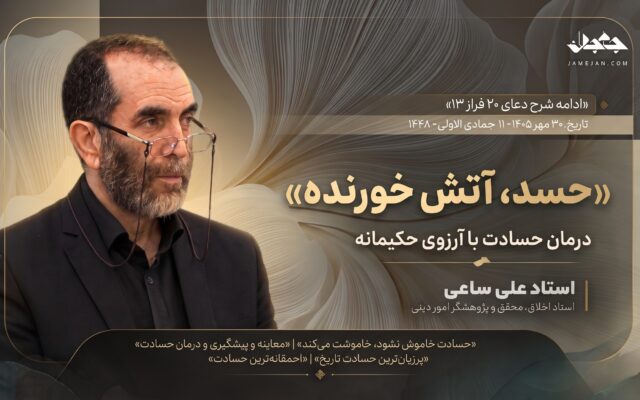
Written transcript of the lecture
The Meshkat-e Noor teachings series🌻🔆🔆🌻
🌼🔆🌼 The Envious Are Defeated; the Envied Endure🌼🔆🌼
🌹🔅☘️ بِسْمِ اللَّهِ الرَّحْمنِ الرَّحيمِ ☘️🔅🌹
🔅🌹 “Envy: Iblis’s Accursed Banner” · “The Direct Detection of Envy” · “Secrets of Strategy Against God’s Enemy” · “The Forms of Envy” · “A Supplement to Passage 13 of Supplication 20 in al-Sahifa al-Sajjadiyya” and more … A summary with a supplement 1405.07.16 Ali Saei (Abdullah Meshkat) 110.141(903) 🌹🔅
🌼
✨ ☀️ 🌟 اللَّهُمَّ اجْعَلْ مَا يُلْقِي الشَّيْطَانُ فِي رُوعِي🌟 ☀️ ✨
☘️🌹مِنَ التَّمَنِّي وَ التَّظَنِّي وَ الْحَسَدِ🌹☘️
🔆🌼🌟🕋🌟🌼🔆
🤲 🌟🌙 ذِكْراً لِعَظَمَتِكَ، وَ تَفَكُّراً فِي قُدْرَتِكَ، وَ تَدْبِيراً عَلَى عَدُوِّك 🌟🌙 🤲
🌟🌼🌟
✅🔆The Relationship Between “Warding Off Envy” and “تَدْبِيراً عَلَى عَدُوِّك”🔆
🌟 Introduction
“ بِسْمِ اللَّهِ الرَّحْمنِ الرَّحيمِ”
Praise and thanks be to God, who made enemies a means of testing His friends and made envy the treacherous scorpion of creation—a scorpion that first stings its own tail, then others. In Supplication 20 of al-Sahifa al-Sajjadiyya, Imam Sajjad (AS) taught us to turn satanic promptings into fuel for spiritual ascent:
“اللَّهُمَّ اجْعَلْ مَا يُلْقِي الشَّيْطَانُ فِي رُوعِي مِنَ التَّمَنِّي وَ التَّظَنِّي وَ الْحَسَدِ ذِكْراً لِعَظَمَتِكَ، وَ تَفَكُّراً فِي قُدْرَتِكَ، وَ تَدْبِيراً عَلَى عَدُوِّكَ”
This treatise continues a commentary on passage thirteen of Supplication 20 of al-Sahifa al-Sajjadiyya.
It explores “envy” as Iblis’s accursed banner; “the direct detection of envy”; “the forms of envy”; “secrets of strategy against God’s enemy”; and “a supplement to passage 13 of Supplication 20.”
These pages speak of the envious, suffocated by their own grief and held captive by their own anger; of Imam Sadiq (AS), who said, “The envier harms himself before the one he envies”; of the tender supplication of Imam Sajjad (AS), who said, “How many an envier has been choked by grief on my account”; and of the prayer of transformation, in which resentment turns to love and envy to friendship.
🌿 Foreword
“Envy is the darkest and most pernicious of the world’s afflictions.”
Within the human faculty of perception—which Supplication 20 calls the “ru‘”—Satan attacks the very command center of our being with three poisoned arrows: wishful thinking (empty desires), suspicion (ill thoughts), and envy (the desire for others’ blessings to be taken away).
Of these three, envy is the most dangerous, because:
Envy first burns its possessor, then others.
Its roots lie in a blind heart and ingratitude for God’s grace, and these are the two wings of disbelief.
Envy is Iblis’s banner, just as Iblis was cast out of God’s presence because of his envy.
Envy consumes every virtue: gratitude, love, justice, chastity, renunciation, humility, patience, and truthfulness.
Envy turns paradise into hell—a hell that first burns the envier himself.
Imam Sadiq (AS) said:
“الْحَاسِدُ يُضِرُّ بِنَفْسِهِ قَبْلَ أَنْ يُضِرَّ بِالْمَحْسُودِ كَإِبْلِيسَ أَوْرَثَ بِحَسَدِهِ لِنَفْسِهِ اللَّعْنَةَ وَ لِآدَمَ الِاجْتِبَاءَ وَ الْهُدَى”
“The envier harms himself before he harms the one he envies, just as Iblis, through his envy, bequeathed a curse to himself and election and guidance to Adam (AS).”
He also said:
“فَكُنْ مَحْسُوداً وَ لَا تَكُنْ حَاسِداً فَإِنَّ مِيزَانَ الْحَاسِدِ أَبَداً خَفِيفٌ بِثِقْلِ مِيزَانِ الْمَحْسُودِ”
“So be envied, not envious; for the envier’s scales are always light beside the weight of the one he envies.”
This treatise is a pledge to the envied and a repudiation of the envious—a pledge in which envy is turned into strategy, and fire into light.
“وَ كَمْ مِنْ حَاسِدٍ قَدْ شَرِقَ بِي بِغُصَّتِهِ”
“How many an envier has been choked by grief on my account.”
📖 Introduction
❇️ Envy, Iblis’s Banner
Envy is the first sin in history. Through envy of Adam, Iblis was cast out of God’s presence. Through envy of Abel, Cain killed him. Out of envy of the Muslims, the Jews wished to turn them back to disbelief. Out of envy of the believers, the hypocrites accused them of being envious.
“وَدَّ كَثِيرٌ مِنْ أَهْلِ الْكِتَابِ لَوْ يَرُدُّونَكُمْ مِنْ بَعْدِ إِيمَانِكُمْ كُفَّاراً حَسَداً مِنْ عِنْدِ أَنْفُسِهِمْ” (al-Baqara: 109)
“Many of the People of the Book wish, out of envy, to turn you back to disbelief after you have believed.”
“أَمْ يَحْسُدُونَ النَّاسَ عَلَى مَا آتَاهُمُ اللَّهُ مِنْ فَضْلِهِ” (al-Nisa’: 54)
“Or do they envy people for what God has granted them out of His grace?”
“سَيَقُولُ الْمُخَلَّفُونَ… بَلْ تَحْسُدُونَنَا” (al-Fath: 15)
“Those who stayed behind will soon say: … Rather, you envy us!”
Thus envy is Iblis’s banner, and its history is a dark one.
❇️ Strategy Against the Enemy Is the Answer to Eradicating Envy
“اللَّهُمَّ اجْعَلْ مَا يُلْقِي الشَّيْطَانُ فِي رُوعِي مِنَ التَّمَنِّي وَ التَّظَنِّي وَ الْحَسَدِ ذِكْراً لِعَظَمَتِكَ، وَ تَفَكُّراً فِي قُدْرَتِكَ، وَ تَدْبِيراً عَلَى عَدُوِّكَ”
This supplication is a formula for transforming psychological energy:
| Negative energy | is transformed into | positive energy |
| Wishful thinking (a futile wish) | remembrance of God | calling to mind God’s greatness |
| suspicion (thinking ill of others) | reflection | contemplation of divine power |
| envy (wanting another’s blessing to be taken away) | deliberate planning | devising a plan against God’s enemy |
Devising a plan against God’s enemy is equivalent to eradicating envy. For:
Envy feeds on positive energy and turns it into negative energy—and then turns that negative energy into something even more pernicious!
Preventing negative energy from being generated means turning low-intensity positive energy into highly active positive energy.
Transforming the potential energy of envy into purposeful planning turns it into fuel for the struggle.
Through planning, God’s enemy is defeated.
Hatred and righteous anger directed against God’s enemy are legitimate and sacred. Whoever is the enemy of God’s enemy is God’s true friend. Righteous anger breaks the power of anger; it neutralises fires and impurities.
❇️ Examining oneself to uncover envy
Envy is hidden. In solitude, one must take oneself to account for it. Managing and curbing envy means managing and preserving a life full of love and affection.
Signs of envy:
| Sign | Explanation |
| Arrogance | Feeling superior to others |
| Pride | An inflated sense of self |
| Narcissism | Feeling self-sufficient |
| Self-praise | Speaking well of oneself |
| Self-satisfaction | Being pleased with oneself without cause |
| Backbiting | Speaking ill of others |
| Slander | Attributing faults to others |
| Tale-bearing | Passing on what others have said |
| Fault-finding | Searching for others’ faults |
| Estrangement | Cutting off relations with others |
| Blind worldly competition | Aimless rivalry |
| Ostentation | Showing off |
| Boasting | Bragging |
| Pretense | Hypocrisy |
| Craving fame | Seeking fame |
| Some forms of depression | — |
| Some forms of loneliness | — |
| Some forms of social withdrawal | — |
| Some cases of severing family ties | — |
Envy burns away every virtue:
| Virtue | How envy burns it away |
| Gratitude | Envy destroys gratitude |
| Love | Envy turns love into hatred |
| Justice | Envy turns justice into oppression |
| Chastity | Envy turns chastity into immodesty |
| Asceticism | Envy turns asceticism into greed |
| Humility | Envy turns humility into arrogance |
| Patience | Envy turns patience into despair |
| Truthfulness | Envy turns truthfulness into falsehood |
Envy turns paradise into hell—a hell that first burns the envious person themselves.
❇️ The Degrees of Envy
Envy has degrees, each lower and more vile than the last:
| Quality | Description | Degree |
| Cold envy | Envy begins with eating away at oneself | First degree |
| Lukewarm envy | Turns into eating away at others | Second degree |
| Warm envy | Turns into burning others | Third degree |
| Scorching envy | Turns into striking others | Fourth degree |
| Fiery envy | Turns into a volcano | Fifth degree |
| Boiling envy | Turns into hell | Sixth degree |
Even cold envy is dangerous, because it begins by eating away at oneself and leads to burning others. Beware lest the worm of envy become a serpent, or even a dragon! Envy must be uprooted! The infection of envy is deadly!
❇️ Envy of Faith and Truth
Those who sin envy the faith of believers. Deep down, they know that believers are following the path to Paradise. So they try to lead them astray by belittling them.
«وَدَّ كَثِيرٌ مِنْ أَهْلِ الْكِتَابِ لَوْ يَرُدُّونَكُمْ مِنْ بَعْدِ إِيمَانِكُمْ كُفَّاراً حَسَداً مِنْ عِنْدِ أَنْفُسِهِمْ… فَاعْفُوا وَ اصْفَحُوا حَتَّى يَأْتِيَ اللَّهُ بِأَمْرِهِ» (Al-Baqarah: 109)
“Many among the People of the Book, out of envy, wish to turn you back to disbelief after you have believed… So pardon them and overlook their faults, until God brings about His command.”
Envy of truth can change the course of history. Envy of ʿAlī (AS) deprived the world of the greatest treasure it could have received. Envy of the Prophet’s family has dealt irreparable blows.
❇️ Accusing Others of Envy
How often the envious accuse others of being envious!
«سَيَقُولُ الْمُخَلَّفُونَ إِذَا انْطَلَقْتُمْ إِلَى مَغَانِمَ لِتَأْخُذُوهَا ذَرُونَا نَتَّبِعْكُمْ… فَسَيَقُولُونَ بَلْ تَحْسُدُونَنَا بَلْ كَانُوا لَا يَفْقَهُونَ إِلَّا قَلِيلاً» (Al-Fatḥ: 15)
“Those who stayed behind will soon say: … Rather, you envy us! But they understand very little!”
The self-proclaimed envious:
| Trait | Description |
| Claim to own privileges | They imagine that the parasites in their society own all the privileges |
| Expect special respect | They expect special respect in return for even minor privileges |
| Turn what they lack into a privilege | They regard what they lack as a privilege |
| Accuse others of envy | They accuse others of being envious |
Seeking refuge in Allah:
«وَ مِنْ شَرِّ حَاسِدٍ إِذَا حَسَدَ» (Al-Falaq: 5)
“And from the evil of the envier when he envies!”
Seek refuge in God from every degree of envy—from its poisonous beginnings to its burning, boiling, volcanic fury!
❇️ The Envious One, His Own Soul’s Killer
Imam al-Ṣādiq (AS) said:
«الْحَاسِدُ يُضِرُّ بِنَفْسِهِ قَبْلَ أَنْ يُضِرَّ بِالْمَحْسُودِ… فَكُنْ مَحْسُوداً وَ لَا تَكُنْ حَاسِداً فَإِنَّ مِيزَانَ الْحَاسِدِ أَبَداً خَفِيفٌ بِثِقْلِ مِيزَانِ الْمَحْسُودِ وَ الرِّزْقُ مَقْسُومٌ فَمَا ذَا يَنْفَعُ الْحَسَدُ الْحَاسِدَ وَ مَا ذَا يَضُرُّ الْمَحْسُودَ الْحَسَدُ وَ الْحَسَدُ أَصْلُهُ مِنْ عَمَى الْقَلْبِ وَ الْجُحُودِ بِفَضْلِ اللَّهِ تَعَالَى وَ هُمَا جَنَاحَانِ لِلْكُفْرِ… وَ لَا تَوْبَةَ لِلْحَاسِدِ لِأَنَّهُ مُسْتَمِرٌّ عَلَيْهِ مُعْتَقِدٌ بِهِ مَطْبُوعٌ فِيهِ»
“The envious person harms himself before the one he envies… So be the one envied, not the envious one; for the envious person’s scales are always light… Provision has been apportioned. So what benefit does envy bring the envious person? And what harm does it bring the one who is envied? Envy takes root in blindness of the heart and ingratitude for God’s grace, and these are the two wings of disbelief… The envious person has no repentance, for he is resolved upon, and habituated to, persistent envy.”
Key points:
| Point | Description |
| The envious harm themselves | The envious person harms himself before the one he envies |
| The envious, like Iblis | Through his envy, Iblis bequeathed a curse to himself |
| The envious: a light scale | The scale of the envious is always light |
| The envious, barred from repentance | There is no repentance for the envious—as long as envy remains, repentance is impossible |
| Envy: the two wings of disbelief | Blindness of the heart and ingratitude are the two wings of disbelief |
| Provision is apportioned | Provision is apportioned; envy serves no purpose |
The envious do not realize that their envy only raises the envied person higher! The more intense the envy, the more exalted the envied becomes! The envious seek to drag the envied down, but God raises them up!
❇️ A tender supplication for protection from the evil of the envious
Imam Sajjad (AS) says in his supplication:
«وَ كَمْ مِنْ حَاسِدٍ قَدْ شَرِقَ بِي بِغُصَّتِهِ، وَ شَجِيَ مِنِّي بِغَيْظِهِ، وَ سَلَقَنِي بِحَدِّ لِسَانِهِ، وَ وَحَرَنِي بِقَرْفِ عُيُوبِهِ، وَ جَعَلَ عِرْضِي غَرَضاً لِمَرَامِيهِ، وَ قَلَّدَنِي خِلَالًا لَمْ تَزَلْ فِيهِ، وَ وَحَرَنِي بِكَيْدِهِ، وَ قَصَدَنِي بِمَكِيدَتِهِ.»
“How many an envious person has been choked by his grief on my account; remained trapped in the grip of his rage against me; hurt me with his sharp tongue; saddened me by finding fault with me; made my honour the target of his arrows; accused me of traits that he himself was constantly guilty of; tormented me with his schemes; and aimed at me with his deceit.”
Rhetorical analysis:
| Feature | Explanation | Example |
| Rhymed prose | The echoing endings | غُصَّتِهِ / غَيْظِهِ / لِسَانِهِ / عُيُوبِهِ / مَرَامِيهِ / فِيهِ / كَيْدِهِ / مَكِيدَتِهِ |
| Simile | Comparing the envious person to an archer | جَعَلَ عِرْضِي غَرَضاً لِمَرَامِيهِ |
| Metaphor | Metaphors of choking and being trapped | شَرِقَ بِي بِغُصَّتِهِ |
| Indirect expression | An indirect reference to hurting someone with one’s tongue | سَلَقَنِي بِحَدِّ لِسَانِهِ |
| Antithesis | An implicit contrast | عِرْضِي (my honour) in contrast with عُيُوبِهِ (his faults) |
| Repetition | The repetition of «وَحَرَنِي» | وَحَرَنِي بِقَرْفِ عُيُوبِهِ … وَ وَحَرَنِي بِكَيْدِهِ |
Structural analysis:
| No. | Verb | Meaning | The envious person’s weapon |
| 1 | شَرِقَ | Was choked | غُصَّتِهِ (his grief) |
| 2 | شَجِيَ | Was trapped | غَيْظِهِ (his rage) |
| 3 | سَلَقَنِي | Hurt me | حَدِّ لِسَانِهِ (the sharpness of his tongue) |
| 4 | وَحَرَنِي | Saddened me | قَرْفِ عُيُوبِهِ (his finding fault with me) |
| 5 | جَعَلَ | Made | عِرْضِي غَرَضاً (my honour a target) |
| 6 | قَلَّدَنِي | Accused me | خِلَالًا (traits he himself possessed) |
| 7 | وَحَرَنِي | Tormented me | كَيْدِهِ (his schemes) |
| 8 | قَصَدَنِي | Aimed at me | مَكِيدَتِهِ (his deceit) |
Central point: By repeating «وَحَرَنِي» twice, the Imam shows that the envious person’s hostility causes him both inward suffering (grief) and outward harm (scheming). And by including «لَمْ تَزَلْ فِيهِ» (a trait that was always present in him), he exposes the envious person’s hypocrisy: he attributes to the Imam the very flaw he himself possesses.
❇️ The believer makes the furnace of envy shine with the light of affection
«اللَّهُمَّ صَلِّ عَلَى مُحَمَّدٍ وَ آلِ مُحَمَّدٍ، وَ أَبْدِلْنِي مِنْ بِغْضَةِ أَهْلِ الشَّنَآنِ الْمَحَبَّةَ، وَ مِنْ حَسَدِ أَهْلِ الْبَغْيِ الْمَوَدَّةَ»
“O God, bless Muhammad and his family, and turn the hatred of those who bear grudges toward me into affection, and the envy of the unjust into friendship.”
Two possible meanings of «مِن»:
| Possibility | Explanation | Translation |
| Substitutive مِن | Affection takes the place of hatred | “Take away hatred and put affection in its place” |
| Originative مِن | Affection emerges from hatred | “Make affection grow from a heart full of hatred” |
The believer transforms the furnace of envy with the light of affection: hatred into love, envy into friendship. This is a prayer for transformation—the transformation of fire into light, of darkness into radiance.
📋 A structured summary
🗂️ Part One: Theoretical foundations
| Topic | Principle | Source |
| Envy, Iblis’s banner | Envy was the first sin in history and is Iblis’s banner | «إِلَّا إِبْلِيسَ أَبى وَ اسْتَكْبَرَ» |
| Envy, the two wings of disbelief | Envy takes root in blindness of the heart and ingratitude for God’s grace | A narration from Imam al-Sadiq (AS) |
| Envy, self-destruction | The envious person harms himself before the person he envies | «الْحَاسِدُ يُضِرُّ بِنَفْسِهِ» |
| Envy, barred from repentance | There is no repentance for the envious person—as long as envy remains, repentance is impossible | A narration from Imam al-Sadiq (AS) |
| Envy burns away every virtue | Envy destroys gratitude, affection, justice, chastity, asceticism, humility, patience and truthfulness | Analysis |
| Envy turns Paradise into Hell | Envy turns Paradise into Hell—a Hell that first burns the envious person himself | Analysis |
| Be envied, not envious | It is better to be envied than to envy | «فَكُنْ مَحْسُوداً وَ لَا تَكُنْ حَاسِداً» |
| Provision is apportioned | Provision is apportioned; envy serves no purpose | «الرِّزْقُ مَقْسُومٌ» |
🗂️ Part Two: Satan’s three weapons
| Weapon | Meaning | Consequence |
| Wishful thinking | Empty, worldly longings | Being caught in a cycle of “if only” |
| Suspicion | Dark thoughts and distrust | Eroded trust, isolation and mistrust |
| Envy | Desire for others to lose their blessings | The destruction of gratitude and the turning of others’ success into a threat |
🗂️ Part Three: Three pillars of defence
| Pillar | Transforms into | Function |
| Remembrance | Awareness of God’s greatness | Lifting the veils, connecting to the light, and closing down Satan’s marketplace |
| Reflection | Contemplating divine power | Fostering certainty, illuminating the heart and increasing knowledge |
| Planning | Making plans against the enemy | Repelling the enemy’s harm with a wise, measured approach |
🗂️ Part Four: A Formula for Transforming Psychological Energy
| Negative energy | transformed into | positive energy |
| wishful thinking | remembrance | remembering God’s greatness |
| suspicion | reflection | contemplating divine power |
| envy | strategy | planning against God’s enemy |
🗂️ Part Five: Degrees of Envy
| Quality | Explanation | Degree |
| Cold envy | The onset of envy; tormenting oneself | First degree |
| Lukewarm envy | Turning one’s resentment outward | Second degree |
| Warm envy | Turning into resentment that consumes others | Third degree |
| Hot envy | Turning into aggression against others | Fourth degree |
| Fiery envy | Turning into a volcano | Fifth degree |
| Boiling envy | Turning into hell | Sixth degree |
🗂️ Part Six: Signs of Envy
| Sign | Explanation |
| Arrogance | Feeling superior to others |
| Pride | An inflated sense of self |
| Narcissism | Feeling self-sufficient |
| Self-praise | Praising oneself |
| Self-satisfaction | Being satisfied with oneself without cause |
| Backbiting | Speaking ill of others |
| Slander | Attributing faults to others |
| Tale-bearing | Passing on what others have said |
| Fault-finding | Searching for others’ faults |
| Estrangement | Breaking off relations with others |
| Blind worldly rivalries | Aimless competition |
| Ostentation | Showing off |
| Boastfulness | Bragging |
| Pretence | Hypocrisy |
| Craving fame | Seeking fame |
| Some forms of depression | — |
| Some forms of melancholy | — |
| Some forms of social withdrawal | — |
| Some cases of severing family ties | — |
🗂️ Part Seven: An Analysis of the Gentle Supplication
| No. | Verb | Meaning | The envious person’s weapon |
| 1 | شَرِقَ | Was choked | غُصَّتِهِ (his anguish) |
| 2 | شَجِيَ | Was held captive | غَيْظِهِ (his rage) |
| 3 | سَلَقَنِي | Hurt me | حَدِّ لِسَانِهِ (the sharpness of his tongue) |
| 4 | وَحَرَنِي | He saddened me | قَرْفِ عُيُوبِهِ (finding fault with his flaws) |
| 5 | جَعَلَ | He made | عِرْضِي غَرَضاً (my good name a target) |
| 6 | قَلَّدَنِي | He accused me of | خِلَالًا (traits that he himself possessed) |
| 7 | وَحَرَنِي | He hurt me | كَيْدِهِ (his scheming) |
| 8 | قَصَدَنِي | He targeted me | مَكِيدَتِهِ (his plot) |
🗂️ Section Eight: The Prayer of Transformation
| Element | Explanation | Textual evidence |
| أبدل | To remove one thing and put another in its place | «أَبْدِلْنِي» |
| بغضة | Hatred | «مِنْ بِغْضَةِ» |
| شنان | Hostility | «أَهْلِ الشَّنَآنِ» |
| محبة | Love | «الْمَحَبَّةَ» |
| حسد | Envy | «حَسَدِ» |
| بغی | Injustice | «أَهْلِ الْبَغْيِ» |
| مودة | Affection | «الْمَوَدَّةَ» |
🗂️ Section Nine: Ways to Prevent Envy
| Preventive measure | Explanation | Textual evidence |
| Understanding provision | Recognising that provision is apportioned | «نَحْنُ قَسَمْنَا بَيْنَهُمْ» |
| Understanding divine grace | Recognising that grace comes from God | «ذلِكَ فَضْلُ اللَّهِ» |
| Understanding wisdom | Recognising that wisdom comes from God | «وَ اللَّهُ حَكِيمٌ عَلِيمٌ» |
| Understanding justice | Recognising that justice comes from God | «وَ اللَّهُ يَحْكُمُ» |
| Gratitude | Giving thanks for one’s own blessings | «لَئِنْ شَكَرْتُمْ لَأَزِيدَنَّكُمْ» |
| Contentment | Being content with what God has given | «وَ قَنِعْتُمْ بِما آتاكُمُ اللَّهُ» |
| Love | Loving others | «وَ الْمُؤْمِنُونَ وَ الْمُؤْمِنَاتُ بَعْضُهُمْ أَوْلِيَاءُ بَعْضٍ» |
| Prayer | Praying for protection from envy | «وَ مِنْ شَرِّ حَاسِدٍ إِذَا حَسَدَ» |
🗂️ Section Ten: How Envy Differs from Similar Concepts
| Topic | Envy | Emulation | Healthy competition | Protective jealousy |
| Definition | Wishing that another person’s blessing would be taken away | Wishing to have a blessing like another person’s | Striving to attain a similar blessing | Protecting one’s own boundaries |
| Ruling | Forbidden | Permissible or recommended | Permissible or recommended | Recommended |
| Aim | The loss of another person’s blessing | Attaining a similar blessing | One’s own growth | Protecting one’s boundaries |
| Method | Undermining others | Striving for one’s own growth | Striving for one’s own growth | Defending one’s boundaries |
| Documented | “وَ مِنْ شَرِّ حَاسِدٍ” | “فَلْيَتَنَافَسِ الْمُتَنَافِسُونَ” | “فَاسْتَبِقُوا الْخَيْرَاتِ” | “إِنَّ اللَّهَ غَيُورٌ” |
🗂️ Part Eleven: The Final Formula for Overcoming Envy
Overcoming envy = recognizing envy + self-examination + seeking refuge in Allah + redirecting its energy + taking action against the enemy
| Stage | Explanation |
| 1. Recognizing envy | Recognizing the signs and qualities of envy |
| 2. Self-examination | Daily examination of envy within oneself |
| 3. Seeking refuge in Allah | Seeking refuge from every degree of envy |
| 4. Redirecting its energy | Turning the energy of envy into the energy of purposeful action |
| 5. Taking action against the enemy | Taking action against God’s enemy |
❇️Acting against God’s enemies is tantamount to eradicating envy
💫🔆اللَّهُمَّ اجْعَلْ مَا يُلْقِي الشَّيْطَانُ فِي رُوعِي مِنَ التَّمَنِّي وَ التَّظَنِّي وَ الْحَسَدِ ذِكْراً لِعَظَمَتِك وَ تَفَكُّراً فِي قُدْرَتِكَ، وَ تَدْبِيراً عَلَى عَدُوِّكَ,[1]
💫 “O God! Turn what Satan casts into my heart—desire, suspicion, and envy—into remembrance of Your greatness, reflection on Your power, and action against Your enemy.”
✅Acting against God’s enemies is tantamount to increasing one’s love and affection for God’s friends!
Resentment and anger are permissible only toward an enemy who is firmly established and pleasing to the heart! Such resentment and anger are sacred!
Sacred resentment and anger may burn like fire, yet you put out fires! They destroy enmity!
The enemy of God’s enemy is God’s sincere friend!
Sacred anger breaks anger,
and neutralizes fires and evils.
The enemy of God’s enemy is an enemy of oppression and darkness!
❇️Beware lest hidden envy cloud the clarity of your soul
💫🔆اللَّهُمَّ صَلِّ عَلَى مُحَمَّدٍ وَ آلِهِ، وَ خَلِّصْنِي مِنَ الْحَسَدِ، وَ احْصُرْنِي عَنِ الذُّنُوبِ، وَ وَرِّعْنِي عَنِ الْمَحَارِم…[2]
💫 “O God, bless Muhammad and his family, free me from envy, keep me from sin, and restrain me from what You have forbidden.”
❇️Envy is Iblis’s banner
Instead of giving in to envy, fight it—be an enviousness-destroyer!
God’s enemy—that is, ignorance and oppression. To oppose God’s enemy is to oppose ignorance and oppression!
Taking action against God’s enemy means repelling God’s enemies in the most beautiful way possible!
Through envy, a person becomes an enemy of God; by purifying oneself of envy, one becomes a friend of God!
❇️Examining oneself for envy
In solitude, examine yourself for envy!
Managing and restraining envy means managing and preserving a life filled with love and affection!
Envy burns away every virtue!
Envy turns Paradise into Hell!
Envy turns every sweetness to bitterness!
Through envy, Satan seeks to make a person like himself!
Do not imagine that you are safe from the evil of envy!
Indeed, envy’s many different forms may keep a person from realizing that envy is within them!
❇️The banners of envy
Among the signs that may indicate the presence of envy are:
Arrogance, conceit, narcissism, praising oneself, self-satisfaction, backbiting, slander, tale-bearing, fault-finding, falling out with others, blind worldly competition, flaunting oneself, boasting, pretence, craving fame, certain forms of depression, certain kinds of despondency, some forms of social withdrawal, and severing ties with relatives and friends.
❇️Envy is Satan’s most venomous sting
The arrow of envy, when it strikes the human soul, turns a person directly into a sworn enemy of God!
❇️Envy, the treacherous scorpion
Envy is the darkest and vilest of the world’s treacherous forces.
The envious person does not seek gain; they seek loss.
Envy is self-destruction—the most self-destructive phenomenon in existence!
❇️The boiling point of envy
Beware lest the worm of envy turn into a snake or dragon!
Envy must be uprooted! Its infection is deadly!
Be careful: the seed of envy will grow and become an evil tree!
Envy has degrees, each lower one more vile than the last.
Even cold envy is dangerous. Fiery envy begins as cold envy, grows tepid, then warm and scorching, until it becomes a raging fire—and boils over!
Envy begins in cold resentment—an inward consuming that leads to consuming others. It starts as self-burning and self-wounding, then turns into burning and wounding others.
Envy turns a person into a hell—a hell that burns him first!
❇️Envy of Faith
✨🔆البقرة : 109 وَدَّ كَثيرٌ مِنْ أَهْلِ الْكِتابِ لَوْ يَرُدُّونَكُمْ مِنْ بَعْدِ إيمانِكُمْ كُفَّاراً حَسَداً مِنْ عِنْدِ أَنْفُسِهِمْ مِنْ بَعْدِ ما تَبَيَّنَ لَهُمُ الْحَقُّ فَاعْفُوا وَ اصْفَحُوا حَتَّى يَأْتِيَ اللَّهُ بِأَمْرِهِ إِنَّ اللَّهَ عَلى كُلِّ شَيْءٍ قَديرٌ
🔆Many among the People of the Book, out of envy deeply rooted within them, wished to turn you back to disbelief after you had embraced Islam and believed, even though the truth had become entirely clear to them. So pardon them and bear with them until Allah issues His command. Surely Allah has power over all things.
✅Those who sin, disobey, and indulge in immorality envy the holiness and faith of believers! They wish believers were like them!
Deep down, those who disobey know that believers are on the path to Paradise. That is why, by belittling believers—a sign of their envy—they try to divert them from the path to Paradise and onto the path to Hell!
❇️Envy of the Truth
✨🔆النساء : 54 أَمْ يَحْسُدُونَ النَّاسَ عَلى ما آتاهُمُ اللَّهُ مِنْ فَضْلِهِ فَقَدْ آتَيْنا آلَ إِبْراهيمَ الْكِتابَ وَ الْحِكْمَةَ وَ آتَيْناهُمْ مُلْكاً عَظيماً
🔆Or do they envy the people [the Prophet and his family] for what Allah has bestowed upon them from His bounty? We gave the family of Abraham—whose descendants include the Jews—the Book and wisdom, and granted them [the prophets of the Children of Israel] great authority.
✅Muhammad and the family of Muhammad (AS) were more than anyone else exposed to the envy of the envious!
Light is the object of darkness’s envy!
Envy of the truth changes the course of history, turning it toward darkness!
Envy of Ali, the Commander of the Faithful (AS), deprived the world of existence of the greatest treasure imaginable!
Envy of the Prophet’s family has dealt irreparable blows!
❇️Accusing Others of Envy Is as Weighty as Envy Itself
✅How often the envious accuse others of envy!
✨🔆الفتح : 15 سَيَقُولُ الْمُخَلَّفُونَ إِذَا انْطَلَقْتُمْ إِلى مَغانِمَ لِتَأْخُذُوها ذَرُونا نَتَّبِعْكُمْ يُريدُونَ أَنْ يُبَدِّلُوا كَلامَ اللَّهِ قُلْ لَنْ تَتَّبِعُونا كَذلِكُمْ قالَ اللَّهُ مِنْ قَبْلُ فَسَيَقُولُونَ بَلْ تَحْسُدُونَنا بَلْ كانُوا لا يَفْقَهُونَ إِلاَّ قَليلاً
🔆When you set out to take the spoils, those who stayed behind at Hudaybiyyah will say, “Let us come with you.” They want to change the word of Allah. Say, “You shall not come with us; Allah has said so before.” They will soon say, “You envy us!” Yet they understand little indeed.
Throughout history, the grasping and the parasites of society have considered themselves entitled to all its privileges! These proven parasites of society are themselves envious, yet in their vile delusion they imagine that others envy them!
In their base estimation, their petty privileges entitle them to special and constant deference!
They want to be the center of attention at all times!
They even regard what they lack as a privilege!
❇️Seek Allah’s Protection from the Evil of the Envious
✨🔆الفلق : 5 وَ مِنْ شَرِّ حاسِدٍ إِذا حَسَدَ
🔆And from the evil of the envier when he envies!
✅Seek refuge in Allah from every degree of envy—from its poison to its seething fury and volcanic eruption!
❇️The Envious Person Is His Own Soul’s Killer!
💫قَالَ الصَّادِقُ ع الْحَاسِدُ يُضِرُّ بِنَفْسِهِ قَبْلَ أَنْ يُضِرَّ بِالْمَحْسُودِ كَإِبْلِيسَ أَوْرَثَ بِحَسَدِهِ لِنَفْسِهِ اللَّعْنَةَ وَ لِآدَمَ ع الِاجْتِبَاءَ وَ الْهُدَى وَ الرَّفْعَ إِلَى مَحَلِّ حَقَائِقِ الْعَهْدِ وَ الِاصْطِفَاءَ فَكُنْ مَحْسُوداً وَ لَا تَكُنْ حَاسِداً فَإِنَّ مِيزَانَ الْحَاسِدِ أَبَداً خَفِيفٌ بِثِقْلِ مِيزَانِ الْمَحْسُودِ وَ الرِّزْقُ مَقْسُومٌ فَمَا ذَا يَنْفَعُ الْحَسَدُ الْحَاسِدَ وَ مَا ذَا يَضُرُّ الْمَحْسُودَ الْحَسَدُ وَ الْحَسَدُ أَصْلُهُ مِنْ عَمَى الْقَلْبِ وَ الْجُحُودِ بِفَضْلِ اللَّهِ تَعَالَى وَ هُمَا جَنَاحَانِ لِلْكُفْرِ وَ بِالْحَسَدِ وَقَعَ ابْنُ آدَمَ فِي حَسْرَةِ الْأَبَدِ وَ هَلَكَ مَهْلَكاً لَا يَنْجُو مِنْهُ أَبَداً وَ لَا تَوْبَةَ لِلْحَاسِدِ لِأَنَّهُ مُسْتَمِرٌّ عَلَيْهِ مُعْتَقِدٌ بِهِ مَطْبُوعٌ فِيهِ يَبْدُو بِلَا مُعَارِضٍ مُضِرٍّ لَهُ وَ لَا سَبَبٍ وَ الطَّبْعُ لَا يَتَغَيَّرُ مِنَ الْأَصْلِ وَ إِنْ عُولِج[3]
💫 Imam Ja‘far al-Sadiq (AS) said: “The envious person harms himself before he harms the one envied. Such was Iblis: through his envy, he bequeathed a curse to himself, while Adam (AS) was granted election, guidance, and elevation to the station of the realities of covenant and divine choosing.”
So be envied, not envious; for the envious person’s scales are always light beside the weight of the one who is envied. Provision has been apportioned. What, then, does envy gain for the envier? And what harm does it do to the one who is envied?
The root of envy lies in blindness of heart and ingratitude for the bounty of God Most High; these are the two wings of disbelief. It was envy that plunged Adam’s child into eternal regret and brought him to a ruin from which he will never be saved.
The envious have no repentance, for they are set in their persistent envy, fixed in it by nature. Envy manifests itself in them without any restraint and harms them. A person’s nature does not change at its root, even if it is treated.
🔸Envy cannot harm the faithful, but the faithless and the weak in faith suffer irreparable harm!
The possibility of envy taking effect is one of the tests woven into creation!
The shortcomings and losses caused by envy are confined to the narrow bounds of the test! In truth, nothing is taken away from the one who is envied!
🔸Deep-rooted, ingrained and dominant envy cannot be cured!
🔸As long as envy remains, repentance is impossible!
Repentance becomes possible once envy has passed!
🔸The envious do not realize that their envy raises the one they envy!
The thicker envy grows, the more refined the one envied becomes!
The envier wants to bring the one envied down, but God raises them higher!
❇️A Tender Supplication for Protection from the Envious
💫 وَ كَمْ مِنْ حَاسِدٍ قَدْ شَرِقَ بِي بِغُصَّتِهِ
“How often an envious person has choked on his own grief [and sorrow] over me [and been stifled by it]”
وَ شَجِيَ مِنِّي بِغَيْظِهِ
“And, in his anger toward me, become sorrowful and distressed”
وَ سَلَقَنِي بِحَدِّ لِسَانِهِ
“And hurt me with the sharpness of his tongue [attacking me with harsh words]”
وَ وَحَرَنِي بِقَرْفِ عُيُوبِهِ
“And caused me pain and resentment by attributing his own faults to me”
وَ جَعَلَ عِرْضِي غَرَضاً لِمَرَامِيهِ
“And made my honour the target of his [barbed-tongued] arrows”
وَ قَلَّدَنِي خِلَالًا لَمْ تَزَلْ فِيهِ
“And laid upon me traits that he himself was constantly afflicted with”
وَ وَحَرَنِي بِكَيْدِهِ
“And made me suffer and resent him through his deceit”
وَ قَصَدَنِي بِمَكِيدَتِهِ[4]
“And sought to harm me with his schemes and snares”
🔸How many envious people there have been
who, because of me,
choked on their envy;
envy closed their throats.
How many envious people, out of envy for me, have felt envy constrict their throats!
How many envious people, out of envy for me, have found their breathing stifled!
How many envious people, out of envy for me, have found life hard and burdensome!
❇️The Believer Makes the Hearth of Envy Shine with the Light of Affection
💫🔆اللَّهُمَّ صَلِّ عَلَى مُحَمَّدٍ وَ آلِ مُحَمَّدٍ، وَ أَبْدِلْنِي مِنْ بِغْضَةِ أَهْلِ الشَّنَآنِ الْمَحَبَّةَ، وَ مِنْ حَسَدِ أَهْلِ الْبَغْيِ الْمَوَدَّةَ…[5]
💫 “O God, bless Muhammad and his family, and turn the hatred of those who bear me enmity into affection, and the envy of the unjust into friendship.”
To be continued…
🌟وَ السَّلامُ عَلى مَنِ اتَّبَعَ الْهُدى
✨سُبْحانَ رَبِّكَ رَبِّ الْعِزَّةِ عَمَّا يَصِفُونَ
✨وَ سَلامٌ عَلَى الْمُرْسَلينَ
✨وَ الْحَمْدُ لِلَّهِ رَبِّ الْعالَمينَ
🔶Ali Saei (Abdullah Meshkat) 110.141 (903)
🌻🔆 A Lyrical Supplement to “Envy: The Wily Scorpion” 🔆🌻
📜 Preface
The treatise “Envy: The Wily Scorpion” addresses envy as one of Satan’s three weapons (wishful thinking, suspicion and envy), and its connection to “devising against the enemy of God” in the twentieth supplication of al-Sahifa al-Sajjadiyya.
Part One: Enrichment
1. Enriching the “connection between warding off envy and devising against the enemy”
1.1. The monotheistic dimension of warding off envy
| Dimension | Explanation | Evidence |
| Oneness in provision | Envy arises from ignorance of God’s apportionment of provision | “نَحْنُ قَسَمْنا بَيْنَهُمْ مَعِيشَتَهُمْ” (al-Zukhruf: 32) |
| Oneness in grace | Envy arises from ignorance of divine grace | “ذلِكَ فَضْلُ اللَّهِ يُؤْتِيهِ مَنْ يَشاءُ” (al-Jumu‘ah: 4) |
| Oneness in wisdom | Envy arises from ignorance of divine wisdom | “وَ اللَّهُ حَكِيمٌ عَلِيمٌ” (al-Hujurat: 8) |
| Oneness in justice | Envy arises from ignorance of divine justice | “وَ اللَّهُ يَحْكُمُ لا مُعَقِّبَ لِحُكْمِهِ” (al-Ra‘d: 41) |
Warding off envy is not merely an ethical act; it is an act of affirming God’s oneness. By warding off envy, the servant practically acknowledges that provision, grace, wisdom and justice belong to God alone.
1.2. “The Poisonous Network of Wishful Thinking, Suspicion, and Envy” as a System
| Stage | Weapon | Function | Consequence |
| First stage | Wishful thinking | Creating an artificial sense of deprivation | Getting caught in a cycle of “if only” |
| Second stage | Suspicion | Undermining trust | Isolation and distrust |
| Third stage | Envy | Wanting blessings to be taken away | The destruction of gratitude |
Together, these three form a poisonous network. Wishful thoughts are the seeds of suspicion, and both lead to envy. To counter this network, all three must be addressed at once.
1.3. “A Formula for Transforming Psychic Energy” as a Strategy
| Negative energy | transformed into | Positive energy |
| Wishful thinking | Remembrance | Remembering God’s greatness |
| Suspicion | Reflection | Contemplating divine power |
| Envy | Planning | Planning against God’s enemy |
This supplication is a formula for transforming psychic energy: the negative energy of temptation becomes fuel for spiritual ascent. It is a strategic approach.
2. “Envy: The Banner of Iblis”
2.1. “The History of Envy” as a Foundation
| Stage | Event | Evidence |
| Iblis’s envy | Iblis envied Adam and was cursed | “إِلَّا إِبْلِيسَ أَبى وَ اسْتَكْبَرَ” (Al-Baqara: 34) |
| Cain’s envy | Cain envied Abel and killed him | “فَطَوَّعَتْ لَهُ نَفْسُهُ قَتْلَ أَخِيهِ” (Al-Ma’ida: 30) |
| The Jews’ envy | The Jews envied the Muslims | “وَدَّ كَثِيرٌ مِنْ أَهْلِ الْكِتابِ” (Al-Baqara: 109) |
| The hypocrites’ envy | The hypocrites envied the believers | “سَيَقُولُ الْمُخَلَّفُونَ” (Al-Fath: 15) |
Envy has a long history: from Iblis to Cain, from the Jews to the hypocrites. This history shows how dangerous envy is.
2.2. “The Qualities of Envy” as a System
| Quality | Description | Degree |
| Cold envy | Envy begins as inward torment | First degree |
| Lukewarm envy | It turns into tormenting others | Second degree |
| Warm envy | It turns into making others suffer | Third degree |
| Hot envy | It turns into striking out at others | Fourth degree |
| Fiery envy | It turns into a volcano | Fifth degree |
| Boiling envy | It turns into hell | Sixth degree |
Envy has different depths; the lower it sinks, the more vile it becomes. Even cold envy is dangerous: it begins as inward torment and leads to making others suffer.
3. Enriching “Envy of Faith and Truth”
3.1. “Envy of Faith” as a Strategy
| Strategy | Description | Evidence |
| Recognising envy of faith | Those who sin envy the believers’ holiness | “وَدَّ كَثِيرٌ مِنْ أَهْلِ الْكِتابِ” |
| Confronting Humiliation | Humiliating believers is a sign of envy | “إِنَّ الَّذِينَ أَجْرَمُوا كانُوا مِنَ الَّذِينَ آمَنُوا يَضْحَكُونَ” |
| Patience and forbearance | Forgiveness and forbearance are the way to respond | “فَاعْفُوا وَ اصْفَحُوا” |
| Awaiting God’s command | Until God’s command comes | “حَتَّى يَأْتِيَ اللَّهُ بِأَمْرِهِ” |
Envy of faith is a strategy for opposing it. Believers should wait patiently and forgive until God’s command comes.
3.2. “Envy of the Truth” as a Strategy
| Strategy | Explanation | Evidence |
| Recognizing envy of the truth | … they envied the House of Abraham | “أَمْ يَحْسُدُونَ النَّاسَ” |
| Countering distortion | Distorting the truth is a sign of envy | “يُحَرِّفُونَ الْكَلِمَ عَنْ مَواضِعِهِ” |
| Patience and perseverance | Patience in the face of distortion | “فَاصْبِرْ كَما صَبَرَ أُولُوا الْعَزْمِ” |
| Awaiting the truth’s emergence | Awaiting the truth’s emergence | “حَتَّى يَأْتِيَ اللَّهُ بِأَمْرِهِ” |
Envy of the truth is a strategy for opposing it. Believers should wait patiently and steadfastly for the truth to emerge.
4. Enriching the “Accusation of Envy”
4.1. “Self-Proclaimed Enviers” as a System
| Characteristic | Explanation | Evidence |
| Claiming to own privileges | The parasites of their society imagine that they own every privilege | “يُريدُونَ أَنْ يُبَدِّلُوا كَلامَ اللَّهِ” |
| Expecting special respect | For even minor privileges, they expect special respect | “بَلْ تَحْسُدُونَنا” |
| Treating what they lack as a privilege | They regard what they do not possess as a privilege | “بَلْ كانُوا لا يَفْقَهُونَ إِلَّا قَليلاً” |
| Accusing others of envy | They accuse others of being envious | “بَلْ تَحْسُدُونَنا” |
The self-proclaimed enviers form a system. By accusing others of envy, they seek to conceal their own.
4.2. “Seeking Refuge in Allah” as a Strategy
| Strategy | Explanation | Evidence |
| Seeking refuge from envy | From every degree of envy, from poisoning to volcanic fury | “وَ مِنْ شَرِّ حاسِدٍ إِذا حَسَدَ” |
| Seeking refuge from the envious | Seek refuge in God from the evil of the envious | “قُلْ أَعُوذُ بِرَبِّ الْفَلَقِ” |
| Seeking refuge from the self | Seek refuge in God from the evil of the commanding self | “وَ ما أُبَرِّئُ نَفْسِي” |
| Seeking refuge from Satan | Seek refuge in God from the evil of Satan | “فَاسْتَعِذْ بِاللَّهِ” |
Seeking refuge in Allah is a strategy for confronting envy. Believers should seek God’s protection from every degree of envy.
5. Enriching “The Envier Who Wounds His Own Soul”
5.1. “Analysis of a Narration from Imam Ja‘far al-Sadiq (peace be upon him)” as a Foundation
| Characteristic | Explanation | Evidence |
| The envier harms himself | Before harming the person he envies, the envier harms himself | “الْحَاسِدُ يُضِرُّ بِنَفْسِهِ” |
| The Envious, Like Iblis | Through his envy, Iblis bequeathed a curse to himself | “كَإِبْلِيسَ أَوْرَثَ بِحَسَدِهِ لِنَفْسِهِ اللَّعْنَةَ” |
| The Envious, Whose Scales Are Light | The scales of the envious are always light | “مِيزَانُ الْحَاسِدِ أَبَداً خَفِيفٌ” |
| The Envious, Barred from Repentance | There is no repentance for the envious—as long as envy remains, repentance is impossible | “لَا تَوْبَةَ لِلْحَاسِدِ” |
A lesson for abundance: The envious person is the slayer of their own soul. Before harming the envied person, they harm themselves. This is a Quranic and narrational principle.
5.2. “Choose to Be Envied, Not Envious” as a Strategy
| Strategy | Explanation | Evidence |
| Choose to be envied | Being envied is better than being envious | “فَكُنْ مَحْسُوداً وَ لَا تَكُنْ حَاسِداً” |
| Provision is apportioned | Provision has been apportioned | «الرِّزْقُ مَقْسُومٌ» |
| Envy is futile | Envy does not harm the person who is envied | “فَمَا ذَا يَنْفَعُ الْحَسَدُ الْحَاسِدَ” |
| Envy takes root in blindness of heart | The root of envy is blindness of heart and ingratitude | “الْحَسَدُ أَصْلُهُ مِنْ عَمَى الْقَلْبِ and …” |
A lesson for abundance: “Choose to be envied, not envious” is a strategy for countering envy. Believers should be envied, not envious.
6. A Lesson for Abundance from “The Gentle Supplication for Protection from the Envious”
6.1. “Rhetorical Analysis of the Supplication” as a Principle
| Rhetorical Feature | Explanation | Example |
| Rhymed prose | Matching end sounds | غُصَّتِهِ / غَيْظِهِ / لِسَانِهِ / عُيُوبِهِ |
| Simile | Comparing the envious person to an archer | جَعَلَ عِرْضِي غَرَضاً لِمَرَامِيهِ |
| Metaphor | Metaphors of suffocation and confinement | شَرِقَ بِي بِغُصَّتِهِ |
| Allusion | An allusion to wounding with the tongue | سَلَقَنِي بِحَدِّ لِسَانِهِ |
| Antithesis | An implicit contrast | عِرْضِي versus عُيُوبِهِ |
| Repetition | Repetition of «وَحَرَنِي» | وَحَرَنِي بِقَرْفِ عُيُوبِهِ … وَ وَحَرَنِي بِكَيْدِهِ |
The Gentle Supplication is a rhetorical masterpiece. It expresses, with extraordinary eloquence, eight kinds of behaviour exhibited by the envious.
6.2. “Structural Analysis of the Supplication” as a Principle
| No. | Verb | Meaning | The Envious Person’s Weapon |
| 1 | شَرِقَ | He choked | غُصَّتِهِ |
| 2 | شَجِيَ | He was left trapped | غَيْظِهِ |
| 3 | سَلَقَنِي | He wounded me | حَدِّ لِسَانِهِ |
| 4 | وَحَرَنِي | He grieved me | قَرْفِ عُيُوبِهِ |
| 5 | جَعَلَ | He made | عِرْضِي غَرَضاً |
| 6 | قَلَّدَنِي | He accused me | خِلَالًا |
| 7 | وَحَرَنِي | He tormented me | كَيْدِهِ |
| 8 | قَصَدَنِي | He targeted me | مَكِيدَتِهِ |
This supplication consists of eight verbs, each marking a stage in the conduct of the envious person. It is a carefully ordered structure.
7. Enriching “The believer makes the hearth of envy shine with the radiance of affection”
7.1. “Analysis of the prayer of transformation” as a foundation
| Element | Explanation | Evidence |
| أبدل | Removing one thing and putting another in its place | «أَبْدِلْنِي» |
| بغضة | Resentment | «مِنْ بِغْضَةِ» |
| شنان | Hostility | «أَهْلِ الشَّنَآنِ» |
| محبة | Love | «الْمَحَبَّةَ» |
| حسد | Envy | «حَسَدِ» |
| بغی | Wrongdoing | «أَهْلِ الْبَغْيِ» |
| مودة | Affection | «الْمَوَدَّةَ» |
The prayer of transformation is comprehensive. It asks God to turn resentment into love and envy into affection.
7.2. “Two possible meanings of مِن” as a foundation
| Possibility | Explanation | Translation |
| مِن as substitution | Love in place of resentment | “Take away resentment and put love in its place” |
| مِن as origin | Love arising from resentment | “Make love grow from a heart filled with resentment” |
«مِن» در «مِنْ بِغْضَةِ» has two possible meanings: substitution and origin. Both deserve consideration in their own right.
Part Two: Supplement
1. Supplementary discussion
1.1. Coherence between sections
| Section | Connection to the preceding section | Connection to the following section |
| Section 1: The relation between warding off envy and planning | Introduction | Leads to envy as the banner of Iblis |
| Section 2: Envy as the banner of Iblis | Outcome of Section 1 | Leads to the firsthand discovery of envy |
| Section 3: The firsthand discovery of envy | Outcome of Section 2 | Leads to the qualities of envy |
| Section 4: The qualities of envy | Outcome of Section 3 | Leads to envy of faith |
| Section 5: Envy of faith | Outcome of Section 4 | Leads to envy of truth |
| Section 6: Envy of truth | Outcome of Section 5 | Leads to accusations of envy |
| Section 7: Accusations of envy | Outcome of Section 6 | Leads to seeking refuge in Allah |
| Section 8: Seeking refuge in Allah | Outcome of Section 7 | Leads to the envious person destroying his own soul |
| Section 9: The envious person destroys his own soul | Outcome of Section 8 | Leads to a tender supplication |
| Section 10: A tender supplication | Outcome of Section 9 | Leads to the prayer of transformation |
This roadmap shows how the sections cohere.
1.2. Supplementary discussion: “The relationship between envy and other sins”
The relationship between envy and other sins
| Sin | Relationship to envy | Evidence |
| Pride | Envy is a consequence of pride | «إِلَّا إِبْلِيسَ أَبى وَ اسْتَكْبَرَ» |
| Backbiting | Envy leads to backbiting | “وَ لَا يَغْتَبْ بَعْضُكُمْ بَعْضاً” |
| Slander | Envy leads to slander | “إِنَّ الَّذِينَ يَرْمُونَ الْمُحْصَناتِ” |
| Tale-bearing | Envy leads to tale-bearing | “هَمَّازٍ مَشَّاءٍ بِنَمِيمٍ” |
| Murder | Envy leads to murder | “فَطَوَّعَتْ لَهُ نَفْسُهُ قَتْلَ أَخِيهِ” |
| Disbelief | Envy is one of the two wings of disbelief | “الْحَسَدُ أَصْلُهُ مِنْ عَمَى الْقَلْبِ ِ وَ الْجُحُودِ بِفَضْلِ اللَّهِ تَعَالَى ” |
Envy is at the root of many sins. To counter these sins, we must address their root: envy.
1.3. Ways to Prevent Envy
| Preventive measure | Explanation | Evidence |
| Understanding provision | Understanding that provision is apportioned | “نَحْنُ قَسَمْنا بَيْنَهُمْ” |
| Understanding divine bounty | Understanding that bounty comes from God | “ذلِكَ فَضْلُ اللَّهِ” |
| Understanding divine wisdom | Understanding that wisdom comes from God | “وَ اللَّهُ حَكِيمٌ عَلِيمٌ” |
| Understanding divine justice | Understanding that justice comes from God | “وَ اللَّهُ يَحْكُمُ” |
| Gratitude | Giving thanks for one’s own blessings | “لَئِنْ شَكَرْتُمْ لَأَزِيدَنَّكُمْ” |
| Contentment | Being content with what God has given | “وَ قَنِعْتُمْ بِما آتاكُمُ اللَّهُ” |
| Love | Loving others | “وَ الْمُؤْمِنُونَ وَ الْمُؤْمِناتُ بَعْضُهُمْ أَوْلِياءُ بَعْضٍ” |
| Prayer | Praying to ward off envy | “وَ مِنْ شَرِّ حاسِدٍ إِذا حَسَدَ” |
Prevention is better than cure when it comes to envy. Believers should guard against envy by understanding divine provision, bounty, wisdom and justice.
2. Content Supplement
2.1. “The Difference Between Envy and Emulation”
| Subject | Envy | Emulation |
| Definition | Wishing for another person’s blessing to be taken away | Wishing to have a blessing like someone else’s |
| Ruling | Forbidden | Permissible or recommended |
| Example | Wishing that another person would lose their wealth | Wishing that I, too, had an advantage like theirs |
| Evidence | “وَ مِنْ شَرِّ حاسِدٍ إِذا حَسَدَ” | «فَلْيَتَنافَسِ الْمُتَنافِسُونَ» |
Envy is forbidden, while emulation is permissible or recommended. Mistaking one for the other can lead to sin.
2.2. “The Difference Between Envy and Healthy Competition”
| Subject | Envy | Healthy competition |
| Aim | For another person to lose their blessing | To attain a similar blessing |
| Approach | Undermining another person | Striving for one’s own growth |
| Ruling | Forbidden | Permissible or recommended |
| Evidence | “وَ مِنْ شَرِّ حاسِدٍ” | «فَاسْتَبِقُوا الْخَيْراتِ» |
Envy means undermining another person; healthy competition means striving for one’s own growth. Mistaking one for the other can lead to sin.
2.3. “The Difference Between Envy and Protective Zeal”
Redress: Here, we explain the difference between envy and protective jealousy:
| Topic | Envy | Protective jealousy |
| Definition | Wishing that another person would lose a blessing | Protecting one’s own boundaries |
| Ruling | Forbidden | Recommended |
| Example | Wishing that someone else would lose their spouse | Protecting one’s own spouse |
| Source | “وَ مِنْ شَرِّ حاسِدٍ” | “إِنَّ اللَّهَ غَيُورٌ” |
Envy is forbidden, while protective jealousy is recommended. Mistaking one for the other leads to sin.
Part Three: Clarifications
1. Clarifying “How warding off envy relates to devising a strategy against the enemy”
1.1. How is warding off envy equivalent to devising a strategy against the enemy?
Answer: Warding off envy is a prerequisite for devising a strategy against the enemy, because:
| Stage | Explanation |
| First stage | Envy feeds on positive energy and produces negative energy from it, which in turn gives rise to even more malign energy |
| Second stage | Preventing the production of negative energy transforms low-activity positive energy into highly active positive energy |
| Third stage | Transforming the energy of potential envy into strategy turns that energy into fuel for the struggle |
| Fourth stage | Through strategy, God’s enemy is destroyed |
Conclusion: Warding off envy is equivalent to devising a strategy against the enemy, because both are processes of energy transformation.
1.2. How can resentment and anger be sacred?
Answer: There are two kinds of resentment and anger:
| Type | Directed against | Ruling |
| Sacred resentment and anger | God’s enemy | Legitimate and sacred |
| Profane resentment and anger | Believers | Forbidden |
Conclusion: Sacred resentment and anger are directed against God’s enemy, while profane resentment and anger are directed against believers. Mistaking one for the other leads to sin.
2. Clarifying “Envy is Iblis’s banner”
2.1. How is envy Iblis’s banner?
Answer: Envy is Iblis’s banner, because:
| Reason | Explanation |
| First reason | Iblis was cast out of God’s presence through envy |
| Second reason | Through envy, Iblis became Adam’s enemy |
| Third reason | Through envy, Iblis rose up against God |
| Fourth reason | Through envy, Iblis led his followers astray |
Conclusion: Envy is Iblis’s banner because it was Iblis’s first sin.
2.2. How does envy turn a person into an enemy of God?
Answer: Envy turns a person into an enemy of God, because:
| Stage | Explanation |
| First stage | Envy distances a person from God |
| Second stage | Envy brings a person closer to Satan |
| Third stage | Envy turns a person into an enemy of God |
| Fourth stage | Envy leads a person to Hell |
Conclusion: Envy turns a person into an enemy of God; by purging envy, a person becomes a friend of God.
3. Clarifying “Examining oneself to uncover envy”
3.1. Question: How can we discover envy in ourselves?
Answer: To recognize envy in ourselves, we need to know its signs:
| Sign | Explanation |
| Arrogance | Feeling superior to others |
| Pride | An inflated sense of self |
| Narcissism | Feeling self-sufficient |
| Self-praise | Praising oneself |
| Self-satisfaction | Being pleased with oneself without reason |
| Backbiting | Speaking ill of others |
| Slander | Attributing faults to others |
| Tale-bearing | Repeating what others have said |
| Fault-finding | Looking for others’ faults |
| Estrangement | Cutting off relations with others |
| Blind worldly competition | Aimless rivalry |
| Showing off | Seeking to draw attention to oneself |
| Boasting | Bragging |
| Pretence | Hypocrisy |
| Craving fame | Seeking fame |
| Depression | Some forms of depression |
| Despondency | Some forms of despondency |
| Social withdrawal | Some forms of social withdrawal |
| Severing family ties | Some instances of severing family ties |
Conclusion: To recognize envy in ourselves, we need to know its signs and take ourselves to account in private.
3.2. How does envy burn away every virtue?
Answer: Envy burns away every virtue because:
| Virtue | How envy burns it away |
| Gratitude | Envy destroys gratitude |
| Love | Envy turns love into rancour |
| Justice | Envy turns justice into oppression |
| Chastity | Envy turns chastity into immorality |
| Asceticism | Envy turns asceticism into greed |
| Humility | Envy turns humility into arrogance |
| Patience | Envy turns patience into anguish |
| Truthfulness | Envy turns truthfulness into lying |
Conclusion: Envy burns away every virtue and turns paradise into hell.
4. Clarifying ambiguities about “the states of envy”
4.1. Question: What is cold envy, and why is it dangerous?
Answer: Cold envy is the beginning of envy, and it is dangerous because:
| Stage | Explanation |
| First stage | Cold envy is inward torment |
| Second stage | Cold envy turns into lukewarm envy |
| Third stage | Lukewarm envy turns into warm envy |
| Fourth stage | Warm envy turns into burning envy |
| Fifth stage | Burning envy turns into fiery envy |
| Sixth stage | Fiery envy turns into boiling envy |
Conclusion: Cold envy is the beginning of envy; if left untreated, it turns into boiling envy.
4.2. How Does Envy Turn a Person into Hell?
Answer: Envy turns a person into hell because:
| Stage | Explanation |
| First stage | Envy first burns the person who feels it |
| Second stage | Then it burns others |
| Third stage | Ultimately, it turns into hell |
| Fourth stage | A hell that burns the person who feels it first |
Conclusion: Envy turns a person into hell—a hell that burns the person who feels it first.
5. Clarifying “Envy of Faith and Truth”
5.1. How Do Those Who Sin Envy the Faith of Believers?
Answer: Those who sin envy the faith of believers because:
| Reason | Explanation |
| First reason | By their innate nature, those who sin know that believers are following the path to Paradise |
| Second reason | Those who sin want believers to be like them |
| Third reason | By belittling believers, those who sin try to lead them astray |
| Fourth reason | Those who sin are tormented by the believers’ holiness |
Conclusion: Those who sin envy the faith of believers; by belittling them, they try to lead them astray.
5.2. How Does Envy of the Truth Change the Course of History?
Answer: Envy of the truth changes the course of history because:
| Stage | Explanation |
| First stage | Envy of the truth prevents it from coming to light |
| Second stage | Envy of the truth leads to its distortion |
| Third stage | Envy of the truth causes history to go astray |
| Fourth stage | Envy of the truth deprives people of the spoils |
Conclusion: Envy of the truth changes the course of history and deprives people of the greatest spoils.
6. Clarifying “The Accusation of Envy”
6.1. How Do Envious People Accuse Others of Envy?
Answer: Envious people accuse others of envy because:
| Stage | Explanation |
| First stage | Envious people imagine that they own their advantages |
| Second stage | Envious people expect special respect |
| Third stage | Envious people regard what they lack as an advantage |
| Fourth stage | Envious people accuse others of envy |
Conclusion: Envious people accuse others of envy in order to hide their own.
6.2. How Do We Seek God’s Protection from the Evil of the Envious?
Answer: To seek protection from the evil of the envious, we should:
| Stage | Explanation |
| First stage | Seek God’s protection from every degree of envy, from poison to a volcanic eruption |
| Second stage | Seek God’s protection from the evil of the envious |
| Third stage | Seek God’s protection from the evil of the commanding soul |
| Fourth stage | Seek God’s protection from the evil of Satan |
Conclusion: To seek protection from the evil of the envious, we should seek God’s protection from every degree of envy.
7. Clarifying “The Envious Person Is the Killer of His Own Soul”
7.1. How Is an Envious Person the Killer of His Own Soul?
Answer: An envious person is the killer of his own soul because:
| Reason | Explanation |
| First reason | The envious person harms himself before he harms the envied |
| Second reason | Through his envy, the envious person bequeaths a curse to himself |
| Third reason | The envious person’s scales are always light |
| Fourth reason | Despite his envy, the envious person is deprived of repentance |
Conclusion: The envious person is his own soul’s destroyer; before he can harm the envied, he harms himself.
7.2. Why is it better to be envied than to be envious?
Answer: It is better to be envied than to be envious, because:
| Reason | Explanation |
| First reason | The envied person is at peace, while the envious person is tormented |
| Second reason | The envied person’s scales are heavy, while the envious person’s are light |
| Third reason | The envied person’s provision has been apportioned |
| Fourth reason | The envied person is in Paradise, while the envious person is in Hell |
Conclusion: It is better to be envied than to be envious; believers should be envied, not envious.
8. Clarifying “Gentle Supplication”
8.1. How are envious people choked by their own sorrow?
Answer: Envious people are choked by their own sorrow, because:
| Stage | Explanation |
| First stage | The envious person grieves intensely because of his envy |
| Second stage | Sorrow grips the envious person by the throat |
| Third stage | The envious person is choked |
| Fourth stage | The envious person’s breath is cut off |
Conclusion: Envious people are choked by their own sorrow; this is a sign of envy consuming them from within.
8.2. How do envious people attribute their own faults to others?
Answer: Envious people attribute their own faults to others, because:
| Stage | Explanation |
| First stage | The envious person does not see his own faults |
| Second stage | The envious person attributes his own faults to others |
| Third stage | By doing so, the envious person presents himself as pure |
| Fourth stage | By doing so, the envious person accuses others |
Conclusion: Envious people attribute their own faults to others; this is a sign of envy’s projection.
9. Clarifying “Supplication for Transformation”
9.1. How is resentment transformed into love?
Answer: Resentment is transformed into love through:
| Stage | Explanation |
| First stage | Praying to Allah |
| Second stage | Seeking intercession through Muhammad and the Family of Muhammad |
| Third stage | Transforming resentment into love |
| Fourth stage | Transforming envy into friendship |
Conclusion: Resentment is transformed into love through prayer and seeking intercession through Muhammad and the Family of Muhammad.
9.2. How is envy transformed into friendship?
Answer: Envy is transformed into friendship through:
| Stage | Explanation |
| First stage | Praying to Allah |
| Second stage | Seeking intercession through Muhammad and the Family of Muhammad |
| Third stage | Transforming envy into friendship |
| Fourth stage | Transforming hatred into love |
The result: Envy is transformed into friendship through prayer and seeking intercession through Muhammad and the Family of Muhammad.
10. Clarifying the “Final Formula”
10.1. What is the final formula for warding off envy?
Answer: The final formula for warding off envy is:
Warding off envy = Recognizing envy + Self-examination + Seeking refuge in Allah + Transforming its energy + Strategizing against the enemy
10.2. How can envy be transformed into strategy?
Answer: To transform envy into strategy:
| Stage | Explanation |
| First stage | Recognize envy in yourself |
| Second stage | Examine yourself |
| Third stage | Seek refuge in Allah |
| Fourth stage | Transform the energy of envy into the energy of strategy |
| Fifth stage | Strategize against the enemy of God |
The result: Envy is transformed into strategy through recognition, self-examination, seeking refuge, transformation and planning.
Part Four: Summary and Final Conclusion
1. Summary of the Enrichment
| Section | Enrichment |
| The relationship between warding off envy and strategy | The monotheistic dimension, the poisonous network, the formula for transforming energy |
| Envy is Iblis’s banner | The history of envy, the qualities of envy |
| Envy of faith and truth | Strategy for confronting it |
| The accusation of envy | The constellation of self-professed envious people, seeking refuge in Allah |
| The envious person harms their own soul | Analysis of the narration from Imam Sadiq (peace be upon him), the strategy: be envied |
| A tender supplication | Rhetorical analysis, structural analysis |
| The supplication of transformation | Analysis of the supplication of transformation, two possible meanings of مِن |
Final Conclusion
Envy is a cunning scorpion that first burns its owner, then others. Envy is Iblis’s banner and the root of many sins. To confront envy, one must:
1. Recognize envy — learn to identify its signs and qualities.
2. Examine yourself — take stock of the envy within you each day.
3. Seek refuge in Allah — seek refuge from every measure of envy.
4. Transform its energy — turn the energy of envy into the energy of strategy.
5. Strategize against the enemy — plan against the enemy of God.
The final formula:
Warding off envy = Recognition + Self-examination + Seeking refuge + Transformation + Strategy
And peace be upon those who follow the guidance.
🌟 Final Words
“Envy is a cunning scorpion.”
A scorpion that first stings its owner, then others. A scorpion that is Iblis’s banner and the root of many sins. A scorpion that burns away every virtue and turns paradise into hell.
But the believer turns envy’s fire into the radiance of affection. The believer turns resentment into love, and envy into friendship. The believer turns envy’s negative energy into fuel for strategizing against the enemy of God.
So:
Recognize envy — Learn its signs and qualities.
Examine yourself — Take stock of yourself every day.
Seek refuge in Allah — Seek refuge in God from every measure of envy.
Transform its energy — Turn the energy of envy into the energy of strategy.
Strategize against the enemy — Plan against the enemy of God.
And know:
“الْحَاسِدُ يُضِرُّ بِنَفْسِهِ قَبْلَ أَنْ يُضِرَّ بِالْمَحْسُودِ”
“The envious person harms himself before the one he envies.”
“فَكُنْ مَحْسُوداً وَ لَا تَكُنْ حَاسِداً”
“So be envied, not envious.”
“وَ مِنْ شَرِّ حَاسِدٍ إِذَا حَسَدَ”
“And from the evil of the envier when he envies!”
“وَ السَّلامُ عَلى مَنِ اتَّبَعَ الْهُدى”
✳️ Appendix 1:
🔷A comprehensive, systematic summary of the commentary on “Passages 13 and 14 of Supplication 20” up to this treatise
The central theme of these passages is the transformation of satanic promptings—wishful longing, conjecture and envy—into three elevating principles: remembrance of God’s greatness, reflection on God’s power, and strategizing against the enemy of God. Across several treatises and sessions, the text develops these ideas in their personal, social, historical and heavenly dimensions.
Three Weapons of Satan:
| Satanic weapon | Meaning | Consequence |
| Wishful longing | Empty, worldly desires | Being trapped in a cycle of consumerism and “if onlys” |
| Wishing | Suspicion and distrust | Eroding trust, isolation and mistrust |
| Envy | The desire for others’ blessings to be taken away | Destroying gratitude and turning others’ success into a threat |
Three defensive pillars (the remedy):
| Pillar | Transformation into | Function |
| Remembrance | Remembering God’s greatness | Lifting the veils, connecting to the light, putting Satan’s market into decline |
| Reflection | Contemplating divine power | Cultivating certainty, illuminating the heart, increasing knowledge |
| Strategy | Planning against the enemy | Repelling the enemy’s harm with wisdom and care |
Key point: This supplication is a “formula for transforming psychological energy”: the same negative energy as temptation is converted into fuel for spiritual growth.
Introduction: Overall structure and key terms
After outlining the general principles and explaining key terms such as “ruʿ” (the system of perception and the command centre of one’s being), these treatises analyse three main themes:
The active axis (Satanic suggestions): wishing, suspicion, envy
The responsive axis (transformation into spiritual growth): remembrance of God’s greatness, reflection on divine power, strategy against the enemy
Central formula:
“اللَّهُمَّ اجْعَلْ مَا يُلْقِي الشَّيْطَانُ فِي رُوعِي مِنَ التَّمَنِّي وَ التَّطَنِّي وَ الْحَسَدِ ذِكْراً لِعَظَمَتِكَ، وَ تَفَكُّراً فِي قُدْرَتِكَ، وَ تَدْبِيراً عَلَى عَدُوِّكَ”
First axis: Active (Satan’s three weapons)
Satan attacks the human “ruʿ” (the centre of perception and spirit) with three poisoned arrows:
1. Wishing (futile desires without purpose)
| Feature | Explanation |
| Nature | False wishes, Satanic fantasies, empty promises |
| Mechanism | Creating an “artificial lack” in the mind and trapping a person in a cycle of “if only” |
| Consequences | Growing accustomed to disobedience, rushing into sin, delaying repentance, neglecting the Hereafter |
| Examples | Desiring others’ wealth and status, changing the past, success without effort, revenge, changing the divine decree |
| Connection with Satan | When a person falls into futile wishing, Satan takes action and sows temptation in their desires |
2. Suspicion (distrust and pessimism)
| Feature | Explanation |
| Nature | Destructive assumptions, pessimism, mistrust |
| Mechanism | Eroding the foundations of trust, creating isolation, mistrusting God’s grace and other people |
| Consequences | Fostering fear and anxiety, turning away from trust in God, destabilising certainty |
| Types | Dark suspicion (irrational, downward-moving, closer to doubt and ignorance) / light suspicion (based on reason, upward-moving, closer to knowledge and certainty) |
| Danger | Ignorant suspicion leads to polytheism; it is the most dangerous kind of supposition |
3. Envy (the desire for others’ blessings to be taken away)
| Feature | Explanation |
| Nature | An inner fire at the sight of others’ blessings |
| Mechanism | Destroying one’s inner system of values and turning others’ success into a threat |
| Consequences | The destruction of gratitude, isolation, resentment, spiritual harm |
| Connection with wishing and suspicion | Wishes are the seeds of suspicions, and both lead to the birth of envy |
| Degree of danger | The most dangerous blow, leading to isolation, resentment and spiritual harm |
A networked relationship: Together, these three form a “poisonous network”: desires sow suspicions, and both lead to envy.
Second axis: A responsive approach (three pillars of defence and transformation)
The central remedy is not “direct confrontation,” but “transforming energy.” Imam Sajjad (AS) presents three pillars as a defensive shield:
1. Remembrance (transforming desire into worship)
| Feature | Explanation |
| Function | Transforming a futile wish into “remembrance of God” |
| Rationale | When, instead of chasing worldly desires—which are mirages—a person remembers God, the animal appetite is satisfied and the celestial appetite awakens |
| Effect | Remembrance of God drives Satan’s market into decline; it lifts the veils and connects one to the Light |
| Outcome | The heart becomes a sanctuary for the remembrance of Allah’s greatness; remembering the divine majesty removes every veil from before the servant |
| Source | «ذِكْراً لِعَظَمَتِكَ» |
2. Reflection (transforming suspicion into knowledge)
| Feature | Explanation |
| Function | Transforming ill suspicion into “reflection on divine power” |
| Rationale | Reflecting on God’s decrees and power dispels fear and mistrust; one comes to understand that there is no power but God’s |
| Effect | It produces certainty, illuminates the heart, increases knowledge, and heals resentment-filled hearts |
| Outcome | An hour of reflection is better than a year of worship; reflection is a mirror of good deeds and an expiation for sins |
| Source | «تَفَكُّراً فِي قُدْرَتِكَ» |
3. Strategic action (transforming envy into a struggle against the enemy)
| Feature | Explanation |
| Function | Transforming envy into “an effort to confront the common enemy” |
| Rationale | The negative energy of envy should fuel the struggle against Satan. Instead of envying others, one should use the energy spent on envy to strengthen one’s resolve and confront the forces of evil |
| Effect | Repelling the enemy’s evil through a judicious, healing approach; bringing down the pillars of oppression |
| Outcome | Destroying the enemy’s stronghold; turning threat into opportunity |
| Source | «تَدْبِيراً عَلَى عَدُوِّكَ» |
Third axis: Operational strategies (devising measures against the enemy)
1. The physician’s approach (from prevention to surgery)
| Stage | Response | Medical equivalent |
| 1 | Avoidance and keeping away | Disease prevention |
| 2 | Counsel and guidance | A simple oral medicine |
| 3 | Making the case clear and issuing a warning | A compound medicine, administered by injection |
| 4 | Severing ties and imposing a boycott | Cupping and a hot bath |
| 5 | Firm and forceful confrontation | Surgery |
| 6 | Definitive elimination (when necessary) | Emergency medicine |
Note: When dealing with Satan and those who act like Satan, there is no alternative to “firm and forceful confrontation.”
2. Five techniques of arming oneself (drawn from the supplication)
| Technique | Words of the supplication | Practical meaning |
| 1. Keeping the Enemy Occupied | “وَ اشْغَلْهُ عَنَّا بِبَعْضِ أَعْدَائِكَ” | Keep the enemy occupied with you or with other enemies |
| 2. Seeking Divine Protection | “وَ اعْصِمْنَا مِنْهُ بِحُسْنِ رِعَايَتِكَ” | Keep yourself under God’s protection |
| 3. Guarding Against Betrayal | “وَ اكْفِنَا خَتْرَهُ” | Stay safe from the enemy’s deception |
| 4. Turning the Enemy Back | “وَ وَلِّنَا ظَهْرَهُ” | Put the enemy on the defensive |
| 5. Neutralizing the Enemy’s Influence | “وَ اقْطَعْ عَنَّا إِثْرَهُ” | Close every avenue through which the enemy could infiltrate |
3. Broadening the Scope of Strategic Planning
| Dimension | Spatial |
| From oneself to the entire universe | Temporal |
| From the past to the present and future, and across generations | Ethnic |
| From oneself to all peoples and ethnicities | Existential |
| Body, spirit, blood, self, thought, action |
4. Strategic Planning for One’s Descendants A narration from Imam al-Sadiq (AS): Satan lies in wait from the moment a child is born. The followers of the Ahl al-Bayt are protected by the blessing of their guardianship. A newborn’s crying is a sign of the first struggle. Conclusion: From this very moment, let us seek our Lord’s grace for our descendants.
|
The Fourth Theme: A Petition and Appeal for Justice before God
1. The Nature of Complaint
Complaining to God is both a “form of spiritual insight” and a “complete act of worship.”
It encompasses supplication, disavowal, turning back to God, and reliance upon Him.
Complaint is the most impassioned and plaintive form of supplication.
2. The Etiquette of Complaint
| Etiquette | Explanation |
| Sincerity | Complain for God’s sake, not for revenge |
| Begin with «بسم الله» | Every important undertaking begun without God’s name is left incomplete |
| Know the enemy precisely | Without knowing the enemy’s offense, the complaint is weak |
| Repentance and purification of the heart | Before complaining, seek forgiveness and reform yourself |
| Presence of heart | Complain with humility and certainty that God hears |
| Seeking intercession | Seek the intercession of the Ahl al-Bayt (AS) |
| Entrusting matters to God and relying on Him | Leave the outcome to God |
| Patience | Wait for God’s permission to act |
3. Distinguishing Whom the Complaint Is Directed Against
| Subject | Complaint against a believer | Complaint against an unbeliever |
| Basis | Verse 12 of al-Hujurat | Verse 8 of al-Mumtahanah |
| Ruling | Backbiting is forbidden | Backbiting does not apply |
| Approach | Counsel, pardon, kindness | Expose, disgrace, retaliate in kind |
| Aim | Reform | Ward off harm |
| Subject | An enemy at war | An enemy not at war |
| Definition | One who wages war against God and His Messenger | One who does not wage war |
| Ruling | Retaliate in kind, expose, disgrace | Counsel, kindness, pardon |
| Reputation | Not entitled to protection | Entitled to protection |
| Spying | Obligatory | Forbidden |
Theme Five: A Complaint That Longs for the Advent
The six great afflictions of the Shi‘a during the Occultation:
| Affliction | Key phrase |
| Loss of the Prophet | «فَقْدَ نَبِيِّنَا» |
| Occultation of the Guardian | «غَيْبَةَ وَلِيِّنَا» |
| Hardship of the age | «شِدَّةَ الزَّمَانِ» |
| Outbreak of trials | «وُقُوعَ الْفِتَنِ» |
| The ascendancy of the enemies | «تَظَاهُرَ الأَعْدَاءِ» |
| Paucity of supporters | «قِلَّةَ عَدَدِنَا» |
Seven strategies for seeking relief:
| Strategy | Key phrase |
| Swift victory | «فَتْحٍ تُعَجِّلُهُ» |
| Glorious triumph | «نَصْرٍ تُعِزُّهُ» |
| A just Imam | «إِمَامِ عَدْلٍ تُظْهِرُهُ» |
| Permission for the Advent | «أَنْ تَأْذَنَ لِوَلِيِّكَ» |
| Overthrow of tyranny | «لا تَدَعَ لِلْجَوْرِ دِعَامَةً: |
| Revival of the Quran | «أَحْيِ بِوَلِيِّكَ الْقُرْآنَ» |
| Support for the Guardian | «اجْعَلْنَا مِنْ أَعْوَانِهِ» |
Theme Six: The Inner Struggle and the Supreme Stronghold of the Fight
1. The fundamental principle
One can prevail over an opponent only by first overcoming the enemy inwardly, before confronting them outwardly.
2. The field of struggle
The most strategic stronghold in the struggle against God’s enemy: the heights of the highest realm.
The condition for reaching it: a pure and purified heart, and righteous deeds.
3. The first inner weapon: divine awe
God-consciousness inspires awe: «مَنِ اتَّقَى اللَّهَ يُتَّقَى وَ مَنْ أَطَاعَ اللَّهَ يُطَاعُ»
Instilling fear in the enemy’s heart: «سَنُلْقِي فِي قُلُوبِ الَّذِينَ كَفَرُوا الرُّعْبَ»
دعا: «وَ أَخْرِجِ الرُّعْبَ عَنْ قُلُوبِنَا»
4. The divine ministry versus Satan’s ministry
| Satan’s ministry | The divine ministry |
| Iblis, his followers, the Whisperer, Rahā and Qafandar | The ministry of Intellect and its troops |
| Satan’s infantry and cavalry | The ministry of the Spirit of Faith |
| Satan’s senior ministers | The ministry of the Two Weighty Things |
| Satan’s cultural arm | Every virtue has a chief minister |
Theme Seven: رسالة الحقوق of Imam Sajjad (AS) (52 rights)
Layers of meaning:
| Layer | Title | Number of rights |
| First | Divine unity | 1 |
| Second | The self | 1 |
| Third | The limbs | 7 |
| Fourth | Worship | 5 |
| Fifth | Governance | 4 |
| Sixth | Family | 6 |
| Seventh | Loyalty | 2 |
| Eighth | Social relations | 7 |
| Ninth | Financial matters | 3 |
| Tenth | Hostility | 2 |
| Eleventh | Consultation | 4 |
| Twelfth | Age | 2 |
| Thirteenth | Questioning | 2 |
| Fourteenth | Beneficence and Wrongdoing | 2 |
| Fifteenth | Nation and Covenant | 2 |
Heart of the text: “حَقُّ اللَّهِ الأَكْبَرُ” (the greatest right: worship and divine oneness)
Core of the text: “جَعَلَ لَكَ عَلَى نَفْسِهِ أَنْ يَكْفِيَكَ” (the promise of sufficiency in this world and the next)
Final synthesis: the strategic formula
The transformative formula:
“Through remembrance, reflection and prudent planning, build a bridge of ascent out of Satanic whisperings (wishful thinking, suspicion, envy); by accepting divine guardianship, join the prevailing party; and with a trans-temporal vision, be in every age a soldier of reason and truth; and if the vein of religion should need blood, embrace martyrdom as the most exalted of all prudent measures.”
Definitive principles:
The Party of God = prevailing
The Party of Satan = doomed to destruction
The greater struggle (struggle against the self) = prior to the lesser struggle
The exalted horizon:
Martyrdom is the most exalted of all prudent measures.
The ultimate goal is not merely the destruction of the enemy, but the transformation of threats into opportunities for growth.
✳️Appendix 2:
🔷An analysis of the supplication ” وَ كَمْ مِنْ حَاسِدٍ قَدْ شَرِقَ بِي بِغُصَّتِهِ…”
💫🔆وَ كَمْ مِنْ حَاسِدٍ قَدْ شَرِقَ بِي بِغُصَّتِهِ، وَ شَجِيَ مِنِّي بِغَيْظِهِ، وَ سَلَقَنِي بِحَدِّ لِسَانِهِ، وَ وَحَرَنِي بِقَرْفِ عُيُوبِهِ، وَ جَعَلَ عِرْضِي غَرَضاً لِمَرَامِيهِ، وَ قَلَّدَنِي خِلَالًا لَمْ تَزَلْ فِيهِ، وَ وَحَرَنِي بِكَيْدِهِ، وَ قَصَدَنِي بِمَكِيدَتِهِ.
🔆And how many an envier has choked on his own grief because of me, and was pained by his rage against me, and assailed me with the sharpness of his tongue, and grieved me by imputing to me faults that were his own, and made my honour the target of his barbed arrows, and attributed to me traits that were always in himself, and hurt me with his deceit and scheming, and aimed to harm me with his guile.
Commentary of Riyad al-Salikin (al-Madani al-Kabir, Sayyid Ali Khan ibn Ahmad):
Lexical and rhetorical notes (based on the text)
1. Envy (hasad)
Text:
الحسد: تمنّي زوال نعمة من مستحق لها، و ربّما يكون مع ذلك سعي في إزالتها عنه، حسده يحسده من باب- قتل- حسدا محرّكة فهو حاسد و حسود.
Translation:
Envy: wishing for the removal of a blessing from one who deserves it, and often this wish is accompanied by an effort to take it away from him. “حسده يحسده” follows the pattern of “قتل”, and “حسدا” is [pronounced] with a vowel [on the ha], while its active participle is “حاسد” and “حسود”.
2. Shariqa
Text:
و شرق زيد بريقه، و بالماء شرقا من باب- تعب-: غصّ به.
Translation:
“شرق زيد بريقه” and “بالماء شرقا” follow the pattern of “تعب”: that is, he choked on it.
Text:
و الغصّة بالضمّ ما نشب في الحلق و اعترض فلم يجر فيه ماء كان أو طعاما أو غيرهما.
Translation:
“غصّه” with a damma [on the ghayn]: that which lodges in the throat and blocks it, so that water or food or anything else cannot pass through it.
Text:
فالباء من قوله عليه السلام: «شرق بي» سببيّة، و الثانية صلة للفعل مثلها في بريقه، و كلا البائين متعلّقان بشرق لاختلاف، معناهما و ان اتّحدا لفظا.
Translation:
So the “ba” in the Imam’s words (peace be upon him) “شرق بي” is causal, and the second “ba” is connected to the verb like the one in “بريقه”, and both “ba”s are attached to “شرق”, although their meanings differ even though their form is one.
3. Shaja
Text:
و شجى الرّجل بالعظم و نحوه شجى من باب- تعب-: غصّ به يقال: عليك بالكظم و ان شجيت بالعظم، و الفرق بين الشرق و الشجى أن الشرق: يكون بالريق و الماء و نحوهما من كلّ مايع، و الشجى: يكون بالعظم و اللقمة و نحوهما من كلّ جامد، و الغصص يعمّهما فيقال: غصّ بريقه و غصّ بالطعام قال تعالى: و طعاماً ذا غصّة و يقال: للغصة و ما اعترض في الحلق: شجى أيضا، و منه قول أمير المؤمنين صلوات اللّه عليه: فصبرت و في الحلق شجى.
Translation:
And “شجى الرجل بالعظم و نحوه” follows the pattern of “تعب”: he choked on it. It is said: “عليك بالكظم و ان شجيت بالعظم”. And the difference between “شرق” and “شجی” is that “شرق” is with saliva and water and the like, from every liquid, while “شجی” is with a bone and a morsel and the like, from every solid. And “غصص” encompasses both, as one says: “غصّ بريقه” and “غصّ بالطعام”. God Most High says: “و طعاماً ذا غصّة”. And a choking obstruction and whatever blocks the throat is also called “شجی”, and from this is the saying of the Commander of the Faithful, blessings of God be upon him: “فصبرت و في الحلق شجی”.
Text:
و من في قوله عليه السلام: «شجى منّي» إمّا للسببيّة نحو: ممّا خطيئاتهم اغرقوا. أو ابتدائية لان الشجى حصل منه.
Translation:
And the «من» in the Imam’s words, peace be upon him, «شجی منّي», either denotes causation, as in «ممّا خطيئاتهم اغرقوا», or marks origin, since the grief arose from him.
Text:
And the bāʾ in «بغيظه» is governed by «شجی».
Translation:
The bāʾ in «بغيظه» is connected to «شجی».
4. سلق
Text:
And «سلقه بلسانه سلقا», from the verb pattern «قتل», means: he addressed him in terms he disliked. The phrase also occurs in the words of God, Exalted is He: «سلقوكم بألسنة حداد». The eminent scholar al-Ṭabrisī said: the root meaning of «سلق» is to strike.
Translation:
«سلقه بلسانه سلقا», from the verb pattern «قتل», means that he spoke to him in a way he disliked. The phrase also occurs in the words of God, Exalted is He: «سلقوكم بألسنة حداد». The scholar al-Ṭabrisī said that the root meaning of «سلق» is to strike.
Text:
And «سلقته بالكلام» means: I made him hear what he disliked. Al-Zamakhsharī said: «سلقوكم» means: they struck you.
Translation:
«سلقته بالكلام» means, “I made him hear unpleasant words.” Al-Zamakhsharī said that «سلقوكم» means “they struck you.”
Text:
Al-Rāghib said: «السلق» is to spread out forcefully, either by hand or by tongue. Hence: «سلقوكم بألسنة حداد».
Translation:
Al-Rāghib said that «السلق» means to extend something forcefully, either with the hand or with the tongue. Hence: «سلقوكم بألسنة حداد».
Text:
For this reason, some commentators have said that «سلقوكم» means: they thrust their tongues out at you.
Translation:
For this reason, some commentators have said that «سلقوكم» means they turned their tongues against you.
Text:
Al-Jawharī said: «سلقه بالكلام سلقا» means he hurt him; it refers to harsh speech. God, Exalted is He, says: «سلقوكم بألسنة حداد». Abū ʿUbayda said: they went to great lengths in their words against you.
Translation:
Al-Jawharī said that «سلقه بالكلام سلقا» means “he hurt him”; it refers to harsh speech. God, Exalted is He, says: «سلقوكم بألسنة حداد». Abū ʿUbayda said that they went to great lengths in their words against you.
Text:
And «حدّ اللسان» means its sharpness.
Translation:
«حدّ اللسان» means the sharpness of the tongue.
5. وحر
Text:
«الوحر» is «الوغر»: the breast filling with anger. One says «وحر صدره عليّ و حرا» and «وغر وغرا», from the verb pattern «تعب» in both cases, with the same meaning: his breast filled with anger. Thus «وحر الصدر» follows the pattern of «كتف», and «واغر الصدر» the pattern of «فاعل». The nouns are «الوحر» and «الوغر», with a quiescent ḥāʾ and ghayn, respectively. The hadith also uses the word: «تهادوا فانّ الهدية تذهب بوحر الصدر».
Translation:
«الوحر» is the same as «الوغر»: the breast filling with anger. One says «وحر صدره عليّ و حرا» and «وغر وغرا», both from the verb pattern «تعب» and with the same meaning: his breast filled with anger. Thus «وحر الصدر» follows the pattern of «كتف», while «واغر الصدر» follows the pattern of «فاعل». The nouns are «الوحر» and «الوغر», with a quiescent ḥāʾ and ghayn, respectively. The hadith also says: «تهادوا فانّ الهدية تذهب بوحر الصدر».
Text:
In one narration, it reads: «تذهب وغر الصدر», with the dotted ghayn.
Translation:
In one narration, it reads «تذهب وغر الصدر», with a dotted ghayn.
Text:
The Imam’s words, peace be upon him, «وحرني» therefore mean: he made my breast fill with anger. The intransitive verb, with a kasra on the middle radical, has been made transitive by changing it to the form with a fatḥa on that radical. This is one of the ways an intransitive verb is made transitive, known as causativisation by vowel change; it is common in usage.
Translation:
The Imam’s words, peace be upon him, «وحرني» therefore mean: “He made my breast fill with anger.” The intransitive verb, with a kasra on its middle radical, has been made transitive by changing that vowel to a fatḥa. This is one of the ways an intransitive verb is made transitive, known as causativisation by vowel change, and it is widely attested.
Text:
An example is «أثم إثما», from the verb pattern «تعب». «الإثم», with a kasra on the hamza and a quiescent mīm, is its verbal noun; the person who commits it is «آثم». It is made transitive by changing the vowel, as in «أثمته إثما», from the patterns «ضرب» and «قتل»: when you make someone commit a sin, he is «مأثوم».
Translation:
An example is «أثم إثما», from the verb pattern «تعب». «الإثم», with a kasra on the hamza and a quiescent mīm, is its verbal noun; the person who commits a sin is «آثم». The verb is made transitive by changing the vowel, as in «أثمته إثما», from the patterns «ضرب» and «قتل»: when you make someone sin, he becomes «مأثوم».
Text:
Another example is «بهت», from the patterns «تعب» and «قرب»: to be astonished and bewildered. The person is «باهت». It is made transitive by changing the vowel, as in «بهته أبهته», with a fatḥa on each vowel; thus «بهت» is used in the passive, and the person is «مبهوت».
Translation:
Another example is «بهت», from the patterns «تعب» and «قرب», meaning to be astonished and bewildered. The person is «باهت». It is made transitive by changing the vowel, as in «بهته أبهته», with a fatḥa on each vowel. Thus «بهت» is used in the passive, and the person is «مبهوت».
Text:
Another example is «ثرم الرجال ثرما», from the pattern «تعب»: when a man’s front tooth is broken, he is «أثرم». It is made transitive by changing the vowel, as in «ثرمته ثرما», from the pattern «قتل», and the person is «مثروم».
Translation:
Another example is «ثرم الرجال ثرما», from the pattern «تعب», meaning that a man’s front tooth has broken; he is then «أثرم». The verb is made transitive by changing the vowel, as in «ثرمته ثرما», from the pattern «قتل»; the person is «مثروم».
Text:
Another example is «حزن حزنا», from the pattern «تعب». Its noun is «الحزن», with a ḍamma on the ḥāʾ, and the person is «حزين». In the language of Quraysh, it is made transitive by changing the vowel, as in «حزنه الأمر يحزنه», from the pattern «قتل»; the person is «حزين».
Translation:
Another example is «حزن حزنا», from the pattern «تعب». Its noun is «الحزن», with a ḍamma on the ḥāʾ, and the person is «حزين». In the language of Quraysh, it is made transitive by changing the vowel, as in «حزنه الأمر يحزنه», from the pattern «قتل»; the person is «حزين».
Text:
And also: «وقرت أذنه وقرا», from the pattern of «تعب», when his hearing grew dull. It can be made transitive by changing the vowel, as in «وقرها اللّه وقرا», from the pattern of «وعد», among many other usages too numerous to count. We have discussed this at length because the scholars, seeing that Imam عليه السلام’s words «وحرني» were transitive and finding them vocalised with a fatḥa on the ḥāʾ, yet finding in the lexicons only «و حر صدره», with a kasra on the ḥāʾ and used intransitively, were perplexed and could not determine how to understand it. God guides to the straight path.
Text:
In some manuscripts, «وخزني», with the dotted khāʾ and zāy, appears in place of «وحرني», with the undotted ḥāʾ and rāʾ. It derives from «وخز», meaning “to prick.” One says «وخزه وخزا», from the pattern of «وعد», when someone gives another a shallow thrust with a spear, needle, or the like.
6. قرف
Text:
«القرف» means “accusation.” One says «قرفه قرفا», from the pattern of «قتل», meaning “he accused him.” The hadith also uses this word: «كان صلّى اللّه عليه و آله لا يأخذ بالقرف»—that is, he would not hold anyone to account on the basis of an accusation.
Text:
It is also used to mean “slander.” In al-Asās, it says: «هو يقرف بكذا» means “he is accused of such-and-such”; «هو مقروف به» means “he is accused of it”; and «قرفني فلان» means “so-and-so slandered me.” The poet says:
When the envious strive to spread slander, how long can brotherhood endure beneath its weight?
Text:
This meaning is also possible here. The word “faults” is ascribed to the envious person in one of two ways. It may be an attribution of the deed to its doer: the meaning would then be that he accused him of the faults of the envious person himself—the faults he had acquired and made his own—as Imam عليه السلام explicitly states later: «و قلدني خلالا لم تزل فيه». This would fall under the general meaning of the verse: «و من يكسب خطيئة أو إثماً ثم يرم به بريئاً فقد احتمل بهتاناً و إثماً مبيناً و إمّا بهتاناً و إثماً مبيناً». Alternatively, it may be an attribution of the statement to the one who made it. In that case, “his faults” would mean faults the envious person invented, fabricated, and falsely attributed to him: he accused and slandered him with them so that indecency would be spread about him. This would fall under the general meaning of the verse: «انّ الذين يحبّون أن تشيع الفاحشة في الذين آمنوا لهم عذاب أليم في الدنيا و الآخرة».
7. عرض
Text:
[1581] «عرض» a man, with a kasra on the ʿayn, means his honour—the aspect of himself, lineage, and standing that he protects and defends against any disparagement or reproach. It is also said to mean good character.
Text:
It is also said to mean the grounds on which he may be praised or blamed, whether concerning himself, his forebears, or those for whom he is responsible. It can also mean the self. Hence the saying: «من اتقى الشبهات استبرأ لدينه و عرضه»—he took precautions for his own sake.
8. غرض و مرامی
Text:
«الغرض», with a fatḥa on the ghayn, means “target.”
Text:
«المرامي» is the plural of «مرماة», with a kasra on the mīm. It means “arrow,” so called because it is used for shooting. «مرماة» can also refer to the small arrow with which children learn to shoot; it is the poorest kind of arrow. Sometimes «المرامي» refers specifically to blunt-tipped arrows children play with, shooting them into a mound of earth; whoever gets one to stick in the mound wins. Here, however, the word means arrows in general.
And “marāmī” is the plural of “marmaʾah,” with a kasrah on the mīm. It means an arrow, so called because it is a means of shooting. The small arrow used to teach beginners how to shoot is also called a “marmaʾah”; it is the least substantial kind of arrow. Sometimes “marāmī” refers specifically to the sharp-tipped darts children play with, throwing them into a mound of earth. Whoever gets one to stick in the mound wins. Here, however, the word means arrows in general.
**Text:**
قال في الأساس يقال: رماه عن القوس بالمرماة و بالمرامي، انتهى.
**Translation:**
In *al-Asās*, it says: “One says: رماه عن القوس بالمرماة و بالمرامي.” End of quotation.
**Text:**
و الكلام استعارة شبّه عليه السلام أقواله و كلماته السيّئة بالسهام بجامع الإضرار و الأذى فاستعار لها المرامي و القرينة جعل العرض غرضا لها.
**Translation:**
This is a metaphor. The Imam (peace be upon him) likened the man’s evil words and statements to arrows, on the basis of their shared capacity to cause harm and injury. He therefore used “marāmī” metaphorically for them. The contextual clue is that he made a person’s honour their target.
**9. “Qallada”**
**Text:**
و قلّدته القلادة تقليدا: جعلتها في عنقه فتقلدها و هو هنا استعارة للإلزام بجامع كمال الارتباط حيث قصد أن يجعل تلك الخلال لازمة له لزوم القلادة أو الغل للعنق لا ينفكّ عنها بحال، و هي استعارة مصرّح بها تحقيقيّة تبعيّة، و جاز أن يجعل الخلال استعارة مكنيّة بتشبيهها بالأغلال فيكون التقليد تخييلا.
**Translation:**
“Qalladtuhu al-qilādah taqlīdan” means: “I put the necklace around his neck, and he wore it.” Here, the word is used metaphorically to convey binding obligation, on account of the complete attachment involved. The intention is to make those qualities inseparable from him, as a necklace or a collar is inseparable from the neck. This is a metaphor مصرّحه تحقيقيّه تبعيّه . It is also possible to treat “qualities” as an implicit metaphor, by likening them to shackles; in that case, “placing the necklace” is an imaginative metaphor.
**Text:**
و الخلال جمع خلّة بالفتح: و هي الخصلة.
**Translation:**
“Khلال” is the plural of “khallah,” with a fatḥah: it means a quality.
**Text:**
و قوله عليه السلام: «لم تزل فيه» أي استمرّت تلك الخلال فيه و لم تنفصل عنه لأنّ ما زال لاستمرار خبرها لفاعلها.
**Translation:**
The Imam’s words, «لم تزل فيه», mean that those qualities endured in him and never left him, since “mā zāla” indicates the continued presence of its predicate in its subject.
**10. “Wakhz” and “makīdah”**
**Text:**
و وخزني بكيده: أي طعنني بخدعته و مكره.
**Translation:**
“Wakhazanī bi-kaydihi” means: “He stung me with his deceit and guile.”
**Text:**
و قصدني بمكيدته: أي طلبني و أمّني.
**Translation:**
“Wa qaṣadanī bi-makīdatihi” means: “He sought me out and set his sights on me.”
**Text:**
و المكيدة: اسم من كاده كيدا، أي خدعه و مكر به.
**Translation:**
“Makīdah” is a noun derived from “kādahu kaydan,” meaning that he deceived and plotted against him.
**11. “Fanādaytuka”**
**Text:**
و قوله: «فناديتك» أي دعوتك عقيب ذلك حال كوني مستغيثا بك، أي طالبا إغاثتك و إعانتك و نصرك، يقال: استغاث به فأغاثه: أي استعانه و استنصره فأعانه و نصره.
**Translation:**
His words, «فناديتك», mean: “Then I called out to you,” immediately after that, seeking your aid—that is, asking you to come to my rescue, help me, and support me. One says, “استغاث به فأغاثه”: he sought someone’s help, and that person came to his aid; and “استنصره فأعانه و نصره”: he sought someone’s support, and that person helped and supported him.
**Text:**
و توسيط النداء: لمزيد الضراعة.
**Translation:**
The use of a direct call here heightens the sense of pleading and supplication.
**Text:**
و وثقت به أثق بكسرهما ثقة و وثوقا: اعتمدت عليه فأنا واثق.
**Translation:**
“Wathiqtu bihi athiqu”—with a kasrah on both consonants—means “I trusted him” or “I relied on him”; hence, “I am trusting.”
**Text:**
و إضافة السرعة إلى الإجابة من باب إضافة المصدر إلى فاعله فتكون من باب المجاز الحكمي.
**Translation:**
Attributing “speed” to “the response” is an instance of annexing a verbal noun to its agent, and thus belongs to the category of predicative metaphor.
**Summary**
This passage is a linguistic and rhetorical commentary on one section of *Nahj al-Balāghah* (or a similar text). The author carefully examines key terms—including “envy,” “شرق,” “شجي,” “سلق,” “وحر,” “قرف,” “عرض,” “غرض,” “مرامی,” “قلّد,” “وخز,” “مكیده,” and “نداء”—with regard to their lexical meanings, morphological forms, transitivity, metaphorical use, and rhetorical implications. The translation above aims to reflect the structure of the original and the author’s explanations in a clear, systematic way.
**Detailed commentary:**
Part One: Key Terms and Their Lexical Meanings
| No. | Term | Meaning / lexical explanation | Evidence in the text |
| 1 | Envious / jealous | Someone who wishes that a blessing be taken away from the person who is entitled to it, sometimes by trying to bring about its loss. | «الحسد: تمنّي زوال نعمة من مستحق لها… فهو حاسد و حسود» |
| 2 | شرق / شرق به | To choke on saliva, water, or any other liquid. Form I, pattern «تعب». | «و شرق زيد بريقه، و بالماء شرقا من باب- تعب-: غصّ به» |
| 3 | غصّه | Something that gets lodged in the throat and blocks it: water, food, or anything else. | «و الغصّة بالضمّ ما نشب في الحلق و اعترض…» |
| 4 | Choking / choking on | To choke on a bone, a morsel of food, or something similar—a solid object. Form I, pattern «تعب». | «و شجى الرّجل بالعظم و نحوه شجى من باب- تعب-: غصّ به» |
| 5 | The difference between شرق and شجی | شرق: choking on liquids; شجی: choking on solids; غصص: applies to both. | «و الفرق بين الشرق و الشجى أن الشرق: يكون بالريق و الماء… و الشجى: يكون بالعظم و اللقمة…» |
| 6 | سلق / سلقه بلسانه | To address someone with hurtful words; to wound them with a sharp tongue. Form I, pattern «قتل». | «و سلقه بلسانه سلقا من باب- قتل-: خاطبه بما يكره» |
| 7 | حدّ اللسان | Sharpness of the tongue. | «و حدّ اللسان: حدّته» |
| 8 | وحر / وغر | To have one’s chest filled with anger. «وحر الصدر» follows the pattern «كتف», while «واغر الصدر» follows the pattern «فاعل». | «و الوحر: الوغر، و هو امتلاء الصدر غيظا… فهو وحر الصدر ككتف و واغر الصدر على فاعل» |
| 9 | قرف | An accusation; speaking ill of someone. Form I, pattern «قتل»: «قرفه قرفا» means “he accused him.” | «و القرف: التهمة يقال: قرفه قرفا من باب- قتل-: أي اتّهمه» |
| 10 | عرض | Honour; the aspect of a person’s self, lineage, and good name that they protect. | «و عرض الرجل بكسر |
العين: جانبه الذي يصونه من نفسه و حسبه و شرفه»
11
| غرض | A target. | «و الغرض محرّكة: الهدف» | |
| 12 | مرامی | The plural of «مرماة» (with a kasra on the mīm): an arrow; a projectile. | «و المرامي جمع مرمات بكسر الميم: و هو السهم» |
| 13 | قلّدته القلادة | I put the necklace around his neck. Here, it is a metaphor for making something binding. | «و قلّدته القلادة تقليدا: جعلتها في عنقه فتقلدها» |
| 14 | خلال | The plural of «خلّة» (with a fatḥa): a trait. | «و الخلال جمع خلّة بالفتح: و هي الخصلة» |
| 15 | وخز | A shallow jab with a spear or needle. Form I, pattern «وعد». | «و هو من الوخز بمعنى: الطعن… وخزه وخزا من باب- وعد-» |
| 16 | مكیده | A noun from «كاده كيدا»: deception and scheming. | «و المكيدة: اسم من كاده كيدا، أي خدعه و مكر به» |
| 17 | استغاث / أغاث | He sought help from him / he helped him. | «يقال: استغاث به فأغاثه: أي استعانه» |
| 18 | وثق به / أثق | I trusted him; «ثقة» and «وثوقا». | «و وثقت به أثق بكسرهما ثقة و وثوقا: اعتمدت عليه فأنا واثق» |
Part Two: Morphological, Syntactic, and Rhetorical Notes
| No. | Topic | Explanation | Textual evidence |
| 1 | The باء in «شرق بي» | The باء indicates cause. | «فالباء من قوله عليه السلام: «شرق بي» سببيّة» |
| 2 | The *bāʾ* in “barīqihi” | The *bāʾ* is an object marker of the verb. | “And the second is an object marker of the verb, as in *barīqihi*.” |
| 3 | The two *bāʾ*s attached to “shariqa” | Both are attached to “shariqa,” although their meanings differ. | “Both *bāʾ*s are attached to *shariqa*, because their meanings differ even though their wording is the same.” |
| 4 | “Min” in “shajī minnī” | It is either causal or indicates origin. | “And *min* in his statement, peace be upon him: ‘shajī منّي» إمّا للسببيّة… or it indicates origin.’” |
| 5 | The *bāʾ* in “bighayẓihi” | It is an object marker of “shajī.” | “And the *bāʾ* in ‘bighayẓihi’ is an object marker of *shajī*.” |
| 6 | Causativisation by vowel change | An intransitive verb is made transitive by changing the vowel on its middle radical from *kasra* to *fatḥa*, as in “waḥaranī,” from “wa ḥara.” | “A verb with *kasra* on its middle radical, which is intransitive, is made transitive by changing it to a verb with *fatḥa* on that radical … This is called causativisation by vowel change.” |
| 7 | Examples of causativisation by vowel change | “Athamtuhu,” “bahattuhu,” “tharamtuhu,” “ḥazantuhu,” “waqarahā Allāh.” | “Among these are: *athima ithman* … *bahata* … *tharama* … *ḥazina* … *waqirat udhunuhu*.” |
| 8 | Why the discussion of “waḥaranī” is so detailed | The scholars were puzzled by the transitive use of “waḥaranī,” with a *fatḥa* on the *ḥāʾ*, because the lexicons listed only the intransitive “wa ḥara ṣadruhu,” with a *kasra* on the *ḥāʾ*. | “We have discussed this at length because, when the scholars encountered his statement, peace be upon him, ‘waḥaranī’ used transitively … they were perplexed.” |
| 9 | Variant reading: “wakhazanī” | In some copies, “wakhazanī,” with *khāʾ* and *zāy*, occurs instead of “waḥaranī,” with *ḥāʾ* and *rāʾ*. | “In some copies, ‘wakhazanī,’ with *khāʾ* and *zāy*, occurs instead of ‘waḥaranī’…” |
| 10 | Attributing faults to the envious person | This may be a genitive construction attributing the action to its agent (his own faults), or attributing the statement to its speaker (faults he invented). | “Attributing the faults to the pronoun referring to the envious person is either a case of attributing an action to its agent … or of attributing a statement to its speaker.” |
| 11 | The metaphor in “jaʿala ʿirḍī gharaḍan limarāmīhi” | The evil words are likened to arrows; “his targets” is a metaphor for his words. The contextual cue is the making of my honour a target. | “The expression is metaphorical: he, peace be upon him, likened his evil statements and words to arrows …” |
| 12 | The metaphor in “qalladanī khilālan” | A metaphor مصرّحه تحقيقيّه تبعيّه for imposing something on someone; alternatively, it is an implicit metaphor in which faults are likened to shackles, with “placing around one’s neck” as the imaginative element. | “Here it is a metaphor for imposing something … and it is a metaphor مصرّح بها تحقيقيّة تبعيّة; it is also possible to treat the faults as an implicit metaphor …” |
| 13 | “Lam tazal” | It indicates the continuance of the predicate with respect to its subject. | “Because *mā zāla* indicates the continuance of its predicate with respect to its subject.” |
| 14 | Inserting a vocative | To heighten the pleading and entreaty. | “And the insertion of the vocative is to heighten the entreaty.” |
| 15 | The genitive construction “surʿat al-ijābah” | A verbal noun attached to its agent; this is a case of grammatical metaphor. | “The attribution of swiftness to the response is a case of attaching the verbal noun to its agent, and thus a grammatical metaphor.” |
Section Three (optional): A word-for-word translation of the first passage
| Arabic phrase | Persian translation |
| وَ كَمْ مِنْ حَاسِدٍ | And how often an envious person |
| قَدْ شَرِقَ بِي بِغُصَّتِهِ | was choked by his grief because of me |
| وَ شَجِيَ مِنِّي بِغَيْظِهِ | and was pained by the intensity of his anger toward me |
| وَ سَلَقَنِي بِحَدِّ لِسَانِهِ | and attacked me with the sharpness of his tongue |
| وَ وَحَرَنِي بِقَرْفِ عُيُوبِهِ | He grieved me by accusing me of faults |
| وَ جَعَلَ عِرْضِي غَرَضاً لِمَرَامِيهِ | and made my honour the target of his [barbed] arrows. |
| وَ قَلَّدَنِي خِلَالًا لَمْ تَزَلْ فِيهِ | He attributed to me traits that had always been his own, |
| وَ وَحَرَنِي بِكَيْدِهِ | distressed me with his deceit and scheming, |
| وَ قَصَدَنِي بِمَكِيدَتِهِ | and plotted [to harm] me through his guile. |
✳️Appendix 3
🔷Explanation of Riyāḍ al-Sālikīn (A Commentary on the Ṣaḥīfa of the Master of Those Who Prostrate; vol. 3, p. 319), on the phrase «وَ مِنْ حَسَدِ أهْلِ البَغْيِ المَوَدَّةَ…»
اللّهُمَّ صَلِّ عَلى مُحَمَّدٍ وَ آلِ مُحَمَّدٍ، وَ أبْدِلْني مِنْ بِغْضَةِ أهْلِ الشَّنآنِ المَحبَّة، وَ مِنْ حَسَدِ أهْلِ البَغْيِ المَوَدَّةَ,
«أبدلت كذا من كذا إبدالا» means: “I removed the first and put the second in its place.”
The preposition «من» may indicate substitution: “Make love a substitute for the hatred of those who bear enmity.” Or, according to those who deny that «من» can indicate substitution, it may indicate origin: the process of replacing began with hatred. More surprising still is the view that it denotes the kind of thing, since hatred is the opposite of love, not its genus. Could anyone with even the least discernment fail to see this? Glory be to the Giver of reason.
«البغضة», with a kasra, means intense hatred.
«الشنان», with either a fatḥa or a sukūn on the nūn, means hatred. Both pronunciations occur in the verse of the Exalted: «شَنآنُ قَومٍ».
Al-Jawharī said: “Both are anomalous: the form with a fatḥa is anomalous in meaning, since فعلان is used for words expressing motion and agitation, such as الضربان and الخفقان; the form with a sukūn is anomalous in form, since no verbal noun follows this pattern.”
Abū ʿUbayda said: “الشنان, without a hamza, is like الشنآن.” Al-Aḥwaṣ recited:
| Life is nothing but what you enjoy and desire, | even if one consumed with hatred and folly blames you. «3» | |
«البغي» means injustice, transgression, overbearing conduct, striving to spread corruption, and seeking evil. One says:
«بغى أحدهما على صاحبه بغيا»—following the pattern of رمى—meaning, “One sought evil for the other.” Since the envious are unjust and wish evil upon the envied by wishing for their blessings to be taken away, the Imam called them أهل البغي, “those who do wrong.”
Kabīr Madanī, Sayyid ʿAlī Khān ibn Aḥmad, Riyāḍ al-Sālikīn fī Sharḥ Ṣaḥīfat Sayyid al-Sājidīn, 7 vols., Daftar-e Intishārāt-e Eslāmī, Iran, Qom, first edition, 1409 AH.
اللّهُمَّ صَلِّ عَلى مُحَمَّدٍ وَ آلِ مُحَمَّدٍ، وَ أبْدِلْني مِنْ بِغْضَةِ أهْلِ الشَّنآنِ المَحبَّة، وَ مِنْ حَسَدِ أهْلِ البَغْيِ المَوَدَّةَ.
O God, bless Muhammad and the Household of Muhammad, and replace for me the hatred of those who bear enmity with love, and the envy of those who do wrong with friendship.
Section 2: The Commentator’s Lexical Notes (Word by Word)
| Arabic phrase | Persian translation | Lexical/rhetorical explanation |
| اللّهُمَّ | O God | «اللهم»: a vocative expression, formed from «الله» and an added «م». |
| صَلِّ | Bless | «صلاة»: supplication and blessing. |
| عَلى مُحَمَّدٍ | upon Muhammad | — |
| وَ آلِ مُحَمَّدٍ | and the Household of Muhammad | «آل»: family, the Household. |
| وَ أبْدِلْني | and substitute for me | «أبدلت کذا من کذا إبدالاً: أذهبت الأول و جعلت الثاني مکان». |
| مِنْ بِغْضَةِ | for the hatred | «بغضة», with a kasra: intense hatred. |
| أهْلِ الشَّنآنِ | of those who bear enmity | «شنان», with either a fatḥa or a sukūn, means hatred and enmity. |
| المَحبَّة | love | The second object of «أبدل»; that which takes the place of something else. |
| وَ مِنْ حَسَدِ | and for envy | «حسد»: wishing that a blessing be taken away from the one who deserves it. |
| أهْلِ البَغْيِ | those who do wrong | «بغی»: injustice, transgression, overbearing conduct, striving to spread corruption, and seeking evil. |
| المَوَدَّةَ | Affection | The second object of «أبدل»; a replacement. |
Section 3: The Commentator’s Morphological and Rhetorical Notes
| Topic | Explanation | Textual evidence |
| Meaning of «أبدل» | «أبدلت كذا من كذا إبدالاً»: You removed the first thing and put the second in its place. | «أبدلت كذا من كذا إبدالا: أذهبت الأول و جعلت الثاني مكانه» |
| «من» in «من بغضة» | It is either substitutive (make affection a substitute for hatred), or, according to those who deny that «من» can indicate substitution, it is inceptive, since the replacement begins with hatred. | «و من بدليّة، اجعل المحبّة بدلا من بغضة أهل الشنآن، أو ابتدائيّة على القول بإنكار مجيء «من» للبدل، لأنّ ابتداء الإبدال حصل من البغضة» |
| An unusual view of «من» | Some have said that «من» indicates the kind, but this is unusual, since hatred is the opposite of affection and has no kind. | «و أغرب من قال: إنّها لبيان الجنس، فإنّ البغضة ضدّ المحبّة لا جنس لها» |
| «بغضة» | With a kasra: intense hatred. | «و البغضة بالكسر: شدّة البغض» |
| «شنان» | With either a vowel or no vowel on the middle letter: hatred. Both forms, «شنان» and «شنآن», are reported in the verse «شنآنُ قَومٍ». | «و الشنان بالتحريك و التسكين: البغض، و قرئ بهما قوله تعالى: «شَنآنُ قَومٍ»» |
| The irregularity of «شنان» | Al-Jawhari says that both forms are irregular. The vocalized form is irregular in meaning, since the pattern «فعلان» is used for words denoting motion and agitation, such as «ضربان» and «خفقان». The unvocalized form is irregular in its form, since no verbal noun follows that pattern. | «قال الجوهري: و هما شاذّان، فالتحريك شاذّ في المعنى… و التسكين شاذّ في اللفظ…» |
| Abu ʿUbayda’s view | «الشنان» without a hamza is like «الشنآن». | «قال أبو عبيدة: و الشنان بغير همز مثل الشنآن» |
| Poetic citation | Al-Aḥwaṣ recited: «و ما العیش إلاّ ما تلذ و تشتهی / و إن لام فیه ذو الشنان و فندا». | «و أنشد الأحوص: و ما العيش إلاّ ما تلذ و تشتهي…» |
| «بغی» | Injustice, transgression, overbearing conduct, striving to spread corruption, and seeking harm. «بغی أحدهما على صاحبه بغیاً — من باب رمی —: طلب له شرّاً». | «و البغي: الظلم و التعدّي و الاستطالة و السعي في الفساد و طلب الشرّ…» |
| Why «أهل البغی» is apt | Since the envious wrong those they envy and seek them harm—wishing their blessings to be taken away—the Imam called them «أهل البغي». | «و لمّا كان الحاسدون ظالمين طالبين للمحسود شرّا بتمنّي زوال نعمته، جعلهم عليه السّلام أهل البغي» |
Section 4: Condensed Word-by-Word Summary Table
| Word | Root | Meaning | Note |
| اللّهُمَّ | الله | O God | Vocative |
| صَلِّ | صلو | Send blessings | — |
| مُحَمَّد | حمد | Muhammad (PBUH) | — |
| آل | أول | Family | — |
| أبْدِلْني | بدل | Replace for me | «أبدل»: removing the first thing and putting the second in its place |
| بِغْضَة | بغض | Hatred | With a kasra: intense hatred |
| أهْل | أهل | People | — |
| الشَّنآن | شنأ | enmity | pronounced with either a fatḥa or a sukūn: hatred; a rare form |
| المَحبَّة | حبب | love | the second object of «أبدل» |
| حَسَد | حسد | envy | the wish that another’s blessing be taken away |
| البَغْي | بغی | wrongdoing | injustice and transgression |
| المَوَدَّة | ودد | affection | the second object of «أبدل» |
Section 5: Final, rule-based translation
O God, bless Muhammad and the family of Muhammad, and replace the hatred of those who bear enmity toward me with love, and the envy of those who do wrong with affection.
Explanation: «أبدل» means to remove one thing and put another in its place. «من» in «من بغضة» may indicate substitution or origin. «بغضة», with a kasra, means intense hatred. «شنان», pronounced with either a fatḥa or a sukūn, means hatred; both forms are rare. «بغي» means injustice, transgression, and the pursuit of evil. Since the envious are unjust and seek harm for the one they envy, the Imam called them “those who do wrong.”
This passage can be translated in two ways, depending on whether «من» signifies substitution or origin. Below, the Arabic text is followed by both translations and a brief explanation.
Arabic text
وَ أبْدِلْني مِنْ بِغْضَةِ أهْلِ الشَّنآنِ المَحبَّة، وَ مِنْ حَسَدِ أهْلِ البَغْيِ المَوَدَّةَ.
First reading: «من» indicates substitution
If «من» indicates substitution, the meaning is: Make love a substitute for hatred and rancour; that is, remove the hatred and let love take its place.
Translation
Replace the hatred of those who bear enmity toward me with love, and the envy of those who do wrong with affection.
Explanation
«أبدل» means to remove one thing and put another in its place.
Here «من» indicates substitution: “love” replaces “hatred,” and “affection” replaces “envy.”
On this reading, love and affection take the place of hatred and envy.
Alternative translation (more fluent)
O God, take away the hatred of those who bear enmity toward me and put love in its place; take away the envy of those who do wrong and put affection in its place.
Second reading: «من» indicates origin
If «من» indicates origin, the meaning is: The act of replacing begins with hatred; that is, hatred itself is the starting point and source of this transformation.
Translation
Bring forth love for me from [the source of] the hatred of those who bear enmity toward me, and affection [from the source] of the envy of those who do wrong.
Explanation
According to those who deny that «من» can indicate substitution, it indicates origin here.
The transformation begins from hatred and envy; that is, hatred and envy provide the ground for their transformation into love and affection.
On this reading, love and affection are the result and culmination of a transformation from hatred and envy.
Alternative translation (more fluent)
O God, bring love forth for me from the hearts of those who bear enmity toward me, and affection from the hearts of those who do wrong.
Comparison of the two readings
| Subject | «من» indicating substitution | «من» indicating origin |
| Meaning of «من» | Substitute and replacement | Beginning and source |
| Role of love and affection | Replacing hatred and envy | The outcome and culmination of a transformation from hatred and envy |
| Translation | Make love a substitute for hatred, and affection a substitute for envy | Bring forth love from the source of hatred, and affection from the source of envy |
| Fluent translation | Take away hatred and put love in its place; take away envy and put affection in its place | Make love from the heart of hatred; make affection from the heart of envy |
Summary
If «من» indicates substitution, love and affection take the place of hatred and envy.
If «من» indicates origin, love and affection arise from hatred and envy as their source.
Both readings merit consideration, but the commentator (Ibn Abi al-Hadid) favours the first, substitution, and considers the interpretation “denoting the kind” unusual.
✳️Appendix 4:
🔷Commentary, analysis, and varied translations of the supplication « وَ كَمْ مِنْ حَاسِدٍ قَدْ شَرِقَ بِي بِغُصَّتِهِ …»
💫 وَ كَمْ مِنْ حَاسِدٍ قَدْ شَرِقَ بِي بِغُصَّتِهِ، وَ شَجِيَ مِنِّي بِغَيْظِهِ، وَ سَلَقَنِي بِحَدِّ لِسَانِهِ، وَ وَحَرَنِي بِقَرْفِ عُيُوبِهِ، وَ جَعَلَ عِرْضِي غَرَضاً لِمَرَامِيهِ، وَ قَلَّدَنِي خِلَالًا لَمْ تَزَلْ فِيهِ، وَ وَحَرَنِي بِكَيْدِهِ، وَ قَصَدَنِي بِمَكِيدَتِهِ.[6]
💫 وَ كَمْ مِنْ حَاسِدٍ قَدْ شَرِقَ بِي بِغُصَّتِهِ
“And how many a jealous person has choked on his own sorrow over me [and been stifled by it],”
وَ شَجِيَ مِنِّي بِغَيْظِهِ
“and, in his rage against me, become distressed and afflicted,”
وَ سَلَقَنِي بِحَدِّ لِسَانِهِ
“and attacked me with the sharpness of his tongue [and assailed me with harsh words],”
وَ وَحَرَنِي بِقَرْفِ عُيُوبِهِ
“and caused me pain and resentment by attributing his own faults to me,”
وَ جَعَلَ عِرْضِي غَرَضاً لِمَرَامِيهِ
“and made my good name the target of his [sharp-tongued] arrows,”
وَ قَلَّدَنِي خِلَالًا لَمْ تَزَلْ فِيهِ
“and saddled me with traits that he himself was always beset by,”
وَ وَحَرَنِي بِكَيْدِهِ
“and wounded me with his deceit, leaving me hurt and resentful,”
وَ قَصَدَنِي بِمَكِيدَتِهِ
“and sought to harm me through his schemes and snares.”
Second translation:
“How many a jealous person has choked on his own sorrow over me; in the intensity of his rage against me, he became stifled and distressed; he attacked me with the sharpness of his tongue; the wounds of his fault-finding burned within me; he made my good name the target of his arrows; he accused me of faults with which he himself was always stained; he wounded me inwardly with his deceit; and with his cunning, he made me his target.”
Clarification:
🔹 1. Correcting the pronoun references
| Phrase | Subject | Object | Meaning |
| “شَرِقَ بِي بِغُصَّتِهِ” | the jealous person | because of me | The jealous person choked on his own sorrow. |
| “شَجِيَ مِنِّي بِغَيْظِهِ” | the jealous person | from me | The jealous person, in the intensity of his rage against me, became stifled and distressed. |
| “سَلَقَنِي بِحَدِّ لِسَانِهِ” | the jealous person | me | The jealous person attacked me with the sharpness of his tongue. |
| “وَحَرَنِي بِقَرْفِ عُيُوبِهِ” | the jealous person | me | The jealous person burned me inwardly with the wounds of his fault-finding. |
| “جَعَلَ عِرْضِي غَرَضاً لِمَرَامِيهِ” | the jealous person | my good name | The jealous person made my good name the target of his arrows. |
| “قَلَّدَنِي خِلَالًا لَمْ تَزَلْ فِيهِ” | the jealous person | me | The jealous person accused me of faults with which he himself was always stained. |
| “And he wounded me inwardly with his deceit” | the jealous person | me | The jealous person wounded me inwardly with his deceit. |
| “He targeted me with his scheme” | the jealous person | me | The jealous person made me his target with his cunning. |
🔹 2. Vocabulary
| Word | Meaning |
| ḥāsid | A jealous person. |
| shariqa | To choke, to be stifled. |
| ghuṣṣa | A constriction in the throat caused by sorrow. |
| shajiya | To become stifled and distressed. |
| ghayẓ | Rage, anger. |
| salaqa | To attack with a sharp tongue. |
| waḥara | To burn inwardly. |
| qarf | Fault-finding and slander. |
| ʿirḍ | Good name, honour. |
| Purpose | A goal. |
| مَرَامِی | Arrows shot. |
| خِلَال | Faults and bad traits. |
| كَيْد | Deceit. |
| مَكِيدَة | A ruse. |
🔹 3. Rhetorical Imagery
| Image | Explanation |
| The envier, like an archer, | makes a person’s good name the target of his arrows. |
| The envier, like an illness, | is choked and suffocated by his own sorrow. |
The envier, like a mirror, attributes his own faults to someone else.
🔹 4. Rhetorical Analysis
🔸 A) Metonymy
«شَرِقَ بِي بِغُصَّتِهِ» A metonymy for the intensity of envy, which burns the envier from within.
«جَعَلَ عِرْضِي غَرَضاً لِمَرَامِيهِ» A metonymy for the envier’s attack on a person’s good name.
🔸 B) Metaphor
«غَرَضاً لِمَرَامِيهِ» A person’s good name becomes the target of arrows—a metaphor for hostile attack.
🔸 C) Contrast and Opposition
| Contrast | Explanation |
| Envier / envied person | The envier is distressed; the envied person is at ease. |
| The envier’s tongue / the envied person’s good name | The tongue is sharp; the good name is the target. |
| The envier’s faults / attributing faults to the envied person | The envier is himself tainted; the envied person is accused. |
🔸 D) Rhyming Cadence and Rhythm
«شَرِقَ … شَجِيَ … سَلَقَ … وَحَرَ … جَعَلَ … قَلَّدَ … وَحَرَ … قَصَدَ» — Musical and harmonious.
«بِغُصَّتِهِ … بِغَيْظِهِ … بِحَدِّ لِسَانِهِ … بِقَرْفِ عُيُوبِهِ … لِمَرَامِيهِ … بِكَيْدِهِ … بِمَكِيدَتِهِ» — Rhyming cadence, with «بِ» at the end of each sentence.
🔹 5. The Passage’s Message
Enviers bring suffering upon themselves through the intensity of their envy.
With their tongues, deceit, and trickery, they attack other people’s good names.
And they attribute their own faults to others.
The passage emphasizes Imam (AS)’s vulnerability in the face of enviers, and the ugliness of envy and fault-finding.
It shows that enviers inflict more suffering and torment on themselves than they do on others.
💎 A Gem:
Enviers are choked and suffocated by the intensity of their envy.
With their tongues, deceit, and trickery, they attack other people’s good names.
And they attribute their own faults to others.
The passage emphasizes the envied person’s vulnerability, and the ugliness of envy and fault-finding.
🔹 Detailed Analysis:
| Element | Meaning | Note |
| كَمْ | How many | Rhetorical particle — expressing abundance |
| مِنْ حَاسِدٍ | Of an envier | Subject |
| قَدْ شَرِقَ | Truly choked | Verb + subject |
| بِي | Because of me | Cause |
| بِغُصَّتِهِ | On his own sorrow | Means |
Key point:
«شَرِقَ» means “to choke on water or food.”
Here it is a metaphor for “one’s throat being constricted by sorrow.”
That is, the envier is so consumed by envy that he feels as though something is stuck in his throat and his breath has been cut off.
✅ Final Suggested Translation:
“And how many an envier, because of me, has choked on his own sorrow.”
Or, more expressively:
“And how many an envier, because of me, has been choked and suffocated by his own sorrow.”
Or:
“And how many an envier, because of me, has had his breath caught in his throat from sheer sorrow.”
💎 Summary:
«شَرِقَ» = to choke, to be suffocated, to have one’s breath cut off.
«بِغُصَّتِهِ» = with his own sorrow (not with envy).
«بِي» = because of me.
Best translation:
“And how many an envier, because of me, has choked on his own sorrow.”
And to make the image more vivid:
“And how many an envier, because of me, has been choked and suffocated by his own sorrow.”
🔷Various translations
💫 وَ كَمْ مِنْ حَاسِدٍ قَدْ شَرِقَ بِي بِغُصَّتِهِ، وَ شَجِيَ مِنِّي بِغَيْظِهِ، وَ سَلَقَنِي بِحَدِّ لِسَانِهِ، وَ وَحَرَنِي بِقَرْفِ عُيُوبِهِ، وَ جَعَلَ عِرْضِي غَرَضاً لِمَرَامِيهِ، وَ قَلَّدَنِي خِلَالًا لَمْ تَزَلْ فِيهِ، وَ وَحَرَنِي بِكَيْدِهِ، وَ قَصَدَنِي بِمَكِيدَتِهِ.
1. Precise, word-for-word (literal) translation:
And how many a jealous person was choked by his grief over me, restrained by his anger toward me, struck at me with the sharpness of his tongue, and saddened me by condemning faults he himself possessed; he made my good name a target for his arrows, hung upon me traits that had always been his own, grieved me with his schemes and deceit, and plotted against me with his cunning.
2. Fluent and eloquent translation:
How many a jealous person has choked on his grief over me and been held captive by his anger toward me; how many have wounded me with their sharp tongues and saddened me by condemning faults with which they themselves were afflicted. They made my good name a target for their arrows, accused me of traits to which they themselves were tainted, tormented me with their schemes and deceit, and took aim at me with their guile.
3. Strong literary translation:
How many a jealous person has had his grief close his throat and choke him in my presence; his anger has bound him against me; he has unsheathed the sharpness of his tongue against me. By cataloguing faults, he wounded my heart; he made my good name the target of his arrows; he attributed to me traits with which he himself was ever tainted; he brought me pain with his schemes and deceit, and took aim at me with his guile.
4. Strong analytical translation:
How many jealous people have been choked by their grief in my presence and bound by their anger toward me. They have unsheathed the sharpness of their tongues against me and saddened me by condemning faults. They made my good name the target of their arrows and accused me of traits with which they themselves were ever tainted. They tormented me with their schemes and deceit and took aim at me with their guile. (Analysis: Here, the Imam points to six behaviors of the jealous: being choked by grief, being bound by anger, sharpness of the tongue, condemning faults, targeting someone’s good name, and accusing them of reprehensible traits—culminating in schemes and deceit.)
5. Explanatory translation:
How many jealous people, because of their grief over me, seemed to have their throats constricted and to choke; how many were bound and ensnared by the intensity of their anger toward me; how many wounded me with their sharp tongues and saddened me by condemning faults and speaking ill of me; how many made my good name the target of their arrows and accused me of traits and behavior with which they themselves were ever tainted; how many tormented me with their schemes and deceit and took aim at me with their guile.
6. Smooth, natural translation:
How many a jealous person has choked on grief over me, been bound by anger toward me, wounded me with his sharp tongue, saddened me by speaking ill of my faults, made my good name the target of his arrows, accused me of traits with which he himself was tainted, tormented me with his schemes and deceit, and taken aim at me with his guile.
7. Aphoristic and philosophical translation:
How many a jealous person has been choked by his grief in my presence; bound by his anger toward me; and driven to unsheathe the sharpness of his tongue against me. He has saddened me by condemning faults, made my good name the target of his arrows, accused me of traits with which he himself was ever tainted, and tormented me with his schemes and deceit, taking aim at me with his guile. (Wisdom: Jealousy is an inner fire that first consumes its owner; the jealous person’s tongue is an instrument of self-inflicted pain.)
8. Interpretive translation:
How many a jealous person has had his grief close his throat and choke him in my presence; his anger has bound him against me; he has unsheathed the sharpness of his tongue against me. By condemning faults, he wounded my heart; he made my good name the target of his arrows; he attributed to me traits with which he himself was ever tainted; he brought me pain with his schemes and deceit, and took aim at me with his guile. (Interpretation: Here, the Imam points to six behaviors of the jealous: being choked by grief, being bound by anger, sharpness of the tongue, condemning faults, targeting someone’s good name, and accusing them of reprehensible traits—culminating in schemes and deceit.)
9. Esoteric interpretation:
How many a jealous person has been choked by his grief in my presence; bound by his anger toward me; and driven to unsheathe the sharpness of his tongue against me. He has saddened me by condemning faults, made my good name the target of his arrows, accused me of traits with which he himself was ever tainted, and tormented me with his schemes and deceit, taking aim at me with his guile. (Esoteric interpretation: In truth, the jealous person has taken aim at himself: his grief and anger consume him first, and it is his own good name—not the Imam’s—that is in danger.)
10. Concise translation (the heart of the meaning):
Jealous people choked on grief, were bound by anger, wounded with their sharp tongues, saddened with their slander, targeted another’s good name, claimed to be pure while accusing me, tormented with their schemes, and took aim with their guile. (Essence: Jealousy is self-destruction, and the jealous person’s tongue is an instrument of self-inflicted pain.)
11. Figurative translation:
The envious were like bows, drawing the arrow of sorrow to the full stretch of their chests and choking themselves; like a bird caught in the snare of its own anger; like a bee that stung me with its tongue; like a mirror that saw its own faults in my face; like an archer who took aim at my good name; like a crow that fastened its own feathers to me; like a beautifully marked snake that plotted deceit; and like a hunter who laid a trap.
12. Verse translation:
Like an envious man whose grief choked him,
whose anger bound him to me, cold and hard;
His sharp tongue wounded me,
and fault-finding seized my heart;
He made my good name the target of his arrows,
and charged me with the very traits that were his own;
His deceit plunged me into suffering,
his trickery caught me in his snare.
✳️Appendix 5:
🔷Comparative Table of Twelve Translations
Original text:
💫 وَ كَمْ مِنْ حَاسِدٍ قَدْ شَرِقَ بِي بِغُصَّتِهِ، وَ شَجِيَ مِنِّي بِغَيْظِهِ، وَ سَلَقَنِي بِحَدِّ لِسَانِهِ، وَ وَحَرَنِي بِقَرْفِ عُيُوبِهِ، وَ جَعَلَ عِرْضِي غَرَضاً لِمَرَامِيهِ، وَ قَلَّدَنِي خِلَالًا لَمْ تَزَلْ فِيهِ، وَ وَحَرَنِي بِكَيْدِهِ، وَ قَصَدَنِي بِمَكِيدَتِهِ.
Comparative table
| No. | Translation type | Translation |
| 1 | Precise, word-for-word | And how many an envious person was choked by me because of his grief, and was bound away from me because of his anger; he struck me with the sharpness of his tongue, saddened me by denigrating his faults, made my good name a target for his arrows, hung upon me traits that had always been in him, saddened me with his deceit and guile, and aimed at me with his trickery. |
| 2 | Eloquent and polished | And how many an envious person was choked by his grief over me, remained bound away from me by his anger, wounded me with his sharp tongue, and saddened me by disparaging his own faults. He made my good name the target of his arrows, accused me of traits that adorned him himself, hurt me with his deceit and guile, and took aim at me with his trickery. |
| 3 | Strong literary style | And how many an envious person was gripped by grief and choked in my presence; his anger bound him against me. He turned his sharp tongue on me and wounded my heart by disparaging faults. He made my good name the target of his arrows, attributed to me traits with which he himself was always tainted, brought me pain through deceit and guile, and took aim at me with trickery. |
| 4 | Strong analytical style | And how many envious people were choked in my presence by their grief, and bound away from me by their anger. They turned their sharp tongues on me and saddened me by disparaging faults. They made my good name the target of their arrows and accused me of traits with which they themselves were always tainted. They hurt me with their deceit and guile, and took aim at me with trickery. (Analysis: The Imam points to six behaviors of the envious: choking with grief, being bound by anger, sharpness of tongue, disparaging faults, targeting one’s good name, and accusing others of blameworthy traits—and, finally, deceit and trickery.) |
| 5 | Explanatory | And how many envious people, because of their grief over me, seemed as though their throats were constricted and they were choking; consumed by anger toward me, they were bound and trapped. They wounded me with their sharp tongues and saddened me by denigrating and speaking ill of faults. They made my good name the target of their arrows and accused me of traits and behaviors with which they themselves were always tainted. They caused me pain with their deceit and guile, and took aim at me with trickery. |
| 6 | Fluent (smooth) | And how many an envious person was choked by grief over me, remained bound by anger toward me, wounded me with his sharp tongue, saddened me by speaking ill of my faults, made my good name the target of his arrows, accused me of traits with which he himself was tainted, hurt me with his deceit and guile, and took aim at me with trickery. |
| 7 | Doctrinal and Philosophical | How many a jealous person has been choked by grief in the face of me; bound by his anger against me; unleashed the sharpness of his tongue upon me; saddened me by dwelling on faults; made my honour the target of his arrows; accused me of traits with which he himself was constantly tainted; tormented me with his scheming and guile; and taken aim at me with his deceit. (Wisdom: Envy is an inner fire that first consumes its owner; the envious person’s tongue is an instrument of self-inflicted harm.) |
| 8 | Exegetical | How many a jealous person has had grief constrict his throat and choke him in the face of me; his anger has bound him against me; he has unleashed the sharpness of his tongue upon me; wounded my heart by dwelling on faults; made my honour the target of his arrows; attributed to me traits with which he himself was constantly tainted; tormented me with his scheming and guile; and taken aim at me with his deceit. (Exegesis: Here the Imam points to six behaviours of the envious: being choked by grief, being bound by anger, a sharp tongue, dwelling on faults, targeting someone’s honour, and accusing them of reprehensible traits—and, ultimately, scheming and deceit.) |
| 9 | Esoteric Interpretation | How many a jealous person has been choked by grief in the face of me; bound by his anger against me; unleashed the sharpness of his tongue upon me; saddened me by dwelling on faults; made my honour the target of his arrows; accused me of traits with which he himself was constantly tainted; tormented me with his scheming and guile; and taken aim at me with his deceit. (Esoteric interpretation: In reality, the envious person has taken aim at himself: his grief and anger consume him first, and it is his own honour, not the Imam’s, that is in danger.) |
| 10 | The Essence (The Core and Spirit of the Words) | The envious were choked by grief, bound by anger, hurt with their sharp tongues, saddened me with their slander, targeted my honour, proclaimed themselves pure and accused me, tormented me with their scheming, and took aim at me with their deceit. (Essence: Envy is self-consuming, and the envious person’s tongue is an instrument of self-inflicted harm.) |
| 11 | Illustrative | The envious were like bows, drawing the arrow of grief back against their own breasts until they choked themselves; like a bird caught in the snare of its own anger; like a bee stinging me with its tongue; like a mirror seeing its own flaw in my face; like an archer taking aim at my honour; like a crow pinning its own feather on me; like a beautifully patterned snake weaving schemes; and like a hunter laying a trap. |
| 12 | Verse | Like the jealous, choked by grief’s cold hand, / Whose anger bound them against me, strand by strand; / Their sharp tongues wounded me, their fault-finding / Brought sorrow to my heart, left it languishing; / They made my honour the mark of their dart, / Though steeped in the very traits they’d impart; / Their scheming and guile brought me pain, / Their deceit drew me into their snare again. |
Rhetorical and Literary Features of the Original Text
| Rhetorical Feature | Explanation | Example in the Text |
| Rhymed Prose | The assonance of the endings | غُصَّتِهِ / غَيْظِهِ / لِسَانِهِ / عُيُوبِهِ / مَرَامِيهِ / فِيهِ / كَيْدِهِ / مَكِيدَتِهِ |
| Simile | Comparing the envious person to an archer | جَعَلَ عِرْضِي غَرَضاً لِمَرَامِيهِ |
| Metaphor | The metaphor of choking and being bound | شَرِقَ بِي بِغُصَّتِهِ |
| Metonymy | An indirect reference to wounding someone with the tongue | سَلَقَنِي بِحَدِّ لِسَانِهِ |
| Antithesis | An implicit contrast | عِرْضِي (my honour) in contrast with عُيُوبِهِ (his faults) |
| Repetition | The repetition of «وَحَرَنِي» | وَحَرَنِي بِقَرْفِ عُيُوبِهِ … وَ وَحَرَنِي بِكَيْدِهِ |
Sentence Structure Analysis
The passage consists of eight verbs, each of which depicts a stage in the envious person’s behaviour:
| No. | Verb | Meaning | The Envious Person’s Instrument |
| 1 | He choked | He was overcome | by his grief |
| 2 | He was embittered | He remained caught | in his rage |
| 3 | He assailed me | He hurt me | with the sharpness of his tongue |
| 4 | And he grieved me | He made me sorrowful | by fault-finding |
| 5 | He made | He set | my honour as a target |
| 6 | He accused me | He charged me | with traits that were his own |
| 7 | And he pained me | He caused me distress | with his schemes |
| 8 | He set upon me | He targeted me | with his deception |
Analytical Summary
In this sermon, the Imam (AS) lists, with unparalleled eloquence, eight behaviours of the envious:
Inner torment (grief and anger) — the envious person first burns himself up.
Verbal abuse (the sharpness of the tongue) — envy’s outward weapon.
Fault-finding (condemning another’s flaws) — projecting one’s own shortcomings onto someone else.
Making another’s honour a target — the most dangerous stage.
Accusing another of reprehensible traits — while being tainted by those very traits himself.
Scheming and deception — the envious person’s hidden weapon.
Key point: By repeating «And he grieved me» twice, the Imam shows that the harm caused by the envious is both inward (sorrow) and outward (scheming). And by using «لَمْ تَزَلْ فِيهِ» (“a trait that was always in him”), he exposes the envious person’s hypocrisy: he attributes to the Imam a fault of his own.
🌟وَ السَّلامُ عَلى مَنِ اتَّبَعَ الْهُدى
✨سُبْحانَ رَبِّكَ رَبِّ الْعِزَّةِ عَمَّا يَصِفُونَ
✨وَ سَلامٌ عَلَى الْمُرْسَلينَ
✨وَ الْحَمْدُ لِلَّهِ رَبِّ الْعالَمينَ
🔶Ali Saei (Abdullah Meshkat) 110.141 (903(
[1]Part of passage 13 of Supplication 20 of al-Sahifa al-Sajjadiyya
[2]Part of passage 5 of Supplication 22 of al-Sahifa al-Sajjadiyya
[3] Misbah al-Shari‘a; p. 104Attributed to Ja‘far ibn Muhammad (AS), 1 volume, A‘lami — Beirut, first edition, 1400 AH.
[4] Al-Sahifa al-Sajjadiyya; p. 244Ali ibn al-Husayn (AS), the fourth Imam, Daftar-e Nashr al-Hadi — Qom, first edition, 1376 Solar Hijri.
[5]Part of passage 7 of Supplication 20 of al-Sahifa al-Sajjadiyya
[6] Al-Sahifa al-Sajjadiyya; p. 244Ali ibn al-Husayn (AS), the fourth Imam, Daftar-e Nashr al-Hadi — Qom, first edition, 1376 Solar Hijri.