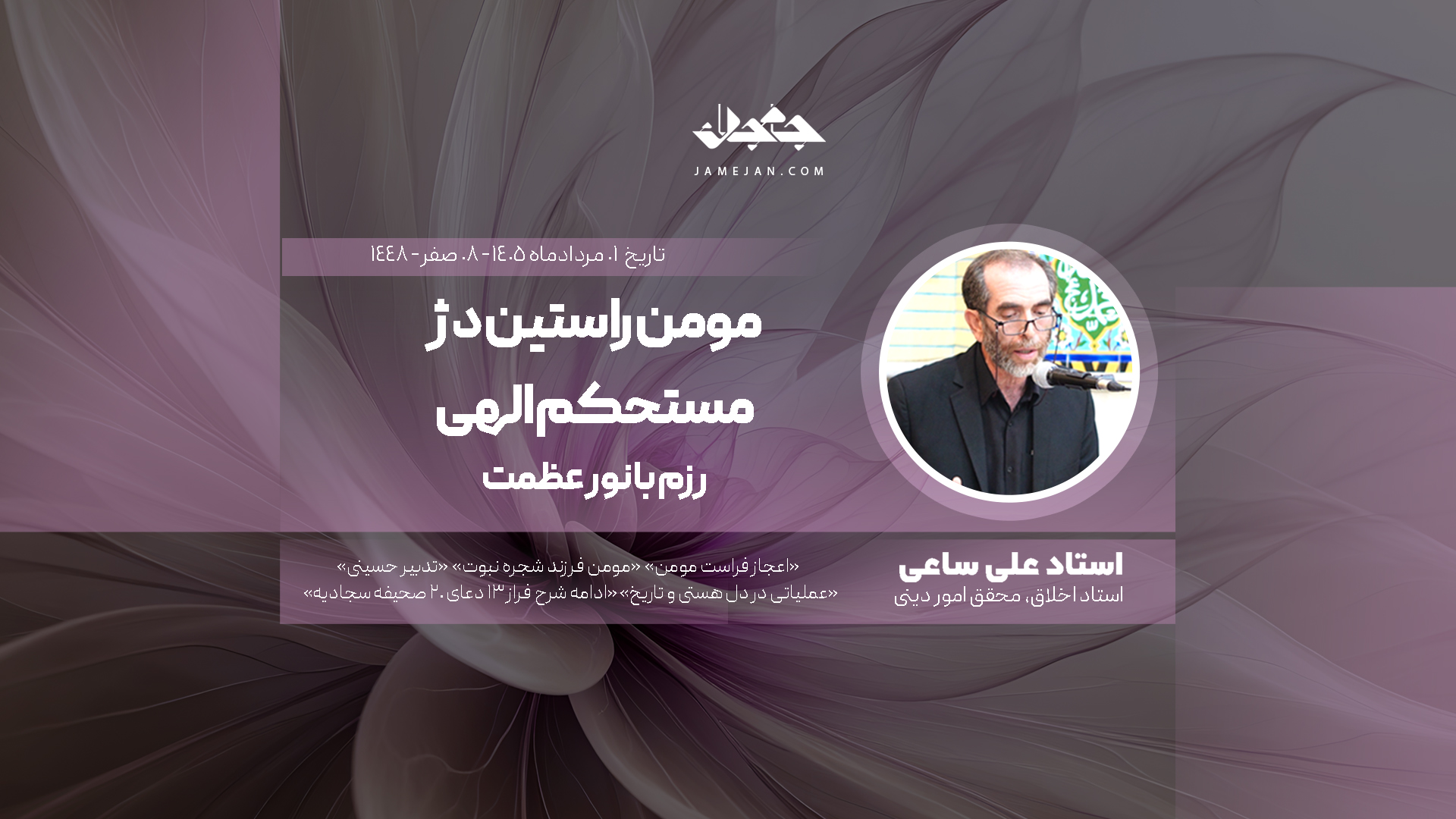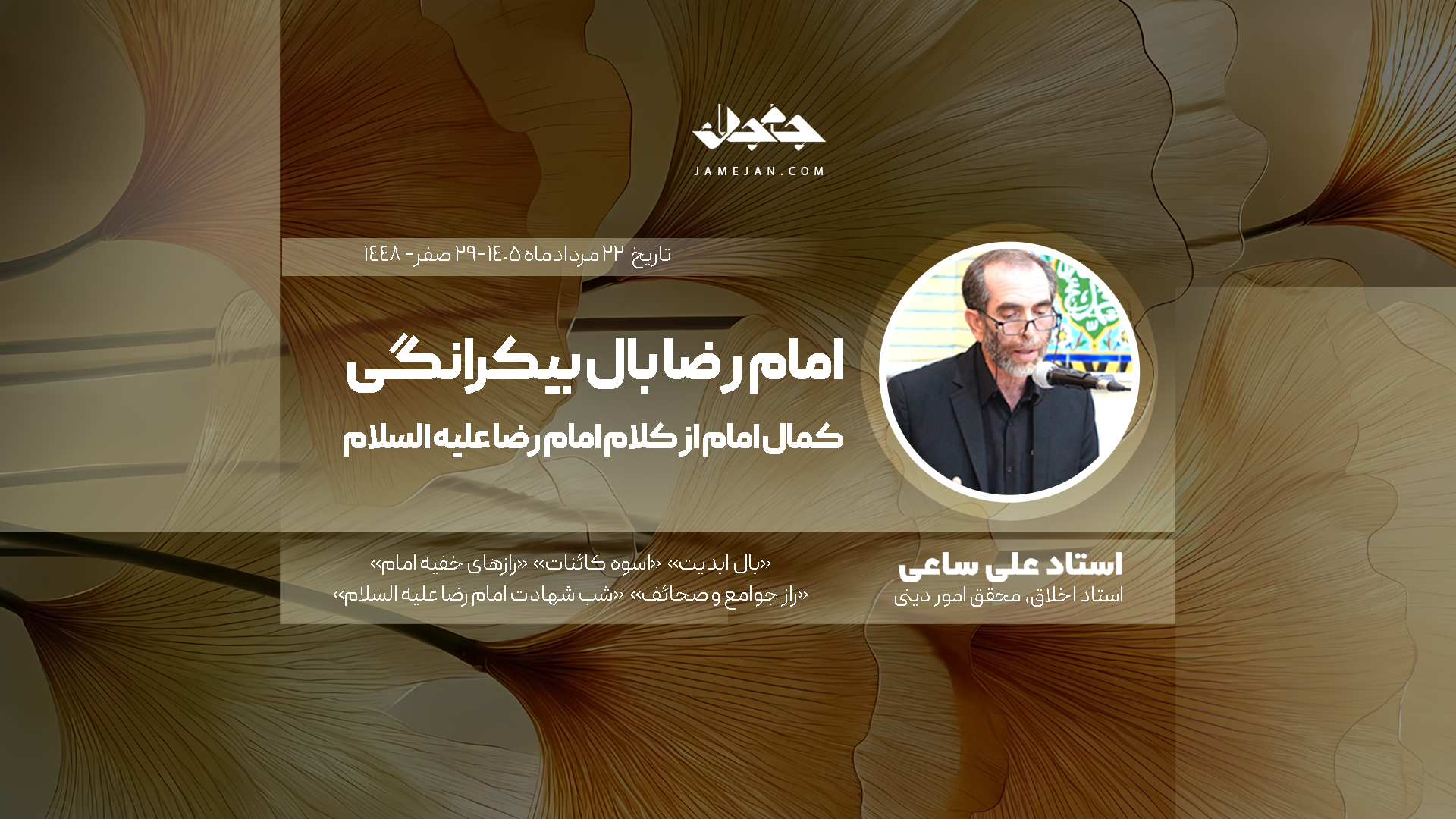
Ahl al-Bayt and Islamic History
Imam Reza: Wings of Eternity
1405/05/22
114
notifications_active Weekly Meshkat-e Noor Session: Thursdays at 20:30 at Haj Reza Mosque
🌻🔆The Beauty of Creation🔆🌻
🌼🔆🌼Queen of the Land of Iran🌼🔆🌼
🔹 The Passing of Lady Fatima al-Ma‘suma (SA)
📅 Date: 1404/07/10 – 10 Rabi al-Thani 1447
✨ Session: Meshkat-e Noor
🎤 Speaker: Master Ali Saei
📝 Some topics discussed in the session:
🕯 The Night of the Martyrdom of the Fragrant Flower of al-Zahra
On the night of the martyrdom of the fragrant flower of al-Zahra, we offer our condolences to the celestial realm, accompanied by blessings upon Muhammad and the family of Muhammad. Fatima al-Ma‘suma, the fragrant flower of al-Zahra, her counterpart and likeness; this Lady among women, the sweet fruit of Fatima; the sign of all that is pure, of believing women and of those who guard their faith; Queen of Iran, Maryam of the family of Muhammad (PBUH), the noble lady of the Household (AS). The garden of holiness, the attraction of heaven and earth, radiant with light; wise, a lady of wisdom, the highest embodiment of purity, beauty and freshness; the illustrious, noble and pure Sayyida, Fatima, daughter of Musa ibn Ja‘far (AS).
Pilgrimage means finding a role model, reaching the very source of that example. To accept the invitation to visit Fatima al-Ma‘suma is to go to her and learn from her. We want to keep her banner flying and proclaim to the world that all women should become like her, so that this world and the next may flourish in the light of this verse of God’s beauty. Fatima al-Ma‘suma is truly the sweet smile of Paradise: when she smiles, all existence becomes Paradise. Fatima al-Ma‘suma, queen of the beehive of piety, the beauty of creation—truly, from the pure soul of Fatima al-Ma‘suma, who is God’s garden of Paradise. The garden of Paradise that is Ma‘suma is where God’s special grace reaches all humanity. Qom, her blessed shrine, is where God’s mercies flow from earth to heaven.
This is the sublime truth of womanhood: a pure, chaste, noble, learned and wise woman is God’s garden of Paradise, His own special garden. Indeed, woman has both an outward and an inward dimension. The womb God has planted within a woman’s being also has an outward and an inward dimension: woman is the place where God sows His seed. God tends a garden in her soul—this is His sign of beauty.
Yes, by God, woman bears children of light, children of the celestial realm. Every woman possesses this blessed womb; it is a heavenly womb, in which God brings all His beauties to fruition. What is the secret of becoming Ma‘suma? How does one become Ma‘suma, God’s garden of Paradise? The only way is vigilance and the refinement of the soul. If a person becomes their own school, they can become a university for all humanity. If they attend to themselves, reach their own soul and preserve its purity, they become nourishment for the world, a university for all creation.
So let us preserve our own dignity. If we safeguard within ourselves the sanctity of God, we too become a sanctuary of God. Fatima al-Ma‘suma is that very sanctuary of God, having guarded His sanctity to the highest degree. She became a sanctuary of God, a place of pilgrimage for those on earth and in heaven.
If a person protects the jewel of their soul, they increase the worth of their being. We must polish the self; we must turn the coal of the soul into a diamond of servitude to God. We are all keepers of God’s trust. Wealth and beauty are among the special trusts He has placed in our care. Some are faithful guardians, while others have signed themselves up as custodians, yet betrayed God’s trusts.
Every sense is a trust from God; each sense is a gateway from within us to the outside world. How can we transcend ourselves and expand? God created senses within us that enable us to connect with what lies beyond our being. A gateway has been opened in our souls onto the outer world, so that our being—our own land of existence—may expand.
Whoever guarded those gates saw the domain of their being—the gates themselves—expand; whoever betrayed that trust was consumed and destroyed. Yes, every chaste woman is a “sanctuary,” a sanctuary of God; the sacred precinct of God’s sanctuary must be protected. A woman who does not uphold the sanctity of this sanctuary—by God—is a woman who sets her own sanctuary ablaze; that is, she sets God’s sanctuary on fire through ingratitude, immodesty and shamelessness. That pure sanctuary catches fire and burns—the sanctuary of God that could have reached such great heights! So we must safeguard God’s trusts at every level and in every form; we must protect our own being, the sanctuaries of God. Each of us is a sanctuary of God. If we uphold our own sanctity—that is, the sanctuary of God—we become a sanctuary at His threshold.
Beware this lower self—the self that lies dormant within the soul—that reduces us to ashes. Yes, this is a special test: God placed this self within us so that we might rise to a higher station, so that we might train it, turn earth into heaven, and transform poison into an antidote. Bitter nectar becomes pure honey. God has planted its secret and mystery within our souls and shown us the way. So we must treat our lower self as both suspect and mad. When we entered this world, our experiences of the spiritual realm were, for a wise purpose, veiled from us, so that we might attain new experiences. God placed the lower self within me so that I might reform and train it, and spread my wings. I descended from the spiritual realm to this earthly world so that, after training this self, I might return to that realm and, with a broader world to encompass, soar to the heights of servitude to God.
So we must treat this lower self and its desires as both suspect and mad. We must be utterly strict with it; never leave it to its own devices. We must call it to account at every moment, examine it, keep watch on it. If I let it go, it turns wild; it drags me down every alley, pulls me from the heights to the lowest depths, casts me down and brings about my ruin.
Every sin, then, is bound up with appetite—that is, appetite ungoverned by reason. Appetite guided by reason becomes one of the delights of creation; but appetite that breaks free of reason and becomes the companion of ignorance is ever joined to disobedience to God. May God have mercy, then, on those who keep themselves distant from this appetite—that is, from this lower self—and suppress its desires, bring them low and humble them. This self is so insidious that it is hard to escape; harder still is it for a person to distance themselves from this lower self, from its desires. Once a person becomes captive to those desires, they will continually be drawn toward sin. We must therefore train this self so that we may attain the heights of glory, beauty and majesty.
When a person has trained their lower self and brought it to the heights of dignity, no deviation can then take hold of them. Once its desires have been disciplined, no sin can penetrate their soul. This lower self—its desires—must be brought down and subdued. We should honor it only when it calls us to obey God, not to disobey Him. When it calls us to sin, it is the base desire that has overcome my heart, allied itself with ignorance, and seeks to cast me into the depths of humiliation, imprison me and make me the lowest of the low.
Whoever indulges their own desires will, in return, be dragged by them to the utmost disgrace and humiliation. So we must not embrace our desires; we must overcome them. The best thing we can do for these very desires is to humble them, cast them down, and keep them hungry and thirsty until they are disciplined.
When a person disciplines the self and raises it to a state of nobility, giving generously in God’s way becomes easy; obedience to God becomes a joy; the heart’s desire for intimate communion with God awakens; love of the Qur’an and the Ahl al-Bayt begins to beat within. Whoever raises the self to the highest purity, honours it—bestowing dignity upon it, nurturing it, elevating it—will no longer debase and humiliate themselves through disobedience. They will be freed from every form of abasement. A person of noble stature is the guardian of God’s treasures. Every human being is entrusted with such treasures—within themselves and across the horizons—and has a duty to guard them: the Qur’an and the Ahl al-Bayt; the signs in the world and within the self; nature; oneself and other people; and all the feelings within one’s soul. Feelings and sensations—all of them—are treasures within a person. Through one sense, through the human eye, they are brought into the light so that a scene may be seen. Should not God’s signs draw us nearer to Him? If we are not their guardians, those very signs will cast us down to earth. If we do not guard our sensations, we will be brought low. The path of our feelings must run along the road of reason; if it follows the road of ignorance, it will expose us to disgrace and lead us to ruin.
Indeed, a pure society is known by its pure women. Who—or what—is a woman? What sign of God’s signs is she? Is she that blessed land? Yes: a pure city, a pure land, pure soil, whose plants and growth spring forth by the command of its Lord. But from soil that has been corrupted, nothing but something worthless and meagre emerges; nothing takes root. Indeed, the pure woman is like that pure land—pure soil. God makes every beauty grow in that soil; from it He brings forth and reveals His majesty. God makes the pure woman a tablet upon which the majesty of His beauty and grandeur is displayed. But once she is corrupted, nothing more will be seen upon that tablet. What could flow forth from a foul land?
The gardener of this land is God, the All-Wise, the All-Knowing, who knows what He will do with this pure land. What becomes of a person if they guard the land of their soul? And if they become captive to the self—to its desires—into what dark straits will they be confined? The Commander of the Faithful, Imam Ali, describes the mechanism of deviation in these words. Advising Muawiya, he says: “Indeed, your self…” What exalted words! “Indeed, your self has made you plunge into evil.” What has it done? What does this self do? The Imam says it has made you plunge—it has drawn you down—into the heart of evil. The human self plunges a person into the heart of evil. The Imam uses the word “ilāj,” from the word “wulūj.” What secret does this hold? It is as though a person cannot enter evil and become its companion; it is not possible for a person to be joined to evil, vice and baseness. Yet the self is so adept that, with force and pressure, it squeezes this greater world into a narrow, dark place. These are the words of the Commander, master of eloquence. What remarkable words he speaks! I have not been able to do justice to them.
This self has dragged you by force and pressure into evil—plunged you into it—and then, swiftly and relentlessly, driven you into rebellion and misguidance. That is, once it has forced a person into evil through effort and pressure, it moves at full speed to incite them to rebellion and lead them astray; it throws them flat on their back and pins them with a wrestling hold. It will not let go: first it draws them into evil, then lays them low. It leads you into “perils.” “Wurūd” means arriving at a watering place; to reach the water is to “wurūd.” That is, the self acts so as to bring you to utter ruin. It treats you as though it were quenching a thirst and bringing you to water—as though you were about to reach the water of life, about to attain indescribable pleasure. That is how it draws you into peril. Will it let go? No. Then it will destroy every place of return—the bridges behind you—so that you cannot flee. Can we find a way to escape? It will destroy everything behind you and make the way back impossibly hard. It will make it seem as though there is no way back, and cause you to forget repentance.
So what should we do? Take our own selves to account. Seize the self by the collar and reckon with it. Yes, a believing woman—if a believing woman is “red sulphur,” or even more precious than that, then she stands above a believing man. Such is the rank of Maʿṣūma. By this account, where does Fāṭimah Maʿṣūma stand in the realm of distinction? A believing woman is more precious than a believing man: more valuable, a rarer jewel. And a believer is more precious than red sulphur. Red sulphur… has anyone ever found it? What is red sulphur, anyway? Is it Yemeni agate? Without doubt, red sulphur is purer and more precious than diamond. If a believing man is so rare, a believing woman is higher still. And such is Maʿṣūma: what horizon of majesty and greatness does she stand upon? A pure woman is a peerless jewel, superior to every other jewel, without equal. In the constellation of faith, a woman’s station is lofty and worthy of praise.
The greatness of a believing woman is defined solely through “righteous deeds.” Islam grants women a fullness of dignity. Her station is such that she nurtures human beings—worlds, lives and all that lives. She cultivates love and compassion and brings peace to society. When a woman is pure, God’s knowledge rains down upon the earth from the highest horizon. Through her purity, the world becomes more honoured and matchless than the heavens. God plants the whole sky upon the earth—sows all beauty in a woman’s soul. This is the greatness of womanhood.
A pure woman is a safe ground for the growth of knowledge. If a woman becomes impure, knowledge is burned up; the rain of knowledge ceases, and the world is afflicted by intellectual famine. If a woman becomes impure, the human race—by God—will become extinct. And, indeed, if this end-times condition continues, humanity will be brought down, unless our master, the Supreme Baqiyyatullah, lets his blessed light shine and restores woman’s greatness to her. Woman has fled from her own greatness; she has run from her purity, turned away from the sanctuary, from this lofty and wondrous distinction. Alas, women today flee from beauty, unaware of the beauty, greatness and glory that come from turning to God. The modern woman begs for the attention of poisoned hearts; in other words, she wants to destroy herself. By God, what can a single glance from God do? It turns the whole universe toward that very woman. By God, He makes the pure woman the Kaʿbah of His attention, and bestows upon her more than she already possesses. So we must honour a woman’s worth and station. Her dignity is a precious jewel; we must guard it.
A pure woman is a sign of God’s beauty; an impure woman, God’s signs burned away. The shrine of Fāṭimah Maʿṣūma is a place of healing, a hospital for the universe, where our pain—our wounded souls—may be healed.
The Master, Amīr al-Muʾminīn, relates from the Messenger of God (PBUH) that the Prophet said: “When I ascended to the fourth heaven on the Night of the Miʿrāj, I looked and saw a dome of pearl. I gazed down toward the earth and, from the fourth heaven, saw a dome made of a unique pearl, resting on four distinctive pillars, with four gates of green brocade. I said, ‘O Gabriel, what is this dome? I have seen no dome in the fourth heaven more beautiful than this. What is this dome, more beautiful than every other dome in the fourth heaven?’ The noble Gabriel replied, ‘O my beloved Muhammad, this dome you see is a city called Qom.’”
With this noble hadith, I want to show the greatness of Fāṭimah Maʿṣūma. Why did she set foot in Qom? What wondrous deed did she perform, that her glory had ascended above the fourth heaven even before then? It is a place where believing servants gather, awaiting Muhammad—they await him; the wording is brief, and I do not know whether it refers to the Messenger of God. It seems to refer to one who shares the Messenger’s name: our master, the Supreme Baqiyyatullah—may my soul be his ransom. They wait for Muhammad and seek his intercession on the Day of Resurrection. For the people of Qom—that is, the people of Iran—sorrow and grief will come; hardships will rain down upon them. The narrator says: “I asked Muhammad al-ʿAskarī, ‘When will the time of joy and relief come to an end?’” “When water appears upon the earth.” In other words, Fāṭimah Maʿṣūma has established, in the heart of Iran, the special command centre of our Imam of the Age. At that time, she knew what she was doing: Fāṭimah had made Iran the supreme base of the Supreme Imam. Fāṭimah Maʿṣūma is the architect of the foundation of expectation. In this world of being, this great ray of light and grace from Fāṭimah al-Zahrāʾ (SA) inscribed a golden design, befitting her own unique rank and station.
A researcher specializing in religious studies and divine unity, with a particular focus on the Qur’an and Hadith (the Two Weighty Things). His research has centered primarily on the Qur’an and Hadith; in recent years, he has also explored divine unity and critiques of philosophical viewpoints.
If any part of this response is unclear, please submit your question so it may be addressed by the teacher after review.
No inquiries have been recorded regarding this response yet. Your perspective or question will be the first.
Research and Thematic Guidance within the Intellectual Framework and Inquiries of the Meshkat-e Noor School
Follow the latest Meshkat-e Noor sessions