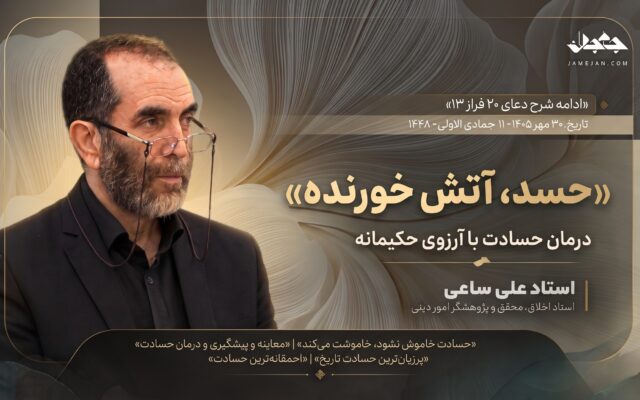
Written transcript of the lecture
The Meshkat-e Noor teachings series🌻🔆🔆🌻
🌼🔆🌼Learning Forbearance🌼🔆🌼
🔹Weekly sessions on the commentary and interpretation of *al-Sahifa al-Sajjadiyya* (Supplication 20)
📅 Date: 1404/07/17 — 17 Rabiʿ al-Thani 1447
✨ Session: Meshkat-e Noor
🎤 Speaker: Master Ali Saei
📝 Some points discussed in the session:
( 8 ) اللَّهُمَّ صَلِّ عَلَى مُحَمَّدٍ وَ آلِهِ ، وَ اجْعَلْ لِي يَداً عَلَى مَنْ ظَلَمَنِي ، وَ لِسَاناً عَلَى مَنْ خَاصَمَنِي ، وَ ظَفَراً بِمَنْ عَانَدَنِي ، وَ هَبْ لِي مَكْراً عَلَى مَنْ كَايَدَنِي ، وَ قُدْرَةً عَلَى مَنِ اضْطَهَدَنِي ، وَ تَكْذِيباً لِمَنْ قَصَبَنِي ، وَ سَلَامَةً مِمَّنْ تَوَعَّدَنِي ، وَ وَفِّقْنِي لِطَاعَةِ مَنْ سَدَّدَنِي ، وَ مُتَابَعَةِ مَنْ أَرْشَدَنِي
📜 “O God, bless Muhammad and his family.”
O God, bless Muhammad and his family, and enable me to respond with goodwill to the one who betrayed me; to repay with kindness the one who abandoned me; to reward with generosity the one who deprived me; and to restore ties with the one who severed them. Let me answer the one who disparaged me in my absence by speaking well of him; then let me give thanks for good deeds and overlook wrongs.
Imam Sajjad—the Imam of the Throne, the Imam of the Footstool, the Lote Tree of the Utmost Boundary—governs the whole universe from that highest height: through the language of his heart, his whispering prayers, his intimate supplications and his calls, he governs all of existence. He rules over hearts; from those lofty heights, he brings the human spirit into balance.
This is the Imam of the Throne, the Imam of the Footstool. He lets human beings drink deeply of forbearance. With hands outstretched in supplication to the Exalted Lord, he breathes the very spirit of forbearance into eager hearts. Yes, this is a teaching in forbearance: these blessed passages are schools—universities of forbearance.
Whoever enters these blessed passages of *al-Sahifa al-Sajjadiyya* hears and tastes forbearance, understands and feels it with heart and soul, and breathes its spirit into their own being. The way has been shown to us by the Imam. We need only reach out to him to become people of forbearance, able to safeguard our knowledge, so that our being may well up with knowledge from God. These blessed passages are universities of forbearance.
👑 “The Minister of Faith: Forbearance and Gentleness”
Faith needs a minister, and the best minister of faith is knowledge. The best minister of knowledge is forbearance; the best minister of forbearance is gentleness—and how beautiful gentleness is: tender and soft. For gentleness, patience and kindness make even better ministers.
The Noble Messenger of God (PBUH) teaches us the grandeur of knowledge, faith, forbearance, gentleness and kindness. Indeed, at the height of one’s power—at the height of one’s authority, ability and knowledge, not in weakness, humiliation or ignorance—a person shows forbearance, softens towards others and deals with them patiently. This is a profound friendship with all of existence. The forbearing person is someone who seeks to set the whole world right through their character; they have begun by cultivating a profound friendship with themselves.
If a person is a mine of knowledge but lacks forbearance, that mine will be destroyed and set ablaze. But the one who has acquired forbearance—that is, who has befriended themselves—then befriends society, and ultimately all of existence. Such a person is a spirit of gentleness, a source of comfort to the world, bringing it tranquillity and rescuing it from savagery.
Without forbearance, a person becomes worse than the most poisonous creatures: both venomous and predatory, with such a savage nature that even animals seem meek beside them. Yes, forbearance is a kind of harnessing: the forbearing person rises to engage all the forces of the world—not for revenge, but for the sake of reform. At the height of their power, they exercise patience in order to bring about change, and to bring all the forces of the world into the service of worshipping God.
A forbearing person turns coal into diamond—that is the work of the forbearing. They extract gold from refuse; they do not leave waste and rubbish to lie as it is. Through their character, they perform miracles.
Yes, the minister of faith is forbearance. If faith is to be strengthened, it must exercise itself through knowledge and show its strength and power. If knowledge is to grow strong, it must be accompanied by forbearance: knowledge shows its strength through forbearance, and its immense energy is brought to light through it. It is the forbearing person—the forbearing scholar—who can work wonders in this world through their forbearance, bringing forth such originality and innovation as to amaze both eyes and hearts.
Through patience and gentleness, forbearance grows strong, capable and steadfast. And if gentleness is to grow strong, it must become soft and tender, so that it can reach the greatest heights. Thus forbearance brings knowledge’s capacities to light and displays it in all its dimensions. Forbearance is the key to unlocking knowledge; knowledge’s “nuclear energy” is released only through forbearance. The nuclear energy within our bodies and souls, our intellect and our noble qualities, depends on forbearance.
For those seeking powers beyond the ordinary, the way—the gateway—is forbearance. If we pass through this gate, we will attain that limitless power. Forbearance is what takes the life out of ignorance. Without forbearance, it is ignorance that will take a person’s life.
The Messenger of God (PBUH) said: If a person lacks three qualities, their deeds will not stand firm; they will never attain steadfastness. Deeds endure and grow strong only in those adorned with these three qualities. A person must possess *waraʿ*, so that it keeps them away from disobeying God. *Waraʿ* means fleeing from sin: possessing the strength and power to run from it. This disposition keeps a person away from disobedience to God. The second quality is a character that enables one to deal patiently with people. The third is forbearance, which enables one to ward off the ignorance of the ignorant.
Here is the key: if we want our deeds to be steadfast, magnificent and ever-growing, we must adorn ourselves with these three qualities. If we lack these three virtues, our deeds will wither; whatever we do will collapse and will not endure. The first quality is *waraʿ*—that is, fleeing from sin. The second is discovering the secret of patience with people, and dealing patiently with them. The third is forbearance, which can keep ignorance away from us. Forbearance is what wards off ignorance from a person. Even if someone is learned and knowledgeable, without forbearance, ignorance will kill them.
🛡 “The Fortress of Forbearance Against Ignorance”
How beautifully the Commander of the Faithful (AS) put it: «How many scholars were slain by their own ignorance.» Who were these scholars? Were they not equipped with forbearance? Indeed, they were not people of forbearance. Had they been, they would have overcome their ignorance. Forbearance transforms a person into a garden, into a paradise: a paradise of worship and servitude to God. This is forbearance—a stronghold against ignorance. Indeed, ignorance is so sharp, so penetrating, that it can pierce even the heart of knowledge—unless one is equipped with the shield of forbearance. A person of forbearance defeats ignorance; in the contest between the learned and the ignorant, it is they who prevail. If the learned lack forbearance, how—and with what weapon—are they to overcome the ignorant? Are they to fight with the weapon of knowledge? Without forbearance, it cannot strike home or vanquish the ignorant. But when one is a person of forbearance, one can take the ignorant person’s life. In the contest between the learned and the ignorant, if the learned fail to exercise care and attack the ignorant, they will be defeated. The ignorant must be met with forbearance. When someone wants to escape filth, how do they do it? They do not throw themselves into it; they act so that their clean hem does not become soiled. The learned, too, must be shrewd in this way: they must be forbearing and avoid giving the ignorant an opening to confront them. Indeed, in the contest between the learned and the ignorant, without forbearance, the ignorant prevail. Forbearance is a warm embrace for the wise and a strong shield against the ignorance of the ignorant—a solid barrier against every coating and stain of ignorance, so that the sacred ground of the learned remains unsullied.
⚖️ “Forbearance and the Increase of Honour”
Knowledge is a trade in honour—a trade in rank and glory. People imagine that if they are forbearing—some think that if they show patience—they will be defeated. When they attain power and do not take revenge, they think they have lost. But that is not so. If a person does three things, they may seem to suffer a loss, but inwardly they gain nothing but good. Imam Muhammad al-Baqir, the Baqir of the House of Muhammad, says: “There are three things that add nothing to a Muslim believer but honour.” That is, there are three things that only increase a person’s honour. One is to forgive someone who has wronged you. You could take revenge, twist their ear—you have the power to do so—but instead you let it go. Why? You want to set them right, to reform them; you want to raise the wall of servitude to God, not your own standing. The second quality is to give to someone who has deprived you. You do not lose by doing so, for God, the Mighty, will grant you honour. You show a quality of God’s own; though they have deprived you and you could demand recompense, you give to them instead of taking revenge. This generosity brings you honour from God; He makes you honoured among your people. The third quality is to maintain ties of kinship with someone who has cut ties with you. If you reach out to them, that reconciliation is no deprivation or humiliation—it is pure honour. The more forbearing, humble and generous a person is, the more they maintain family ties, the more God increases their honour. God increases the guidance of those who are already guided. This is God’s way, His law: it does not fail. It flourishes, because God makes it flourish; He brings a person to the summit of honour and strength. So forbearance is a means of increasing honour. It does not diminish a person; rather, it adds to their honour, rank, glory and authority, and raises their station. Why? Because this is what God wills; because He is the One who increases; because the transaction is with Allah.
🧭 “Practising Forbearance: Play the Part”
What should I do if I am not forbearing? What should I do if I cannot be patient? I must “play the part of forbearance.” If I do, it will reach my very soul; God will bring it to me. If a person is seeking a “helper”—someone or something to come to their aid—forbearance is the best helper, because God has planted this “helper” within the human heart. Forbearance is a divine faculty within the human soul; it must be put to use. It lies imprisoned in the heart and must be set free and brought into action. Imam Ja‘far al-Sadiq of the House of Muhammad (AS) said: “If you cannot be forbearing, then make yourself appear forbearing.” If you cannot be patient, practise patience. “Feign illness”? No—“practise forbearance”: act as if you are forbearing; play the part. This is not hypocrisy; it is not something blameworthy. Someone who wants to play the part of a forbearing person and appear forbearing is not being hypocritical; they are practising forbearance, seeking to adorn themselves with a noble quality. Once they begin to act with forbearance, it takes root in their soul and does not depart. Just as knowledge is acquired through learning, forbearance is acquired through practice. We must learn forbearance and lay the groundwork by practising it, so that it may come alive within us—a kind of summoning to submit to the Divine will.
💎 “Modest Forbearance: The Elixir of Divine Love”
Imam Sajjad (AS), that light of God, has something remarkable to say about forbearance—something that makes one exclaim. He says: «همانا آن شخصی که هنگامی که خشمگین میشود، حِلم میورزد، مرا به شگفتی میاندازد؛ یا من چنینم: چقدر آن مردی را که هنگامِ خشم حِلم بورزد دوستش دارم.» In other words, I love him so much that I fall in love with him; I am captivated by him. I marvel at what he does—forbearing even in anger.
So if anyone wishes to become beloved at the court of the Ahl al-Bayt, forbearance is one of the ways. If anyone wishes to dwell in their company, forbearance is the finest opportunity—the best path and guide. Forbearance is a seed of beauty and love that makes a person beloved of those whom God loves. Beyond that, there is God’s own love: God, the All-Knowing and Almighty, loves the forbearing person—He is enamoured of one who is forbearing.
There is one special condition for this love: forbearance must be joined with modesty. «همانا الله عزّوجل دوست میدارد—میدارد—حلیمِ باحیا را.» When someone is modest and, at the same time, forbearing, God falls in love with that person. The blend of modesty and forbearance, then, is the elixir of divine love. Anyone who wishes to traverse the “seven cities of love” in a single step has an open path: simply unite modesty with forbearance and witness the wonders that unfold. Modesty and forbearance are the two wings of divine love, carrying one to God’s threshold. Whoever cultivates both within them comes to dwell in the embrace of divine love.
Forbearance is a mark of divine honour and dignity. These beautiful words are from the Messenger of God, Muhammad al-Mustafa (PBUH): «هرگز خداوند کسی را به خاطرِ نادانی عزیز نگردانیده است»—that is, it is impossible for an ignorant person to attain honour; God will not allow it. And it is impossible for a forbearing person to be brought low and humiliated on account of their forbearance, because God will not allow it. No one has ever been made «خار» on account of patience.
The «عزّتِ ظاهریِ نادانان» is «تسویلِ عزّت» است—اصلاً عزّت ». Anyone who serves ignorant people and acts humbly before them—putting on a show, currying favour, trying to pass off the worthless as valuable—is only pretending. The «عزّتِ ظاهریِ نادانان» is surely «تسویلِ شیطان»: a false image of honour. It puts on the mask of dignity and hides behind it; the fool’s ignorance emerges from behind that mask, exposing, humiliating and degrading them. Only those who thirst for ignorance rush toward that very «تسويل»—a falsehood they have fashioned for themselves out of humiliation and ignorance.
Ignorance is utter abasement; forbearance is utter dignity. Whoever honours an «نادان» is even more «نادان» than that person.
So, at the height of power and authority, let us choose neither passive acquiescence nor silence born of helplessness, but forbearance: a deliberate strategic choice, a modern, civilised and globally relevant strategy. This forbearance is a «ملکهٔ نفسانی»—one that nurtures, brings to bloom and liberates. It is a «سامانه» for governing a society of excellence. It is «استخدامِ تمامِ تواناییها برای خدا». Forbearance makes it possible to move beyond a personal virtue and attain a higher form of power. It is global stature and the secret of distinction.
Forbearance is a «سلاحِ راهبردی» against ignorance: an effective, prevailing weapon—even on the terrain of knowledge. It is «معجزهگر». Forbearance is an effective defence against the stratagems of ignorance; and «تَحَلُّم» means «تعلیمِ راهبردیِ حِلم»—in other words, cultivating forbearance.
Now for the outcome of this session: a few strategic, practical lessons. What should we do? We have understood forbearance; now what? We must let it make us a «قلعهٔ محکم» and help us attain «اقتدارِ درونی». How? Stand against oppression; be resolute in pursuing justice; do not be «مظلوم»; break the oppressor’s tyranny along with the oppressor—but once it is broken, remain forbearing at the height of our strength and uphold justice.
What else should we do? Give our tongues the strength to defend the truth; overcome our enemies with authority—with dignity, strength and a spirit of reconciliation, not out of personal revenge. Challenge others’ views with divinely guided wisdom; remember God and keep His pleasure in mind.
What else? Be «قاطع و قدرتمند» in the face of every oppressor. Discredit lies through clarification; have the strength to defeat them; and make ourselves safe from threats.
🌿 «The Foundations of Spiritual Wayfaring and Good Action»
In these lessons, we have learned that a person can become an “inner paradise” for all humanity—someone of exalted character. Here are a few of its secrets: at the height of power, honour, strength and knowledge, to wish others well in the face of betrayal; to do good to someone who has abandoned you; to give to someone who has deprived you; to reconnect with someone who has cut ties with you; to speak well of someone who has found fault with you; to be “grateful for kindnesses”; and to overlook “wrongdoing.” We can now lay a few foundations for our spiritual wayfaring: be generous like abundant rain, showering everyone; each person will receive from us what they deserve. At the height of power, be “humble” and “forgiving”; answer wrongs with “goodness”—always take the initiative. Let others’ mistakes pass with goodwill. Place your “trust” in God alone, rather than relying on your own strength. Make forbearance and patience your way of life.
🔥 “Self-Mastery and the Social Impact of Ethics”
So how can I struggle against the “Satan within”? I master the “lower self” by going against its wishes—whatever it tells me to do, I do the opposite. I become angry only for God’s sake, and at the right time; and I grow calm only for the sake of His pleasure. I practise patience—I cultivate forbearance—even when true forbearance is hard. How can I influence society? It is enough to work wonders through my “ethics”: to bring “security” and “peace” to society; to overcome “lies” with “truth”; and to establish a practical example of goodness in society.