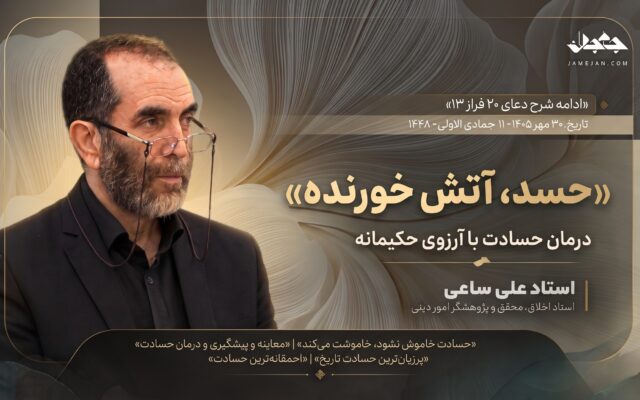
Written transcript of the lecture
The Meshkat-e Noor teachings series🌼🔆🌼The Believer Is Serenity🌼🔆🌼
🔹 Sessions on the Commentary and Exegesis of al-Sahifa al-Sajjadiyya: Supplication 20
📅 Date: 1404/07/03 – 02 Rabi al-Thani 1447
✨ Session: Meshkat-e Noor
🎤 Speaker: Master Ali Saei
📝 Some of the topics discussed in this session:
Passage (9) of the supplication 📜
( 9 ) اللَّهُمَّ صَلِّ عَلَى مُحَمَّدٍ وَ آلِهِ ، وَ سَدِّدْنِي لِأَنْ أُعَارِضَ مَنْ غَشَّنِي بِالنُّصْحِ ، وَ أَجْزِيَ مَنْ هَجَرَنِي بِالْبِرِّ ، وَ أُثِيبَ مَنْ حَرَمَنِي بِالْبَذْلِ ، وَ أُكَافِيَ مَنْ قَطَعَنِي بِالصِّلَةِ ، وَ أُخَالِفَ مَنِ اغْتَابَنِي إِلَى حُسْنِ الذِّكْرِ ، وَ أَنْ أَشْكُرَ الْحَسَنَةَ ، وَ أُغْضِيَ عَنِ السَّيِّئَةِ .
Responding to estrangement and slander with goodness 🤝
O God, grant me the grace to respond with goodwill to those who have betrayed me; to repay with kindness those who have abandoned and cut me off; to reward with generosity those who have deprived me; and to make amends by restoring ties with those who have severed them. Let me speak well of anyone who has found fault with me in my absence, and in this way act contrary to their conduct; let me give thanks for kindnesses and overlook wrongs. In these blessed passages, Imam Sajjad (AS) leads us up to the peaks of forbearance. These passages call to mind the radiant aspect of forbearance. The Imam wishes his followers to be equipped with this noble, exalted quality: forbearance, one of the beautiful attributes of the Almighty Lord. Allah has praised Himself for this noble quality.
Divine praise of forbearance 🌟
Our discussion concerns these blessed passages of al-Sahifa al-Sajjadiyya, in which the Imams show us the path of forbearance—the very forbearance with which Allah has praised Himself. He says: God will not call you to account for your unintentional oaths, but He will call you to account for what your hearts have earned. Allah is Forgiving—He pardons—and Forbearing. In other verses, too, He praises Himself for this noble quality: “وَاللهُ غَنِیٌّ حَلِیمٌ”. Allah is Self-Sufficient and Forbearing; He is without need, and Forbearing. He is at the summit of power; He is absolutely self-sufficient. He has no need even of self-sufficiency; He has no need even to be praised. He describes Himself: Allah is Self-Sufficient, Forbearing; Allah is All-Knowing, Forbearing; Allah is Appreciative, Forbearing. Allah, the Appreciative, is Forbearing. Allah praises Himself for this noble quality of forbearance and adorns His prophets and His saints with it.
Abraham, the one who sighed, and the sovereignty of forbearance 🕯
Abraham was indeed one who sighed again and again; he was forbearing. Abraham would cry, “Ah”—that is, he would invoke God’s name with deep longing; he would call upon Him with fervor, yearning and sighs, and he was forbearing. How beautifully God speaks of Abraham; how beautifully He praises him: once He says … another time He says … He was one who sighed; one who spoke of God; he called upon God with his sighs and turned to Him with his whole being. All of God’s proofs are also forbearing; God has endowed them with forbearance. In this world, the proofs of God are the sovereigns of forbearance. They are forbearing—all of God’s proofs. Our Imam of the Age (AJ) is the sovereign of this era, the Master of the Age; through his forbearance, he shows patience. Were it not for his forbearance, the earth would swallow its inhabitants. Our Imam of the Age is the sovereign of forbearance; all of His followers, too, are forbearing and adorned with forbearance. All the believers in the world have adorned their souls with the inscription of “Forbearing”; all believers are equipped with forbearance. The forbearing person is the serenity of all existence. A true believer is one who has adorned himself with every noble quality, including forbearance. Without forbearance, knowledge and reason depart from a believer’s soul; they flee from it. Without forbearance, all a believer’s virtues are plundered and laid waste. The believer is discerning and has equipped himself with every noble quality; with the shield of forbearance, he protects all his virtues. In the sight of God, the believer is like a near angel.
The superiority of the forbearing believer 👑
A believer, in God’s sight, is like a close angel—or even greater. Yes … Which believer is it who has surpassed the angels? Believers, too, have ranks: the righteous believer, the believer who is like a close angel, and another believer greater still—greater and more honoured. In God’s sight, a believer is greater than a close angel. And there is nothing in all existence dearer to Allah than a man or woman who repents. The story is not over; the sinner is not beyond hope. If they repent—if they repent—they become the dearest being in all existence to God, greater than a close angel. A believer is known in heaven as a man knows his own family and children; and that same believer is more honoured by God than even a close angel. A believer is a garden of good deeds, adorned with every beauty. A believer seeks only God’s pleasure. They do not take revenge; even at the height of their power, they answer evil with goodness. It is precisely this that makes them surpass the angels: they are equipped with the noblest virtues. A believer is a garden of good deeds.
A garden of good deeds, like water that purifies 💧
When a believer wishes to do a good deed, they need only wish for it and form the intention. If they intend it but do not carry it out, God records a good deed for them; and if they do carry it out, He multiplies its reward tenfold. Thus a believer is a garden of good deeds. God seeks an opportunity to cultivate goodness in a believer’s heart, to multiply it, to make the believer His own field of growth. A believer is like water: they bring life and clarity, wash away evil, dispel weariness and sluggishness, and drive away sleep. Whatever is clouded, the believer clears; they bring clarity to hearts. The sincere believer is like water. So, in all your acts of worship, offer the very essence of your soul to Allah Most High with water’s purity. Be like the water that falls from the sky, which Allah has called “ṭahūr”—pure and purifying. Purify your heart with piety and certainty. Just as you cleanse your limbs with pure water when you turn to water, purify your spirit and soul with piety and certainty. Become like water; fall from the sky; be a divine rain, pouring down upon God’s creation and making it flourish.
This is the believer. The believer is forbearing, the stillness of the world, the calm at the heart of all existence. They give souls hope and clarity. The believer is the most advanced and best-equipped being in all existence. They turn to God with every beauty, sign and good deed; adorned in every way, they direct themselves towards the Exalted Lord. The true believer is adorned with every virtue. A believer in the fullest sense is a being who has reached perfection: the sincere, true believer is one who has attained perfection and brought every aspect of their being to its utmost beauty.
A true believer is like a father or mother, a faithful brother to all creation. Like fresh, wholesome water, they quench thirst; they bring clarity and give life. A believer is the guarantor and the steward of society and the world. A believer’s conduct and response are corrective, instructive and constructive; they are never vengeful. They seek only God’s pleasure and act accordingly. A believer masters their anger beautifully and does not expose the faults of others. They hold their tongue: they do not take verbal revenge or sting with their words. They are patient and self-restrained, mindful only of God’s pleasure. They are God’s lamp, shining without pause.
If a person is deprived of forbearance, they become blind. Even knowledge without forbearance is blind, sightless. Knowledge is itself a light, but without forbearance it is blind. So it is with the scholar: a scholar who lacks forbearance is blind and will get nowhere; they will have no power to take flight. It is forbearance that gives them wings.
Forbearance differs from patience. Patience is called for in hardship: when a person seeks to mount the steed of obedience, to remain steadfast in obeying God and flee from disobedience. But the forbearing person makes themselves the very spirit of society; they bring society peace and inspire a spirit of obedience. They help people endure adversity and steer them away from rancour and wrongdoing. A forbearing person is a slayer of ignorance. They do not answer evil with evil. In dealing with others, the forbearing person is equipped with a higher form of stewardship; their conduct in society is exemplary, worthy of remembrance.
The forbearing person’s higher stewardship 🌍
He shapes his conduct in society with consummate grace, exercising a higher order of leadership in social, national, international and interworldly relations. The forbearing person knows no boundaries. Forbearance is the beautiful face of justice, and justice is the most nourishing food for the human soul. Forbearance keeps thought and reason active; it is what awakens the human mind. The dormant, angelic and supra-angelic dimensions of the human being are brought to life through forbearance alone. Without it, the supra-angelic and human faculties lock up, while the animal nature takes over; even a learned person will behave like an ignoramus. A person without forbearance becomes closed off. The forbearing believer transforms society through his forbearance. His conduct strengthens trust in the community and leaves a distinct impression on its soul; he makes society receptive to listening and, in the truest sense, keeps the spirit of light kindled in its heart. Forbearance is the secret of joy; it is the secret of charisma—the secret of individual, social, political, scientific, global and interworldly joy. Forbearance has such power that it conquers without bloodshed: hearts, strongholds, borders, history, geography and the cosmos. Why? Because it is equipped with forbearance and is pleasing to the Most High Lord.
“Forbearance is God’s lamp”—a saying of al-Sadiq (AS) 🕯
O God, what is this forbearance? Explain it to us, so that we may understand. Al-Sadiq of the House of Muhammad (AS) says: “Forbearance is God’s lamp.” One version reads: “Forbearance is the lamp of Allah, by which its possessor finds light along life’s difficult passages.” Another version explains that forbearance is a lamp by which its possessor finds light on the way to nearness to God. In other words, forbearance is the finest lamp for the spiritual journey: it helps one cross life’s rough terrain and reach the station nearest to divine nearness. Forbearance is an extraordinarily effective tool; it makes the unattainable possible. In the truest sense, it is a wing for flight. Every scholar must be equipped with forbearance; it is the minister of knowledge. Without forbearance, a scholar is left without support. With it, the scholar gains a distinctive intellectual capacity: knowledge becomes practical, dignified and effective. Forbearance gives knowledge strength and enables it to bear fruit. Without forbearance, the scholar himself does not benefit from his knowledge; he gains nothing from it and remains in the depths. Whoever seeks to attain that exalted power must blend forbearance with knowledge. Al-Sadiq of the House of Muhammad (AS) says: “Forbearance is God’s lamp, by which the forbearing person attains nearness, companionship and proximity to God.”
How to Attain Forbearance—Five Arenas 🎓
How do we attain this forbearance? What is the way to it? Only one who has acquired knowledge can become forbearing—one adorned with divine oneness. When knowledge and tawhid become part of a person, that person grows forbearing. The truly patient and forbearing are those strengthened and nourished by the light of knowledge, insight and tawhid. Forbearance shines only through knowledge, insight and tawhid. If we want this lamp of God to shine within us, we must equip ourselves with forbearance—and we can do so only through insight and tawhid.
Forbearance unfolds in five forms and circles around four arenas. It is instilled in a person, and its lamp begins to shine, when that person is equipped with knowledge, insight and tawhid, has passed through these four paths, and has endured the trials of five arenas. Only then can one equip oneself with forbearance:
1) When you are powerful and esteemed, you are humiliated. You are respected, yet people insult and belittle you, and still you do not waver. It is hard—by God, it is hard—because this jewel is so precious. Whoever hopes to attain the jewel of forbearance must prevail in these five arenas.
2) Though truthful, you are accused; they call you a liar.
3) When you call people to the truth, they dismiss you and your invitation. You call them to what is right, but they belittle you and your words. Still, you keep calling them to the truth and do not grow weary.
4) You are hurt despite having committed no wrong. They torment and abuse you; they distress you without cause or sin. They break your heart and leave you shaken.
5) The fifth arena: if someone wants to know whether they are forbearing, let them test themselves in these five arenas. When they seek the truth, they are opposed.
These are the five arenas. The Imam says: When you have prevailed in all five, and remain patient in each of these situations, you have found the straight path; you have attained forbearance. What a profound counsel the Imam offers: If you are confronted by an ignorant person, keep away from them; turn aside and pay them no heed. Do not react to the fool; do not answer them—whatever you do, do not respond. This is the truly forbearing person: when confronted by a fool, they turn away. The fool taunts them, but they pay no heed and do not reply. When you act this way, people will become your allies and supporters. That is, when you do not engage with the ignorant person and keep your distance, people will turn to you. For if you engage with a fool, you too will be counted among the foolish. You should overlook foolishness when you can—let it pass—unless you are compelled to respond.
Keeping Away from Fools: The Example of the Earth 🌾
A person does not let themselves be brought down to the level of the ignorant and the foolish. Remarkable! This is a masterful example, offered by the truthful one from the household of Muhammad. The essential counsel of Imam Ja‘far al-Sadiq (AS) is this: Try to keep away from fools. If you wage war against them, it is as though you are adding fuel to the fire of their folly—what a striking example! Whoever engages with a fool only feeds their fire. They cannot defend themselves; instead, they are overcome. Whoever has fought fools has lost—by God—because they become the one who brings fuel to the fire of foolishness. Imam Ja‘far al-Sadiq (AS) relates a hadith from the Prophet (PBUH): The believer is like the earth. Its benefits come from it, while harm is inflicted upon it. It is like the earth that benefits everyone: it grows plants, nurtures flowers, and brings forth fruits, nectar and honey. Yet every kind of harm is visited upon it. Still, it remains steadfast in its faith; it continues to yield and never tires.
Divine Pleasure and Patience in Hardship 🎯
Whoever does not patiently bear people’s wrongs, injustice and hardships will not attain the pleasure of Allah, Exalted is He. It is worth accepting this challenge, for it becomes a wing for flight and carries a person into the presence of God. What a remarkable trial Allah, Exalted is He, has placed before people: He has made His pleasure contingent upon bearing the hardships inflicted by others.
The Mission of the Prophet Centered on Forbearance; Closing Supplication 🕊
The Imam relates another hadith: The Messenger of Allah (PBUH) said, “I was sent as the very embodiment of forbearance; I am its central place. I am the source of knowledge—the source from which knowledge flows—and the abode of patience, a home of tranquillity. True forbearance means overlooking and forgiving someone who has wronged and opposed you, even when you have the power to take revenge.” Imam Jaʿfar al-Sadiq (AS) then offers a beautiful supplication—what a remarkable prayer this is, from al-Sadiq of the House of Muhammad:
الهی …
“O God, Your grace is boundless—vast beyond measure. O God, Your forbearance is immense, greater than all greatness. O God, Your forbearance is so immense that You do not call me to account for my deeds; so immense that You do not disgrace me for my errors. O God …”