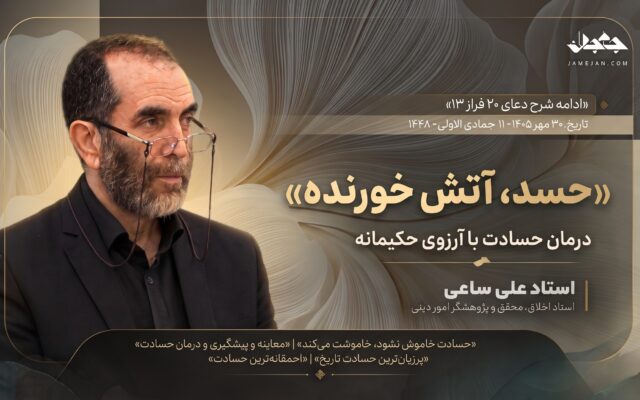
Written transcript of the lecture
The Meshkat-e Noor teachings series🌻🔆Imam Sajjad, Teacher of the Fitrah🔆🌻
🌼🔆🌼An Educational System Grounded in the Fitrah🌼🔆🌼
🌹🔅☘️ بِسْمِ اللَّهِ الرَّحْمنِ الرَّحيمِ ☘️🔅🌹
🔅🌹 “Fitrah-based attention” “Territorial envy” “Istihwādh” “Greed as a lethal weapon” “Continuation of passage 13 of Du‘a 20” and more … Summary with supplement 1404.11.09 Ali Sa‘i (Abdullah Meshkat) 110.141(903) 🌹🔅
❇️A Fitrah-based Reading of Imam Sajjad’s Supplication
💫اللَّهُمَّ اجْعَلْ مَا يُلْقِي الشَّيْطَانُ فِي رُوعِي مِنَ التَّمَنِّي وَ التَّظَنِّي وَ الْحَسَدِ ذِكْراً لِعَظَمَتِكَ، وَ تَفَكُّراً فِي قُدْرَتِكَ، وَ تَدْبِيراً عَلَى عَدُوِّك
🔆“O God! In place of the vain hopes, ill thoughts, and envy that Satan casts into my heart, instil in me the remembrance of Your greatness, reflection on Your power, and a plan to counter Your enemy!
🌸 Keep your fitrah system alight, so that you may partake fully and abundantly of the blessings of Sajjad!
❇️Imam Sajjad’s Educational System Is Grounded in the Fitrah
🌸 The educational system of the Qur’an and the Ahl al-Bayt is grounded in the fitrah and transcendent; it has no rival.
Our world needs an educational and developmental system of the highest order, guided by the fitrah—a system that surpasses all educational and university systems. Has anyone arrived at this way of thinking?!
The fitrah-based absorption of knowledge, wisdom, and technology is the transcendent educational system.
In a fitrah-based educational system, all beings are continually renewed in step with the renewal of existence, moment by moment and day by day.
The fitrah-based educational system is the most subtle of all systems of education and development.
Human beings are attuned to this bodily system through the fitrah, drawing on all their senses; this is how they learn.
How does a child learn?! The speed with which children learn language and behaviour, and develop emotionally and socially, offers a glimpse of an educational system grounded in the fitrah.
The key to benefiting from the transcendent, fitrah-based system of the Qur’an and the Ahl al-Bayt is connection of the heart to the Two Weighty Things. This connection keeps one in constant communion with the Centre, the Creator, and continually renews one in keeping with God’s ever-new manifestation.
❇️Habit, when paired with heedlessness, is a blight on life
Give the Sahifa Sajjadiyya its due!
Take stock of how well you fulfil the Sahifa Sajjadiyya’s due, and put its teachings into practice!
Examine the effects of the cups of pure wine we drink, again and again?!
💫🔆يُغْبَقُونَ كَأْسَ الْحِكْمَةِ بَعْدَ الصَّبُوح[1]
🔆“After drinking the morning wine (sabuh), they drink a cup of wisdom.”
🌸 The spiritual intoxication and soulful delight experienced by God’s friends after drinking cups of the pure wine of the Qur’an and the Ahl al-Bayt, and performing their nightly and daily acts of worship—the very cups of divine wisdom and knowledge they drink with joy—have these found expression in our lives?!
With the Sahifa Sajjadiyya and the mighty legacy of the Ahl al-Bayt before us, how are our states changing?! In our individual, family, social, national, transnational, and cosmic lives, and in our relationship with the Eternal, Everlasting Beloved?!
Be kind to yourself; do not wrong yourself—or anyone else.
Adorn yourself with every noble virtue.
Good character is the sweet fragrance of noble virtues. Do not forget it.
Let husband and wife be mirrors to one another, examining and taking account of themselves; so too should family members and friends do for one another.
❇️The Devoted Servant as Artist
🌸 Once again, read the passages of the Sahifa Sajjadiyya through the lens of the fitrah!
Passage 13 of the Ṣaḥīfa Sajjadiyya reveals countless secrets!
Seek your provision with wisdom; aspire with wisdom. Give your aspirations dignity and composure. Guard against every suspicion, and strive with certainty for the share that comes through servitude to God!
Repeat this often:
💫« لَا يُدْرَكُ شَيْءٌ مِمَّا عِنْدَ اللَّهِ إِلَّا بِطَاعَتِه»
🔆 Whatever is with God can be attained only through obedience to Him.
❇️Greed burns up the Hereafter in pursuit of this world
🌸 Greed merely makes the engine burn oil: all throttle and little work. It only increases the toil and the noise; it does not increase one’s provision. In the end, greed deals a mortal blow to body and soul. For a person, greed is like a weapon that kills its own wielder!
💫رُبَّ حَرِيصٍ قَتَلَهُ حِرْصُهُ
🔆 Perhaps a greedy person was killed by his own greed.
💫قَتَلَ الْحِرْصُ رَاكِبَهُ
🔆 Greed killed its rider.
💫مَنْ حَرَصَ عَلَى الدُّنْيَا هَلَكَ
🔆 Whoever is greedy for this world is ruined.
💫بِئْسَ الرَّفِيقُ الْحِرْص[2]
🔆 How wretched a companion greed is.»
❇️When mixed with other vices, greed drives a person into the fire of sin
💫 وَ الْحِرْصُ وَ الْكِبْرُ وَ الْحَسَدُ دَوَاعٍ إِلَى التَّقَحُّمِ فِي الذُّنُوبِ وَ الشَّرُّ [جَامِعٌ لِمَسَاوِئِ] جَامِعُ مَسَاوِئِ الْعُيُوب[3]
🔆“Greed, pride, and envy are impulses that make one leap into sins (and fall into disobedience); and evil [the gatherer of all ugliness] gathers the worst of flaws.”
🌱 Greed, avarice, and cowardice are born of suspicion and wishful thinking.
❇️Greed is the adornment of vileness
💫وَ لَا تُدْخِلَنَّ فِي مَشُورَتِكَ بَخِيلًا يَعْدِلُ بِكَ عَنِ الْفَضْلِ وَ يَعِدُكَ الْفَقْرَ وَ لَا جَبَاناً يُضْعِفُكَ عَنِ الْأُمُورِ وَ لَا حَرِيصاً يُزَيِّنُ لَكَ الشَّرَهَ بِالْجَوْرِ فَإِنَّ الْبُخْلَ وَ الْجُبْنَ وَ الْحِرْصَ غَرَائِزُ شَتَّى يَجْمَعُهَا سُوءُ الظَّنِّ بِاللَّهِ [شَرُّ] إِنَّ شَرَّ وُزَرَائِكَ مَنْ كَانَ [قَبْلَكَ لِلْأَشْرَارِ] لِلْأَشْرَارِ قَبْلَكَ وَزِيراً وَ مَنْ شَرِكَهُمْ فِي الْآثَام[4]
🔆 “Never include a miser in your counsel: he will keep you from generosity and promise you poverty. Nor a coward, who will weaken your resolve in your affairs; nor a greedy man, who will make evil and covetousness seem fair to you as a pretext for injustice and oppression. For miserliness, cowardice, and greed are different impulses, all brought together by mistrust of God. The worst of your ministers is one who served those before you who were wicked, and shared in their sins.”
🌱 شَرَه makes a person mad and savage, a blind lover of this world who can never have enough. With runaway greed, he will covet anything!
☘️شَرَه:
الشَّرَهُ: أَسْوَأُ الحِرْصِ, and it is overpowering force الحِرْصِ، شَرهَ شَرَهاً فهو شَرهٌ و شَرْهانُ. A شَرهٌ man is شَرْهانُ النفس حَريصٌ. و الشَّرِهُ و الشَّرْهانُ: السريعُ الطَّعْمِ الوَحِيُّ, even if he eats little. One says, “So-and-so شَرِهَ إلى الطعام يَشْرَهُ شَرَهاً إذا اشْتَدَّ حِرْصُه عليه. And سَنة شَرْهاء: مُجْدِبة; according to al-Fārisī. And قولُهم: هَيا. شَراهِيا, meaning, O حيُّ يا قيُّومُ بالعِبْرانِيَّةِ.[5]
☘️شَرَه:
شَرَه is the worst kind of greed (covetousness); it is greed when it has gained mastery and control. The verb شَرَهَ، شَرَهاً means “to be greedy”; the person is then called شَرِه or شَرْهان.
A man described as *shariʿ* is one whose appetite is exceedingly voracious.
*Shariʿ* and *sharhān* mean someone who eats quickly and greedily, even if he eats only a little.
They say, “So-and-so *shariʿa* (sharahan) toward food,” meaning that his craving for it grew intense.
A *sharhāʾ* year (a year of severe drought) is one marked by extreme hunger and little rain; this expression is reported to come from Persian.
Their expression, “هَیَا شَرَاهِیَا,” means in Hebrew: “O Living One, O Sustainer (Qayyūm).”
❇️Territorial envy
🌸 Wishes and suppositions pave the way to envy!
When wishes, suppositions, and envy become partisan, the vile tree of “wishes, suppositions, and envy” takes root; it then enters politics and the strategies of parties, groups, and nations.
Wishes and suppositions are envy’s counterfeit salt! They make envy seem bearable to the envied person, and make it appear alluring and legitimate!
✨Al-Kahf: 104 الَّذينَ ضَلَّ سَعْيُهُمْ فِي الْحَياةِ الدُّنْيا وَ هُمْ يَحْسَبُونَ أَنَّهُمْ يُحْسِنُونَ صُنْعاً
🔆“Those whose efforts in the life of this world have gone astray and come to nothing, yet who imagine that they are doing good!”
Racism is one of the world’s satanic policies. It brings envy into the political arena. Under this policy, everyone imagines their own people to be superior!
When envy enters politics, sinister and covert global policies take shape and are put into operation through particular international programs and secret satanic operations.
Many bloody wars are caused by envy mixed with wishes and suppositions; it also lies behind coveting the resources of wealthy countries.
The reach of these sinister, abhorrent satanic policies extends from health and food to the economy, security, social life, culture, marriage, and more.
Satan operates from within the heart of international organizations.
This supplication from al-Ṣaḥīfa al-Sajjādiyya is a global warning.
❇️Blind wishful thinking is one of Satan’s tools
✨Al-Nisāʾ: 119 وَ لَأُضِلَّنَّهُمْ وَ لَأُمَنِّيَنَّهُمْ وَ لَآمُرَنَّهُمْ فَلَيُبَتِّكُنَّ آذانَ الْأَنْعامِ وَ لَآمُرَنَّهُمْ فَلَيُغَيِّرُنَّ خَلْقَ اللَّهِ وَ مَنْ يَتَّخِذِ الشَّيْطانَ وَلِيًّا مِنْ دُونِ اللَّهِ فَقَدْ خَسِرَ خُسْراناً مُبيناً
🔆“I will surely lead them astray! I will fill them with vain hopes! I will command them to perform superstitious rites and to slit the ears of cattle, and to alter God’s pure creation!” (thereby tainting the innate disposition toward the oneness of God with polytheism.) Whoever takes Satan as a protector instead of God has suffered a manifest loss.
☘️ وَ لَأُضِلَّنَّهُمْ
لَ: the lām of the oath (for emphasis: “I swear”)
أُضِلَّنَّ: an emphatic imperfect verb with the heavy nūn of emphasis, from the root (ض ل ل), first-person singular (“I will most certainly lead astray”)
وَ لَأُمَنِّيَنَّهُمْ
أُمَنِّيَنَّ: an emphatic imperfect verb with the heavy nūn of emphasis, from the root (م ن ی), first-person singular (“I will most certainly fill them with vain hopes and fantasies”)
وَ لَآمُرَنَّهُمْ
آمُرَنَّ: an emphatic imperfect verb with the heavy nūn of emphasis, from the root (أ م ر), first-person singular (“I will most certainly command”)
فَلَيُبَتِّكُنَّ آذانَ الْأَنْعامِ
يُبَتِّكُنَّ: an emphatic imperfect verb with the heavy nūn of emphasis, from the root (ب ت ک), third-person (“they will most certainly slit”)
آذانَ: an accusative direct object, marked by the fatḥa (“ears”)
فَلَيُغَيِّرُنَّ خَلْقَ اللَّهِ
يُغَيِّرُنَّ: an emphatic imperfect verb with the heavy nūn of emphasis, from the root (غ ی ر), third-person (“they will most certainly alter”)
☘️ This verse is part of Satan’s speech, in which, after being cursed, he vows to lead people astray. Its content can be divided into three parts:
1. Satan’s three promises:
Misguidance (إضلال): turning people away from sound beliefs and truths.
Instilling false hopes (تمنی): conjuring up beguiling fantasies and making false promises.
Issuing misleading commands: presenting wrongful acts as desirable. Stirring base, animal appetites and awakening people’s lowly desires in order to obstruct their higher aspirations and concerns.
2. Concrete examples of misguidance (in two parts):
Slitting the ears of livestock: a reference to a superstitious and false pre-Islamic custom, which was considered a form of altering God’s creation. It also points to Satan’s ongoing strategy of perpetuating superstition.
Changing God’s creation: a broad concept that includes any distortion of human nature, religion or ethics, and even impermissible alterations to the human body or the natural world—from genetic, instinctual and behavioural manipulation to other related forms.
3. Conclusion and warning:
Anyone who chooses Satan, rather than God, as their guardian and protector will suffer manifest loss. This loss is both worldly—the decline of moral and social life—and otherworldly—divine punishment. To join Satan’s party is to forfeit human dignity and the exalted rank of humanity.
Beware of Satan’s gradual, calculated temptations.
“Changing God’s creation” may include distorting religion, changing sex, harmful tattoos and any act contrary to human nature.
Following Satan leads only to loss, even if it may seem desirable in the short term.
The phrase «خسراناً مبیناً» shows that this loss is so plain that any person of sound judgment can recognize it.
Seeking to alter and distort human nature is one of Satan’s enduring strategies for destroying humanity’s essential nature.
❇️ Let your heart flourish through communion with God
🌸 Satan seeks to gain control over people through various means and devices. When a person keeps the sweet remembrance of God alive in their heart, they break Satan’s hold and leave him in despair.
Communion with God makes the heart flourish, awakens it and gives it life. Without such communion, the human heart dies; people forget themselves. Once they forget themselves, Satan, the lower self, and all ignorance and its hosts take control and put themselves in their place!
Their true self is forgotten.
✨Al-Mujādilah: 19 اسْتَحْوَذَ عَلَيْهِمُ الشَّيْطانُ فَأَنْساهُمْ ذِكْرَ اللَّهِ أُولئِكَ حِزْبُ الشَّيْطانِ أَلا إِنَّ حِزْبَ الشَّيْطانِ هُمُ الْخاسِرُونَ
🔆Satan has gained mastery over them and made them forget God. They are Satan’s party! Know that Satan’s party are the losers!
✅ Explaining istihwādh
Istihwādh: to drive swiftly, surround, overcome and dominate; to drive forcefully; a camel-driver following behind the camels and driving them harshly and with difficulty.
The worst form of domination is domination of the heart and control over perception and the senses.
Satan is like a donkey that mounts a person by dominating them and brings them under its control.
استحوذ العير على الأتان, “The male donkey overcame and dominated the female donkey.”
استحوذ: to dominate and prevail / العير: male donkey / الأتان: female donkey.
Conceptual translation: “Someone unworthy and unqualified gained control over someone superior to them—or over something important.”
Explanation and interpretation: This proverb is an example of an “extended metaphor” and is used in the following cases:
The unworthy ruling over the worthy: when someone unfit, incapable, or base (symbolised by the male donkey, a figure of vulgarity and lust) gains authority over someone more deserving, wiser, or superior, or over an important position.
A reversal of the natural order: in nature, the male donkey usually seeks the attention and company of the female. In this example, however, the situation is reversed, and the male behaves as though he has mastery over her. This signifies the disruption of order and the improper displacement of one person by another.
Context: This expression is generally used to condemn a situation in which the unworthy have gained control over affairs or over those who are worthy, thereby disrupting the proper order of things.
A human being, the noblest of creatures, becomes subject to the basest of creatures.
✅ Further explanation of istihwādh (الْحَوْذُ)
الْحَوْذُ: أن يتبع السّائق حَاذِيَيِ البعير، أي:
أدبار فخذيه فيعنّف في سوقه، يقال: حَاذَ الإبلَ يَحُوذُهَا، أي: ساقها سوقا عنيفا، و قوله: اسْتَحْوَذَ عَلَيْهِمُ الشَّيْطانُ
[المجادلة/ 19]، استاقهم مستوليا عليهم، أو من قولهم: اسْتَحْوَذَ العير على الأتان، أي: استولى على حَاذَيْهَا، أي: جانبي ظهرها، و يقال:
اسْتَحَاذَ، و هو القياس، و استعارة ذلك كقولهم:
اقتعده الشيطان و ارتكبه، و الْأَحْوَذِيُّ: الخفيف الحاذق بالشيء، من الْحَوْذِ أي: السّوق.[6]
When Satan gains mastery over a person, it is worse than a donkey’s domination of a human being: he mounts him, puts a bridle on him, and drives him wherever he wishes.
1. Parse the sentence: «اقْتَعَدَهُ الشَّیْطَانُ وَ ارْتَكَبَهُ»
2. Parse the sentence: «وَ الْأَحْوَذِیُّ: الْخَفِیفُ الْحَاذِقُ بِالشَّیْءِ، مِنَ الْحَوْذِ أَیْ: السَّوْقِ»
«اقْتَعَدَهُ الشَّیْطَانُ وَ ارْتَكَبَهُ»
“Satan saddled him and mounted him.”
Explanation: «اقتعد» means to sit on something, and is an allusion to complete control and influence; «ارتکب» means to mount something.
«وَ الْأَحْوَذِیُّ: الْخَفِیفُ الْحَاذِقُ بِالشَّیْءِ، مِنَ الْحَوْذِ أَیْ: السَّوْقِ»
“And [the word] اَحوَذِیّ means: a light-footed, agile person, skilled and adept at his work; [the word] derives from the root «حَوْذ», meaning to drive.”
Thus, when Satan gains mastery over a person, that mastery is accompanied by degradation, humiliation, and disgrace.
❇️Satan steals the remembrance of God from the human heart.
🌸 When remembrance of God is stolen from the human heart, all its wealth, resources, and human dignity are plundered!
And when remembrance of God is forgotten, a person comes to forget himself.
✨Al-Hashr: 19 وَ لا تَكُونُوا كَالَّذينَ نَسُوا اللَّهَ فَأَنْساهُمْ أَنْفُسَهُمْ أُولئِكَ هُمُ الْفاسِقُونَ
🔆Do not be like those who forgot God, so He made them forget themselves. They are the defiantly disobedient.
If we forget God, we will be forgotten; in the end, we will be erased.
He does not hasten, but His decree is never revoked: the appointed time He has set is neither advanced nor delayed.
If a human being forgets that he is human, he will then commit every inhuman act. People today behave a hundred times worse than the basest animals.
❇️A small patch of rot is a sign of widespread corruption.
🌸 Let us make our aspirations universal, transcendent, and God-centred!
The human being is connected to all existence.
Through a single illness, the human being can make the whole world sick.
A person who lives only for themselves remains confined within themselves; our vision and aspirations should embrace the whole world.
A self-centred outlook leads people to see everyone as a rival and enemy, and to act against them. This is like cancer in society: when the body’s immune system attacks the body itself, humanity inflicts a wound on the world.
Illness in one part of the body is illness in the whole body.
One person’s illness is an illness of the whole world.
Do not live for yourselves; live for the world, so that you may become one with it. Serve God with your soul and with the world.
A person who destroys their own humanity has done something worse than suicide or killing another: they have destroyed the greater world.
✨Al-Māʾidah: 32 مِنْ أَجْلِ ذلِكَ كَتَبْنا عَلى بَني إِسْرائيلَ أَنَّهُ مَنْ قَتَلَ نَفْساً بِغَيْرِ نَفْسٍ أَوْ فَسادٍ فِي الْأَرْضِ فَكَأَنَّما قَتَلَ النَّاسَ جَميعاً وَ مَنْ أَحْياها فَكَأَنَّما أَحْيَا النَّاسَ جَميعاً وَ لَقَدْ جاءَتْهُمْ رُسُلُنا بِالْبَيِّناتِ ثُمَّ إِنَّ كَثيراً مِنْهُمْ بَعْدَ ذلِكَ فِي الْأَرْضِ لَمُسْرِفُونَ
🔆For this reason, We ordained for the Children of Israel that whoever kills a person—unless in retribution for murder or for spreading corruption in the land—it is as though they had killed all humanity; and whoever saves a life, it is as though they had saved all humanity. Our messengers came to them with clear proofs, yet many of them, even after that, continued to transgress in the land and exceed all bounds.
✨Āl ʿImrān: 200 or أَيُّهَا الَّذينَ آمَنُوا اصْبِرُوا وَ صابِرُوا وَ رابِطُوا وَ اتَّقُوا اللَّهَ لَعَلَّكُمْ تُفْلِحُونَ
🔆O you who believe, be steadfast; stand firm against your enemies; guard your frontiers; and be mindful of God, so that you may prosper.
🌸Be part of the whole; do not live for yourself, and you will become master of the entire world.
🌼Ali Saei (Abdullah Meshkat) 110.141 (903)🌼
❇️ 🌻🔆Imam Sajjad (peace be upon him), Teacher of Human Nature🔆🌻In the frame of a lecture
💫Part One: A Nature-Centred Educational System and the Cognitive System
A nature-centred educational system surpasses every other educational and university system in existence.
With a single inward transformation and an upsurge of love, a person can attain all the knowledge in existence.
Those who, with a pure and sound heart, connect themselves to the vast Sajjadi system benefit from an astonishing speed of learning.
This educational system is constantly renewed and updated from moment to moment.
Until we equip our inner educational system with this framework, we will not attain pure and distinctive knowledge.
We become learned when we can establish nature-centred education within our own souls.
This is the most subtle system of education and cultivation in existence.
We must gain mastery over our bodily system and make the best possible use of it.
Through innate knowledge, we have mastery over our visual, auditory and sensory systems.
If we can discover this innate knowledge, then just as we have mastery over our bodies, we will have mastery over all of existence.
Connecting to the City of Knowledge and the system of human nature enables us to benefit from the immense blessing of nature-centred education.
💫Part Two: How Learning Works and the Role of Connecting to the Two Weighty Things
An infant learns language at an incredible speed and forges a strong bond with society.
This shows that the child benefits from the educational system of human nature.
If we had the innocence of that child, we could learn all the knowledge in existence just as swiftly.
The quickest and easiest path to knowledge is to connect the heart to the system of the Two Weighty Things—the Qur’an and the Prophet’s Household.
This connection links us to the exalted educational system of human nature, allowing knowledge to flow directly into the soul.
In every passage, Imam Sajjad (AS) weaves a bond between us, the unseen realm, and our innate nature.
He teaches the inner truths directly to our souls so that we may prevail in the contest with Satan.
Imam Sajjad (AS) turns Satan’s designs on their head, elevating human beings from creatures of earth to beings of the heavens.
Through desires, delusions, and envy, Satan seeks to take control of our faculty of perception.
Drawing on the teachings of Imam Sajjad, we can turn the very path along which Satan attacks us into a flight toward remembrance of God’s greatness.
💫Part Three: The Resilient Economy and the Psychology of Livelihood
We have learned that we should feel no anxiety about our livelihood.
We must believe that God apportions sustenance, and that ours has already been decreed and allotted.
In seeking our livelihood, we should be measured, striving with skill and grace, and only as much as is necessary.
Striving beyond what we need is forbidden and will not bring us any greater provision.
Seeking sustenance with skill and restraint both brings blessing and allows us to benefit from God’s grace and generosity.
According to a Prophetic hadith, whatever is with God can be obtained only through obedience to Him.
We must therefore free ourselves from blind desires and groundless suspicions, and set ourselves on the path of obedience to God.
Desires and groundless suspicions inevitably lead a person toward envy.
Together, these three baleful forces—desire, suspicion, and envy—draw people into mistrust, away from the truth, and into bondage to the world.
Greed and covetousness quicken a person’s pace without bringing greater results, leaving them exhausted.
Greed becomes a deadly weapon against a person, burning away their afterlife at the brazier of this world.
💫Part Four: Diagnosing the Harm of Moral Vices (Greed, Miserliness, Envy)
The Commander of the Faithful (AS) said: “Whoever rides greed will be killed by the very thing he rides.”
Greed deprives people of both this world and the next, leaving them in loss.
When greed, arrogance, and envy converge, they drive people toward sin without regard for the consequences.
One should not seek advice from a miser, for by warning of poverty, he cuts off the hand of generosity.
One should not seek advice from a coward, for he weakens one’s resolve to act.
One should not seek advice from a greedy person, for he makes injustice and oppression seem acceptable when pursuing worldly gain.
“Insatiability” means an intense appetite—a state in which the more a person eats, the hungrier they become.
An insatiable person piles wealth upon wealth and gives nothing away.
When miserliness, fear, and greed come together, a person begins to think ill of God.
These three instincts manifest themselves in desires and groundless suspicions, exposing people to irreparable harm.
💫Part Five: Satan’s Domination and the Alteration of Human Nature
Satan has sworn to lead human beings astray and draw them toward futile desires.
Satan intends to command them to slit the ears of livestock and alter God’s creation.
This alteration includes genetic and behavioral change, the distortion of God’s religion, and efforts to divert people from their innate nature.
Satan’s domination does not mean outward control, but rather a hidden, spiritual hold.
Satan mounts a person, puts a bridle on them, and drives them toward sin.
It is a profound disgrace when an inferior being overpowers and colonises a superior one.
The consequence of this domination is that one forgets the remembrance of God and becomes part of Satan’s party.
When a person forgets God, they forget themselves as well, and fall into sin.
In this state, human dignity and the divine breath are forgotten, and the human being becomes lower than the animals.
💫Section Six: The Ultimate Remedy and a Monotheistic Worldview
Wishes and fantasies become the salt of envy, making it seem appealing.
The envious person’s efforts are wasted in this world, yet they take pride in their own misdeeds.
The way to salvation is to devote oneself to communion with God, so that the heart may come alive and awaken.
Without remembrance of God, the heart dies and a person’s humanity is extinguished.
A person should not look only at themselves; they should see themselves as a world.
A person should be a source of healing for the universe, not its affliction.
Escaping from vain desires frees a person from the bounds of limitation and makes them universal.
Through their humanity, a person is the whole universe; if their humanity dies, their greater world is destroyed.
To kill the human spirit is tantamount to killing the entire universe.
We have come into this world to journey alongside all creation and steer the vessel of growth towards transcendence.
🌼Ali Saei (Abdullah Meshkat) 110.141(903)🌼
❇️ “A Spiritual Manifesto”
A Call to Awaken and Reconsider Our Way of Life
The idea of a “nature-centred educational system” comes to life through connection with the source of revelation—the Qur’an and the Ahl al-Bayt. This perspective holds that true learning is “drinking knowledge into one’s soul,” not merely acquiring information.
“Istihwādh” (domination):
“Istihwādh”—the lowest of beings dominating the noblest of creatures and changing human nature—is an existential and innate deviation
A precise blueprint for a “nature-centred educational system”
has been drawn up. Below, I offer my critique and reflections within the text, in the form of key points:
“Istihwādh,” likened to a donkey dominating a female donkey (or vice versa), paints a painful picture of the human condition when remembrance of God has been forgotten.
Istihwādh means “Satan violently driving a person,”
showing that without remembrance of God, a person loses control of their own being and becomes an instrument in the hands of base forces.
“Forgetting God” and “forgetting oneself” (which leads to sin).
In literary and mystical language, the text conveys a highly practical and strategic message: returning to our “innate nature” is the only way to escape the clutches of satanic “wishes and fantasies.”
🌻🔆 Expansion and Further Reflections: A Nature-Centred Educational System and the Return to the Self 🔆🌻
🔅 Introduction: The Need to Move Beyond “Imitation” Towards “Innate Nature” 🔅
Today’s world is awash with information and fast-paced yet soulless educational systems. Modern people have learned “how” to be, but have forgotten “who” to be. Imam Sajjad’s (AS) educational system, embodied in the Ṣaḥīfa Sajjādiyya, offers a response to the crisis of identity. It does not seek merely to pour information into the mind; it seeks to awaken the “conscience” and revive the “innate nature” buried beneath mountains of empty desires. In this system, the primary teacher is “innate nature,” and the guiding masters are “the Qur’an and the Ahl al-Bayt.”
❇️ Part One: Deep Surgery on the Psychology of Temptation
(Expanding on the concepts of wishing, fantasising and envy)
To gain control over human beings, Satan has set up a complex factory of temptations whose products are three deadly commodities: tamannī (misplaced hopes), tazannī (suspicious assumptions), and envy.
1. Tamannī: Sweet Poison
Tamannī consists of delusional fantasies that paint the future in rainbow colours and make it seem effortless. Through tamannī, Satan traps people in a “future that does not exist,” distracting them from the “devotional present”—the only time in which they can act for God. Those given to tamannī are forever waiting for some extraordinary, ego-gratifying event, and that very expectation keeps them from making any real effort. As noted in the original text, “blind wishful thinking” is one of Satan’s tools for making people “dream” instead of “building themselves.”
2. Tazannī: Colourless Poison
Tazannī means judging on the basis of conjecture, without knowledge. When people lose the certainty of faith, they fill the void with “doubt” and “suspicion.” Tazannī leads them to view others—and even God—through the lens of distrust. It lies at the root of many family and social conflicts. Imam Sajjad’s (AS) supplication, which says, “Turn tamannī and tazannī into remembrance of Your greatness,” seeks, in effect, to clear these dark clouds from the mirror of the heart, so that the light of truth may shine through.
3. Envy: Hidden Fire
Envy is the ultimate expression of selfishness. The envious person not only wants to possess things for themselves, but also cannot bear for anyone else to possess them. This trait turns a person into an enemy of divine grace. The “land of envy” mentioned in the text refers to the extension of this moral failing into politics and governance: a situation in which nations cannot bear to see another country prosper and plot to destroy its blessings.
❇️ Part Two: Istihwādh—The Danger of Falling from the Threshold of Humanity
(Developing the concept of istihwādh and self-forgetfulness)
The word “istihwādh” evokes a disturbing image of total domination. As the original text explains, this domination is like the violent driving of a camel that drags its rider wherever it pleases. But where does the real tragedy lie?
It lies in “self-forgetfulness.” When people banish the remembrance of God from their hearts, they gradually lose sight of their true selves as well.
Stage one: Forgetting God (heedlessness).
Stage two: Forgetting oneself (people imagine they are nothing more than a body and a collection of instincts).
Stage three: Obeying Satan (with God’s place in the heart left empty, Satan occupies it under the banner of base desire).
A person under the sway of istihwādh is no longer an “agent” who “chooses,” but rather an object controlled by instincts and satanic schemes—sometimes appearing in the guise of fashion trends and colonial cultures. They think they are free, but in reality, invisible chains bind their hands and feet.
❇️ Part Three: Greed—The Engine That Burns People Up
(Developing the concepts of greed and rapacity)
Greed is an illness treated through “contentment” and “trust in God.” The original text rightly calls greed a “deadly weapon.” To develop this point, we must ask: is greed any different from “effort” and “ambition”?
It is. Effort means moving towards growth with inner peace; greed, by contrast, is constant anxiety to possess more in pursuit of base desires. Greed turns a person into a rapacious seeker—the most extreme form of greed—who is willing to burn their afterlife, reputation, and even humanity itself to attain worldly things.
The key point is this: “Greed does not increase one’s provision, but it destroys the pleasure of having.” Even if a greedy person possessed the whole world, they would still fear losing it and would never know peace.
❇️ Part Four: Practical Ways to Keep the Innate Disposition Alive
(Supplement to the practical sections of the text)
To succeed in this educational system centred on the innate disposition, and to escape the traps described above, we need a daily plan:
1. A Clarifying Supplication
Reciting the Ṣaḥīfa Sajjadiyya should not be merely an exercise of the tongue. Its words must be understood in the language of our very being. When we read “اللَّهُمَّ اجْعَلْ مَا يُلْقِي الشَّيْطَانُ… ذِكْراً لِعَظَمَتِكَ,” we should recognize the temptations of our hearts as they arise and replace them with remembrance of God’s greatness. This is a daily inner struggle waged through gentle means.
2. Nightly self-examination (vigilance):
As the original text notes, the “cups of pure wine” should have a real effect. Before going to sleep, take a few minutes to ask yourself:
Was I greedy today?
Did I envy anyone?
Did idle wishes keep me from doing meaningful work?
This self-examination strengthens the innate nature’s “immune system.”
3. A monotheistic worldview:
We must take hold of the world’s axis through God-centredness and steer it towards perfection. A person in harmony with their innate nature does not see themselves as separate from nature or society. They know that their sin has a harmful effect on the order of existence—just as verse 32 of Sūrat al-Māʾida states that killing one person is like killing all humanity. So, to set the world right, we must begin by setting ourselves right.
4. Cultivating good character in the family:
Good character is a mirror in which we can see our faults. Spouses and family members should guide one another towards their innate nature with kindness, not anger. The home should be a “training ground for our innate nature,” not a battlefield for our egos.
🌸 Conclusion: The Sajjadi ideal
Imam Sajjad (AS) taught us that being human is a “project,” not a “state.” We must be constantly at work building ourselves. An education system rooted in our innate nature is not a school with brick walls; it is a school established in our “hearts,” with the “Holy Spirit” as its teacher.
Let us, trusting in God and seeking refuge in the system of our innate nature, break Satan’s power and attain “true dignity,” which lies in servitude to God.
🔅 و آخر دعوانا أن الحمد لله رب العالمین 🔅
🌼Ali Saei (ʿAbdullāh Meshkāt) 110.141(903)🌼
[1] نهج البلاغة (للصبحي صالح) ؛ ؛ ص208 Sharīf al-Raḍī, Muḥammad ibn Ḥusayn, Hijrat – Qom, first edition, 1414 AH.
[2] تصنيف غرر الحكم و درر الكلم ؛ ؛ ص294 Tamīmī Āmidī, ʿAbd al-Wāḥid ibn Muḥammad, Office of Islamic Propagation – Iran; Qom, first edition, 1366 SH.
[3] نهج البلاغة (للصبحي صالح) ؛ ؛ ص541Sharīf al-Raḍī, Muḥammad ibn Ḥusayn, Hijrat – Qom, first edition, 1414 AH.
[4] نهج البلاغة (للصبحي صالح) ؛ ؛ ص430 Sharīf al-Raḍī, Muḥammad ibn Ḥusayn, Hijrat – Qom, first edition, 1414 AH.
[5] لسان العرب
[6] مفردات راغب