Ahl al-Bayt and Islamic History
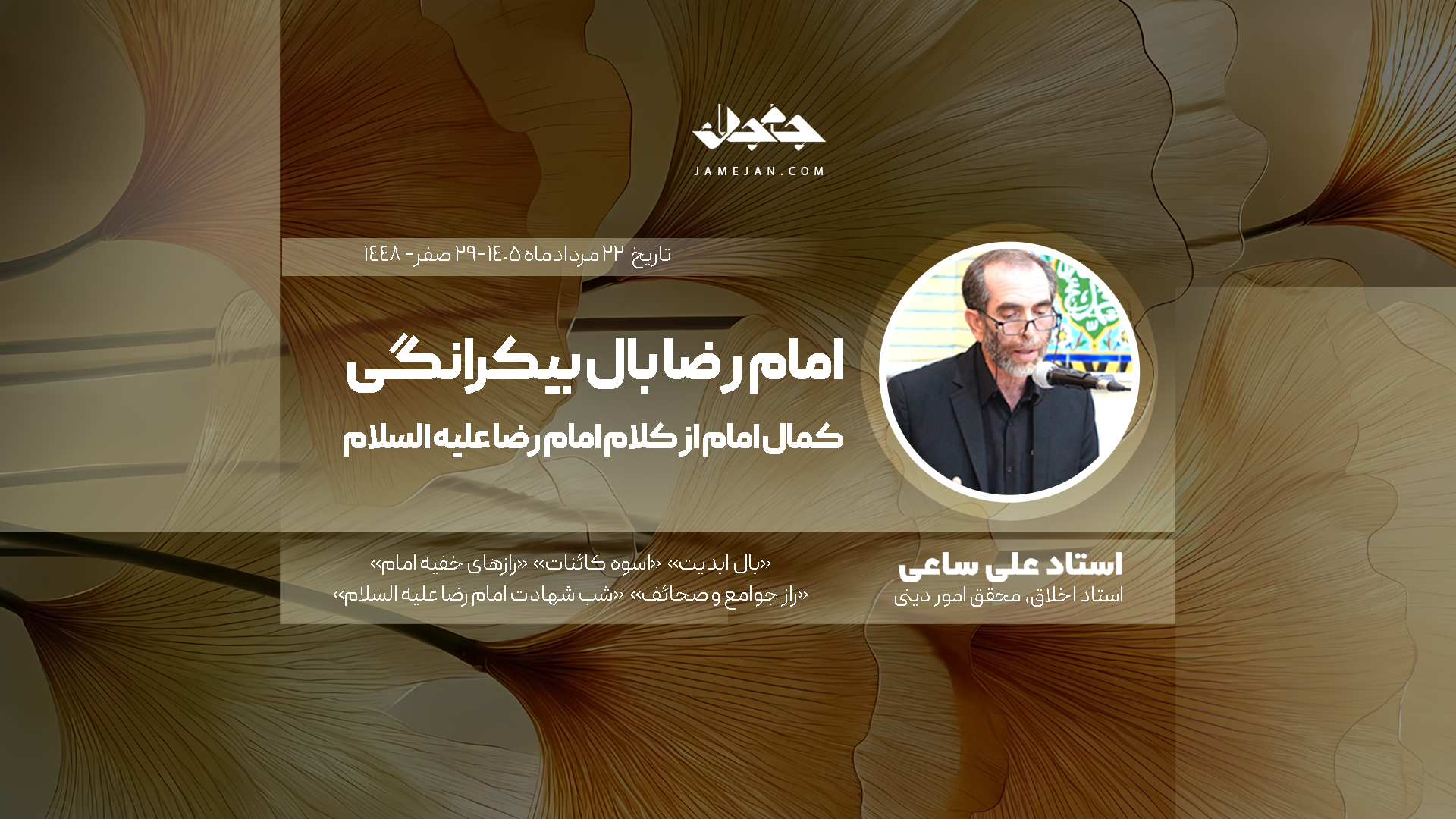
Imam Reza: Wings of Eternity
1405/05/22
118
notifications_active Weekly Meshkat-e Noor Session: Thursdays at 20:30 at Haj Reza Mosque
🌻🔆🔆🌻
🌼🔆🌼A Nature-Centered Educational System🌼🔆🌼
🔹Weekly sessions on the commentary and interpretation of al-Sahifa al-Sajjadiyya
📅 Date: 1404/11/09 – 9 Sha‘ban 1447
✨ Session: Meshkat-e Noor
🎤 Speaker: Master Ali Saei
📝 Some topics discussed during the session:
🧠 A nature-centered educational system: the foremost of all systems
A nature-centered educational system stands above all educational and university systems. Through a single breath, a transformation, a surge of love, a person can come to possess all the knowledge of the universe at once. Who is familiar with this nature-centered educational system? Whoever connects to this vast Sajjadi system with a pure and sound heart will discover that the speed of learning is astonishing. This nature-centered system is constantly renewed; it is updated from moment to moment. Until we equip our own educational system with it, we will not attain its special and pure knowledge.
When will we become learned? When we can establish this education as a system within our very being—for it is the subtlest system of education and cultivation in the universe. Have we ever considered how we might activate this system within our bodies, gain mastery over them, and make the best possible use of them? What knowledge enables me to make use of my eyes and see? To use my hearing and hear? I imagine that hearing is simply what I hear, but it is not so. I am equipped with this system. I can make use of it: I am the one who activates the systems of sight, hearing, taste and sensation. I make use of the entire system of my body. Through what knowledge? Through that same nature-centered knowledge. I ride upon this system of my being, both physical and spiritual. So I was learned all along, and never knew it! Just as I have mastery over this body, I can also gain mastery over the whole universe—if I can learn that innate knowledge, that nature-centered way of learning. If I can connect to the system of Madinat al-‘Ilm through the very nature-centered system within me, then I will be able to benefit from this great blessing of God: the blessing of nature-centered education.
How can a child, still so young and nursing, learn at such remarkable speed? The child learns a language with astonishing ease. How does this happen? Through what educational system? A child can learn a language and forge strong ties with society. Indeed, a child can make better use than anyone of the system of innate nature, and benefit greatly from its educational system. If we, too, had the innocence of that child, we could learn all the knowledge of the universe with the same speed and ease. The quickest and easiest way is to connect my heart to the system of the Two Weighty Things—the Qur’an and the Ahl al-Bayt—thereby joining the exalted educational system of innate nature, and receiving knowledge directly into my being.
In every passage, Imam Sajjad (AS) creates a connection, a link between us, our world, and the realm beyond and our innate nature. The Imam connects us to the system of the soul and innate nature; he directly pours that knowledge into our being. He possesses truths—inner truths. The Imam teaches us how to succeed in the contest of overcoming Satan: not only to bring Satan down and pin him to the ground, but also to turn Satan himself into a launchpad to the highest heights. Satan seeks to take possession of our hearts, souls and faculties of perception; through our desires, enticements and envy, he seeks to bring us down. Imam Sajjad (AS) turns all Satan’s designs on their head. We do not merely remain earthbound; we become heavenly. Satan charges at us with desires, enticements and envy, while we take the very path on which he charges and soar toward remembrance of the greatness of the Most High Lord.
We have learned that we must never be anxious about our livelihood. We must believe in God. He apportions our provision; our share has already been allotted. Let us believe it. In seeking our livelihood, we should be measured: we should strive for it wisely, gracefully and in due measure, and forbid ourselves to go beyond that. Extra effort will not bring us more provision. But a wise, measured pursuit of it will bring us provision blessed with abundance and allow us to benefit from God’s grace and generosity. And, as the Noble Messenger (PBUH) said in this blessed hadith: “Whatever is with God cannot be obtained except through obedience to Allah.” Whatever we desire, whatever we hope to attain, we can reach only through obedience to God.
So we must free ourselves from blind desires and worldly adornments, and lovingly set ourselves on the path of obedience to God. Then we will attain both what we seek and what never even crossed our minds. Desire and worldly adornment will inevitably lead us towards envy. When these three sinister forces—desire, adornment and envy—join forces, they make a person suspicious and lead them away from the path of truth. They enslave people to this world and make them thirst for it, until they run themselves ragged across its scorching desert and, in the end, bring about their own ruin. They become avaricious, but avarice only makes them rush faster, exhausting them without bringing them any greater reward. It merely increases a person’s toil; it does not bring them more provision. Avarice makes a person burn their hereafter at the hearth of this world, without gaining anything more in return. A person’s avarice becomes the weapon that kills them.
How many avaricious people have been killed by their own avarice! In other words, a person becomes the victim of their own greed, deprived of both this world and the hereafter, and left “خَسِرَ الدُّنْیَا وَالْآخِرَةَ”. How beautifully Imam Ali (AS) put it: “Whoever rides avarice will be killed by it.” This is the law of avarice. Whoever wishes to be avaricious may do so—but that avarice will kill them.
When avarice, pride and envy join forces, they urge a person to leap into sin. Without even imagining the ugliness of sin, a person throws themselves into its filthy swamp. Avarice, alongside pride and envy, leads a person to commit any sin for worldly gain, without considering the consequences. How beautifully our master Imam Ali (AS) says: “Never seek counsel from a miser; never bring a miser into your deliberations. Be on your guard!” Why? Because this continues the same pattern of desires and worldly adornments. Why? Because if you seek a miser’s advice, they will turn you away from generosity and cut off your giving hand, preventing you from being generous. Why? They will warn you that generosity leads to poverty: “If you give and do good, you’ll end up poor.” That is the advice of a miser. And never seek counsel from a coward, for they will weaken your resolve to act. And never seek counsel from someone avaricious. Why? Because they will make injustice and oppression seem attractive to you. Avarice intensifies your attachment to worldly ambitions; it makes rapacious greed seem appealing when joined with injustice. That is what an avaricious person does: they mingle rapacity with injustice, dress it up attractively and hand it to you, luring you into a cruel and filthy trap. Rapacity is an extreme form of greed. A person who eats ravenously eats quickly but is never full. That is rapacity. They are always pursuing the world, accumulating wealth and piling it upon wealth, yet never satisfied. That is rapacity—the worst kind of greed. When greed takes hold of a person, this is what happens: they eat a great deal, and the more they eat, the hungrier they become; meanwhile, they grow ever more stingy. They acquire much but give nothing away, and want to possess everything.
What a monstrous thing avarice is! More dangerous still is when miserliness, fear and greed come together. Though they are distinct, disparate base impulses, when joined they expose a person to a far greater danger—one that cannot be undone. Once united, they breed suspicion of Allah in a person. Imagine—a person growing suspicious of their Lord! Now consider how this relates to desire, adornment and envy: these disparate impulses are all gathered together in them.
The Master says: If you wish to choose a minister, companion, supporter, or partner for yourself, beware of turning to the wicked—the very people who once served as assistants and ministers to evildoers and shared in their sins. This is the warning of the Master, Amir al-Mu’minin. Satan seeks to plant desires, false allurements, and envy in our souls, so that he may ensnare us. The Master, Imam Sajjad (AS), teaches us that when faced with this satanic onslaught, we must take flight to the remembrance of God’s majesty, to reflection on God’s power and His designs against the enemies of God.
Satan has sworn to disgrace humankind. He has sworn: «حتماً حتماً و حتماً, I will surely lead them astray»—that is, human beings—«and I will certainly lure them with empty hopes.» This is Satan’s oath. «And I will surely command them to cut off the ears of their livestock»—that is, I will instil in them whatever I wish, so that they carry it out blindly. «I will command them to alter God’s creation.» Cutting the ears of livestock may mean literally cutting their ears. But it may also mean altering the genes of those animals, changing their natural, livestock qualities into something else. Perhaps they bring about such genetic changes in them that, instead of the qualities of livestock, they acquire the qualities of pigs; they take on the traits of wild animals, perhaps even the habits of dogs. And so they make people eat dogs, pigs, and forbidden things, without their knowing it. Satan has sworn that he will certainly command human beings to alter God’s creation—from genetic changes to changes in behaviour, from altering God’s religion to striving to distort human nature.
When Satan penetrates our souls, our system of perception, he makes us submit to whatever he commands. It is not that a person appears to surrender to Satan; rather, Satan so beguiles and humiliates a person that they come to loathe themselves. The apparent meaning of this noble verse is: «Satan has gained mastery over them and made them forget the remembrance of God. They are Satan’s party. Know that Satan’s party are the losers.» Satan’s domination of a person does not mean outward control, like a donkey gaining control over a human being. A person is meant to ride the donkey; but if the donkey rides the person, the person’s human dignity collapses. Satan’s domination of a person is worse still. The apparent meaning of domination is for one donkey to gain control over another. There is also a very subtle meaning, but I am too embarrassed to use it in this sacred place. Perhaps in a more private gathering I can explain that finer meaning of domination.
Satan wants to ride a person, sit on their back, and put a bridle on them. That is the outward meaning of domination. Its inner meaning goes further: first he climbs onto their back and puts a bridle on them; then, tormenting them, he drives them forward with all his force towards whatever he wills. Satan saddles a person and mounts them. It is a terrible disgrace for Satan to ride a human being. Thus, the outward meaning of domination is for a lowly being to overpower a higher one—to colonise and exploit it, to use it as a beast of burden and displace it. That is domination. So let us look again at the noble verse: «Satan gained mastery over them»—that particular kind of domination. Its consequence was that they forgot the remembrance of God. If a person forgets themselves, that is better than forgetting their God. How could they forget their God? Even Satan, in all his baseness, does not forget God. Yet a person can become so base that Satan gains mastery over them, the remembrance of God fades from their heart, and they become one of Satan’s party. And Satan’s party are the losers.
So it is enough for Satan to gain mastery over a person’s heart. Once Satan has gained control, a person’s faculty of perception falls into his hands. Riding upon their desires, he both instils blind hopes in them and, from that vantage, drives them towards a scorching wasteland. Whoever forgets God will forget themselves: «Do not be like those who forgot God, so He made them forget themselves. They are the defiantly disobedient.» That is, when a person forgets themselves, they forget their humanity; they consign to oblivion the dignity God bestowed upon them, and forget the breath of God within them. Then they become lower than the animals.
Thus, cravings and worldly adornments become the salt that feeds a person’s envy: they make envy seem beautiful and lead a person to the basest of deeds. A person grows envious and comes to love that envy. Why? Because cravings and adornments have embellished and beguiled them. “They are those whose efforts in the life of this world have come to nothing, yet they think that what they do is good and beautiful.” They take pride in their own shameful deeds. So what should we do? Let us bring our hearts to life through intimate communion with God, so that we may become alive and awake. Without remembrance of God, a person dies—that is, the heart dies. When the heart dies, a person’s humanity dies; they forget their God and even forget themselves. Instead of following reason and its forces, they follow ignorance and its forces. A person should not look only to themselves, be preoccupied with themselves, and consider only their own cravings. Rather, they should see themselves as a world, in relation to all of existence, and strive to be a healing draught and remedy for this world, not its affliction. One enslaved to cravings and adornments is imprisoned within themselves; their wishes and all the plans they make for their life are confined to this worldly sphere. Whoever escapes their cravings frees themselves from the bonds of limitation and becomes a world entire.
A human being, through their humanity, is a world entire, though they do not know it. When someone kills their own humanity—when they become captive to the world—their humanity dies; that is, their Greater World is destroyed, and in a sense they forget that Greater World. Whoever destroys another person’s body and kills them is as though they had killed all people. But if someone kills another’s spirit, have they killed all people? Rather, it is as though they had killed the whole world. When a person kills themselves—their own spirit, their sacred spirit, their heart, their reason, the spirit of their faith—and destroys their virtues, they are killing the Greater World. We came into this world to journey alongside all creation, to board the ship of growth and help propel it towards growth as well.
A researcher specializing in religious studies and divine unity, with a particular focus on the Qur’an and Hadith (the Two Weighty Things). His research has centered primarily on the Qur’an and Hadith; in recent years, he has also explored divine unity and critiques of philosophical viewpoints.
If any part of this response is unclear, please submit your question so it may be addressed by the teacher after review.
No inquiries have been recorded regarding this response yet. Your perspective or question will be the first.
Research and Thematic Guidance within the Intellectual Framework and Inquiries of the Meshkat-e Noor School
Follow the latest Meshkat-e Noor sessions