Ahl al-Bayt and Islamic History
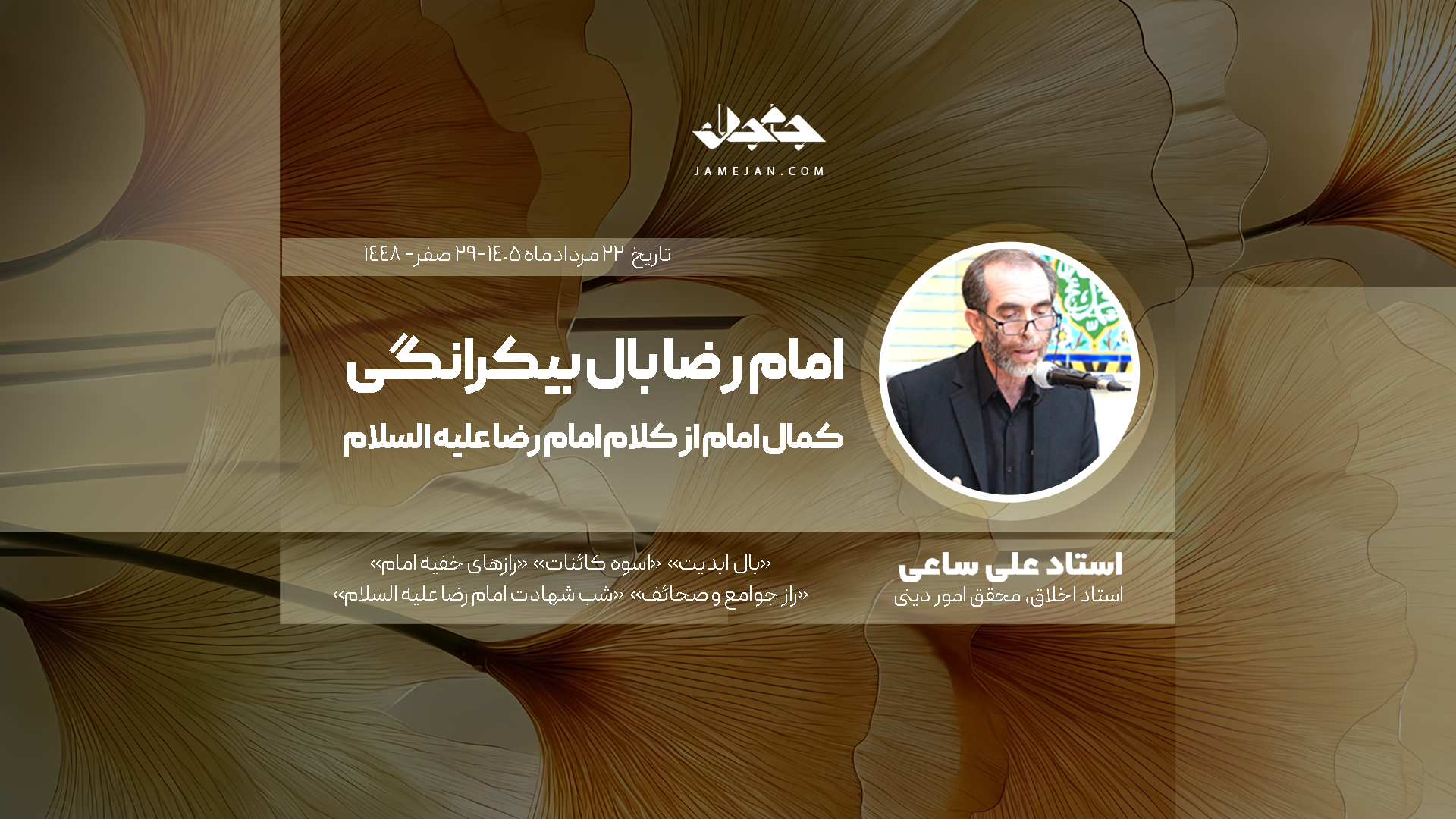
Imam Reza: Wings of Eternity
1405/05/22
114
notifications_active Weekly Meshkat-e Noor Session: Thursdays at 20:30 at Haj Reza Mosque
🌻🔆🔆🌻
🌼🔆🌼Imam Sajjad (AS): The Radiant Beauty of Creation🌼🔆🌼
🔹The Birth of Imam Sajjad (AS)
📅 Date: 1404/11/05 – 5 Sha‘ban 1447
✨ Session: Meshkat-e Noor
🎤 Speaker: Master Ali Saei
📝 Some of the topics discussed in the session:
📜 This world is a dream, and the Hereafter is wakefulness
Until I awaken, I will not be able to visit the Imam of wakefulness. The brilliant star is the sign of light. If only I could awaken! If only my heart would awaken, so that I might behold the radiance of that brilliant star! How beautifully our Imam Sajjad speaks! How beautifully he interprets this world for us! Without the slightest doubt, I have never yet encountered an interpretation of this world as beautiful as the one our Imam Sajjad has given us. The Imam says: “This world is a dream, and the Hereafter is wakefulness; and between the two, between this world and the Hereafter, we are troubled dreams.” It takes subtle discernment to grasp the subtle words of Imam Sajjad (AS). This world itself is a dream, and the Hereafter itself is wakefulness. Who—or rather, what—are the dreams of this world, the visions of this world, its confused dreams? They are not things; they are people. They are us: the troubled dreams between this world and the Hereafter. Have we grasped the subtlety of his words? I am still dazed and bewildered in this world—the world that is a dream, in which we are troubled dreams. In other words, the stuff of this world’s dreams, its visions, is us ourselves. Those who are steeped in this world are its troubled dreams: their thoughts, their conduct, their every movement and stillness.
How remarkable! Imam Sajjad (AS) has unlocked a great secret. The relation between sleep and wakefulness is like the relation between death and life. If we are to establish a relation between this world and the Hereafter, so that we may understand their boundaries, those boundaries are like the divide between death and life. True life belongs to the Hereafter. This world is a dream, and we move about within it. We are carrying out our tasks on the screen of a dream. We are the visions within this dream. But those who are awake are the ones who have freed themselves from the world’s captivity. Whoever is captive to this world is one of its troubled dreams. Who, then, is awake? Or, better put, who are the true dreams of this world? Whoever frees themselves from the world’s chains is a blessed and true dream of this world, and it is for these dreams that we will be called to account. We are the dream of this world. The God-fearing are pure people who awaken in this very world, before reaching the Hereafter. Their very being is this world’s wakefulness, its light—not its troubled dreams, but its true and blessed visions. The world seeks out the God-fearing; it wants to seize them. It turns toward them: the world’s wealth and riches, its pleasures and adornments, all call out to them, seeking to draw them in. But the God-fearing flee from it. When they sense that they may become captive to the world, they would give their lives rather than be ensnared. They accept death, but not love of the world. These pure people are the true dreams between this world and the Hereafter.
How can I become a true dream of this world?
The Master says: “Those pure ones meet this world only with their bodies; only their bodies keep company with the world, while their spirits and souls remain suspended in the Highest Abode.” They are the vicegerents of God. The Master sighs: “Ah…” In other words, the only one who is fully, truly awake is the Master, the Lord of the Age and Time, the Greatest Remnant of God. So are we asleep in this world? No—are we asleep? We are in a state of sleep. We are asleep, and in our sleep we dream.
Let us return once more to the blessed words of Imam Sajjad. The Imam says: “This world is sleep, the Hereafter is wakefulness, and between this world and the Hereafter we are confused dreams.” Whoever dreams within this sleep, within this world, has lost. Whoever is heedless within this sleep is dead—more dead than the dead. The one who wakes has found the answer to the riddle. And the key is this: we must wake up, startle out of this ominous sleep, and tear through it. That is, we must awaken this world, not fall asleep amid a world that is itself asleep. This world is sleep, and we are its dreams; one day, in the Hereafter, those dreams will be interpreted. My deeds and actions—the dreams of this sleep—will one day be interpreted in the world to come. Blessed are those whose dreams are true! What can we do to wake up, to make our dreams true, and to ensure that this world’s interpretation in the Hereafter is to our benefit? We must not fall in love with the world.
I say it again: we are within a dream, and we ourselves—our actions and thoughts—are the dreams of that sleep. If we fall in love with this dream, if we become enamoured of this world, our heart’s eye will be blinded and our hearts will grow sick. We will see with impaired, unhealthy eyes, and what we see will be illusions inspired by the world and Satan. We will hear with unhealthy ears, and our passions will tear our reason to pieces.
The world has stolen his heart; his soul is captive to it, bewitched by it. He has become infatuated with the world and turned into its abject servant. In other words, he has become a servant of this dream, sunk into sleep, serving the dream and lost in its dark, poisonous, troubled visions. Such a person, captive to the world, loves both the world and those who possess its goods; he serves them too. A dream-struck soul, lost in troubled dreams! Wherever the world turns, he turns with it. He will heed no warning and accept counsel from no preacher, even as he sees those ensnared by this world.
We must therefore sacrifice the dream for wakefulness, and this sleep for that awakening. This world must be sacrificed for the Hereafter, not the Hereafter for this world. How many people, lost in this dream, sacrifice that awakening, that real world, for this sleep! Let us spend this world in pursuit of the Hereafter. This is the key to a true dream: the world must be interpreted, in the most beautiful way, as a passage to the Hereafter.
The Master says: “Everything in this world is greater when heard of than when seen”—that is, whatever we hear of in this world is greater than what we see—“and everything in the Hereafter is greater when seen than when heard of.” Everything in this world is greater to hear of than to see, and everything in the Hereafter greater to see than to hear of. “So hearing of it should suffice you in place of seeing it.” That is, do not turn your attention to the world; know instead what has been revealed of the unseen. Whatever diminishes in this world and increases in the Hereafter is better than whatever diminishes in the Hereafter and increases in this world. How often what is lacking here is found in abundance there—and the reverse as well! What you have been commanded to do is far greater than what you have been forbidden to do. Who would seek pleasure in a dream? Does one sleep in order to enjoy being awake? What would it mean to lose everything in a dream?
How beautiful, then! I should read this brief saying of Imam Sajjad’s (AS) hundreds, thousands of times. It interprets everything from this world to the Hereafter: “This world is sleep, the Hereafter is wakefulness, and between this world and the Hereafter we are confused dreams.” These words of the Imam unravel a profound riddle that philosophers everywhere have wrestled with. They seek to uncover the world’s mysteries, the pleasures of this life, while our Imam Sajjad has revealed all those secrets in this brief saying. Our Imam: the very meaning of knowledge, the truth of divine unity. Blessed are his words; his blessed presence is the greatest light, a radiant star. In another of his sayings on divine unity, he says:
The Imam wants to introduce us to maʿrifa and acquaint us with it. What is the reality of maʿrifa? The Imam says, “The reality of maʿrifa is affirming divine oneness.” In other words, when we say that we seek maʿrifa of God, we mean that we seek to attain knowledge of God’s oneness, not knowledge of His Essence, for His Essence cannot be known. Thus, the beginning of maʿrifa is the affirmation of divine oneness; after that comes knowledge of the meanings. But affirming divine oneness… Whoever boards this ship becomes a monotheist. How? Our Imam Sajjad (AS) says, “I want to inscribe divine oneness in my soul”—that is what it means. The Imam says, “Maʿrifa is, in the first degree, affirming divine oneness, and in the second, knowing the meanings.” Affirming divine oneness and knowing the meanings.
Affirming divine oneness means recognizing that He is the Eternal God, whom eyes cannot perceive, while He perceives all eyes; He is the Subtle, the All-Aware. He is the hidden, unseen One. You will know Him only when you describe Him as He has described Himself. As for the meanings: we are His manifestations. He is among you… We are His manifestations among you. God created us from His light, entrusted the affairs of His servants to us, and, by His permission, we do whatever we will. God, Mighty and Majestic, has established us in this station, chosen us from among His servants, and made us His proof on earth. Whoever denies or rejects anything, then, has rejected God and disbelieved in His messengers.
The Imam then tells Jabir, “Whoever knows God Most High by this attribute has affirmed divine oneness, for this attribute accords with what has been sent down in the Book: ‘Eyes cannot perceive Him, but He perceives all eyes’; ‘There is nothing like Him’; ‘He is the All-Hearing, the All-Knowing.’” And God’s word is: “He is not questioned about what He does.”
In truth, they have explained this beautiful supplication for us. When I ask God, «اللهم عرفنی نفسک», I am asking Him to bring us to His oneness, not to enable us to know His Essence; for His Essence cannot be known and has no need of being known.
This is the vast system of maʿrifa of God. When we attain knowledge of the meanings—that is, knowledge of the Imams—our faculties of understanding and spiritual insight become active, fluid and mobile, and enter a new realm. Knowledge of the meanings means that we seek to raise our limited system of knowledge to the system of the Ahl al-Bayt and the Proof of God. We connect our system of knowledge to the Proof’s, so that we may attain the highest knowledge of divine oneness. Through knowledge of the meanings, we seek to reach the summit, increase our capacity, and bring our ability to know divine oneness to its utmost, so that we can experience it as it truly is.
But how do we attain knowledge of the meanings? We must reach the channels through which the meanings are conveyed: love in the precinct of the Ahl al-Bayt, immersion in the words of the Infallible Ones, and their supplications. The Imam says, “Maʿrifa is affirming divine oneness.” That means divine oneness must take root in our souls and be established in every part of our being. We must bring it to life and make it endure within us, and let its flame shine through every part and member of our bodies.
When divine oneness is established throughout our whole being… not a single cell in us should remain without it taking root. No dark corner should remain in our souls. Even the breath we take in should be monotheistic; as it enters the kingdom of divine oneness and leaves us, it should make the world around us monotheistic. So let us inscribe divine oneness in every part of our being and make it shine in every particle of us. Our entire being must become an ordered universe of divine oneness.
One way to do this is to attune ourselves to the descriptions in the Qur’an and to those given by the Ahl al-Bayt, and to bring ourselves into harmony with the supplications of the Qur’an and the narrations, so that we resonate with them and perceive divine oneness as it truly is. When the Imam describes God in this way—«لاتدرکه الابصار…»—and we pray this supplication of Imam Sajjad (AS) with feeling, the melody of the prayer unlocks the seal of our primordial nature, even without our realizing it: that primordial nature of divine oneness which God Himself has inscribed within us. That nature, that divine oneness, will shine forth.
When we turn to the verses of the Qur’an and recite them, we must read them in that spirit, with that same melody, with that same truth, so that the waves of divine oneness within our being awaken. Our primordial nature is a book of divine oneness, and it must be opened. How? Through the Qur’an and the Ahl al-Bayt. If we read the Qur’an with our whole hearts and minds—if we read the Sahifa Sajjadiyya just once with our whole hearts and minds—not only will our primordial nature of divine oneness awaken, and divine oneness be inscribed in our souls and throughout our being; it will also grow, and lift us into flight.
The innate disposition must be opened, unfolded and inscribed in every part of us. Only the Qur’an and the Ahl al-Bayt can unlock the human innate disposition; it opens only with the sacred key of the Two Weighty Things. Without that key, it lies buried beneath layers of rust. Through the Qur’an and the Ahl al-Bayt, our innate disposition is brought to fruition and set in motion, for they are its mirror. So let us measure our beliefs against the Qur’an and the Ahl al-Bayt: they are the heart from which tawḥīd is inscribed and disseminated.
The expressions of tawḥīd in the Qur’an and in the narrations of the Infallibles carry a spirit of tawḥīd. When we read them, their spirit must be breathed into our own, so that their effects become manifest in us. They are like the means that set tawḥīd in motion; we are merely its users. In general, then, let us attend to the cadence of the Qur’anic descriptions and attune ourselves to the measure of tawḥīd in the divine verses. Let the cadence of the Qur’anic descriptions and of the sincere servants take effect in our souls. Let the song of the All-Merciful’s descriptions unlock the innermost lock of our innate disposition.
If we can recite the word of tawḥīd, the Sūrat al-Tawḥīd, with proper recitation—not merely outwardly, but inwardly too—then we will have brought our knowledge to completion. The life of tawḥīd will be alive and inscribed within us. So let us allow the spirit of the divine verses to be breathed into our souls. The Qur’an’s outward recitation must be governed by tajwīd and tartīl, and so must its inward cadence. The Qur’anic verses are miraculous: let us expose our hearts and souls to their miracle. The intimate prayers of the Ahl al-Bayt (peace be upon them), which dawned within their pure souls, will stir a storm of tawḥīd within us. Let us rhyme with the Qur’an and the Ahl al-Bayt, matching their measure, their metre and their vibration, and taste the flavour of the verses and descriptions. Here is one practical way: when we enter the world of the Qur’an, when we enter the world of the Ahl al-Bayt, we must step in humbly.
I can see now that I used to recite the Qur’an while in manifest loss. Anyone who recites the Qur’an without humbling themselves before God, whose heart does not soften, whose spirit does not grow tender, who is not enveloped by sorrow and whose whole being is not surrounded by awe and fear, has shown disrespect to the exalted presence of the Lord. How astonishing! How could I recite the Qur’an and not realise? My recitation was an affront to His threshold. O God, I repent of my recitation!
What, then, must we do for the Qur’an to work its miracle within us and bring us to knowledge of the First and the Last? The Qur’an reciter needs three things: a humble heart, a body free of preoccupations, and an empty place.
That is, first I must be alone with God if I am to recite the Qur’an. So I begin with the heart: I humble it and free my body of distractions. I must cut myself off from everything and empty my heart of every desire. I wish to meet my Lord and be alone with Him. I must therefore distance myself from everything, set everything else aside, and free myself of all but Him, so that I may devote myself to Him. And I need a place where no one else is present—utterly empty. The doorway of my heart and the house around me must both be utterly empty.
Then what should I do? I should seek refuge in God, for Satan lies in wait. I must clear the space of Satan. “When you recite the Qur’an, seek refuge in God from Satan, the accursed.”
When you have freed your being from all distractions, when your heart has become detached for the recitation of the Qur’an, and when nothing has come between you and the blessing of its light, then establish your gathering for the Qur’an. In that empty place, withdraw from people. With these two qualities—a humble heart and a body free of distractions—make your soul intimate with God and attune your inner self to His sacred presence, so that we may experience the sweetness of God’s address… That is, God is about to speak intimately with you, and you are to taste its sweetness.
You have chosen that empty place so that you may witness the state of the righteous… I, too, choose that empty place for reciting the Qur’an, so that I may see how the Mahdi (AJ) loves his Lord, how he prays to Him in intimate communion. This is a gathering of intimacy. It is permission for every sincere reciter to behold that special solitude and, in turn, be alone with their Beloved.
Imam Sajjad is the radiant star of the Light Verse. This is the same blessed hadith of light in which Imam Amir al-Mu’minin said, “I marvel at those who recite this noble verse yet fail to grasp its truth.” Then he recited: “الله نورالسماوات والارض…”. He said, “The niche is Muhammad (PBUH).” He said, “I am the lamp.” And the Imam… the radiant star is Ali ibn al-Husayn. How can I describe it? The glass is like a brilliant star. It is the manifestation of the star of light, the reality of light. It is more than the brilliance of light: it is a reality that unfolds in this gathering. Light is not simply brightness; brightness is only one of light’s qualities. Light is a tremendous reality—the very reality through which Allah displays His artistry. Light is the reality toward which Allah opens windows, allowing something of it to shine upon us. One aspect of this reality is the niche, another the lamp, another the glass, and another the radiant star. Each Imam is a window opened onto the truths, and each window is a vast constellation of knowledge. The radiant star means the knowledge of God shining into the world of being through the window of Imam Sajjad.
The truth is that this light of God is within our hearts. How astonishing—I had never known this! God’s very niche and lantern… God’s niche itself, God’s light, is in our hearts, and we are unaware of it. This verse, with all its intricate design, is present within us, yet we remain absent from the light.
Someone asks the Imam about this noble verse: “So believe in Allah and His Messenger and the light which We have sent down.” He replies, “Abu Khalid, by God, the light is the Imams.” Then he swears by God: “It is the very light that Allah sent down. By God, it is the light of Allah in the heavens and the earth.” That is, this Verse of Light, this light of God, is present in the heart of every believer. He says, “Abu Khalid, the light of the Imam shines in the hearts of the believers more brightly than the sun at midday.” He goes on to say, “By God, they illuminate the hearts of the believers, and God withdraws that light from whomever He wills, whereupon their hearts sink into darkness.”
Then he says, “Abu Khalid, no servant loves us and accepts our authority unless Allah has first purified his heart. And God purifies no one’s heart unless that heart submits to us, submits to our command, and is at peace with us.” When someone submits to us and is at peace with us, that means they have turned away from disobedience and are reconciled with the Imams. Whoever makes war on God makes war on the Imams; whoever obeys God is at peace with the Imams. On the Day of Reckoning, God will protect them from the terror of that great day and spare them the severity of the reckoning.
Our Imam Sajjad is the radiant star of the Light Verse. That is, he is light made manifest. If light were to take form and show its face, that face would be Imam Sajjad (AS). If light shines—let me repeat—its radiance is only one of its effects. When light shines, the beauty of our Imam Sajjad comes into view. Our Imam Sajjad is the very soul of light, its essence, the splendour, majesty and beauty of God’s light. The star of light is light on display: one manifestation following another. The glass itself is light, and its star is the halo around that light. In other words, Imam Sajjad (AS) is the luminous halo of Imam Husayn. Our Imam Sajjad is the distilled essence of light, its singular manifestation, its universal splendour.
When we look up at the sky, only the radiant star can dazzle our eyes, and our Imam Sajjad holds this exalted rank in the world of being. When light becomes visible, it takes the form of a star; its light becomes stellar, and its star becomes radiant. Our Imam Sajjad is the pearl among the stars of the universe. The Imams… our Imam Sajjad is the Kaaba of Light; he draws every gaze toward himself. He is the supreme vision of truth. Imam Sajjad is the star of lovers, the place where moths in love gather. A star is a whole constellation of grace and allure.
Just as our Lord said… our Imam Sajjad is a star in the heart of time, in history; a star in the heart of Karbala, of Ashura; a star in the realms of the visible, the unseen and the divine dominion. He is a star of this world and the next, a star of hearts. A star guides the wayfarer’s journey and movement, the quest to arrive, the journey of love.
A researcher specializing in religious studies and divine unity, with a particular focus on the Qur’an and Hadith (the Two Weighty Things). His research has centered primarily on the Qur’an and Hadith; in recent years, he has also explored divine unity and critiques of philosophical viewpoints.
If any part of this response is unclear, please submit your question so it may be addressed by the teacher after review.
No inquiries have been recorded regarding this response yet. Your perspective or question will be the first.
Research and Thematic Guidance within the Intellectual Framework and Inquiries of the Meshkat-e Noor School
Follow the latest Meshkat-e Noor sessions