Written transcript of the lecture
The Meshkat-e Noor teachings series🌼🔆🌼Satanic Intoxicants🌼🔆🌼
🌹🔅☘️ بِسْمِ اللَّهِ الرَّحْمنِ الرَّحيمِ ☘️🔅🌹
🔅🌹 “The Calamity of Forgetting God” “Nature’s Lullaby” “A Critique of Reincarnation and Karma” “An Exposition of Supplication 20 of al-Sahifa al-Sajjadiyya” “Session 230” and more … Summary with an Addendum
1403.07.26
Ali Saei (Abdullah Meshkat) 110.141(903) 🌹🔅
🔹Replacing the Hereafter—A Satanic Intoxicant
📅 Date: 1403/07/26 – 13 Rabi al-Thani 1446
✨ Session: Meshkat-e Noor
📖 Weekly session on the exposition and interpretation of al-Sahifa al-Sajjadiyya (Supplication 20)
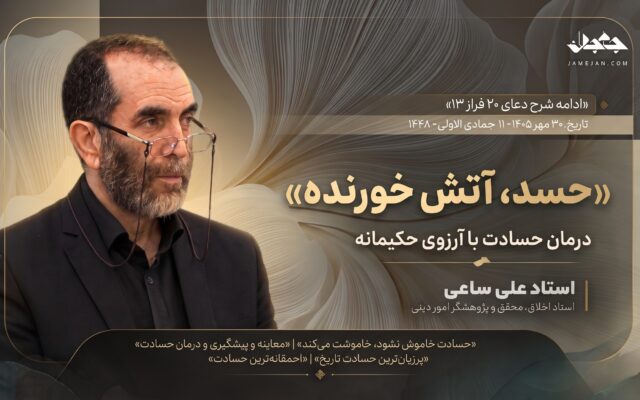
🎤 Speaker: Master Ali Saei
📝 Some topics discussed in the session:
🌸 Can we dispense with God and believe in the Hereafter or in karma?
Do we not know that God is the source of all goodness? Without God, can there be any goodness in this world?
Goodness is goodness even if we do not believe in God, because God is the creator of all that is good. If, God forbid, we were to do away with God, would any goodness remain in the world? Water sustains life because God has willed it so. If God did not will it, that same water could bring death.
🌿 Water: A Means of Life and a Means of Death
The very water that gives life can, by God’s will, become a cause of death. The same is true of oxygen. God has ordained that breathing should bring us comfort and meet the body’s needs. But if God does not will it, that same oxygen can fuel a fire and burn a person.
🍃 Goodness is like this too: if God does not will it, even goodness can become evil.
Buddhists and followers of other schools imagine God as a limited being and believe in various gods, some good and some evil. Concepts such as reincarnation and karma have arisen from these ways of thinking.
🍁 Satanic Intoxicants and the Deviation from Human Nature
Anything that runs counter to human nature is satanic, like narcotic drugs. Drugs initially produce a high and trigger the release of certain hormones in the body. At first, they create an artificial sense of calm, but ultimately strip a person of all genuine peace. 🌺
🌻 The Satanic Intoxicant: An Attack on First Principles
Satan also attacks first principles. If he can destroy belief in divine unity, prophethood, divine justice, the Hereafter, or the Imamate, he has succeeded. Otherwise, he turns to subsidiary and peripheral matters, gradually drawing people away from the truth. 🌾
🌼 Deviating from Human Nature and Distorted Beliefs
Satan succeeds even through the smallest deviation, because it takes a person one step further from the truth. Yet those who hold fast to their own nature remain vulnerable to his deception. He creates artificial forms of human nature to rob people of their original nature, then distorts it and leads them astray. One such deviation is belief in reincarnation and karma, which takes the place of the Hereafter.
🌳 Karma: Satan’s Lullaby for Belief in the Hereafter
With its attractive gloss, karma captivates people’s minds and becomes the perfect tool for silencing belief in the Hereafter. In an age when false forms of spirituality emerge, true, God-given spirituality is pushed to the margins. To extinguish authentic spirituality, concepts like karma act as intoxicants. 🌺
🌸 Distorting the Hereafter and the Dangers of False Spiritualities
Karma may look like spirituality, but it is spirituality turned upside down, and more dangerous than disbelief. In its place, frivolous and vain practices may take hold instead of prayer and supplication, with dancing and singing replacing worship. 🌼
🌼 Desire and Worship: Promoting Misconceptions
If someone were led to believe that indulging in one’s desires is a form of worship, what would they do? Human nature inclines towards desire. What would happen if people were persuaded that these inclinations themselves count as worship? What would people do if they were told, “Sin and go to Paradise”?🌸
🌿 Recklessness arising from denying punishment in beliefs about the afterlife
Those who believe in the afterlife may become reckless and unrestrained if they come to believe that there is no punishment. In the belief in reincarnation, people believe they will be born again and again, until they imagine that one day they will attain liberation. 🌾 Once they are convinced of this, they forget Paradise and rush towards worldly life. If they sin, they imagine they can make amends in their next births. Yet every contest has its own rules, and people are held to account according to those rules. ⚖️
🌻 Do repeated births bring liberation?
They seek to justify the means of reaching a false goal. But reaching any goal requires a certain measure and quality, as determined by the Creator of existence. 🌸 Thus, karma is one of the key concepts in Hindu beliefs, and is also called “the work of life.” This understanding is a mistaken interpretation of cause and effect.
🌳 Karma: the Hindu misunderstanding of cause and effect
This concept first appeared in Hindu religious texts. It rests on the principle that a person’s physical actions in this life and in lives to come produce consequences through rebirth or reincarnation. Hindus believe that each person will reap the fruits of their own actions. But this raises the question:
🍂 Does every action have a reaction?
Will an action always be followed by an equal and opposite reaction? Or can an action go without consequence? 🍁 These questions require careful examination if the truth is to be established. 🌺
🌼 The absence of God in karma
There is no place for God in karmic beliefs. According to Hindus, everything happens on its own and, God forbid, there is no God involved—although they do believe in gods whose status is lower than, or equal to, that of other beings. 🌿
🌳 Actions as the source of their own consequences in karma
In this view, actions themselves produce their results and punishments. Both nature and action play the central role. Whoever performs an action must see its consequences. 🌾 But in Islam, Allah is All-Forgiving and Compassionate. If a person repents and feels remorse, God forgives them, and their action will have no corresponding reaction. Why? Because God is the Creator of humankind and Himself guides human actions; He does not hold a servant to account if that person has repented. 🌸
🌻 Imposing the sins of past generations on new generations
In some beliefs, later generations are condemned for the actions of earlier ones. In other words, we are the consequence of what our ancestors did. But what role do we have in all this? 🌿 Must we answer both for our own actions and for the sins of others?
🌼 Enduring injustice in karma and resisting it in belief in the afterlife
One consequence of karmic beliefs is that people are taught to remain silent in the face of injustice, since from a karmic perspective, oppressors are justified: they are the result of people’s own actions, and one must endure oppression in order to attain liberation. If one resists injustice, one commits another wrong and must be punished. 🌾
🌸 The difference between karma and belief in the afterlife in confronting injustice
Submission to oppression is one of the principles of karma; by contrast, resisting oppression is part of Islamic belief in the afterlife. 🌻
🌿 Using karma to justify oppression and poverty
The wealthy and powerful have used karma as a tool to mislead and subdue the people. If we look at the great Hindu lands, we can see how people have been made to submit to poverty and oppression, seeing them as the consequences of their own actions. They not only make no attempt to escape this condition, but regard it as legitimate.
🌺 A Mental Sedative for Justifying Injustice
Belief in karma works like a powerful sedative—or a mental drug—keeping people calm and resigned in the face of injustice. 🌾 Though even among believers in karma and reincarnation there are unbelievers. Fortunate are those who disbelieve in karma and reincarnation, freed from these illusions. 🌸
🌼 Philosophical Belief and Islam’s Critique of Reincarnation
In karma and reincarnation, the idea of action and reaction has become a philosophical and religious belief. Though these concepts are challenged within physics itself, in our minds they have become “principles.” In this view, human beings are condemned to return and experience the consequences of their actions through repeated births. 🌿 Islam teaches otherwise: after death, human beings are not permitted to return. 🌸
🌿 The Misguidance That Comes from Belief in Karma
Someone who believes in karma and imagines that they will return will find, when they realize there is no return, that they have lost their eternity. Sadly, this belief has taken hold even among some believers, knowingly or unknowingly, without their realizing where this suggestion was planted in their minds. 🌸
🌼 The Spread of False Beliefs and the Rise of Sects
These people are gradually drawn toward Buddhism. Sects emerge that make karma appealing by dressing it up in attractive trappings. Eventually, a person reaches a point where they perform actions without feeling attached to them. They imagine this state to be a stage of liberation—but liberation from what? 🌿 What attachment do they wish to be free of? Who established this law? Did nature lay down these laws, or did some other power?
🌻 Questions About the First Creation and the Meaning of Liberation
Another important question is this:
What was the state of the first creation?
Was humanity not already free from the very beginning? What was primordial, unformed humanity like? 🌍 From the perspective of karma, there are no answers to these questions; this school of thought does not know where human beings came from, why they came, or where they are going.
🌳 The Endless Search for Liberation and Freedom from Suffering
In this way of thinking, people seek to experience repeated births so they can attain liberation and freedom from suffering. But what suffering are they talking about? Had humanity not reached its destination from the outset? This school of thought offers no answer as to why human beings exist or what their ultimate destination is; on these matters, it remains silent. 🌺
🌼 Karma’s Problem with Origin and Final Return
Those who believe in karma are confused on both counts: origin and final return. 🌿 If later lives are the fruit of earlier ones, then which life was the first life the fruit of? To resolve this problem, they remove the Creator from the picture, yet regard the human soul as eternal.
🌸 The Mystery of the Unformed Being and Its Errors
This view has no explanation for the unformed state of human existence or for human error. How can an unformed being fall into error? To resolve this contradiction, they invent imaginary gods—evil gods who force human beings to do wrong. But if we suppose those gods are to blame, what fault lies with humanity? Is the sin not on the shoulders of the very gods who compelled people to act this way?
🌿 Nature’s Vengeance in Beliefs About Karma
Karma offers no clear answer to these contradictions. Its adherents believe that nature is the avenger: nature takes revenge on those who do wrong and condemns them to keep turning in this world. But how long, and how many times, must a person keep turning before reaching liberation? 🌱 This raises another question: who or what is this vengeful nature? Is nature intelligent and conscious? Is it the Creator? 🌿
🌸 Different Interpretations of the Riddle of Nature and Karma
Different sects offer various interpretations of this riddle. But none provides clear answers to these questions. 🌼
🌳 Karma: Denying the Hereafter and Erasing Belief in God
From the perspective of karma, there is no afterlife. All rewards and punishments occur in this world, and when a person reaches perfection, they are freed from all suffering. In effect, karma is a tool for denying the Resurrection and destroying belief in God. 🌺
🌻 From Human to Animal in the Cycle of Reincarnation
According to the belief in reincarnation, the human soul may reappear in this world in various forms:
It may descend from human to animal form, 🌱 enter plants, or even pass into inanimate objects. This endless cycle continues until a person attains liberation. Unfortunately, this belief has also found its way into some Islamic sects. 🌾
🌼 Repeated Cycles and the Ultimate Goal of Liberation
In reincarnation and karma-based beliefs, the soul continues to pass through different cycles until the person attains liberation and perfection.
🌸 Imam al-Rida (AS) on Reincarnation
Imam al-Rida (AS) says of those who believe in reincarnation:
_”Whoever believes in reincarnation has disbelieved in Allah, the Almighty, and denied Paradise and Hell.”_
These words are the final, decisive verdict on belief in karma and reincarnation. 🌿
🎥 Watch the full lecture at the link below:
🔗 Jame Jan website
🌍 jamejan.com
🟠 Jame Jan Eitaa channel
🔅🌼 Satanic Drugs to Numb Beliefs 🌼🔅
🌹The most dangerous drugs are those that induce a dopamine high. Their illusory euphoria is used as a cover for their deadly poison, which cuts off the heavenly flow of dopamine and destroys eternal ecstasy.
🌹Satan first attacks the very roots; if he fails, he turns to the branches and peripheral matters.
🌹Introducing even a slight deviation into people’s religion and beliefs is Satan’s greatest success.
🔅🌼 Is Belief in “Karma” Really an Obstacle to Religious Belief? 🌼🔅
🌹Is karma a substitute for the Resurrection?
☘️Objection: Why should we question “karma”? How is belief in “karma” a substitute for belief in the Resurrection? Doesn’t “karma” simply say, “Whatever good you do, you will see its fruits”?
☘️Further objection: Suppose God has been left out of “karma,” and, in a sense, it is nature that somehow establishes this justice. Why should we attack this idea at its roots? What harm could possibly come of it? Surely belief in it might at least lead a person towards goodness and spirituality—so why oppose it?
🔅🌼 “Karma” Is a Deadly Poison 🌼🔅
🌹The consequences of believing in “karma and reincarnation” are irreparable. It is like a poison that tastes sweet at first: that false sweetness conceals its poisonous nature, until, over time, it corrupts a person’s beliefs.
🌹Iblis and the devils never cease engineering, manipulating and distorting humanity’s innate beliefs.
🌹Distorting human nature means distorting servitude to God and turning people away from the best of all orders towards the lowest of the low.
🌹Replacing human nature is to deform our humanity.
🌹A fabricated nature is designed to suppress the human drive to seek truth.
🌹Because “karma” stands opposed to the innate belief in the Resurrection, it is, in a sense, a distortion of that innate belief.
🌹Is karma a substitute for the Resurrection?
🔅🌼Forgetting God is total defeat and loss🌼🔅
🌹When people ask, “What is the problem with believing in karma if it means forgetting God?” we reply: Is forgetting God—or ignoring Him across the vast expanse of existence—not sheer ignorance, utter defeat and manifest loss? If tawhid is disregarded, nothing remains as a foundation for human beings.
🌹When God is forgotten, everything will be forgotten: goodness itself, the human being, belief in “karma” itself, and every other belief, whether true or false.
🌹Those who believe in reincarnation are even faithless to their own beliefs. Which of the actions of Buddhists and pseudo-Buddhists accord with the foundations and principles of their own faith? Most act in ways contrary to what they profess, though a few may make a show of it.
🌹Isn’t God the owner of all things? Goodness is good with God; without God, it is lifeless, without spirit—because it is God who breathes life into the soul of all things.
🌹Water and oxygen are beneficial through God and by virtue of His order, laws and measure; otherwise, they would be harmful and deadly. Instead of bringing life, water would bring death.
🌹By God’s leave, the water system benefits the body; oxygen does too. Without God’s laws, oxygen would be a raging fire.
🌹Goodness without God is worse than any evil.
🔅🌼A lullaby for human nature 🌼🔅
🌹“Reincarnation and karma” replace the Hereafter. They lull human nature to sleep by stealing away belief in the Hereafter; Satan sings this lullaby to put human beings’ religious beliefs to sleep.
🌹False mysticism severs the lifeline of the mysticism of the Two Weighty Things.
🌹A person’s inner spiritual life is damaged by false forms of mysticism.
🌹False mysticism is a counterfeit of mysticism: it resembles the real thing, but turns it upside down.
🌹So-called mystical paths may substitute base acts, and at times frivolities and vain pursuits, for prayer, supplication and worship. Indeed, what happens if people are taught to indulge their desires and are told that such indulgence is an act of worship? What happens if they are told, “Sin, and go to Paradise”?
🔅🌼The Hereafter has no substitute 🌼🔅
🌹If a person becomes certain that their punishment will not be eternal, they will grow bolder and more at ease in committing sin.
🔅🌼Means do not necessarily justify ends 🌼🔅
🌹False and ignorant goal-seeking amounts to justifying any means in order to reach one’s ends.
🌹The journey of servitude is accepted only in accordance with divine laws—that is, the religion of Islam. Otherwise, every act is invalid. It is the specific quality, quantity and rules for reaching the goal that form the basis of worship, not just any method.
🌹Every contest has its own rules and etiquette; without observing them, the contest is meaningless.
🌹It is unreasonable to turn certain physical laws, principles, assumptions and theories into philosophy! It is entirely wrong to philosophize Newton’s law of action and reaction, which is itself open to criticism and question within physics and mechanics. Moreover, action is not necessarily accompanied by reaction, whether in physics or beyond it; even when there is a reaction, it is not necessarily equal to the action, nor is it necessarily in the opposite direction!
🔅🌼What is karma?🌼🔅
🌹Karma is a core concept shared by Hinduism, Buddhism, Sikhism and Jainism. It is also found in the beliefs of some false mystical movements and certain deviant religious sects.
🌹Karma, or karma/karman in Sanskrit, meaning “the work of life,” is a term in Hinduism and Buddhism that in fact reflects a mistaken understanding of the principle of cause and effect.
🌹Karma was first set out in detail in the Upanishadic texts. Karma means “action”; as a technical term, it refers to the consequences of a person’s actions: if they are good, they bring happiness; if bad, they bring hardship.
🔅🌼Karma: the whirlpool of reincarnation🌼🔅
🌹According to the belief in “karma,” each person’s physical and mental actions have consequences in this life and in subsequent lives, which come about through rebirth (reincarnation).
🌹In everyday usage, “karma” means that whatever we do, think or say will come back to us. In this sense, karma encompasses both the action itself and its result; the result of an action is called vipāka (the fruit of karma).
🌹In reality, “karma” is a fanciful, personal interpretation of events in the universe, or a fabricated belief devised for some hidden purpose; it is also a covert satanic attempt to distort religious beliefs.
🌹Another definition describes “karma” as the sum of a person’s actions in life and the outcomes of those actions. Whatever these outcomes may be, good or bad, those who believe in karma hold that they will return to the person in this life or the next.
🔅🌼The Relationship Between Karma and Reincarnation🌼🔅
🌹According to the belief in reincarnation, after death the soul of every being enters another body: a human body, in transmigration; an animal body, in metempsychosis; a plant, in transformation into plant life; or an inanimate form, in transformation into inanimate matter. In this way, its life is renewed, according to their view. Karma is, in fact, one of the principles of “reincarnation.”
🌹In the beliefs in reincarnation and karma, the cycles repeat and the soul passes into other forms until the person attains purity.
🔅🌼Condemnation to Return🌼🔅
🌹“Karma” is a corollary of the belief in reincarnation, which conflicts with resurrection and belief in life after death. It holds that after death, people return to this world in another form and live again, in an endless cycle. Islam does not endorse belief in karma, both because it rejects resurrection and because of its fundamental flaws.
🌹In the reincarnationist and karmic view, a person is condemned to return in order to see the consequences of their actions, whereas Islam teaches the opposite.
🌻🔆المؤمنون : 99 حَتَّى إِذا جاءَ أَحَدَهُمُ الْمَوْتُ قالَ رَبِّ ارْجِعُونِ
🔆 Until, when death comes to one of them, he says, “My Lord, send me back,
🌻🔆المؤمنون : 100 لَعَلِّي أَعْمَلُ صالِحاً فيما تَرَكْتُ كَلاَّ إِنَّها كَلِمَةٌ هُوَ قائِلُها وَ مِنْ وَرائِهِمْ بَرْزَخٌ إِلى يَوْمِ يُبْعَثُونَ
🔆so that I may do righteous deeds in what I have left behind!” No indeed! These are merely words he says. And behind them is a barrier until the Day they are raised.
🔅🌼The Gloss They Give “Karma” to Make It Appealing🌼🔅
🌹According to this belief, a person attains liberation when they reach a stage at which they perform actions without the slightest attachment to them.
🌹In the “karma” view, detachment from life in all its aspects helps a person break the cycle of repeated births and attain “liberation.” But what is one liberated from, and what does this liberation mean? There is no clear answer.
🌹Is the purpose of this liberation to ensure that people no longer suffer? Is freedom from suffering the ultimate goal? The question is: what was the state of things at the beginning of creation? Was there not already absolute freedom from suffering at the beginning? This view has a fundamental problem with both the origin and the ultimate end of existence.
🌹The karmic view does not make clear who established this law or who governs it. On the one hand, its adherents believe in devas, or gods—that is, they have a fundamental problem with divine oneness—and even regard the gods as subject to limitations and birth. On the other hand, they consider their gods limited while believing the soul to be eternal. Some even hold that the god of evil drives people towards wrongdoing.
🔅🌼“Karma” Presents People as Condemned by Their Actions🌼🔅
🌹According to this belief, actions inherently carry good or bad consequences.
🌹 In religions that believe in cyclic rebirth, such as Hinduism, Buddhism and Jainism, the effects of karma extend into future lives and manifest in subsequent lifetimes.
🌹 On this view, each person is responsible, through their actions, for the suffering and happiness they experience across their repeated lives.
🌹 In the karmic worldview, questions such as “Where did I come from? Why have I come here? Where am I going?” do not have any particular place.
🔅🌼 The Fruit of Deeds 🌼🔅
🌹 If, according to this view, the next life is the fruit of the previous one, then what life is the first life of a being the fruit of? What came before life?
🌹 Was this human being, or any other being, not initially unformed? Did the being’s raw nature at the beginning of life already contain the potential for ugliness? Who created that potential in them? How were the inclination to evil and the capacity to commit wicked acts established within them? Karma offers no clear answer to these questions!
🔅🌼 Nature’s Vengeance 🌼🔅
🌹 In the karmic belief system, it is the universe that takes revenge: people are condemned to cycle back into worldly life to taste the consequences of their actions, and this cycle continues until they attain complete purity.
🌹 Is nature a force? What, or who, is this nature that adherents of karma speak of? Does it possess intelligence? Is it the creator?
🌹 In the karmic worldview, there is no resurrection, and people will see the consequences of their actions in this very world.
🌹Karma has a particular connection with denial of the Resurrection and, in a sense, acts as a narcotic against belief in it.
🔅🌼 Islam’s View of Reincarnation 🌼🔅
🌷🔆 فَقَالَ الْمَأْمُونُ يَا أَبَا الْحَسَنِ فَمَا تَقُولُ فِي الْقَائِلِينَ بِالتَّنَاسُخِ فَقَالَ الرِّضَا ع مَنْ قَالَ بِالتَّنَاسُخِ فَهُوَ كَافِرٌ بِاللَّهِ الْعَظِيمِ مُكَذِّبٌ بِالْجَنَّةِ وَ النَّارِ [1]
🔆Imam al-Rida (AS) says: “Those who believe in reincarnation disbelieve in Almighty God and deny Paradise and Hell.”
🔅🌼 Forgetting God is a common affliction of karmic belief 🌼🔅
🌹 In karma, God scarcely features. Hindus believe that “karma” operates by itself, through the action itself, or through nature—and, God forbid, that the Almighty has no role in it.
🌹 In the karmic worldview, deeds themselves, or nature, administer punishment; in fact, remorse, repentance, turning to God and seeking forgiveness play no part in purifying one’s deeds.
🔅🌼 Karmic belief is an excuse for the powerful to justify oppression 🌼🔅
🌹In some karmic sects, later generations are held responsible for the actions of those who came before them; in other words, each person’s future is affected by the actions of every individual.
🌹Karmic doctrine legitimises oppressive systems by treating them as the result of people’s actions. In belief in the Resurrection, by contrast, oppressors have no legitimacy, even if their actions are said to be punishment for the deeds of others.
🌹In the karmic worldview, oppressive systems must be endured because they are the result of people’s actions. In belief in the Resurrection, however, rising up against oppressors is a duty. Submission to oppression is a tenet of karmic belief, whereas opposing oppression is a tenet of belief in the Resurrection.
🌹The wealthy and powerful use karma to pull the wool over the eyes of its adherents. India is one example: the tyrannical portray themselves as the punishment for the poor, and anyone who does not believe in karma is an unbeliever in the reincarnationist faith.
🌹Karma serves more to dull the mind than to bring comfort.
To be continued…
🌼Ali Saei (Abdullah Meshkat) 110.141(903)🌼
[1] ʿUyūn Akhbār al-Riḍā, peace be upon him, vol. 2, p. 202 Ibn Bābawayh, Jahan Publications, Tehran, first edition, 1378 AH.