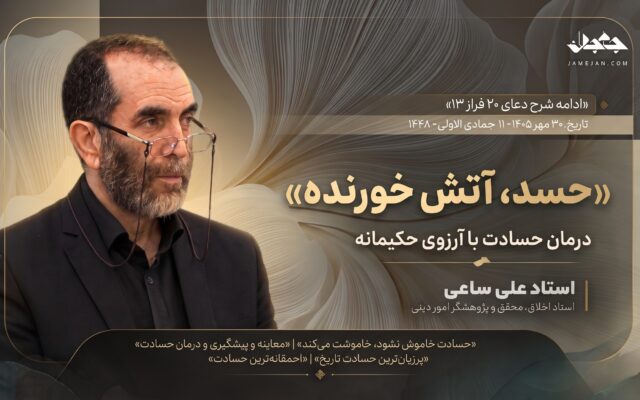
Written transcript of the lecture
The Meshkat-e Noor teachings series🌻🔆The Seer and the Forerunner in Insight (Abu’l-Fadl)🔆🌻
🌼🔆🌼Piercing Insight🌼🔆🌼
🌹🔅☘️ بِسْمِ اللَّهِ الرَّحْمنِ الرَّحيمِ ☘️🔅🌹
🔅🌹“Abu’l-Fadl’s Sovereign Insight” “The Abbasid Miracle” “The Hidden Secrets of Love” “The Mystery of Life in the Imam’s Words” “The Night of Tasūʿāʾ” and more … Summary with Supplement 1405.04.02 Ali Sa‘i (Abdullah Mishkat) 110.141(903) 🌹🔅
🌹كَانَ عَمُّنَا الْعَبَّاسُ
نَافِذَ الْبَصِيرَةِ، صُلْبَ الْإِيمَانِ,
جَاهَدَ مَعَ أَبِي عَبْدِ اللَّهِ، وَأَبْلَى بَلَاءً حَسَنًا، وَمَضَى شَهِيدًا🌷
💫Plumbing the depths of Abu’l-Fadl al-ʿAbbās’s station
in the world of the words of God’s Proof, peace be upon him💫
❇️The words of God’s Proof bring forth fresh blossoms and fruit at every moment
The Imam’s words have many layers!
The Imam’s words are alive! They grow! They blossom anew at every moment! Fruit springs from the very heart of his words! A seed of speech becomes a tree of words, with branches reaching skyward and fruit that ripens, renews itself, and multiplies!جَابِرٌ قَالَ: قَالَ أَبُو جَعْفَرٍ عَلَيْهِ السَّلَامُ💫🔆
إِنَ حَدِيثَنَا صَعْبٌ مُسْتَصْعَبٌ، لَا يُؤْمِنُ بِهِ إِلَّا مَلَكٌ مُقَرَّبٌ، أَوْ نَبِيٌّ مُرْسَلٌ، أَوْ عَبْدٌ امْتَحَنَ اللَّهُ قَلْبَهُ لِلْإِيمَانِ فَمَا عَرَفَتْ قُلُوبُكُمْ فَخُذُوهُ، وَ مَا أَنْكَرَتْ فَرُدُّوهُ إِلَيْنَا:
[1]
🔆 Jābir relates that Imam al-Bāqir (AS) said: “Our hadith—our words—are difficult and hard to grasp. None believes in them except an angel brought near, a messenger prophet, or a servant whose heart God has tested for faith. So accept what your hearts recognize, and refer back to us whatever they reject.”عَلِيُّ بْنُ إِبْرَاهِيمَ عَنْ أَبِيهِ عَنِ الْبَرْقِيِّ عَنِ ابْنِ سِنَانٍ أَوْ غَيْرِهِ رَفَعَهُ إِلَى أَبِي عَبْدِ اللَّهِ ع قَالَ: إِنَ حَدِيثَنَا صَعْبٌ مُسْتَصْعَبٌ لَا يَحْتَمِلُهُ إِلَّا صُدُورٌ مُنِيرَةٌ أَوْ قُلُوبٌ سَلِيمَةٌ أَوْ أَخْلَاقٌ حَسَنَةٌ إِنَّ اللَّهَ أَخَذَ مِنْ شِيعَتِنَا الْمِيثَاقَ كَمَا أَخَذَ عَلَى بَنِي آدَمَ أَ لَسْتُ بِرَبِّكُمْ فَمَنْ وَفَى لَنَا وَفَى اللَّهُ لَهُ بِالْجَنَّةِ وَ مَنْ أَبْغَضَنَا وَ لَمْ يُؤَدِّ إِلَيْنَا حَقَّنَا فَفِي النَّارِ خَالِداً مُخَلَّداً💫🔆.
[2]
🔆 ʿAlī ibn Ibrāhīm relates from his father, from al-Barqī, from Ibn Sinān or another narrator, through an interrupted chain of transmission from Imam al-Ṣādiq (AS), who said: “Our hadith—our words—are difficult and hard to grasp. They can be borne only by radiant breasts, sound hearts, or noble character. God took a covenant from our Shīʿa, just as He took a covenant from the children of Adam: ‘Am I not your Lord?’ Whoever remains faithful to us, God will fulfill His promise of Paradise to them; and whoever opposes us and fails to give us our due will abide in the Fire forever.”قَالَ لِي أَبُو جَعْفَرٍ ع يَا فُضَيْلُ إِنَ حَدِيثَنَا يُحْيِي الْقُلُوبَ💫🔆.
[3]
🔆 Imam al-Bāqir (AS): “O Fuḍayl, our words bring hearts to life!”
The words of the Imam have their own earth and heavens, their galaxies and stars; they grow, well forth, and renew themselves!
Who are the travelers through the earth and heavens of the words of wilayah?
Who are the riders of the words of the Ahl al-Bayt (AS)?
So let us carefully explore the words of the Imam of our time (AS) concerning Abu’l-Fadl al-ʿAbbās!
❇️Piercing insight, or the penetrating power of insight
💫🔆“ كَانَ عَمُّنَا الْعَبَّاسُ نَافِذَ الْبَصِيرَةِ، صُلْبَ الْإِيمَانِ، جَاهَدَ مَعَ أَبِي عَبْدِ اللَّهِ، وَأَبْلَى بَلَاءً حَسَنًا، وَمَضَى شَهِيدًا.”[4]
🔆Imam al-Sadiq (AS) said: “Our uncle Abbas was penetrating in insight and firm in faith. He fought alongside Abu Abdullah (Imam Husayn), acquitted himself splendidly in battle, and went forth as a martyr.”
✨Smooth translation:
“Our uncle Abbas possessed deep insight and steadfast faith. He fought at Abu Abdullah’s (Imam Husayn’s) side, distinguished himself in battle, and ultimately attained the honor of martyrdom.”
✨A stronger translation:
“Abbas, our uncle, was a man of penetrating insight and unshakable faith. With his whole being, he rose to fight alongside Abu Abdullah. In that fierce battle, he acquitted himself so nobly that he became the very standard of self-sacrifice; and at last, having reached this station, he rose from the earthly realm to martyrdom, his true home.”
💫Specialist commentary (lexical, theological, historical, and biographical)
1. Key terms examined:
“نافذ البصیره”:
“نافذ” comes from the root “نفوذ,” meaning to pass through the surface and reach the depths. Here it is a metaphor for profound insight and the ability to distinguish truth from falsehood at the most critical moments. The description points to Abbas’s elevated understanding of the status of the Imamate and the need to defend the sanctity of the Prophet’s Household—not merely to physical courage.
“صلب الایمان”:
“صلب” means hard and impenetrable, like stone or bone; that is, a faith untouched by doubt or faltering, retaining its strength in the face of adversity. The expression has roots in the Quran, as in “فَثَبِّتوا الَّذینَ آمَنوا”.
“جاهد مع أبی عبدالله”:
“جاهد,” from the verbal form “مفاعله” (جِهاد), conveys active and wholehearted participation in battle—both armed combat and resistance to psychological and political pressure. The preposition “مع” (“alongside”) emphasizes complete allegiance to the Imam, not merely physical presence.
“أبلی بلاء حسناً”:
“أبلی” comes from “بَلاء,” meaning a severe trial and a perilous battle. In Arabic military literature, the expression denotes selfless sacrifice and outstanding conduct in combat. “حسناً” (“nobly”) means that this sacrifice was of the highest order and met with God’s approval.
“مضی شهیداً”:
“مضی” means to depart from this world and journey toward the Hereafter, rather than simply to die; “شهیداً” is an adverbial complement, meaning that he departed in the state of martyrdom—not merely that he was killed.
The martyrdom of حضرت عباس is not merely a historical event but a symbol of absolute obedience to the infallible Imam and of reason guided by love. The words “جاهد مع أبی عبدالله” show that the greater jihad—the struggle against the self—and the lesser jihad—armed combat—were united in him.
The phrase “مضی شهیداً” expresses the belief that martyrdom is not the end of the way, but an elevation of one’s being to the station of divine nearness. The word “مضی” (“departed”) is used instead of “مات” (“died”) to affirm the continuation of life in the Hereafter—the life of blessedness.
4. Literary and rhetorical note:
The use of emphatic adjectives—“نافذ,” “صلب,” and “حسناً”—in this brief text creates a sonic harmony and highlights three dimensions: insight, conviction, and action. The implicit contrast with qualities such as poor insight, weak faith, and disgraceful conduct among the enemy also clearly delineates the boundary between truth and falsehood.
Summary: This passage encapsulates all of the virtues of حضرت عباس (AS) in a single sentence, presenting him as a model of the insightful, steadfast, self-sacrificing believer and martyr in the cause of the Imamate—one whose place in Islamic history was secured not by the sword alone, but by insight and faith.
❇️Insight is an arrow made of light and knowledge
نَفَذَ السهمُ – نفوذاً و نفاذاً: The arrow struck its target, passed through it, and emerged on the other side.
Penetrating insight: an insight that pierces the heart of realities and emerges beyond them!
Insight that penetrates is victorious and prevailing!
Insight like an arrow of knowledge shot toward the unknown and its secrets, splitting open and ploughing through the core of questions, bringing forth the blossoms of truth, knowledge, and wisdom!
Penetrating speech: speech that reaches into the depths of the heart and emerges on the other side!
It conquers the heart!
Passages: points of penetration.
نفذ = مضاء: proceeding, passing through!
✨🔆«یا مَعْشَرَ الْجِنِّ وَ الْإِنْسِ إِنِ اسْتَطَعْتُمْ أَنْ تَنْفُذُوا مِنْ أَقْطارِ السَّماواتِ وَ الْأَرْضِ فَانْفُذُوا لا تَنْفُذُونَ إِلَّا بِسُلْطانٍ» (Surah al-Rahman, verse 33)
🔆“O company of jinn and humankind, if you can pass beyond the bounds of the heavens and the earth, then pass beyond them. But you cannot pass beyond them without authority (power and proof).”
“Company” refers to a group of ten or more, gathered together.
“Ability” means the attainment of readiness for an action required by a command and a duty.
“Bounds” is the plural of “bound” (with a ḍamma), meaning sides and distinct, limited regions; its root sense is the cutting off and separation of a part from the whole.
“Authority” is a verbal noun, like “forgiveness,” meaning mastery accompanied by superiority in any matter.
This verse indicates that jinn and humankind have no power to penetrate or enter the regions and bounds of the heavens and the earth—whether material or spiritual. They can do so only if they attain mastery and superiority over the other beings of the heavens and the earth. But how could they ever attain such mastery and superiority?
If human beings and jinn cannot penetrate any realm or any region within it, and all are subject to God’s precise laws, powerless and subdued before the ordinances and systems of the universe, how could they disobey, rebel against, and defy the majesty of God, the Mighty, the Most High?!
❇️The Sovereign Insight of Abu al-Fadl
Abu al-Fadl’s insight is sovereign; it encompasses every region of existence!
❇️Penetrating Hearts
His pure spirit and awe-inspiring presence penetrate the annals of history and the hearts of believers, of all people, of prophets and saints; they reach into souls, the unseen realm, and the very life of the Imamate.
His love, his power of attraction, penetrates every pillar of existence.
💫🔆عَنْ أَبِيهِ عَنْ ثَابِتِ بْنِ أَبِي صَفِيَّةَ قَالَ: نَظَرَ سَيِّدُ الْعَابِدِينَ عَلِيُّ بْنُ الْحُسَيْنِ ع إِلَى عُبَيْدِ اللَّهِ بْنِ عَبَّاسِ بْنِ عَلِيِّ بْنِ أَبِي طَالِبٍ فَاسْتَعْبَرَ ثُمَّ قَالَ مَا مِنْ يَوْمٍ أَشَدَّ عَلَى رَسُولِ اللَّهِ ص مِنْ يَوْمِ أُحُدٍ قُتِلَ فِيهِ عَمُّهُ حَمْزَةُ بْنُ عَبْدِ الْمُطَّلِبِ أَسَدُ اللَّهِ وَ أَسَدُ رَسُولِهِ وَ بَعْدَهُ يَوْمَ مُؤْتَةَ قُتِلَ فِيهِ ابْنُ عَمِّهِ جَعْفَرُ بْنُ أَبِي طَالِبٍ ثُمَّ قَالَ ع وَ لَا يَوْمَ كَيَوْمِ الْحُسَيْنِ ع ازْدَلَفَ عَلَيْهِ ثَلَاثُونَ أَلْفَ رَجُلٍ يَزْعُمُونَ أَنَّهُمْ مِنْ هَذِهِ الْأُمَّةِ كُلٌّ يَتَقَرَّبُ إِلَى اللَّهِ عَزَّ وَ جَلَّ بِدَمِهِ وَ هُوَ بِاللَّهِ يُذَكِّرُهُمْ فَلَا يَتَّعِظُونَ حَتَّى قَتَلُوهُ بَغْياً وَ ظُلْماً وَ عُدْوَاناً ثُمَّ قَالَ ع رَحِمَ اللَّهُ الْعَبَّاسَ فَلَقَدْ آثَرَ وَ أَبْلَى وَ فَدَى أَخَاهُ بِنَفْسِهِ حَتَّى قُطِعَتْ يَدَاهُ فَأَبْدَلَهُ اللَّهُ عَزَّ وَ جَلَ بِهِمَا جَنَاحَيْنِ يَطِيرُ بِهِمَا مَعَ الْمَلَائِكَةِ فِي الْجَنَّةِ كَمَا جَعَلَ لِجَعْفَرِ بْنِ أَبِي طَالِبٍ وَ إِنَّ لِلْعَبَّاسِ عِنْدَ اللَّهِ تَبَارَكَ وَ تَعَالَى مَنْزِلَةً يَغْبِطُهُ بِهَا جَمِيعُ الشُّهَدَاءِ يَوْمَ الْقِيَامَةِ.[5]
💫🔆 It is narrated from his father (Imam Sajjad? or the narrator), from Thabit ibn Abi Safiyya, who said: The master of the worshippers, Ali ibn al-Husayn (Imam Sajjad (AS)), looked at Ubayd Allah ibn Abbas ibn Ali ibn Abi Talib and began to weep. Then he said:
“No day was harder for the Messenger of God (PBUH) than the day of Uhud, when his uncle Hamza ibn Abd al-Muttalib—the Lion of God and the Lion of His Messenger—was killed. After that came the day of Mu’ta, when his cousin Ja‘far ibn Abi Talib was killed.”
Then he said: “No day was like the day of Husayn (AS), when thirty thousand men descended upon him—though they believed themselves to belong to this community—and all sought nearness to God عزّ و جلّ تقرّب by shedding his blood, while he adjured them by God, but they would not take heed until they killed him unjustly and transgressed all bounds.”
Then he said: “May God have mercy on Abbas. He truly showed selflessness and strove [for his brother], giving his life for him until both his hands were severed. In their place, God, Mighty and Exalted, bestowed upon him two wings with which he flies in Paradise alongside the angels, just as He did for Ja‘far ibn Abi Talib. Indeed, Abbas holds such a rank before God, Blessed and Exalted, that all the martyrs will envy him on the Day of Resurrection.”
💫Abu’l-Fadl, envied by Yahya ibn Zakariya; Hamza, the master of the martyrs of his age; Ja‘far al-Tayyar; and the martyrs of Badr, Uhud, Hunayn—and all the martyrs of the world!
Abu’l-Fadl, peace be upon him, is truly the red rose of all the martyrs of the world!
❇️A penetrating look at the hadith describing him as “penetrating in insight”
With this wording, the destination is made clear from the outset:
It shows that Abu’l-Fadl’s insight is always victorious on the field;
With Abbas, insight reached its perfection! It is as though, with Abbas, insight was elevated into Abbasian insight!
Abbas bestowed nobility upon the quality; it was not the quality that bestowed nobility upon Abbas!
1. The grammatical role (case analysis) of “نافذ البصیره” and “صلب الایمان”
In the phrase “كان عمّنا العبّاس نافذَ البصیرةِ، صلْبَ الإیمانِ,” these two expressions are the second and third predicates of “كان” (or, as some grammarians explain it, they are both considered a single predicate because they refer to the same subject). The more precise analysis, however, is as follows:
| Expression | Primary role | Morphological–syntactic analysis – نافذَ |
| Predicate of “كان” (accusative) | An adjective of inherent quality (صفت مشبّهه), conveying constancy and permanence. It follows the pattern “فاعل” and denotes an essential attribute. | البصیرةِ |
| Genitive complement (مضافٌإلیه) | This is an explicative or specifying construct: it does not restrict “insight” but identifies the subject and domain of penetration—penetration into what? Into insight. | صلْبَ |
| Predicate of “كان” (accusative) | An adjective of inherent quality, meaning firmness and impenetrability. | الإیمانِ |
| Genitive complement (مضافٌإلیه) | Again, this is a specifying construct: firmness in what domain? In faith. | A subtle grammatical point: |
Here, “نافذ” and “صلب” are not nouns on their own; together with their genitive complements, they form adjectival-construct phrases, known in Arabic as “الإضافة الوصفیّة” (“descriptive annexation”). Compared with the ordinary form (
»), this construction has greater semantic density and shows that the quality has become an ingrained disposition and trait of the person described, rather than something incidental or temporary.مثلاً «نافذةٌ بصیرتُه2. The reason the adjective precedes the noun it describes (نافذ before بصیرت / صلب before ایمان)
In Arabic, the usual rule is for the noun to precede its adjective (
»). Here, however, the adjective (نافذ/صلب) is deliberately placed before the noun it describes (بصیرت/ایمان). This fronting brings about three fundamental changes in meaning and rhetoric:مثلاً «رجلٌ عالمٌa) A shift from mere description to central emphasis
If the wording were “العبّاسُ نافذَةٌ بصیرَتُه,” the emphasis would fall on insight itself (that is, insight of a penetrating kind). But when it says “نافذُ البصیرةِ,” it means that penetration is the principle and foundation, while insight is merely the sphere in which that penetration manifests itself. In other words:
First construction: Insight = the focus; penetration = its quality.
Second construction: Penetration = the focus; insight = its sphere.
Rhetorical effect: Abbas’s (AS) very essence is “penetration”; it is not that he possesses penetrating insight. This means that penetration has become an established, abiding quality in him.
b) Creating “restriction and exclusivity” (qaṣr) through fronting
In Arabic rhetoric, whenever an attribute is placed before the noun it qualifies, it conveys a measure of distinction and exclusivity. That is:
“نافذ البصیره” = the penetration particular to his insight (not to the insight of others).
“صلب الایمان” = the firmness particular to his faith (not ordinary faith).
Thus, fronting in a sense distinguishes Abbas from all others who possess penetration or faith, placing him at the very summit.
c) Conceptual sequencing from cause to effect (or root to branch)
With the natural word order (“penetrating insight”), the listener would first attend to “insight,” then to its penetration. But by placing “penetrating” before “insight,” the audience’s mind first encounters the idea of “penetration” (the primary cause of insight’s strength), then turns to the ground in which it operates—insight. This sequence signals an ontological order of priority:
Where does penetrating insight originate? In steadfast faith.
Thus, placing “penetrating” before “insight” prepares the mind to grasp “steadfast in faith,” for it is steadfast faith that makes insight penetrating.
In truth, the relationship between these two attributes (penetrating in insight / steadfast in faith) is sequential and causal:
Steadfast in faith → penetrating in insight → good action (noble striving).
3. The rhetorical shift produced by fronting (at the level of the whole expression)
When both attributes are foregrounded in place of the nouns they qualify, the expression shifts from simple description to a definition of essence. In other words, the sentence “کان عمّنا العبّاس نافذ البصیره…” no longer says, “These were Abbas’s qualities”; rather, it says, “Abbas is the very embodiment of these two concepts.”
Moreover, placing “penetrating” and “steadfast”—both active, transitive attributes—before the complement lends the description vitality and dynamism. Abbas is not merely a passive person endowed with insight; within him lies the active agency of penetration and firmness.
4. Final rhetorical and theological synthesis
| Element | When the attribute follows (ordinary order) | When the attribute is fronted (the expression under discussion) |
| Focus of the expression | Insight / faith | Penetration / firmness |
| Semantic force | Descriptive (qualitative) | Essential and ontological |
| Emphasis on | The presence of the attribute | The attribute’s depth and dominance over what it qualifies |
| Rhetorical effect | Conveying information | Evoking spiritual awe and grandeur |
Theologically speaking, these acts of fronting portray for al-ʿAbbās the station of the “tranquil soul”: a station in which neither insight rules over his penetration nor faith over his firmness. Rather, he himself is the living embodiment of “unseen penetration” and “unshakable steadfastness.” This is precisely the meaning expressed in the visitation texts that call him “باب الحوائج” and “قمر بنی هاشم”: these constructions evoke the image of a wholly God-centered human being, whose attributes have reached their highest perfection and become one with his very soul.
❇️Expanded analysis:
First level: grammatical analysis (syntax and morphology) from a comparative perspective
1. A precise analysis of the construct forms in “نافذُ البصیرةِ” and “صلبُ الإیمانِ”
In Arabic, the construct (iḍāfa) has two main types:
| Type of construct | Example | Characteristic |
| Formal (non-semantic) construct | “غلامُ زیدٍ” | The first noun has no independent meaning here; the second noun simply identifies it. |
| Semantic (specifying) construct | “کاتبُ الرسالةِ” | The first noun is usually an active participle or an adjective denoting an inherent quality, while the second specifies the object or domain of that quality. |
Here, “نافذ” and “صلب” are both adjectives denoting enduring qualities, and their constructs are of the “explanatory specifying” type. That is:
نافذُ البصیرةِ = “one whose penetration is defined in the domain of insight” (not penetration into wealth or status).
صلبُ الإیمانِ = “one whose steadfastness is manifest in the sphere of faith” (not in physical strength or worldly resolve).
A precise morphological point:
The pattern “فاعل” in “نافذ” usually denotes the agent of an instantaneous action (as in “ضاربٌ,” meaning “one who is striking now”). But when it functions as an adjective denoting an enduring quality and appears in a construct (نافذُ البصیرة), it conveys an established and lasting disposition: penetration is rooted in his very nature, not merely a passing state. This is precisely the distinction Arabic makes between “عالمٌ” (one who is knowledgeable) and “عليمٌ” (one whose knowledge is intrinsic); here, however, the construct combines both senses in a single pattern.
2. The place of these two attributes in the structure of a “كان” sentence
The sentence begins with “كان,” a defective verb used here to emphasize that the qualities endured in the past, rather than being present only at the moment of martyrdom. The clause has three predicates of “كان”:
1. نافذَ البصیرةِ (first predicate)
2. صلبَ الإیمانِ (second predicate)
3. مجاهِداً مع أبیعبدالله (third predicate, expressed as an active participle)
This multiplicity of predicates itself points to a process of spiritual perfection: first, insight (penetrating vision); then its source (steadfast faith); and finally, its practical expression (struggle). In effect, “كان” here expresses a causal sequence:
Steadfast faith → penetrating insight → noble struggle → martyrdom.
3. Placing the adjective before the noun from the perspective of information structure
In functional linguistics, word order depends on whether information is definite or indefinite, and given or new. The general rule is for the noun (usually definite) to precede the adjective (which is indefinite or less specific), so that the listener first learns the subject and then hears its description. Here, however, the adjective comes first: new and prominent information (penetration and firmness) precedes the familiar subject (insight and faith). This means that:
The point of the sentence is not to introduce “Abbas” (who is already known to the audience), but to emphasize the unparalleled heights of his qualities amid the crisis of Karbala.
In effect, the sentence is saying: if we speak of Abbas, it is not because of his lineage or tribe, but because of these two astonishing qualities.
Level Two: Rhetorical Elaboration (the sciences of meaning, figurative language, and rhetorical embellishment)
1. Why “نافذ” was chosen over its synonyms
Arabic has several words for keen vision:
بصیر = seeing
حدید = sharp-sighted
ثاقب = piercing (as in “ستارهی ثاقب”)
نافذ = one that passes through the surface and reaches the depths.
“نافذ” was chosen from among these because it carries three distinct layers of meaning:
1. Penetrating to the reality of things (intellectual insight)
2. Penetrating the enemy’s heart (awe and courage)
3. Penetrating the layers of time and space (for the martyr has crossed the Barzakh and reached the celestial realm)
By contrast, “steadfast” (صلب), unlike “strong” or “firm,” carries the sense of an unbreakable hardness.
2. The rhetorical device of “paronomasia” in the ordering of the attributes
Placing “penetrating” before “insight” and “steadfast” before “faith” creates an implicit correspondence:
Penetration corresponds to insight (since insight is the means of penetrating meaning).
Steadfastness corresponds to faith (since faith requires deep-rooted solidity).
But this ordering turns correspondence into causation:
Being “penetrating” manifests itself in “insight,” while being “steadfast” reveals itself in “faith.” The sentence thus comes to mean that Abbas’s very essence is full of “penetration” and “steadfastness,” which find expression in the two domains of insight and faith—not that insight and faith are incidental attributes of his.
3. The rhetorical device of “antithesis” in the context of Karbala
On that very day of Ashura, the enemy possessed:
Blind insight (for they failed to see the truth)
Weak faith (for they pledged allegiance to Yazid)
Vile jihad (for they fought in the cause of rebellion)
Thus, describing Abbas with these attributes implicitly sets him against the entire Kufan army. The ordering of the attributes intensifies this contrast, as if to say: “penetration” against their “stagnation,” and “steadfastness” against their “humiliation.”
Level Three: Theological and Philosophical Elaboration (Ontological and Mystical)
1. The relationship between “penetrating in insight” and “steadfast in faith” and the theory of “degrees of faith”
Faith has degrees, from “imitation” to “realised knowledge” to “the eye of certainty.” Describing faith as “steadfast” indicates that Abbas’s faith had reached the degree of “the truth of certainty”: a faith in which he himself—not proof, transmitted reports, or even mystical unveiling—had become faith. This is the same “firm faith” attributed to Abraham (AS) in the Qur’an: “وَإِبْرَاهِيمَ الَّذِي وَفَّى” (Najm 53:37).
For this reason, in the visitation texts Abbas is described as “a righteous servant” (عبدٌ صالحٌ): “steadfast in faith” means that he had attained the station of pure servanthood, in which no doubt or uncertainty can find a place.
“نافذٌ فی کلِّ شیءٍ بِإذنِ Allah”)
The second degree = insight (the manifestation of penetration in the realm of knowledge)
The third degree = steadfast faith (the manifestation of penetration in the realm of will and action)
3. The relationship between this ordering and Abbas as “the firm rope”
In Shi‘i literature, Hadrat Abbas is called “the Gate of Needs.”
One who is “penetrating in insight” passes beyond the surface of people’s needs and reaches the heart of what they truly need. And one who is “steadfast in faith” can stand firm and unflinching in the station of intercession.
Level Four: Psychological and Social Elaboration (The Phrase’s Educational Function)
1. How the ordering conveys a “comprehensive model of resistance”
If we were to expand on this phrase for a contemporary audience, the placing of “penetrating” and “steadfast” first teaches us that in particular circumstances, such as Ashura:
The first need is “penetrating insight”: seeing the reality behind the veil of deception (rather than being swept along by passing emotions).
The second need is “steadfast faith”: standing by what insight has revealed (rather than surrendering to circumstances).
But the reverse order—“penetrating insight” and “steadfast faith”—would suggest: first gain insight, then strive to make it penetrating; first believe, then make your faith steadfast. The order used here conveys something different: penetration and steadfastness are two essential pillars that must be firmly established within you before all else; insight and faith then become their manifestations.
This is a profound lesson in spiritual formation. Many of us seek “insight” and “faith” first, while neglecting “penetration” and “steadfastness.” Yet these are the foundations of knowledge and commitment.
2. The rhetorical effect of this word order in Ashura sermons
In sermons and elegies, when this phrase is recited, the preacher’s emphasis on “penetrating” and “steadfast” (often drawing out the words) unconsciously shifts the audience’s attention from ordinary qualities to exceptional ones. This ordering is, in effect, a form of rhetorical foregrounding that prompts listeners to reflect on Abbas’s very nature—not merely on his deeds.
Final summary (a detailed comparative table)
| Dimension | When the quality follows the noun (the usual form) | When the quality precedes the noun (the final wording) |
| Grammatical construction | A simple attributive construction | A specifying construction with causal significance |
| Semantic rhetoric | Emphasis on the presence of the quality | Emphasis on the quality’s precedence over the person it describes |
| Ontology | The quality is incidental to the essence | The quality is an established disposition of the essence, preceding its manifestations |
| Formative function | Encouragement to acquire insight and faith | Encouragement to make penetration and steadfastness an inner foundation before all else |
| ConclusionUltimate conclusion | Abbas, a figure possessed of lofty qualities | Abbas, the living embodiment of divine insight and steadfastness |
❇️Insights into Clear-Sightedness, the Core of Faith:
A dry staff in the hand of Moses works miracles! It turns a stick into a serpent, parts the sea, and makes springs gush forth!
A ring on Solomon’s finger works miracles!
Dhu’l-Faqar in Ali’s hand works miracles!
One cry of “یا الله” makes Ali, peace be upon him, the Hand of God and the conqueror of Khaybar!
That staff, that ring, and Dhu’l-Faqar, in any hand but a pure soul’s, would be the source of no miracle!
An arrow reaches its mark through the archer’s strength and steadfastness!
Faith works miracles in Abbas’s heart!
Insight works miracles in Abbas’s heart!
Pure love fills the world with the finest nectar of love through Abbas’s heart!
Abu’l-Fadl did not become Abu’l-Fadl through sight alone!
Sight alone did not lead Abu’l-Fadl to insight!
Rather, it was sight and insight that, through Abu’l-Fadl, attained excellence and became Abu’l-Fadl!
What is the relationship between martyrdom and Abu’l-Fadl—and between Abu’l-Fadl and martyrdom?
Through Abu’l-Fadl, martyrdom took on a different hue!
What is the relationship between love and Abu’l-Fadl—and between Abu’l-Fadl and love?
Through Abu’l-Fadl, love was born anew!
Love works miracles in Abbas’s heart, just as insight works miracles within him!
Abbas’s love, too, works miracles in hearts! But for love to work miracles, it needs a worthy vessel!
Love for each of the Household, peace be upon them, and for the pure lineage of the Imamate is, in each case, a means to a particular miracle!
🔹 The Imam’s mode of expression: “The beginning reveals the destination”
“Ontological Primacy”
In some works of the mystical literature of the Ahl al-Bayt (AS), when an attribute precedes the one it qualifies, that attribute may be understood not as something incidental to the essence, but as its very foundation, with the qualified one serving as its locus of manifestation. (Allah knows best.)
In other words:
From an ordinary perspective: Abbas is a man who attained insight and faith.
From the perspective of this hadith: through Abbas’s very being, insight and faith attained their ultimate perfection.
Thus the destination—complete insight and steadfast faith—is already apparent from the outset, in the words “piercing” and “unshakable”; for Abbas is himself the very destination, not a path leading to it.
🔹 “Through Abbas, insight was elevated into ‘Abbasian insight’!”
“Particular Gradation”
Insight is a graded reality, with weaker and stronger degrees.
In Abbas’s being, insight reaches the degree of “the eye of certainty”—a degree at which it is no longer merely a “means of knowing,” but becomes an “existential identity.”
Thus “Abbasian insight” means an insight that, through Abbas’s very being, has undergone a fundamental transformation and attained such piercing power as is found in no other human being, save the Infallibles.
A linguistic proof of this claim: in Arabic, when we say “رجلٌ عَدْلٌ,” we mean a man who is justice itself, not merely just. Here, too, “نافذُ البصیرة” means one who is himself the very essence of penetrating insight.
🔹 “Abbas ennobled the attribute; it was not the attribute that ennobled Abbas.”
| A superficial view | A deeper view (the mysticism of the Ahl al-Bayt) |
| Insight ennobles Abbas | Abbas ennobles insight, for insight without Abbas is incomplete |
| Faith makes Abbas steadfast | Abbas lends faith its strength, for in the vessel of his being, faith reaches the summit of firmness |
| Martyrdom makes Abbas noble | Abbas ennobles martyrdom, for martyrdom without Abbas does not shine with such splendour |
The rational basis for this claim: in the order of creation, when the “locus of manifestation” is perfect, it brings to perfection that which is manifested. By virtue of his innate purity and his special bond with divine authority, Abbas possesses such capacity that every attribute in him reaches its highest possible degree.
🔹 Subtleties of “piercing in insight” and “unshakable in faith,” illustrated through Quranic and historical examples
“The Alid Principle of Power Manifested in Things”
| Outward element | Its possessor | Power manifested | The lesson |
| A dry staff | Moses (AS) | Turning into a serpent, parting the sea, bringing forth a spring | A lifeless object performs miracles through God’s mighty hand |
| A ring | Solomon (AS) | Dominion over the jinn and the wind | Through its association with a Prophet, an inanimate object becomes invested with divine authority |
| Dhu’l-Fiqar | Ali (AS) | The conquest of Khaybar | Through its association with an Imam, a sword surpasses its ordinary limits |
| An arrow | A skilled archer | Striking its target | The power lies not in the arrow, but in the archer’s will |
Insight is like that staff and ring: in Abbas’s heart, it not only becomes piercing, but becomes miraculous in itself.
Faith is like Dhu’l-Fiqar: in Abbas’s breast, it attains such firmness that it shatters the mountains of the enemy’s doubt.
Love is like the “يا الله” uttered by Ali (AS): in Abbas’s heart, it blazes so fiercely that it fills the world with the pure nectar of love.
In conclusion: the staff in Moses’ hand, the ring in Solomon’s hand, and the Dhulfiqar in Ali’s hand worked miracles only through their “connection to their bearer.” Likewise, insight, faith and love attain this degree of wonder-working only in the vessel of Abbas’s being.
🔹 “Abu al-Fadl did not become Abu al-Fadl through sight; rather, sight became insight through Abu al-Fadl!”
The secret of grammatical precedence
If we say, “Abbas possessed insight,” we imply that insight was an external instrument at his disposal.
But when the Imam says «نافذُ البصیرةِ» (“penetrating in insight”), placing “penetrating” before “insight,” it means that Abbas’s very essence is penetration, and insight is simply the domain in which that penetration is manifested.
Thus:
“Sight” (the outward eye) in Abbas is ordinary.
“Insight” (the inward eye) in Abbas is sublime.
But Abbas’s becoming “Abu al-Fadl” is due neither to sight nor to ordinary insight; rather, it is because sight and insight themselves, in the light of his being, have been raised to “fadl” (absolute excellence).
In mystical terms: “The locus of manifestation becomes the mirror in which an attribute is revealed.” In other words, Abbas has such capacity that he draws the attribute of insight beyond its ordinary limits and transforms it into “Abbasian insight.”
🔹 “With Abu al-Fadl, martyrdom took on a different hue! With Abu al-Fadl, love was born anew!”
These two statements point to Abbas’s unique relation to abstract concepts:
| Concept | In the ordinary view | In relation to Abbas |
| Martyrdom | The end of earthly life | An elevation of being: Abbas transformed martyrdom from an “event” into an “identity” |
| Love | An emotional feeling | A source of grace: Abbas’s love is so profound that it can transform hearts |
The philosophical reason: in the order of being, any concept, when manifested through a more perfect “locus of manifestation,” itself attains a higher perfection. In Abbas’s being, martyrdom has gone beyond “a heroic death.” And in his breast, love has risen from a human emotion to “celestial love”—a love capable of working miracles in hearts.
🔹 “Love works miracles in Abbas’s heart, just as insight is wonder-working.”
❇️Love transforms states
🌷🔆 وَ قَالَ أَمِيرُ الْمُؤْمِنِينَ ع حُبُّ اللَّهِ نَارٌ لَا تَمُرُّ عَلَى شَيْءٍ إِلَّا احْتَرَقَ وَ نُورُ اللَّهِ لَا يَطْلُعُ عَلَى شَيْءٍ إِلَّا أَضَاءَ وَ سَمَاءُ اللَّهِ مَا ظَهَرَ مِنْ سَحَابٍ تَحْتَهُ I [superfluous] شَيْءٌ إِلَّا غَطَّاهُ وَ رِيحُ اللَّهِ مَا تَهُبُّ فِي شَيْءٍ إِلَّا حَرَّكَتْهُ وَ مَاءُ اللَّهِ يَحْيَا بِهِ كُلُّ شَيْءٍ وَ أَرْضُ اللَّهِ يَنْبُتُ مِنْهَا كُلُّ شَيْءٍ فَمَنْ أَحَبَّ اللَّهَ أَعْطَاهُ كُلَّ شَيْءٍ مِنَ الْمُلْكِ وَ الْمِلْكِ
🌷🔆 Amīr al-Mu’minīn (AS): “Divine love is a fire that passes over nothing without consuming it, and the light of God that shines on nothing without setting it aglow.
[Love] is God’s sky, overshadowing every cloud that appears beneath it; God’s wind, stirring whatever it blows upon; God’s water, by which all things live; and God’s earth, from which all things grow.
So whoever loves God, He will grant them everything in the realms of dominion and the unseen.”
💫The lamp of divine love, the sky of divine love, the fragrance of divine love—the passage and flow of divine love through Abu al-Fadl al-Abbas’s every fibre, through the very particles of Abbas’s soul!
Its heat releases the power and hidden inner energy within. Love’s effect on being, its tumult, ardour and movement, drives it to the utmost motion. God’s love in Abbas’s heart is the greatest storm of divine miracle!
The love of Abbas, kindled in hearts, is a gentle warmth from the fire of divine love—a warmth that should give rise to wonders of servitude to God within them!
It must be renewed and sustained at every moment: a continual transformation, with light ascending beneath a sky filled with rain-bearing clouds!
The fire of pure love purifies!
❇️ Love is a great trust from God
قَالَ النَّبِيُّ ص إِذَا أَحَبَّ اللَّهُ عَبْداً مِنْ أُمَّتِي قَذَفَ فِي قُلُوبِ أَصْفِيَائِهِ وَ أَرْوَاحِ مَلَائِكَتِهِ وَ سُكَّانِ عَرْشِهِ مَحَبَّتَهُ لِيُحِبُّوهُ فَذَلِكَ الْمُحِبُّ حَقّاً طُوبَى لَهُ ثُمَّ طُوبَى لَهُ وَ لَهُ عِنْدَ اللَّهِ شَفَاعَةٌ يَوْمَ الْقِيَامَة[6]
🌷🔆 The words of the Noble Prophet (PBUH): “When God loves a servant from among my community, He casts love for that servant into the hearts of His chosen ones and into the souls of the angels and the inhabitants of His Throne, so that they may love him.
Blessed, then—again and again—be that true lover! And he will have intercession with God on the Day of Resurrection.”
💫 Let the love of the family of divine authority never make us complacent. For if we are not worthy of them, it will not merely fail to save us—it will drown us, as it drowned Pharaoh!
❇️ Love holds sway over hearts
✨🔆 Ta-Ha: 39 أَنِ اقْذِفيهِ فِي التَّابُوتِ فَاقْذِفيهِ فِي الْيَمِّ فَلْيُلْقِهِ الْيَمُّ بِالسَّاحِلِ يَأْخُذْهُ عَدُوٌّ لي وَ عَدُوٌّ لَهُ وَ أَلْقَيْتُ عَلَيْكَ مَحَبَّةً مِنِّي وَ لِتُصْنَعَ عَلى عَيْني
🔆 “Place him in a chest and cast it into the sea; the sea will carry it ashore, where an enemy of Mine and his will take him.” And I cast upon you love from Me, so that you might be formed and nurtured under My watchful gaze.
💫 In Abbas’s heart, an ocean of love; a vessel of love to cross its waves
The Merciful and Mighty God cast love for Abbas into hearts—not merely so that it might grow within them, but so that it might nurture them, guide them and give them life.
We, too, have duties in return for the blessing of love for Abbas!
Love for Abbas has a claim upon us!
❇️ Love that distinguishes, love that is a distinction, and love that is a test—love as an opportunity
قَالَ رَسُولُ اللَّهِ ص إِنَّ حُبَّ عَلِيٍّ قُذِفَ فِي قُلُوبِ الْمُؤْمِنِينَ فَلَا يُحِبُّهُ إِلَّا مُؤْمِنٌ وَ لَا يُبْغِضُهُ إِلَّا مُنَافِقٌ وَ إِنَّ حُبَّ الْحَسَنِ وَ الْحُسَيْنِ قُذِفَ فِي قُلُوبِ الْمُؤْمِنِينَ وَ الْمُنَافِقِينَ وَ الْكَافِرِينَ فَلَا تَرَى لَهُمْ ذَامّاً
وَ دَعَا النَّبِيُّ الْحَسَنَ وَ الْحُسَيْنَ قُرْبَ مَوْتِهِ فَقَبَّلَهُمَا وَ شَمَّهُمَا وَ جَعَلَ يُرَشِّفُهُمَا وَ عَيْنَاهُ تُهْمِلَان[7]
The Prophet said that love and affection for Ali have been placed in the hearts of the believers; thus only a believer loves him, while only a hypocrite harbours hatred and enmity toward him. But love for Hasan and Husayn has been placed in the hearts of believers, hypocrites and unbelievers alike; that is why you will find no one who speaks ill of the two. Near the end of his life, the Prophet (PBUH) called Hasan and Husayn to him, kissed and embraced them, held them close, and wept profusely.
💫 Could anyone be more vile than a hypocrite or an unbeliever?
The hearts of believers, hypocrites and unbelievers alike became vessels for love of God’s most beloved creatures.
Love for Moses (peace be upon him) was placed at once in the hearts of his “mother, sister, brother, Lady Asiya and Pharaoh”!
This kind of love is a special opportunity and privilege for guidance—even for Pharaoh. If he cannot make use of it, it will drown him! Love for Imam Hasan and Imam Husayn (peace be upon them both) is like this, too!
So the mere presence of love is neither the end nor the final measure. This kind of love is a catalyst:
a seed that God has cast into the heart and that must be nurtured.
It brings the desolate soul to life and illuminates its darkness; it makes one’s being radiant, fragrant, and adorned, and raises the dust of the earth to the heavens!
✨🔆Āl ʿImrān: 27 تُولِجُ اللَّيْلَ فِي النَّهارِ وَ تُولِجُ النَّهارَ فِي اللَّيْلِ وَ تُخْرِجُ الْحَيَّ مِنَ الْمَيِّتِ وَ تُخْرِجُ الْمَيِّتَ مِنَ الْحَيِّ وَ تَرْزُقُ مَنْ تَشاءُ بِغَيْرِ حِسابٍ
🔆“You cause the night to enter into the day, and the day to enter into the night; You bring the living out of the dead, and the dead out of the living; and You provide for whom You will without measure.”
💫🔆 قَالَ عَبْدُ اللَّهِ بْنُ مَسْعُودٍ جَاءَ رَجُلٌ إِلَى النَّبِيِّ ص فَقَالَ يَا رَسُولَ اللَّهِ كَيْفَ تَقُولُ فِي رَجُلٍ أَحَبَّ قَوْماً وَ لَمْ يَلْحَقْ بِهِمْ فَقَالَ رَسُولُ اللَّهِ ص الْمَرْءُ مَعَ مَنْ أَحَب[8]
🔆 ʿAbd Allāh ibn Masʿūd said: A man came to the Prophet (PBUH) and asked, “Messenger of God, what do you say of someone who loves a people but does not attain their rank?” The Messenger of God (PBUH) replied, “A person is with the one he loves.”
💫A lover follows in the footsteps of the beloved and cherishes what the beloved cherishes!
The worst kind of enmity is that which enters the field of professed friendship wearing the guise of a friend: a friendship warped by self-deception, or one deliberately contrived as a deceit, professed to strike a blow—or one born of ignorance and error, which has become a torment, a pain, and a wound in the beloved’s soul!
The lover is always walking in the field of love for the beloved!
Whatever the beloved loves stirs the lover’s own desire!
This is the secret of becoming Abū al-Faḍl!
💫🔆 عَنْ أَبِي عَبْدِ اللَّهِ ع قَالَ: جُبِلَتِ الْقُلُوبُ عَلَى حُبِ مَنْ يَنْفَعُهَا وَ بُغْضِ مَنْ أَضَرَّ بِهَا[9]
🔆 Imam al-Ṣādiq (AS) said: “Hearts are formed to love those who benefit them and to hate those who harm them.”
🌼ʿAli Sāʿi (ʿAbd Allāh Mishkāt) 110.141(903)🌼
🌟 A structured summary of the text “The Insightful Guide and Forerunner (Abū al-Faḍl)”
1. Central theme: Ḥaḍrat Abū al-Faḍl al-ʿAbbās (AS) as “penetrating in insight”
The discussion of Imam al-Ṣādiq’s (AS) words—“Our uncle ʿAbbās was penetrating in insight, firm in faith…”—addresses the depth of Ḥaḍrat ʿAbbās’s (AS) insight and the steadfastness of his faith.
“Penetrating in insight” describes someone whose discernment strikes its mark like an arrow, passing beyond outward appearances to reach the heart of realities.
“Firm in faith” describes a faith that remains steadfast in the face of hardship and admits no doubt.
2. The Imam’s words: alive, dynamic, and layered
The words of the Imam—the Ahl al-Bayt (AS)—have many layers and continually yield fresh blossoms and fruits.
A hadith of Imam al-Bāqir (AS) says: “Our hadith is difficult and hard to grasp; none can bear it save a luminous breast, sound hearts, or noble character.”
The Imam’s words bring hearts to life and contain an “earth and a heaven,” “galaxies and stars.” Those who journey through these words must explore their depths with care.
3. Examining “penetrating in insight” and “firm in faith” from grammatical and rhetorical perspectives
a) Placing the attribute before the noun it modifies (“penetrating” before “insight”; “firm” before “faith”)
In the phrase “نافذُ البصیرةِ، صلبُ الإیمانِ,” the attribute precedes the noun it modifies. This placement brings about three fundamental shifts:
1. Emphasis on the central quality: “penetration” is primary, while insight is the vessel in which it appears.
2. Exclusivity: this penetrating insight is particular to ʿAbbās—not the insight of others.
3. A conceptual progression from cause to effect: “firmness in faith” causes “penetrating insight,” and “penetrating insight” leads to “excellent jihad.”
b) The Explanatory Genitive of Specification
“نافذُ البصیرةِ” means “one whose penetration is defined by insight,” while “صلبُ الإیمانِ” means “one whose steadfastness is manifest in the realm of faith.”
This genitive construction conveys an enduring quality: penetration and steadfastness were firmly rooted in Abbas (AS).
4. Penetrating Insight: An Arrow Made of Light and Knowledge
To penetrate is to pass beyond the surface and reach the depths. Penetrating insight pierces the heart of reality and emerges on the other side.
Abu al-Fadl’s sovereign insight encompassed every quarter of existence.
Penetrating hearts: his pure soul, majesty, love and power of attraction reached into every aspect of existence, every age and the hearts of the faithful.
5. The Peerless Rank of Abbas (AS) in the Words of Imam Sajjad (AS)
Imam Sajjad (AS) said: “No day is like the day of Husayn (AS)… May God have mercy on Abbas, who gave himself and laid down his life for his brother until both his hands were severed. In their place, God granted him two wings with which he flies in Paradise alongside the angels. Abbas holds such a rank before God that all the martyrs will envy him on the Day of Resurrection.”
Abu al-Fadl (AS) is the rose among all the martyrs of the world, envied by Hamza, Ja‘far al-Tayyar, Yahya ibn Zakariya and every martyr.
6. The Relationship Between “Insight” and “Abbas”: An Elevated Meaning
“With Abbas, insight rose to become Abbasian insight!”
⇒ In Abbas, insight reached the station of “the truth of certainty” and became not merely “a means of knowing,” but “an identity of being.”
“Abbas ennobled the attribute; the attribute did not ennoble Abbas!”
⇒ Abbas (AS) had such capacity that he brought every attribute—insight, faith, martyrdom and love—to its utmost possible fulfillment.
7. Quranic and Historical Images of Penetrating Insight
The dry staff in Moses’ (AS) hand worked a miracle; the ring in Solomon’s (AS) hand; Dhu’l-Fiqar in Ali’s (AS) hand.
These objects worked miracles through their association with their bearer. Insight, faith and love, too, attained the power to work miracles in Abbas’s (AS) being.
“Abu al-Fadl did not become Abu al-Fadl through sight; rather, sight became insight through Abu al-Fadl!”
⇒ In the light of his being, sight and insight themselves rose to “faḍl”—absolute excellence.
8. Divine Love: A Blazing Fire and a Radiant Light
The Commander of the Faithful (AS): “Divine love is a fire that passes over nothing without burning it, and God’s light that shines on nothing without setting it aglow.”
Abbas’s (AS) love is a gentle warmth drawn from the heat of divine love, shining upon hearts and meant to become the source of miracles in devotion.
The divine love in Abbas’s heart is the mightiest storm of divine miracle, filling the world with the pure nectar of love.
9. Love for the Ahl al-Bayt (AS): A Distinction and an Opportunity for Guidance
The Prophet (PBUH): “When God loves a servant, He casts love for that servant into the hearts of His chosen ones, the angels and the inhabitants of the Throne… Blessed is the one who truly loves!”
Love for Hasan and Husayn (AS) has been placed in the hearts of believers, hypocrites and unbelievers alike. This love is a “special distinction” that offers a path to guidance; but if it is not put to use, it can lead to drowning, as Moses’ (AS) love in Pharaoh’s heart did.
Love is a “seed” that God casts into the heart. It must be nurtured, bring life to the soul, illumine darkness and raise a person to the heavens.
10. Final Summary
His Eminence Abu’l-Fadl al-Abbas (AS) is the living embodiment of penetrating insight and unwavering faith. With an insight that pierced beyond appearances and a faith that never faltered, he fought at his Imam’s side with such valor that he became the very measure of self-sacrifice. Through his martyrdom, he attained a rank envied by all martyrs.
Love for him is the warmth of divine love. If we nurture it in our hearts, it leads us to become Abu’l-Fadl in our very being; if we neglect it, we drown in self-centredness, like Pharaoh.
11. Key concepts for quick reference:
Penetrating insight = an insight that pierces, like an arrow, to the heart of reality.
Steadfast faith = firm, unbreakable faith.
Precedence in rank = placing an attribute before the one it describes to emphasise that the attribute is intrinsic.
Abbāsian insight = insight brought to the height of perfection through Abbas’s very being.
Divine love = a blazing fire and radiant light that worked miracles in Abbas’s heart.
Love for the Ahl al-Bayt = a seed to be cultivated—not merely a feeling, but a duty rooted in our very being.
🍃 In the service of Abu’l-Fadl (AS), the guide and forerunner of insight.
🌟 Philosophical and wisdom-filled statements drawn from “The Guide and Forerunner of Insight (Abu’l-Fadl)”
1. Ontology (the study of being)
“The Imam’s words have their own earth and sky, their own galaxies and stars; they grow, well up, and renew themselves.”
⇒ The words of God’s friends are a “living reality”: they grow and bear fresh fruit not only in their own time, but in every age. This reveals the “living nature of the words of divine authority.”
“When light is martyred, it shines more brightly; when darkness draws near to light, it perishes.”
⇒ In the order of existence, martyrdom does not diminish light; it is “the height of its radiance.” And when darkness confronts true light, it is effaced and destroyed.
“Abu’l-Fadl’s sovereign insight encompasses every reach of the universe.”
⇒ The insight of God’s friends is not confined by time or place; it is an all-encompassing reality, flowing through every layer of existence.
2. Epistemology (the study of knowledge)
“The Imam’s words have many layers; with every passing moment, they blossom and bear fresh fruit.”
⇒ Religious knowledge is not static; it is dynamic, revealing new layers over time and as our vision deepens.
“Our traditions are difficult and hard to grasp. None can bear them except a luminous breast, sound hearts, or noble character.”
⇒ Knowing the truths of divine authority requires an inner capacity; not everyone can receive the mysteries of the Ahl al-Bayt (AS).
“Penetrating insight” means an insight that goes beyond the surface and reaches the depths of reality.
⇒ True knowledge does not stop at appearances; it passes beyond them and finds its way to the inner reality of things.
“Through Abbas, insight was raised to the level of Abbāsian insight!”
⇒ Knowledge has degrees. In the being of God’s friends, it reaches a level at which it becomes an “identity of being” in its own right—not merely a tool for knowing.
3. Anthropology (divine authority and human perfection)
“Abbas ennobled the quality; the quality did not ennoble Abbas!”
⇒ The perfected human being has such capacity that he brings every quality to its fullest possible expression. He is not merely “a locus in which qualities appear”; he is the one who “ennobles qualities.”
“Abu’l-Fadl did not become Abu’l-Fadl through sight; rather, through Abu’l-Fadl, sight became insight!”
⇒ Human perfection lies not in the “instrument of knowledge,” but in the way the wayfarer’s very being is bound to reality. Abbas’s (AS) very being became “the essence of insight.”
“The divine love in Abbas’s heart is one of the greatest storms of divine miracle.”
⇒ Divine love, when it finds a home in the being of the Perfect Human, becomes an “immense force” capable of transforming the world.
“On the Day of Resurrection, all the martyrs will envy Abbas’s station.”
⇒ In the order of creation, the saints occupy different ranks, and some are higher than others. This distinction depends on “the ontological relation each has to the reality of divine authority.”
4. The Philosophy of Grammar (Ontological Linguistics)
“Putting the adjective before the noun means that the quality is primary and fundamental, while the noun is its manifestation.”
⇒ In the order of being, some qualities possess “ontological primacy,” while the thing they describe is merely “the vessel in which that quality appears.” This is an “ontological” view of language.
“The explicative specifying genitive denotes an abiding and enduring quality.”
⇒ When a quality is linked to the thing it describes through a genitive construction, this indicates “that the quality is established in its essence”—not that it is incidental or temporary.
“Ranked precedence” means that firmness and fortitude are rooted in Abbas’s essence before insight and faith.
⇒ In mystical ontology, some qualities are the “substructure” of others; this precedence points to the “ontological causality of qualities.”
5. The Philosophy of Martyrdom (Ontological Optics)
“With Abu al-Fadl, martyrdom took on a different hue!”
⇒ Martyrdom is not a fixed concept; in each martyr’s being, it takes on a “distinctive quality.” Abbas’s martyrdom went beyond a “heroic death” and became an “ontological ascent.”
“He passed away as a martyr”—rather than “he died”: martyrdom is not an end, but “a passage from this world toward the blessed life.”
⇒ Martyrdom is not “biological death,” but “rebirth” in the realm of the unseen.
“In place of Abbas’s two hands, God granted him two wings with which he flies in Paradise.”
⇒ In the order of recompense, every “sacrifice” is repaid with “ontological ascent”; this is the cosmic law of “divine compensation.”
6. The Philosophy of Love (Ontological Love Studies)
“Divine love is a fire that burns whatever it passes over, and the light of God that illuminates whatever it shines upon.”
⇒ Divine love is both “overpowering” (a consuming fire) and “illuminating” (radiant light): it both “annihilates the self” and “brightens the soul.”
“The love of Abbas in people’s hearts is a gentle warmth drawn from the heat of divine love.”
⇒ The love of the saints is a “grace” from God’s love, reaching hearts through them; this is the “mediation of grace.”
“Love for Hasan and Husayn (AS) has been placed in the hearts of believers, hypocrites, and unbelievers.”
⇒ Love for the Ahl al-Bayt (AS) is a “universal gift.” Yet if it does not lead to “recognition” and “obedience,” it can become a cause of “drowning,” just as Moses (AS) was loved in Pharaoh’s heart.
“A person is with the one they love.”
⇒ Love creates an “ontological bond”: in the order of creation, a person becomes “one in identity” with the beloved.
7. The Philosophy of Insight (Epistemic Optics)
“Penetrating in insight” means that penetration belongs to insight—not that insight itself is penetrating.
⇒ In mystical ontology, some qualities are “essential,” while others are “accidental.” In Abbas’s being, penetration is “essential,” while insight is “the vessel in which it appears.”
“Insight that penetrates is victorious and triumphant.”
⇒ True insight is not “passive” but “active”: it pierces through realities and draws knowledge and wisdom from them.
“Insight is an arrow made of light and knowledge.”⟦33⟁
Knowledge is not a “defensive tool”; it is an “offensive weapon” for conquering the unknown and uncovering its secrets.
8. The Philosophy of Jihad (the Existential Study of Action)
“He strove alongside Abū ʿAbdullāh”—that is, jihad alongside the Imam, not jihad undertaken independently.
⇒ Any action, unless accompanied by “wilāya,” has no true worth. Because ʿAbbās strove alongside the Imam, his jihad became “a splendid trial.”
“أبلی بلاءً حسناً” means self-sacrifice at the highest level of excellence.
⇒ The worth of an action lies not in its “quantity,” but in the “quality of one’s alignment with the truth.” ʿAbbās’s self-sacrifice became the measure of excellence.
9. The Philosophy of Language (the Existential Study of Speech)
“The Imam’s words are alive; they grow and blossom anew with every passing moment.”
⇒ The words of God’s chosen ones are not “inanimate”; they possess “creative life”—that is, new meanings emerge from them over time.
“The Imam’s words have their own earth and sky, galaxies and stars.”
⇒ Every utterance is a “world”; and the Imam’s words contain worlds of their own, each requiring a “journey of insight” to understand.
“Who can journey through the earth and sky of the words of wilāya?”
⇒ Understanding the Imam’s words requires spiritual wayfaring; not everyone can journey through this earth and sky.
10. Final Summary (in a single aphoristic statement)
“Ḥaḍrat Abū al-Faḍl (AS) is the living embodiment of ‘sovereign insight’ and ‘unshakable faith at its highest’; through the penetration established within his very being, he passed beyond the outward forms of existence and reached the depths of the truth of wilāya. Love for him is the warmth of divine love: if we cultivate it in our hearts, it will lead us to an ‘Abū al-Faḍl-like existence’; but if we are heedless, we will drown, like Pharaoh, in the sea of our own selfishness.”
A lyrical unfolding“Abū al-Faḍl: the one who leads and the one who goes ahead in insight”
🌟 1. The Imam’s Words: A Galaxy in the Making
The words of God’s chosen ones are like the sea—not because they are deep, but because every drop is itself a sea.
The Imam’s words are like a tree rooted in the Throne, whose branches spread to the earth below. Each moment brings a fresh blossom, and each season, ripe fruit.
Our hadith is difficult—not because it is beyond understanding, but because only radiant hearts can bear the weight of its meanings.
The Imam’s words have their own earth and sky; galaxies of knowledge shine within them, and stars, each one pointing a way to the truth.
The wayfarer of these words is one who journeys through this galaxy on the feet of the heart, gathering from each star a light to guide the way.
🌸 2. Nāfidh al-Baṣīra: An Arrow That Passes Through the Heart of Reality
Penetrating insight means seeing so keenly that you pass through the surface of things and reach their core.
Just as an arrow passes through its target and emerges beyond it, the insight of ʿAbbās (AS) passed through the veils of darkness and deception to reach the light of truth.
He saw not with the eyes of the head, but with the eyes of the heart; and he thought not with earthly reason, but with heavenly reason.
And this is the secret of his martyrdom: with insight, he went to meet death, wholly out of love.
🌺 3. Ṣulb al-Īmān: A Mountain Against the Storm
The faith of ʿAbbās (AS) was like a steadfast mountain, never shaken by the storms of doubt and uncertainty.
On the day when everything was collapsing, his faith stood like a rock against which the waves of tribulation crashed, only to recede.
Ṣulb al-Īmān means one whose faith rests not on imitation, but on certainty—a certainty admitting neither doubt nor hesitation.
With this faith, he stood alone before thirty thousand enemy horsemen and cried out, “I am Abbas, son of Ali; I will not abandon Husayn.”
This was a steadfastness made harder than stone—not by force, but by love.
🌷 4. Abul-Fadl: A Love Story That Gave Martyrdom Its Radiance
Before Abbas (AS), martyrdom was the end of a life; he gave it a different hue.
His martyrdom was not an incident but an “identity”—one in which death became rebirth and blood, an eternal message.
Through his martyrdom, he taught us that even at the height of self-sacrifice, one can live so beautifully that death itself bows before such greatness.
He showed that martyrdom is not merely an “ending” but a “beginning”: a flight in which two severed hands become the wings of an angel.
With Abul-Fadl, martyrdom rose beyond “heroic death” and became a “tender act of love” for God.
🌻 5. Abbas’s Insight: A Quality Elevated by Abbas
Before Abbas (AS), insight was merely a quality; through him, it became an “identity.”
He ennobled insight; insight did not ennoble him.
Just as the staff in Moses’ hand worked miracles and the ring in Solomon’s hand held power, Abul-Fadl transformed insight into a “sovereignty” that ruled every realm of existence.
“Abul-Fadl did not become Abul-Fadl through sight; rather, through Abul-Fadl, sight became insight!”
That is, his very gaze was luminous; his very being was the essence of knowledge.
He saw not with his eyes but with his soul, and understood not with reason but with love.
🌹 6. Divine Love: The Fire That Blazed in Abbas’s Heart
Divine love in Abbas’s (AS) heart was like a fire that grew warmer and brighter the more fuel was added to it.
This fire not only consumed itself; it filled the world with the pure nectar of love.
The Commander of the Faithful (AS) said: “حُبُّ اللهِ نارٌ لا تَمُرُّ عَلى شَیءٍ إلّا احْتَرَقَ”
And in Abbas’s breast, this fire blazed so fiercely that everything other than God was consumed in it, leaving only love for God, the Messenger and the Imam.
Abbas’s love is a gentle warmth from that divine fire, shining upon our hearts too, so that it may perfume us with that same love.
🌼 7. Love of the Ahl al-Bayt: A Seed to Be Nurtured
Love of Hasan and Husayn (AS) has been sown in the hearts of believers, hypocrites and unbelievers alike.
This love is a “universal privilege”; but if it is not nurtured, it will never bear fruit, like a seed fallen on barren ground.
Love for Moses (AS) was present even in Pharaoh’s heart, but Pharaoh drew no benefit from it and was drowned.
Love of the Ahl al-Bayt is like this too: if it does not lead to knowledge and obedience, it can become a source of pride—and then of ruin.
Love, then, is not merely a “feeling”; it is an “existential duty” that must bear fruit through action.
🌿 8. Abbas, the Red Rose among Martyrs
On the Day of Resurrection, all the martyrs will envy Abbas’s (AS) rank.
He was not merely a martyr, but “the one among the elect martyrs whom all envy”: a martyr whose martyrdom was made eternal not by the sword, but by insight and love.
Hamza, Jaʿfar al-Tayyar and John son of Zechariah all bow their heads before him, for with both hands severed, he scaled a summit no other martyr has reached.
He is “بابُ الحوائج”—the Gate of Needs—not because he grants people’s requests, but because he shows the way to the true need: لقاءالله.
🌾 9. Diving into the Sea of the Imam’s Words
The Imam’s words are a sea: the deeper you dive, the more new treasures you discover.
Abbas (AS) himself was a diver in this sea. He passed beyond the outer layers of the Imam’s words and reached their subtleties and truths.
We, too, must dive into this sea—not with our hands, but with our hearts; not outwardly, but inwardly.
Every word of the Imam is an “āyah,” and every āyah has an inner dimension. Until you reach it, you remain deprived of its truth.
💫 A Final Word
O heart, if you wish to grasp insight, look to “Abbas”—for he was insight itself.
If you wish to see faith, look to “the very essence of faith”—for his faith stood like a mountain before the storm.
If you wish to taste love, step into the “divine love” in his heart—for the fire of his love perfumed the world with pure sweetness.
He is “Bāb al-Ḥawāʾij,” the Gate of Needs—not because he fulfills our small requests, but because he teaches us that our true need is nothing less than “meeting with God.”
So let us dive with him into the sea of the Imam’s words, until every drop becomes a sea within us, and every wave a storm of love and insight.
Reflections on the Sultan of Insight:
💫 Abbas’s royal insight bound him to the firm circle joined to the cord of God and to the very soul of infallibility!
💫 Abu’l-Faḍl’s penetrating insight made him the sovereign of submission to the Wilaya, and the crown of the Shi‘a!
💫 The words of the Infallible are truth, and he does not speak from the prompting of the lower self. Abbas, envied by the martyrs, bears witness to his role as their teacher: martyrdom continues to flow like a stream, even after death!
💫 Abbas is the closest jewel to the soul of Wilaya! This is the very secret of his greatness!
💫 The martyrs’ envy of Abbas increases their own share, for a new heaven opens before them, allowing them to soar again, beyond even their own station.
💫 Abbas could not carry the waterskin to the tents of the thirsty, yet it seems that his celestial waterskin quenched the thirst of their souls! His compassion is water that flows forever for the thirsty!
💫 Abbas was the meeting point of opposites, uniting courage and fearlessness with compassion and tenderness worthy of praise!
💫 True believers reach the heart of love, while others partake only of its outward form! The hypocrite and the unbeliever, if they do not attain the blessing of repentance, will be eternally bereft! Though life-giving water is present, they die of thirst, for want of faith and certainty! Love, whatever its form, is not the end of the journey; it is fuel for the ascent!
💫 Insight is impossible without reason; it shines only by the light of pure reason!
💫 Insight is impossible without a pure heart and sound reason. Otherwise, what passes for insight is merely self-deception: in truth, “mystical delusion” or “blind zealotry.”
💫 “Penetrating in insight” and “firm in faith” grow only from the soil of a pure heart.
💫 All virtues, joined together, form wondrous excellences, while strengthening one another!
💫 Virtues are medals that reveal the distinction and greatness of the one who bears them!
A quality cannot outrun the one who possesses it!
A quality becomes one with the essence of its bearer!
💫 Like the one who bears it, a quality is also created by God and has its own created nature. The bond between a quality and its bearer involves action and response: they affect one another and transform each other!
💫 Virtues guide us toward the highest degrees of tawhid, until we reach a point where we confess, “ وَ كَمَالُ الْإِخْلَاصِ لَهُ نَفْيُ الصِّفَاتِ عَنْه”
💫 “The staff, the ring, and Dhu’l-Fiqar” become sources of miracles through their owner. This reveals the capacity of the one who bears such means: not every seed takes root in every soil, and not every element combines with hydrogen to become water!
💫 Focusing on “Abbas’s insight” does not mean neglecting the other dimensions of his virtues. Rather, the constraint is a lack of space; we must pray for the grace of a wider horizon, so that we may dive into the depths of Abbas’s other acts of grace!
“Deepening Understanding”
🌟 1. Sovereign Insight: Bond with the Unbreakable Cord of Infallibility
Abbas’s (AS) insight was no ordinary insight. It bound him to the “firmest link in the cord of God” and to the very heart of infallibility.
He saw not with the eyes of the head, but with the eye of spiritual authority; he thought not with earthly reason, but with the celestial intellect of the Imamate.
This bond made him the “sovereign of submission to spiritual authority” and the “crown of the Shia”—a model for all believers of how insight can lead one, in the Imam’s service, to the highest form of devotion.
🌸 2. The Infallible’s Word: Pure Truth, Free of Self-Interest
The Infallible’s words do not spring from “self-serving desire”; they flow from “pure truth.”
When Imam Sajjad (AS) says, “Abbas is the envy of the martyrs,” this is not an affectionate compliment but a “statement about the nature of things”—a declaration that martyrdom continues to flow, martyrdom after martyrdom, like a stream.
Abbas (AS) is the teacher of martyrs: every martyr who came after him learned from his school how to face death with insight and faith, and turn martyrdom into a “lover’s wedding.”
🌺 3. Abbas: A Jewel Close to the Heart of Spiritual Authority
The secret of Abbas’s (AS) greatness lies in his being “the jewel closest to the heart of spiritual authority.”
He was not merely a loyal companion, but the Imam’s “confidant”; his bond with Husayn (AS) was not confined to the battlefield but united them in the depths of their souls.
This closeness raised him to a rank envied by all the martyrs. Their envy, however, does not arise from any sense of their own inadequacy, but from the “opening of a new heavenly expanse” in which to soar once more.
For Abbas’s (AS) rank opens a new horizon before the martyrs, enabling them, too, to rise beyond their own station.
🌷 4. Abbas’s Celestial Waterskin: Quenching Thirsty Souls
Though Abbas (AS) could not carry water to the thirsty tents, his “celestial waterskin” quenched the thirst of souls yearning for truth.
Through his compassion, he set water flowing that will never run dry: water springing from the “fountain of love,” from which whoever drinks remains quenched for all eternity.
His compassion flows not only in the moment of his martyrdom but forever, reaching those who thirst for spiritual knowledge and connecting them to the source of spiritual authority.
🌻 5. Abbas: The Meeting Point of Opposites
Abbas (AS) embodied the meeting of opposites:
He was both the bravest of soldiers and the kindest of brothers.
He was both fearless on the battlefield and deeply tender toward the thirsty children.
He was both steadfast in faith and tender-hearted in the face of a sacred cause.
This union of opposites is a sign of “existential perfection,” for perfection does not lie in being one-sided, but in “reconciling opposing qualities” within a single being.
Through this union, Abbas taught us that one can be both a “lion on the battlefield” and a “tender father,” both a “steadfast soldier” and a “lover devoted heart and soul.”
🌹 6. Love: Fuel for the Ascent, Not the End of the Journey
Love for the Ahl al-Bayt (AS), whatever the case, is not the end of the journey; it is “fuel for the ascent.”
True believers reach the “heart of love” and draw on it to climb the peaks of spiritual knowledge.
But hypocrites and unbelievers take only from the “outward form of love”; if they do not receive the grace of repentance, they become “eternal losers.”
Despite the life-giving water of faith and certainty, they die of thirst; for love, without knowledge and action, is not merely fruitless—it can become a source of pride and, ultimately, a cause of downfall.
🌼 7. Insight: A Light That Shines Only in “Pure Intellect”
Insight is impossible without reason; it shines only by the “light of pure intellect.”
Sound reason is the ground in which insight grows; penetrating insight is the fruit of this reason, illuminated by the light of wilayah.
Without reason, insight has no meaning. It becomes either “mystical delusions” or “blind fanaticism”—neither of which shows the way, and both of which can lead the spiritual wayfarer into the abyss of misguidance.
Thus, “keen of insight” and “firm in faith” grow only in the “pure soil of the heart” and beneath the “sky of sound reason”; in the shade of wilayah, they come to fruition.
🌿 8. Virtues: Medals That Reveal the Greatness of Their Bearer
Virtues are like medals, displaying the greatness of the one who bears them.
An attribute does not precede the one it describes; rather, it becomes one with that person’s essence and finds its true expression in their being.
Attributes guide us toward the highest degrees of tawhid, until we acknowledge that all attributes must be denied of God’s sacred essence—for God is beyond every attribute we know.
🌾 9. The Staff, the Ring, and Dhu’l-Fiqar: Instruments Through Which Their Bearers’ Power Is Manifest
The staff worked a miracle in the hands of Moses (AS), the ring in the hands of Solomon (AS), and Dhu’l-Fiqar in the hands of Ali (AS).
This points to the “capacity of the one who wields the means”; it does not mean that the instrument itself possesses power.
Just as not every seed flourishes in every soil, nor does every element combine with another to yield water, unless the “soil of the heart” is ready to receive the “seed of wilayah.”
A miracle, then, lies in the “will of the bearer,” not in the “instrument.” Through his insight, Abbas (AS) brought that will to its fullest possible perfection.
🌺 10. Overlooking Other Dimensions: Not from Ignorance, but for Want of Space
Our focus on “the insight of Abbas” does not mean that we have overlooked other dimensions of Abbas’s (AS) virtues; rather, we have lacked the space to explore them all.
We should ask God for “abundant grace,” so that we may become “divers of Abbas’s other virtues” and draw a new jewel from every sea of his being.
For Abbas (AS) is an ocean without shore, and each diver draws from it according to their capacity.
In a final, concise formulation:
“Abbas (AS) was not merely a discerning soldier, but the ‘sovereign of submission to wilayah’ and ‘a jewel close to the very heart of wilayah.’ Through his union of opposites, his incomparable tenderness, and his brotherly love, he taught us that insight without sound reason and a pure heart does not show the way; it becomes ‘mystical delusion.’ And if we do not reach the very core of love, it is not fuel for flight, but a source of pride and downfall. So, through God’s abundant grace, let us become divers of Abbas’s other virtues, and draw a new jewel from every sea of his being.”
🌼Ali Saei (Abdullah Meshkat) 110.141(903)🌼
[1] Al-Uṣūl al-sittata ʿashar (ed. Dar al-Hadith), p. 215 A group of scholars, Dar al-Hadith Cultural Foundation—Iran, Qom, first edition, 1423 AH / 1381 SH.
[2] Al-Kāfī (Islamic edition), vol. 1, p. 401 Kulayni, Muhammad ibn Yaqub ibn Ishaq, Dar al-Kutub al-Islamiyya—Tehran, fourth edition, 1407 AH.
[3] Al-Khiṣāl, vol. 1, p. 22 Ibn Babawayh, Muhammad ibn Ali, Qom Seminary Society, first edition, 1362 SH.
[4] In Mourning for the Prince of Freedom (Translation of مثير الأحزان); p. 254 Ibn Nama al-Hilli, Ja‘far ibn Muhammad; edited by Ali Karami Haziq; Iran, Qom, first edition, 1380 Sh.
[5] الأمالي( للصدوق) ؛ النص ؛ p. 462 Ibn Babawayh, Muhammad ibn Ali; edited by Ketabchi; Tehran, sixth edition, 1376 Sh.
[6] مصباح الشريعة ؛ p. 192 Attributed to Ja‘far ibn Muhammad, peace be upon him; Alami; Beirut, first edition, 1400 AH.
[7] مناقب آل أبي طالب عليهم السلام (لابن شهرآشوب) ؛ vol. 3 ؛ p. 383 Ibn Shahrashub Mazandarani, Muhammad ibn Ali; edited by Allameh; Qom, first edition, 1379 AH.
[8] عمدة عيون صحاح الأخبار في مناقب إمام الأبرار ؛ النص ؛ p. 278 Ibn Bitriq, Yahya ibn Hasan; Qom Seminary Teachers’ Association, Islamic Publishing Institute; Qom, first edition, 1407 AH.
[9] الكافي (ط – الإسلامية) ؛ vol. 8 ؛ p. 152 Kulayni, Muhammad ibn Ya‘qub ibn Ishaq; Islamic Books Publishing House; Tehran, fourth edition, 1407 AH.