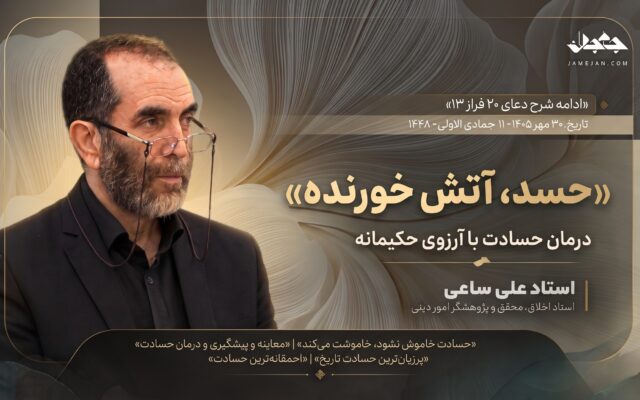
Written transcript of the lecture
The Meshkat-e Noor teachings series🌻🔆 🔆🌻
🌼🔆🌼The Most Subtle Form of Shirk🌼🔆🌼
🔹Weekly Sessions on the Commentary and Interpretation of al-Sahifa al-Sajjadiyya (Supplication 20)
📅 Date: 1404/08/29 – 29 Jumada al-Awwal 1447
✨ Session: Meshkat-e Noor
🎤 Speaker: Master Ali Saei
📝 Some of the topics covered in the session:
🕊 The discourse opens with blessings upon Muhammad and his family
(11) اللَّهُمَّ صَلِّ عَلَى مُحَمَّدٍ وَ آلِهِ، وَ اجْعَلْ أَوْسَعَ رِزْقِكَ عَلَيَّ إِذَا كَبِرْتُ، وَ أَقْوَى قُوَّتِكَ فِيَّ إِذَا نَصِبْتُ، وَ لَا تَبْتَلِيَنِّي بِالْكَسَلِ عَنْ عِبَادَتِكَ، وَ لَا الْعَمَى عَنْ سَبِيلِكَ، وَ لَا بِالتَّعَرُّضِ لِخِلَافِ مَحَبَّتِكَ، وَ لَا مُجَامَعَةِ مَنْ تَفَرَّقَ عَنْكَ، وَ لَا مُفَارَقَةِ مَنِ اجْتَمَعَ إِلَيْكَ.
In the presence of the blessed twentieth supplication of al-Sahifa al-Sajjadiyya—the eleventh passage of Supplication 20. The Sahifa is this surging sea of the Sajjadiyya, and we are the divers who draw from this vast ocean the great pearls and jewels of this most blessed supplication. The Imam begins this blessed passage with blessings upon Muhammad and his family.
🎶 Blessings: the loveliest sound in all existence
Blessings in al-Sahifa al-Sajjadiyya are among the mysteries of Imam Sajjad (AS). Blessings are the loveliest sound in all existence, the most beautiful song in this world: blessings upon Muhammad and the family of Muhammad. These blessings, this magnificent heavenly song, this prayer that is always answered, are a song shared by human beings and all creation—from the honeybee to the angels, from the lowest to the highest, from earth to the Throne and all the way to Sidrat al-Muntaha. This blessed refrain of blessings resounds everywhere.
🔑 Blessings: the key to every difficulty and God’s unknown mercy
The Imam continues his supplication by beginning with blessings, because blessings are a remedy and a cure, a secret sweetness in this existence. They are a key—the key to every difficulty, unlocking every door. They dispel hypocrisy and bring sincerity to fruition in every soul. Blessings are God’s most unknown, particular mercy in this world: His most mysterious and least known mercy, neither of the kind associated with the All-Merciful nor with the Ever-Merciful. These blessings, this mercy, belong to a unique kind. Blessings are the most purely monotheistic form of intercession before God. If I wish to turn to God in the most beautiful way, then I must send blessings upon Muhammad and the family of Muhammad. Blessings are intercession of the highest possible order. They are the most beautiful, powerful and effective form of intercession. They are the very secret of seeking a means of access to God.
🙏 Praying under the shelter of two blessings
The most effective and most readily answered prayer—the prayer that is always answered—is blessings. So we place all our prayers between two answered prayers, between two invocations that are always answered: blessings upon Muhammad and his family. Blessings are both prayer and intercession—a golden intercession. They are both communion with God and the soundest form of seeking a means of access to God. Blessings are prayer directed to the very means of access. Through blessings, we pray by means of the means: we pray to the means itself, the means that leads us to God and serves as a means for our prayers to be answered. Blessings are a request for the growth and exaltation of this exalted means—a growth from which we benefit more and more than we can imagine. So we begin this blessed passage so beautifully: اللهم صل علی محمد و آله.
⏳ Asking for abundant provision in old age
What beautiful paths Imam Sajjad (AS) has opened for us! What mysteries he reveals to us! “O God, grant me the broadest and most abundant of Your provisions when I grow old.” “O God, make Your finest provision mine when I have grown old.” What is the mystery the Imam is teaching us here? Yes, as a person grows old, his needs grow too—not material needs, but spiritual needs, which increase more and more in old age. Old age is a time of turning, the beginning of a passage into a vast, boundless world. So I must finish the work: bring this soul of mine, this soul grown old, to its fullness through nourishment. I am in the womb of this earthly world. I must take in all the sustenance this world of being offers and enter that higher world. In other words, I must nourish this greater world within me. From now, while I am still an infant, a child, I must remember my old age. Old age is the time of ripening: the whole fruit has reached its full sweetness, and it is time to be plucked. So I must gather all the spoils I can from this world…
💪 Nourishing the spirits and soaring in weakness
…all the spoils—not only material, but material and spiritual. I must bring this body of mine to its full flowering, and nourish all the spirits within my soul: from the spirit of faith to the spirit of the body and desire, which is governed by reason. And if I can open a way to the Holy Spirit, I must nourish that too, as well as the Spirit of the Command and my reason—the hosts of reason, those seventy-five soldiers within me—bringing them to their fullness, so that I may enter that higher world with a greater world within me.
What an astonishing supplication this prayer of Imam Sajjad (AS) is! How many mysteries it holds! I cannot see them all; I have found only one of its mysteries and shared it with you: “O God, make the broadest of Your provisions mine when I grow old.” What mysteries! And: “Your greatest strength toward me when I have become weak.” When a person grows weak, he must not simply lie down to sleep. The depths of weakness are the moment to leap. This is the mystery Imam Sajjad teaches us. By God, these mysteries cannot be found anywhere else. Where can we find this Sajjad’s anthology, these Sajjadian mysteries? In Sidrat al-Muntaha? No—they are found only in the heart of Imam Sajjad. This mystery is profoundly hidden. The Imam teaches us that a day will come when we draw the fullest benefit from these mysteries; if this prayer takes root in our souls, one day it will bear fruit. We must put all these prayers into practice. When I grow weak, I must reach the very height of my abilities. How? In what way? Only by turning to the true power, that Being beyond whom there is no strength or might. Weakness, utter exhaustion, is not the time to sleep or give in; it is the beginning of a leap, the moment to take flight and rise to the summit. It is precisely when we grow weak that the nuclear force within our souls must explode. Yes, we carry immense power within us—power beyond measure, a greatness beyond all greatness, like God’s. When I reach a state of weakness, when I understand that I am weak, then I can call upon the Truly Powerful and attain that tremendous explosion of power. Yes, this is a small reward for being a disciple of Imam Sajjad. It is a great distinction. How far we would fall short if, with our Imam Sajjad, we did not scale the heights of Sidrat al-Muntaha and conquer the distance of two bow-lengths or nearer; we would have wronged Imam Sajjad.
🏃 Fleeing the trial of sloth in worship
One great mystery follows another; the farther we go, the more radiant and beautiful the jewels become: “O God, do not test me with sloth in worshipping You.” O God, do not let me be tested by sloth in worshipping You. O God, I will flee this trial. O God, do not test me with sloth in worshipping You. God, I withdraw from this test. I refuse to accept it. This is not disrespect; it is the height of courtesy. Fleeing in this way is a mark of true servitude to God. It is a victory, not a defeat. We must shun such trials and absent ourselves from them. To pass the test of weariness in serving God is to flee from that test. A test of sloth in loving and cherishing God… No, God, I do not want to be slothful in loving and cherishing You.
👁🗨 Avoiding Blindness on the Path: The Way of the Qur’an and the Ahl al-Bayt
And “O God, I do not wish to be blind on Your path.” I do not wish to be tested by blindness on Your path. If I become blind to the path, I will be blind in heart. Are there people who have accepted this kind of trial—weariness and blindness on the path of God? How many blind people there must be who have accepted this trial and are lost in error. To accept such a trial is the height of ignorance. Perhaps those who have fallen and become unjust in this world are precisely those who willingly took on this kind of trial. They failed to understand that this was the very trial they should have fled from. We must never close our eyes, even for a moment, to the way of the Qur’an. I do not want to turn my eyes away from the Qur’an, Muhammad, and his family.
💡 Seeing the Way: Love Joined with Knowledge and Obedience
The way of God is the Qur’an and the Ahl al-Bayt. How many blind people read the Qur’an! How many blind people speak of the Ahl al-Bayt! They claim to love the Ahl al-Bayt, yet recite and follow what is other than the Qur’an and the Ahl al-Bayt, without understanding. O God, I wish to be clear-sighted on Your path, with my eyes always open, fixed upon and illumined by Your two weighty trusts. Blindness on the path means love without knowledge. Blindness on the path means love without obedience. I know of no greater blindness than to claim love for the Qur’an and the Ahl al-Bayt, yet not walk their path or submit to them. Yes, we must relinquish many of our own choices. I say without hesitation that all the corruption in the world stems from this blindness on the path of God.
💔 Fleeing from Opposition to God’s Love
“O God, I do not wish to turn away and oppose Your love.” O God, I do not wish to follow a path contrary to Your love. I do not wish to turn my back on the abode of Your love. O God, I did not realize that even for a moment I had turned to other than You—and so had turned to what was other than Your love. I had cut myself off from all love. O God, I seek refuge in You from acting in opposition to Your love. Love itself is a path; it has a destination, and it is a wing with which to fly. I must take flight and reach the highest destination.
🤝 Avoiding Those Who Have Fallen and Keeping Company with Those Who Have Turned Away from God
“O God, I do not wish to keep company with those who have separated themselves from You.” O God, I seek refuge in You from keeping company with those who have strayed far from You. O God, how could I keep company with those who have fallen to the lowest depths—those who have plunged into the pit of filth? I seek refuge from the company of those who have cut themselves off from You, becoming companions of the lowest and most base. I do not wish to befriend those who have turned away from Your most perfect order, those who have been transformed. If we could taste the joy of communion with God, of His signs, and of the words of His saints, we would not flee. The sweetness of gatherings devoted to intimacy with the Qur’an and the Ahl al-Bayt—and our avoidance of such gatherings and of the Ṣaḥīfa Sajjādiyya—show that we have become companions of the fallen; we have joined the misguided.
🫂 Staying Connected to Those Who Gather in the Cause of God
And “not to be separated from anyone who has gathered in Your direction.” O God, how could I separate myself from someone who seeks only You? I ask You not to let me part from those whose hearts overflow with love for You. If I part from those who are Your companions, I will incur Your wrath. If I flee from the light, I will go blind and sink into darkness. Who can flee the sun without sinking into darkness? Whoever flees the flower garden ends up among the flies. Why did the fly become a fly? Why did the beetle and the mouse sink to such degradation? Because they fled from Your companions, ran from the flowers, and became companions of filth.
🚀 Rushing with God in Times of Need
What profound mysteries lie within the prayers of Imam Sajjad! “O God, make me rush with You when I am in need, when necessity calls.” O God, make me such that, when necessity arises, I rush with You. O God, when my needs and necessities come rushing upon me, make me such that with You I rush into the very heart of hardships and afflictions. What could a person not do if they rushed with God? Nothing can withstand such a rush. How can I attain the power that never wanes? It is a mystery—the very mystery Imam Sajjad teaches us.
What might I accomplish if I found this spirit within myself? In my personal life, in politics, society, and leadership—what could I not do? Someone who faces political, moral, managerial, and global challenges in this spirit will find no problem insurmountable. We need people who rush with God into the heart of difficulties, so they may perceive God’s solution with the eye of direct witnessing. And: “I ask You that, in times of need, I call upon You alone.” Could anyone turn to another when in need? How many people call upon other than God even when they are not in need! How often, when need has come upon us, have we forgotten the Reliever of Needs? Is it only in times of desperation that we cry out, “أَمَّن یُجِیبُ الْمُضْطَرَّ”? How can a person turn to anyone but God when in need? Need itself is God’s voice, calling me toward Him. God is calling us. He has awakened my longing so that I may call upon Him. Do not forget to call upon God at the time of need.
😭 Sincere Supplication to God
“I ask You to let me plead with You alone, and no other, in times of poverty, helplessness, and utter need.” O God, I want to beseech You alone. I want to rub myself into the dust before You. O God, make me break myself before You alone, pour myself out for You alone. “O God, do not put me to the test.” O God, do not subject me to that particular trial of Yours: that, when I am desperate, I should stretch out a begging hand to anyone but You, or seek help from anyone but You. What astonishing words! What hidden mysteries they contain! This is a prayer of the elect. We must listen with the ear of the heart. Prophets must recite this prayer and implore God to answer it. What a secret! Could anyone become desperate and call upon someone other than God? I have heard that it can happen—and has happened! When a person reaches a state of utter distress, they call upon God alone, and that is all. God alone is present in their heart, and that is all. Anyone who forgets God even in a state of utter distress is seeking to sever their bond with God once and for all. We become desperate, and our innate nature awakens. When people board a ship and find themselves amid towering waves, at risk of drowning in a storm, they call upon God sincerely. But once they reach dry land, they become polytheists. Desperation awakens a person’s innate nature and turns them toward God. Someone who does not call upon God in desperation has allowed polytheism to take such hold of their soul that they do not realize they are calling upon someone other than God, believing all the while that they are calling upon God. We are all afflicted by this in our time. This truth is becoming manifest. Why, and how? In desperation, everyone calls upon God alone. So why does Imam Sajjad seek refuge from it? He prays this way so as not to fall into this trial. Why does he teach us this prayer in these words? Someone who does not remember God in a state of distress has, in effect, severed the vein of their monotheistic nature. So let us take stock of ourselves right now, in our own times of distress. In those moments, whom do we remember? Whoever we call upon in desperation is the very object of worship we have worshipped all our lives. A desperate cry for help belongs to God alone; no one else has any share in it. This is the very mystery that Muhammad and the Household of Muhammad have repeatedly impressed upon us. With this phrase, Imam Sajjad (AS) reminds us of this most grievous calamity, so that we may flee from it. To call upon someone other than God in times of distress is pure, sincere worship of the one we call upon.
🚫 Refraining from Humbling Oneself and Supplicating Before Anyone but God
This is no longer hidden idolatry, for it occurs in the purest state of worship, and only in a moment of utter need. “O God, do not let me humble myself in asking, in begging from anyone but You when I fall into poverty.” “And do not let me humble myself in asking when I am destitute.” Humility is the formal expression of worship. We want to display our inner state in the most beautiful way. That beautiful outward expression is the humility we show. It is the measured grace of our movements. This is humility: I present my whole bearing and appearance to Him. I want to offer myself to Him in the most beautiful humility I can; that is what humility is. This humility belongs to God. Let us not humble ourselves in this way before anyone but God in times of poverty and helplessness. Humility is the most beautiful way of expressing servitude to God. A time of poverty is a time of trial, when a person discovers whether they worship God or someone besides Him. Poverty puts us to the test; it comes crashing down upon us. If we turn away from God, we have surely lost. If we turn to someone besides Him, we have chosen another to worship.
🛑 The entitlement to be delivered for fleeing from evils
And “nor to plead and lament before anyone but You when fear overwhelms me.” Times of poverty and fear are times to prove the sincerity of one’s devotion to God. Supplication is when a person, at the height of helplessness, cries out in distress—like a child weeping and restless, searching for arms to hold them. That is supplication: asking with one’s whole being. Supplication means seeking safety and peace, the safety and peace found only at God’s threshold. When a child cries and grows restless, they are seeking their God; and God sends their mother to the very one they were seeking. He places love for the child in the mother’s heart. These are signs of God’s care. A mother’s embrace is the embrace of God’s mercy. This is how it is for everyone. Everyone should feel this way toward their Lord.
So that I may “O God, through all these wrongs of mine, become deserving of Your deliverance and protection, not deserving of Your turning away and withdrawing from me, O Most Merciful of the merciful.”