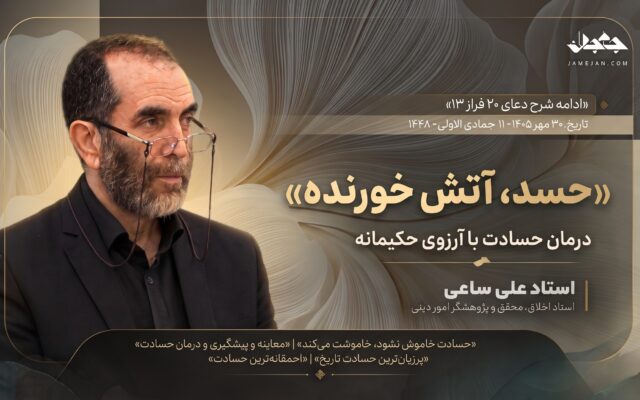
Written transcript of the lecture
The Meshkat-e Noor teachings series🌻🔆🔆🌻
🌼🔆🌼The Attributes of the Governor🌼🔆🌼
🔹Weekly sessions of commentary and interpretation of Sahifa Sajjadiyya (the Twentieth Supplication)
📅 Date: 1404/07/24 – 23 Rabi’ al-Thani al-Thani 1447
✨ Session: Meshkat-e Noor
🎤 Speaker: Master Ali Saei
📝 Some of the points raised in the session:
📿 “The Adornment of the Righteous and the Beauty of the God-fearing”
(10) اللَّهُمَّ صَلِّ عَلَى مُحَمَّدٍ وَ آلِهِ، وَ حَلِّنِي بِحِلْيَةِ الصَّالِحِينَ، وَ أَلْبِسْنِي زِينَةَ الْمُتَّقِينَ، فِي بَسْطِ الْعَدْلِ، وَ كَظْمِ الغَيْظِ، وَ إِطْفَاءِ النَّائِرَةِ، وَ ضَمِّ أَهْلِ الْفُرْقَةِ، وَ إِصْلَاحِ ذَاتِ الْبَيْنِ، وَ إِفْشَاءِ الْعَارِفَةِ، وَ سَتْرِ الْعَائِبَةِ، وَ لِينِ الْعَرِيكَةِ، وَ خَفْضِ الْجَنَاحِ، وَ حُسْنِ السِّيرَةِ، وَ سُكُونِ الرِّيحِ، وَ طِيبِ الْمُخَالَقَةِ، وَ السَّبْقِ إِلَى الْفَضِيلَةِ، وَ إِيثَارِ التَّفَضُّلِ، وَ تَرْكِ التَّعْيِيرِ، وَ الْإِفْضَالِ عَلَى غَيْرِ الْمُسْتَحِقِّ، وَ الْقَوْلِ بِالْحَقِّ وَ إِنْ عَزَّ، وَ اسْتِقْلَالِ الْخَيْرِ وَ إِنْ كَثُرَ مِنْ قَوْلِي وَ فِعْلِي، وَ اسْتِكْثَارِ الشَّرِّ وَ إِنْ قَلَّ مِنْ قَوْلِي وَ فِعْلِي، وَ أَكْمِلْ ذٰلِكَ لِي بِدَوَامِ الطَّاعَةِ، وَ لُزُومِ الْجَمَاعَةِ، وَ رَفْضِ أَهْلِ الْبِدَعِ، وَ مُسْتَعْمِلِ الرَّأْيِ الْمُخْتَرَعِ.
📜 “The Purifying Wine of the Sajjadiyya”
The tenth passage of the twentieth supplication of Sahifa Sajjadiyya; after our Imam adorned us with all the ornaments of the world, he now wishes to bring us into the very soul of the world. We have cultivated ourselves, and now the Imam wishes us to cultivate the world as well. The Imam taught us the path and method of attaining the heights of moral excellence, and now is the time to make use of those noble traits and lofty virtues. For what purpose was all that wealth of noble traits? We wish to trade; we wish to cultivate both this world and the next; to free ourselves from ourselves, to step outside our own soul and join the world; we wish to adorn the world too with those same noble traits and lofty virtues. Our Imam does not approve of our standing still; we must set out continually, continually crawl toward the summit, leap, fly; always be ascending; move upward. Stagnation in the school of Imam Sajjad is forbidden. This is the “appointed meeting with God”; the Sahifa Sajjadiyya is the place of encounter with the Beloved; this is itself a kind of Hajj. We intend our God, we reach the meeting with our Beloved; we take the greatest share from this encounter and meeting and nearness. This is the purifying wine of the Sajjadiyya, which it keeps giving us to drink, and at every moment draws a new taste into our experience. This is the Imam of light, this is the life of knowledge; our Imam Sajjad is the life of noble traits, of lofty virtues; our Imam Sajjad is the life of greatness—the cause of living. With the Imams we taste the flavour of life; when we are in the company of our Imam Sajjad, we are the confidants of our Beloved; we taste the flavour of worship.
👑 “The Adornment of the Righteous and the Beauty of the God-fearing”
Blessings upon blessings; that is, with every breath of our life we must continually refresh our soul through the breathing of blessings upon Muhammad and the family of Muhammad. O Lord, adorn me with “the adornment of the righteous”; O Beloved, clothe me in the adornment of the righteous. “Hilya” means anything with which one is adorned, and hilya also means countenance, beauty, attribute. He asks God—on our behalf—that we become a place for the adornment of the righteous. O God, adorn me with the attributes of the righteous; O God, beautify me with the beauty of the worthy; O God, adorn me with the ornament of the righteous and the worthy; O God, make me a covering of the righteous; and clothe me with “the beauty of the God-fearing”—O God, may I be clothed in “the garment of the people of piety.” Why does the Imam wish to adorn us thus in “God’s salon of adornment”? What is the goal? What revolution do we wish to bring about in this world of existence? He wishes us to be adorned with the adornment of the righteous and clothed in “the beauty of the God-fearing” so that we may begin the most wondrous act of servitude to God. This is the highest ornament: when, with the help of our Lord, we adorn ourselves with the adornment of the righteous and wear “the beauty of the God-fearing” upon our spirit and soul like a garment, it means we become the most beautiful face of this world of existence; we leave the world astonished at us. Now I understand: it is the beginning of the mission; this garment, this adornment, this beauty, is the weapon of our mission in this world of existence—we wish to carry out the mission; to complete the servitude of God.
⚖️ “The Extension of Justice and the Suppression of Anger”
What are we to do? What storm are we to set loose in this world of existence? To carry out this mission, our first task—once we have donned this “garment of servitude”—is to “spread justice.” We must make justice prevail throughout this world. It is the “first” task, not the “last”; it continues. If I cannot do it, then I have not yet begun to serve God; I am lame and powerless, with no strength in this world of existence. Until I am adorned with the qualities of the righteous and clothed in the adornment of the God-conscious, I will be unable to spread justice. I will play no part in this world of existence; I will bring no good to anyone; I will bear no fruit. The tree of my servitude will have neither leaves nor fruit, and no sweetness or nourishing drink will flow from me.
How am I to be adorned with the qualities of the righteous and clothed in the raiment of the God-conscious? From the beginning of the supplication up to this point—up to the “tenth passage”—the Imam has been preparing us for this adornment; he has made us worthy of this “garment of the God-conscious.” He did so from the very start of the intimate prayer, through the way he prayed. Now I understand what my Imam has done: he has prepared us for a great mission; he has equipped us, teaching us all knowledge so that we may adorn the world with its light, set it in motion, and become effective in this world of existence.
Indeed, the “qualities of the righteous” and the “adornment of the God-conscious” are prerequisites for the renewal of the soul and of the worlds. Until now, whatever I have done, I have done for myself: I have prepared myself; I have become beautiful—but for the sake of my God. Now I want to adorn the world with that same beauty. Now is the time to build and cultivate.
But what great lesson does the Imam wish to teach us? Who is worthy to lead the work of renewing the world? He reveals to us the secret of pure supplication: the secret of cultivation, leadership, and governance. Without the qualities of the righteous and the garment of the God-conscious, this is possible for no one. Whoever has not adorned and clothed himself in the qualities of the righteous and the adornment of the God-conscious can have no agency in bringing about good and what is right—it is impossible. The duties of worthy leadership are precisely the truths the Imam has laid out for us, one by one. These two qualities—the qualities of the righteous and the adornment of the God-conscious—are the driving force behind the flourishing of the soul and the worlds. Every leader, wherever they may be in this world, must possess these two qualities for their good to reach society and the world. Together, they mean a community grounded in virtue and excellence; they mean both ability and knowledge; they are essential conditions for spiritual, social, and political stewardship.
🏛 “Spreading justice and restraining anger”
In spreading justice, I want to enter into the very heart of this world and make justice prevail. That means I have attained justice within myself; I have become an embodiment of justice; I myself am just—and now I want my presence to spread throughout this world of existence. If I had not attained the “order of justice”—if I were not upright—how could I make the world upright? If I am upright, then, through those two qualities, justice blazes within me. This justice is a sovereign, and forbearance is one of its ministers—the very forbearance we have been speaking of.
So now we understand: the Imams have planted the foundations of justice in our hearts and beings, and we did not even know it. They have prepared us and made us worthy of every sphere of renewal in the very heart of this world, so that we may sow and cultivate spirituality in it, spread justice, and shine like light throughout this world of existence, illuminating it with the light of justice—with justice’s gentleness.
And “swallowing one’s anger”—“كَظْمِ غَيْظ”: am I supposed to swallow my own anger? No. The Imam has revealed something else: if I could not contain my anger—if I could not practice “كَظْمِ غَيْظ”—then I would not have been adorned with the qualities of the righteous. So I am capable of mastering myself; I contain my anger. I swallow it within myself; I seal myself like a waterskin filled to the brim, so that not a drop leaks out. The force within me must be held in check so that I do not become turbulent. I keep that volcano contained within myself, ready to expend its force where it is needed, so that no child can make me lose control. I have bound myself fast. I preserve God’s immense power within me. I am like nuclear energy: I do not let power pour out of God’s reactor without measure. I must release this energy in a measured way, so that I may illuminate the world.
“غَيْظ” is the agitation and boiling up that a person stirs within himself because of aversion, then vents outward. Something particularly upsetting happens to us at someone’s hands; it throws us into turmoil—that is “غَيْظ.” As for “غَضَب,” the Imam places it opposite “رِضا.” So I have swallowed my anger. I want to quell all anger in this world—not merely to control my own anger, but to extinguish the fire of anger. I am to become a firefighter against anger.
🤝 “Putting out the blaze and reconciling those estranged”
What a remarkable passage: in pursuit of restraining anger, and to quench the flames of discord, enmity and resentment, once I have subdued my own anger—once I have bound it—I must then quench every fire, every discord, every enmity and resentment in this world of being. I would become a “volcano of discord”—I ask God to make me a “volcano that pours out enmity and anger.” And “reuniting those who have been separated”: I must stitch back together all those who have fallen out. I ask God to make me a “tailor of hearts,” sewing hearts back together and putting an end to estrangement. In other words, I ask God to make me a “bone-setter for His servants,” a mender of their broken hearts: to heal and stitch those shattered hearts together, to reunite them, and to become “a peacemaker among people.” Every hurt, every resentment, every enmity and every rift between people—I must set all of it right; I must “rebuild” what has been broken, “mend people’s relationships,” and sow affection and compassion among them. And “revealing what is known to be good”: I must bring to light every good thing recognized as good—every “maʿrūf.” To make goodness visible, I must become a “disseminator of what is good,” spreading every virtue and beauty in this world of being. I must become a “divine waterfall”; I must become “God’s paradise,” showing forth every beautiful scene, revealing every joy, becoming a grand display of God.
🕊 «سَترِ العائِبة، لِینِ العَریكة و خَفضِ الجَناح»
And to “conceal every fault that has been exposed”—a fault that affects this world and harms it, like rubbish whose foul stench offends the world’s senses—I ask my God to grant me the power to conceal such faults. The blemishes must be covered; infections must be dried up; rubbish must be removed, and “moral waste” must be cleared from the world in every form. And “gentleness of temperament and character”: “ʿarīka”—the camel’s hump—I want to become “soft in ʿarīka,” like the camel’s hump, which does not hurt its rider: it is gentle and tender, and whoever rides upon it feels that softness beneath them. I ask God to make me, too, a gentle support for His servants—to make me tender; to carry society on my back and draw it towards progress, gently and joyfully. I must become a “vessel,” a heavenly vessel; whoever travels with me should experience nothing but joy, and wish to remain in my company always. All this is necessary in individual, communal and global life alike. Every leader must possess these qualities; without them, they are deficient and will hurt and bring down those who accompany them. And “humility and lowliness,” and “lowering the wing”: O God, grant me the grace to “lower my wing”—to break my wings. How am I to break them? Though my wings are spread wide, I must break them; then, like a bird sheltering its chicks beneath its wings, I must gather people beneath the wings of my love and compassion. I must break my wings, break myself, and become “humble,” treating people with the utmost humility and becoming for them “a warm, gentle and safe home.”
🌿 «حُسنِ السِّیرة، سُکونِ الرّیح و طِیبِ المُخالَقة»
And I ask God for “excellence of conduct”—to help me spread “good conduct” throughout this world of being. I want to become like a pure, flowing river: to stream along, embracing all whom I pass, taking them in, reaching into their very being. And “calmness and breath”—“the stilling of the wind”: I want to become like a wind at rest, a wind that has left its tempestuousness behind and come to stillness—bringing calm, offering tenderness. In other words, I want to attain the utmost dignity, to slow my pace and, like the wind, touch the soul of this world. If I wield power—if I am a ruler—then my “power and sovereignty” should be like a gentle wind that harms no one, but becomes “a tender caress to their souls.”
And “purity in companionship”—goodness of character in one’s dealings with others: I want to become like a healing medicine for the souls of all people; to reach into their souls, so that “my good character” becomes “the character of all people.” And “being first in virtue”: I want to be first in “virtue,” first in “doing good”—swift as a flash of light, to “outstrip” everything that is. “Virtue” is that exalted degree of doing good which brings about particular transformations in this earthly realm.
And “giving others precedence in generosity”: I should put others before myself; consider them “better” than myself; “choose them over myself.” I should flee self-centredness and preoccupation with myself, escape the prison of the self. How long must I keep coming back to myself? I must rise above myself and look beyond; become “one who adorns all creation”; give myself wholly in service to God’s creatures.
And “abandoning fault-finding and blame”: I should give up blaming and finding fault, and be such that I never stir a wound, never make an old wound bleed again. Rather, I should mend wounds—help them heal—not intensify the suffering of others. I should not “dig up graves,” revive faults or turn the faults of others into thorns.
And “lavish generosity toward one who does not deserve it”: Yes, I should give my life for anyone who deserves it; but even toward one who does not deserve it, I should show kindness and generosity. I should become like “God’s rain of mercy,” pouring down upon everyone, so that each may benefit from me as they are able.
And “speaking the truth”—speaking the truth, however weighty or difficult it may be. I must never sacrifice truth for anyone, make no concessions when truth is at stake, never exchange truth for anything or abandon it.
And “considering one’s good deeds few”: even if my words and actions are many, even if I am immersed in goodness, I should still count them as “few,” so that my path forward is not blocked; I should not make myself a “homebound practitioner of good” or “retire from doing good.” Even if I attain all the goodness in this world of being, I should still count it as little. What is our Imam al-Sajjad aiming at? Where is it that he wants to lead us!
🕌 “Perseverance in obedience, adherence to the community, and disavowal of the people of innovation”
And this, too: O God, “let me consider evil abundant”—let me count evil and wickedness as abundant, even if they amount to little in my words and deeds; even if there is only one tiny speck of evil within me, let me still count it as “much” or “great,” so that I may cast it away—not leave that black speck untouched, abandoned to itself.
And bring all this to “completion and perfection” for me: O God, bring everything I have asked of You to fulfilment through “steadfast obedience to You”; and “unceasing adherence to the community.” Do not separate me from my “community”; make me one of its companions—what a reckoning this is! And unceasing adherence to the community: let me regard myself as a member of this society, like part of “a single body.”
And “abandoning and keeping away from the people of innovation”: I should leave anyone who is “among the people of innovation”—anyone who would rise up against God’s religion. I should leave behind whatever opposes God’s religion or rises against it. And “one who puts an invented, heretical opinion into practice”—that is, I should refrain from becoming “an agent of an invented opinion,” from helping the views of the people of innovation come to fruition; I should become the ally and supporter of no innovator.
Yes, here is Imam al-Sajjad’s “exclusive adornment salon,” where he makes us “clothe ourselves” in golden, exalted qualities—where he adorns us. He leaves no good trait unaddressed, but adorns his followers with it and shows them the way, so that through their very presence they may adorn the whole world of being. This is “the wine of al-Sajjadiyya”: it binds each quality to the others, works “a miracle of beauty,” brings “beauty within beauty” to light. It joins beauty to beauty; it is “ornament upon ornament”—for he himself is Zayn al-‘Abidin.