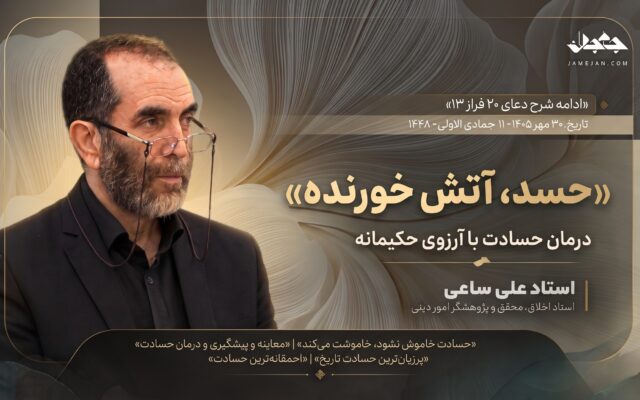
Written transcript of the lecture
The Meshkat-e Noor teachings series🌼🔆🌼Doubt-Laden, Yet Seemingly Certain🌼🔆🌼
🌹🔅☘️ بِسْمِ اللَّهِ الرَّحْمنِ الرَّحيمِ ☘️🔅🌹
🔅🌹 “Ill-Omened Suspicion” “A Journey on the Endless Road” “The Secret of the Summit of Certainty” “Further Commentary on Supplication 20 of al-Ṣaḥīfa al-Sajjādiyya” “Passage 13” and … A Summary with Supplement 1405.02.31 Ali Saei (Abdullah Meshkat) 110.141(903) 🌹🔅
🌷 🕋 اللَّهُمَّ اجْعَلْ مَا يُلْقِي الشَّيْطَانُ فِي رُوعِي 🕋 🌷
☘️☀️مِنَ التَّمَنِّي وَ التَّظَنِّي وَ الْحَسَدِ☀️☘️
🤲 ✨ذِكْراً لِعَظَمَتِكَ، وَ تَفَكُّراً فِي قُدْرَتِكَ، وَ تَدْبِيراً عَلَى عَدُوِّك✨ 🤲
❇️Analytical and mystical summary (from previous sessions): Diagnosing the harms of “desires” and defensive strategies in the struggle against the rūʿ
💫1. Defining the problem: What is the “rūʿ,” and where is the battlefield?
The concept of the rūʿ: The rūʿ is the “command center of one’s being,” beyond the heart (the seat of emotion) and the intellect (the faculty of reason). It is where the self, intellect, and spirit converge, and where a person’s identity and ultimate direction take shape.
Satan’s aim: To seize the rūʿ and alter a person’s “cognitive software,” so that sin is recast from “wrongdoing” as “truth” or “legitimate pleasure.”
💫2. Dissecting satanic weapons: A destructive triad
Satan uses three psychological and existential tools to weaken the will:
Desire (false aspiration): Creating an artificial sense of lack and trapping people in a cycle of consumerism and the gratification of superfluous appetites.
Suspicion (destructive assumptions): Eroding social and divine trust, and plunging a person into isolation and distrust.
Envy: Destroying gratitude and turning others’ success into a threat to one’s own peace of mind.
Causal relation: Desires are the seeds of suspicions, and both give rise to envy.
💫3. Conceptual roots: From “munī” to “amāniyyāt”
The word’s root: The word “munī” originally means “to decree” and “to long for something to come to pass” (like semen, which is emitted with desire).
Amāniyyāt (ill-omened desires): When wishes and wants are shaped by the lower self’s appetites, without regard for external reality, they become “amāniyyāt.”
The danger of interpreting through amāniyyāt: When religious and social realities are judged through the filter of the lower self’s appetites, this leads to worship of desire. This is the worst kind of “interpretation according to personal opinion,” which distorts religion and leads people to choose unfit leaders.
💫4. Defensive measures: A threefold strategy
To resist the seizure of the rūʿ, Imam Sajjād (AS) offers the following practical model:
Reflection (understanding): Knowing oneself, understanding how the self operates, and contemplating God’s power and wisdom.
Remembrance (an energetic shield): Shifting one’s focus from creation to the Creator. Remembering God’s greatness renders desire powerless before His self-sufficiency, suspicion before His knowledge, and envy before His good pleasure.
Deliberate action (practical response—redirecting energy toward what is higher): Turning negative energy into good deeds:
Turning greed into generosity.
Turning suspicion into a warm, loving conversation.
Turning envy into prayers for others.
💫5. An essential distinction: Worldly desires versus yearning for the encounter with God
Worldly desires lead to self-abasement, evasion of responsibility, and the silencing of conscience (the reproaching self).
Divine yearning (the encounter with God): This is the pinnacle of spiritual ascent. The measure of sincerity in faith is the “longing for death” in order to reach God (based on verses 94 and 95 of Sūrat al-Baqara). Those who yearn in this way see death as the gateway to meeting the Beloved, not the end of pleasure.
💫6. Final Conclusion: Transforming the Map of Being
The person who succeeds in this struggle is a “wise gardener,” not a passive soldier. By bringing together understanding (reflection), love and commitment (remembrance), and practical skill (wise planning), this gardener not only clears the garden of their own being of the pests of the self and Satan, but also purifies society and the surrounding environment of envy, suspicion, and consumerism, guiding them towards felicity and flourishing.
Central message: The supplication “اللَّهُمَّ اجْعَلْ مَا يُلْقِي الشَّيْطَانُ فِي رُوعِي…” is not a request for a miracle, but a plea to receive a tool of understanding that can turn Satanic threats—desires and conjectures—into materials for building the palace of servitude to God.
❇️Section 13 Supplication 20: The Sublime Teaching of Imam Sajjad (peace be upon him)
Section 13 of Supplication 20 in al-Sahifa al-Sajjadiyya is like a system for “turning darkness into light, hell into paradise, fire into water, desert into garden, earth into the heavens, the earthly realm into the celestial, pain into healing, threat into golden opportunity, descent into ascent, disarmament into renewed strength, Satan’s laughter into his wailing and lament, and a journey from ruin to renewal.”
This passage of the supplication reveals the key to changing Satan’s paradigm, strategy, and sinister designs—and to dispelling the awe he falsely inspires.
The path from worldly desires to the conjectures born of them, and their mingling with envy, creates the conditions for capturing the human faculty of perception (ruʿ). This supplication offers a practical way to thwart Satan’s efforts to achieve that end.
❇️A major instrument of colonization, exploitation, stupefaction, and intellectual impoverishment
Nurturing desires is a prison built for life.
“Worldly desires” are seeds of decline, Satan’s hunting net, and a breeding ground for vile conjectures.
The “ruʿ,” as the faculty of perception, is like the operating system, the central processor—the CPU—and it is captured through desires.
Idol worship is a form of desire worship!
❇️Vile desires produce vile conjectures
💫The fruit of desires “arising from one’s own self, from others, and from Satan” is dark and vile conjecture.
💫 Conjectures are the result of desires in whose formation the human essence and intellect have played no part. By “intellect” is meant the guide to noble character, not mere outward, material awareness.
💫 Conjecture is an unreal image of reality, acquired by a path that is neither true nor rational.
💫 Conjecture is the molten lava of desires untutored by reason.
💫 Rationally grounded supposition stands in the arena and on the path leading to knowledge and certainty.
💫 Irrational supposition lies on the path to ignorance and doubt.
💫 With reason, the human heart is like a beehive: a hive of noble qualities, a temple and sanctuary, a lofty throne. It is a garden of Paradise and of God’s good pleasure.
💫 When reason is absent, ignorance takes command, and the human heart becomes a pit of depravity and defilement.
❇️White and black supposition: “supposition approaching certainty and doubt-ridden supposition”
✨🔆 Yunus: 36 وَ ما يَتَّبِعُ أَكْثَرُهُمْ إِلاَّ ظَنًّا إِنَّ الظَّنَّ لا يُغْني مِنَ الْحَقِّ شَيْئاً إِنَّ اللَّهَ عَليمٌ بِما يَفْعَلُونَ
🔆 Most of them follow nothing but conjecture (and baseless imaginings); yet conjecture can never make a person independent of the truth (or lead them to it). Surely God is fully aware of what they do.
If certainty scores one hundred, a score above 50 falls in the white realm of supposition, rising towards the summit of certainty, illumination, and knowledge. A score below 50 lies in the dark, vile realm of doubt: it is a downward fall, towards ignorance and the lowest depths!
Certainty is a lofty station that even those who are humble before God have not yet attained; they are still on the ascending path, in the realm of white supposition!
✨🔆Al-Baqarah: 45 وَ اسْتَعينُوا بِالصَّبْرِ وَ الصَّلاةِ وَ إِنَّها لَكَبيرَةٌ إِلاَّ عَلَى الْخاشِعينَ
🔆Seek help through patience and prayer; (draw strength from perseverance, mastery over your inner desires, and turning your attention to the Lord.) This is indeed difficult, except for the humble.
✨🔆Al-Baqarah: 46 الَّذينَ يَظُنُّونَ أَنَّهُمْ مُلاقُوا رَبِّهِمْ وَ أَنَّهُمْ إِلَيْهِ راجِعُونَ
🔆They are those who believe they will meet their Lord and return to Him.
💫🔆In the Tafsir of Ali ibn Ibrahim, it is related that he said: In the Book of God, ظن has two meanings:
one is certainty, and the other is doubt. In this passage, it means certainty. As for its meaning of doubt, examples include His words:
إِنْ نَظُنُّ إِلَّا ظَنًّا. وَ ما نَحْنُ بِمُسْتَيْقِنِينَand His words: وَ ظَنَنْتُمْ ظَنَّ السَّوْءِ.[1]
🔆The Tafsir of Ali ibn Ibrahim states:
“ظن” (supposition) has two meanings in the Book of God:
One is “ظن” in the sense of “certainty,” and the other is in the sense of “doubt.” Thus, in this verse under discussion, “ظن” means certainty. Examples of “ظن” meaning doubt include:
God’s words: «إِنْ نَظُنُّ إِلَّا ظَنًّا… وَ ما نَحْنُ بِمُسْتَيْقِنِينَ» (“We have only a doubtful supposition … and we are not among those who are certain”).
And also God’s words: «وَ ظَنَنْتُمْ ظَنَّ السَّوْءِ» (“You were harbouring suspicion and doubt”).
💫🔆فِي كِتَابِ التَّوْحِيدِ حَدِيثٌ طَوِيلٌ عَنْ عَلِيٍّ عَلَيْهِ السَّلَامُ يَقُولُ فِيهِ وَ قَدْ سَأَلَهُ رَجُلٌ مِمَّا اشْتَبَهَ عَلَيْهِ مِنْ الْآيَاتِ: فَأَمَّا قَوْلُهُ «بَلْ هُمْ بِلِقاءِ رَبِّهِمْ كافِرُونَ» means الْبَعْثَ فَسَمَّاهُ اللَّهُ عَزَّ وَ جَلَّ لِقَاءَهُ وَ كَذَلِكَ ذَكَرَ الْمُؤْمِنِينَ يَظُنُّونَ أَنَّهُمْ مُلاقُوا رَبِّهِمْ يَعْنِي أَنَّهُمْ يُوقِنُونَ أَنَّهُمْ يُبْعَثُونَ وَ يُحْشَرُونَ وَ يُحَاسَبُونَ، وَ يُجْزَوْنَ بِالثَّوَابِ وَ الْعِقَابِ- وَ الظَّنُّ هَاهُنَا الْيَقِينُ.[2]
💫🔆The book Tawhid relates a lengthy hadith from Imam Ali (peace be upon him), in which he responds to a man’s questions about the obscurity of certain verses:
Regarding God’s words, «بَلْ هُمْ بِلِقاءِ رَبِّهِمْ كافِرُونَ» (“Rather, they deny that they will meet their Lord”), the meaning is resurrection. God, Mighty and Majestic, has called this return “meeting Him.”
And of the believers He has said: «يَظُنُّونَ أَنَّهُمْ مُلاقُوا رَبِّهِمْ» (“They believe they will meet their Lord”).
Here, “ظن” means that they are certain they will be raised, gathered, called to account, and recompensed with reward or punishment. Thus, in this passage, “الظنّ” means certainty.
💫So ظن may be divided into two broad categories: “the certainty-like ظن and the doubt-laden ظن.”
❇️The wayfarer presses on towards the summit of certainty
To stand still or become self-admiring on the path of servanthood is to court ruin! Anyone who becomes enamoured of the spiritual stations and ranks they have attained will perish; and if they lose the desire to continue onward, they too will be lost!
The one who acts must become a worshipper, and the worshipper must advance to the station of the learned; the learned must ascend to the rank of the truthful, and the truthful must climb to the summit of purity. From purity, one must rise to the station of God-consciousness, and God-consciousness must ascend to the summit of certainty. The path of servanthood has no end!
Worldly desires and conjectures bring a person to a halt, leaving them frozen in place. They stifle progress and advancement, and bring them down!
💫🔆قَالَ الصَّادِقُ ع الْإِخْلَاصُ يَجْمَعُ فَوَاضِلَ الْأَعْمَالِ وَ هُوَ مَعْنًى مِفْتَاحُهُ الْقَبُولُ وَ تَوْقِيعُهُ الرِّضَا فَمَنْ تَقَبَّلَ اللَّهُ مِنْهُ وَ يَرْضَى عَنْهُ فَهُوَ الْمُخْلِصُ وَ إِنْ قَلَّ عَمَلُهُ وَ مَنْ لَا يَتَقَبَّلُ اللَّهُ مِنْهُ فَلَيْسَ بِمُخْلِصٍ وَ إِنْ كَثُرَ عَمَلُهُ اعْتِبَاراً بِآدَمَ ع وَ إِبْلِيسَ عَلَيْهِ اللَّعْنَةُ وَ عَلَامَةُ الْقَبُولِ وُجُودُ الِاسْتِقَامَةِ بِبَذْلِ كُلِّ مَحَابٍّ مَعَ إِصَابَةِ عِلْمِ كُلِّ حَرَكَةٍ وَ سُكُونٍ وَ الْمُخْلِصُ ذَائِبٌ رُوحُهُ بَاذِلٌ مُهْجَتَهُ فِي تَقْوِيمِ مَا بِهِ الْعِلْمُ وَ الْأَعْمَالُ وَ الْعَامِلُ وَ الْمَعْمُولُ بِالْعَمَلِ لِأَنَّهُ إِذَا أَدْرَكَ ذَلِكَ فَقَدْ أَدْرَكَ الْكُلَّ وَ إِذَا فَاتَهُ ذَلِكَ فَاتَهُ الْكُلُّ وَ هُوَ تَصْفِيَةُ مَعَانِي التَّنْزِيهِ فِي التَّوْحِيدِ كَمَا قَالَ الْأَوَّلُ هَلَكَ الْعَامِلُونَ إِلَّا الْعَابِدُونَ وَ هَلَكَ الْعَابِدُونَ إِلَّا الْعَالِمُونَ وَ هَلَكَ الْعَالِمُونَ إِلَّا الصَّادِقُونَ وَ هَلَكَ الصَّادِقُونَ إِلَّا الْمُخْلِصُونَ وَ هَلَكَ الْمُخْلِصُونَ إِلَّا الْمُتَّقُونَ وَ هَلَكَ الْمُتَّقُونَ إِلَّا الْمُوقِنُونَ وَ إِنَّ الْمُوقِنِينَ لَعَلَى خُلُقٍ عَظِيمٍ قَالَ اللَّهُ تَعَالَى- وَ اعْبُدْ رَبَّكَ حَتَّى يَأْتِيَكَ الْيَقِينُ وَ أَدْنَى حَدِّ الْإِخْلَاصِ بَذْلُ الْعَبْدِ طَاقَتَهُ ثُمَّ لَا يَجْعَلُ لِعَمَلِهِ عِنْدَ اللَّهِ قَدْراً فَيُوجِبَ بِهِ عَلَى رَبِّهِ مُكَافَأَةً بِعَمَلِهِ لِعِلْمِهِ أَنَّهُ لَوْ طَالَبَهُ بِوَفَاءِ حَقِّ الْعُبُودِيَّةِ لَعَجَزَ وَ أَدْنَى مَقَامِ الْمُخْلِصِ فِي الدُّنْيَا السَّلَامَةُ مِنْ جَمِيعِ الْآثَامِ وَ فِي الْآخِرَةِ النَّجَاةُ مِنَ النَّارِ وَ الْفَوْزُ بِالْجَنَّة[3]
💫🔆 Imam al-Sadiq (AS) said:
“Sincerity”—purifying one’s deeds for God—encompasses the virtues of all actions. Its meaning is expressed in its key, which is “acceptance,” and its fruit, which is “contentment.” Whoever is accepted by God and earns His pleasure is sincere, even if his deeds are few; and whoever’s deeds God does not accept is not sincere, even if his deeds are many. This is the standard, as shown by the comparison between Adam (AS) and Iblis, accursed be he.
The sign of acceptance is steadfastness, even at the cost of sacrificing all that the self loves, together with sound knowledge of every movement and stillness.
The sincere person’s spirit melts away, and he gives himself utterly, striving to set right the knowledge, deeds, agents and effects of created beings. For if he reaches this station, he has attained everything; if he falls short of it, he has fallen short of everything.
This is the very purification of the meanings of declaring God transcendent in affirming His oneness, as the early generations have said:
«هَلَكَ الْعَامِلُونَ إِلَّا الْعَابِدُونَ» (Those who act are lost, except for those who worship).
«وَ هَلَكَ الْعَابِدُونَ إِلَّا الْعَالِمُونَ» (And those who worship are lost, except for the learned).
«وَ هَلَكَ الْعَالِمُونَ إِلَّا الصَّادِقُونَ» (And the learned are lost, except for the truthful).
«وَ هَلَكَ الصَّادِقُونَ إِلَّا الْمُخْلِصُونَ» (And the truthful are lost, except for the sincere).
«وَ هَلَكَ الْمُخْلِصُونَ إِلَّا الْمُتَّقُونَ» (And the sincere are lost, except for the God-fearing).
«وَ هَلَكَ الْمُتَّقُونَ إِلَّا الْمُوقِنُونَ» (And the God-fearing are lost, except for those of certainty).
Indeed, those who possess certainty are of noble character.
God Most High has said: «وَ اعْبُدْ رَبَّكَ حَتَّى يَأْتِيَكَ الْيَقِينُ» (Worship your Lord until certainty comes to you [that is, death or meeting God]).
The least degree of sincerity is for the servant to devote all his strength, then not to assign any worth to his deeds before God, such that he considers his deeds to entitle him to a reward from his Lord. For he knows that if God were to demand of him that he fulfil the full right of servitude, he would be unable to do so.
The lowest station of the sincere person in this world is to be free of all sins; in the next world, it is to be saved from the Fire and attain felicity in Paradise.
Note: In some versions, “إِنَّ الْمُوقِنِينَ لَعَلَى خُلُقٍ عَظِيمٍ»، «إِنَّ الْمُوقِنِينَ لَعَلَى خَطَرٍ عَظِيم”[4] is replaced by: Even those who are certain face immense danger. No matter how exalted one’s station, one must never fall into self-admiration. Even “light” is not beyond danger!
❇️A brief explanation of the degrees of conjecture (conjecture approaching certainty and conjecture clouded by doubt)
White conjecture belongs to the realm of the journey toward light and knowledge; black conjecture belongs to the realm of decline, turning toward darkness and ignorance.
Black conjecture tends toward doubt and is downward in nature; conjectures arising from worldly desires lead downward.
Black conjecture has degrees, culminating in idolatry and disbelief!
White conjecture tends toward certainty and is upward in nature!
White conjecture, too, has degrees and levels, culminating in حق الیقین and direct communion with the Real!
❇️The constellation of stations in servitude to God
✨🔆الأحزاب : 35 إِنَّ الْمُسْلِمينَ وَ الْمُسْلِماتِ وَ الْمُؤْمِنينَ وَ الْمُؤْمِناتِ وَ الْقانِتينَ وَ الْقانِتاتِ وَ الصَّادِقينَ وَ الصَّادِقاتِ وَ الصَّابِرينَ وَ الصَّابِراتِ وَ الْخاشِعينَ وَ الْخاشِعاتِ وَ الْمُتَصَدِّقينَ وَ الْمُتَصَدِّقاتِ وَ الصَّائِمينَ وَ الصَّائِماتِ وَ الْحافِظينَ فُرُوجَهُمْ وَ الْحافِظاتِ وَ الذَّاكِرينَ اللَّهَ كَثيراً وَ الذَّاكِراتِ أَعَدَّ اللَّهُ لَهُمْ مَغْفِرَةً وَ أَجْراً عَظيماً
🔆Indeed, Muslim men and Muslim women, believing men and believing women, obedient men and obedient women, truthful men and truthful women, steadfast men and steadfast women, humble men and humble women, men who give in charity and women who give in charity, men who fast and women who fast, chaste men and chaste women, and men who remember God often and women who remember God often—for all of them God has prepared forgiveness and a great reward.
❇️Intellectual and spiritual stagnation means death
Knowledge has no end. To stop on the journey of learning and servitude is meaningless—and deadly.
✨🔆 يوسف : 76 … نَرْفَعُ دَرَجاتٍ مَنْ نَشاءُ وَ فَوْقَ كُلِّ ذي عِلْمٍ عَليمٌ
🔆 … We raise in rank whom We will; and above everyone endowed with knowledge is One who knows more!
✨🔆 البقرة : 4 وَ الَّذينَ يُؤْمِنُونَ بِما أُنْزِلَ إِلَيْكَ وَ ما أُنْزِلَ مِنْ قَبْلِكَ وَ بِالْآخِرَةِ هُمْ يُوقِنُونَ
🔆 And who believe in what has been sent down to you and what was sent down before you, and who have sure faith in the Hereafter.
❇️Following the self’s conjectures is a sign that ignorance has prevailed
✨🔆 النجم : 23 إِنْ هِيَ إِلاَّ أَسْماءٌ سَمَّيْتُمُوها أَنْتُمْ وَ آباؤُكُمْ ما أَنْزَلَ اللَّهُ بِها مِنْ سُلْطانٍ إِنْ يَتَّبِعُونَ إِلاَّ الظَّنَّ وَ ما تَهْوَى الْأَنْفُسُ وَ لَقَدْ جاءَهُمْ مِنْ رَبِّهِمُ الْهُدى
🔆 These idols—regarded as objects of worship, intermediaries, and intercessors—are nothing but empty names that you and your forefathers have given them. God has sent down no proof to affirm their truth. They follow nothing but conjecture and their own desires, even though guidance has come to them from their Lord.
✨🔆 النجم : 24 أَمْ لِلْإِنْسانِ ما تَمَنَّى
🔆 Is everything a person wishes for to be granted to them—that idols should be gods, grant their needs, and intercede for them?!
✨🔆 النجم : 25 فَلِلَّهِ الْآخِرَةُ وَ الْأُولى
🔆 No indeed! The Hereafter and this world belong to God alone; He has no partner in them.
❇The foolish pursuit of desire goes hand in hand with the isolation of reason
The difference between following reason and following conjecture is like the difference between following the rightful Imam and following one who only seems to be rightful. A conjectured imam is like dust compared with water: when water is available, dry ablution is invalid.
Sound reasoning leads toward certainty; reasoning divorced from sound principles slopes toward doubt and misgiving!
Unreasonable conjecture gives rise to baseless hypotheses and ignorant analysis.
❇️A captive of irrational desires is a follower of ignorance.
Blind imitation—following without knowledge—is a journey through darkness!
Following one’s own whims or those of others, especially in matters of religious belief, lays the groundwork for true ruin!
The source of all these deviant schools, false mysticisms, invented religions, and misguided sects is wishful thinking; and wishful thinking turns into conjecture!
Wishes are like seeds, and conjectures are the poisonous, dangerous fruit of desire!
❇️Let divine religion guide our thoughts and beliefs.
We must not bend religion to fit our wishes; we must bring our wishes into accord with religion!
Changing or interpreting religion and divine rulings to suit the ego’s desires and wishes leads to the distortion of religion!
Indeed, this is how religion can become a tool in the hands of certain misguided politicians!
We must not make religion and divine rulings conform to our own tastes and inclinations, lest we misunderstand and misinterpret religious teachings!
Do not update divine religion; rather, bring the times into accord with it! Water does not change; beauty has its own enduring nature. Light is not updated!
If water is changed, life takes on the color of death.
If beauty is altered, grace gives way to ugliness.
Religion is not colored to match the times; rather, each day must take on the color of religion!
❇️In every circumstance and every age, take on the color of God’s religion.
✨🔆Al-Baqarah: 138 صِبْغَةَ اللَّهِ وَ مَنْ أَحْسَنُ مِنَ اللَّهِ صِبْغَةً وَ نَحْنُ لَهُ عابِدُونَ
🔆 (Yes, faith in our hearts bears) the coloring of God—and whose coloring is better than God’s? And Him alone do we worship.
In every circumstance and at every moment, perfume yourself with the fragrance of love for God!
Do not prefer anything to religion, or to love for God and His good pleasure!
The whole world and everyone in it must submit to God’s religion. In international society, under all kinds of deceptive popular slogans and pretexts, a coup was staged against divine religion and moral values—and this is what has brought our world to its present wretched state.
Many democratic slogans have been wielded against God’s religion, with the result that humanity, at the height of its learning, has sunk into the depths of suffering and torment.
❇️Indulgence toward those who stray is enmity toward God.
Compromise with the ego’s desires cannot be reconciled with the truth. All must submit to the truth; the truth must not be made to submit to desire, for that would be its death.
The slightest inclination toward the ego or Satan brings eternal ruin!
Coddling sinners only encourages sin!
✨🔆Al-Qalam: 9 وَدُّوا لَوْ تُدْهِنُ فَيُدْهِنُونَ
🔆 For they would like you to compromise, so that they too might compromise.
✨🔆Al-Qalam: 10 وَ لا تُطِعْ كُلَّ حَلاَّفٍ مَهينٍ
🔆 And do not obey any contemptible person who is given to swearing oaths.
❇️Let us purify our tastes.
Let us not measure truth with a distorted palate or the tastes of the lower self!
Let us purify our palate so that we may savor the fullness of truth!
❇️Suspicion reveals a weakness of reason
Suspicion begins where reason is weak.
Suspicion gives rise to mistaken judgments.
Certainty is attainable through reason—and reason depends on noble virtues, which serve as its limbs, faculties, tools, fuel and energy.
The closer suspicion draws to doubt, the darker and more dangerous it becomes.
Suspicion that approaches certainty is suspicion guided by reason!
❇️The pernicious suspicion
Suspicion directed at «God Almighty, the Messenger of God, the Book of God, God’s saints, God’s religion, and divine commands and rulings» is the most pernicious suspicion in the world!
Ignorant suspicion leads to shirk, the gravest danger!
Ignorant suspicion breeds hostility toward God.
Ignorant suspicion leads one to object to God and call Him to account!
❇️Suspicion is like a devastating flood
It spreads from person to person, from nation to nation, until it reaches the sacred threshold.
❇️The affliction of suspicion must be treated
Suspicion leads down the path of pessimism!
Suspicion leads down the path of empty optimism.
Ignorant suspicion puts an angel in the place of Iblis and Iblis in the place of an angel. It makes truth appear false and falsehood appear true!
Suspicion is one of the most powerful tools of temptation and delusion.
🌼Ali Saei (Abdullah Meshkat) 110.141(903)🌼
❇️A systematic summary of “Servitude Must Never Cease”
📜 A mystical-analytical summary: The struggle against “Rūʿ” and the passage from “suspicion” to “certainty”
1. Defining the problem: the command centre of being (Rūʿ)
Definition of rūʿ: Beyond the heart (emotion) and the intellect (reasoning), rūʿ is the “command centre of being,” where the self, intellect and spirit converge.
The satanic aim: to seize the rūʿ and alter the human being’s “cognitive software,” so that sin is made to seem right or an illicit pleasure legitimate.
Satan’s weapons (a destructive triad):
Wishful longing: manufacturing a false sense of lack and entangling people in consumerism.
Destructive suspicions: undermining trust and plunging people into isolation and mistrust.
Envy: destroying gratitude and turning others’ success into a psychological threat.
Causal connection: wishful longings are the seeds of destructive suspicions, and both lead to the birth of envy.
2. Conceptual diagnosis: from “wishful longings” to “destructive suspicions”
Pernicious wishful longings (amāniyyāt): desires shaped by the lower self, without regard for external reality. This is a form of “worship of desire” and interpretation according to personal opinion, leading to the distortion of religion and the choice of unworthy leaders.
Destructive suspicions (products of wishful longings):
Notions lacking rational substance and presenting an unreal image of truth.
White suspicion: grounded in reason, ascending, and close to knowledge and certainty (a score above 50).
Black suspicion (pernicious): grounded in what is irrational, descending, and close to doubt, ignorance and, ultimately, shirk (a score below 50).
The danger of blind imitation: Following the lower self or others without knowledge is a journey through darkness, paving the way for false mysticisms and deviant sects.
3. Defensive Strategies: Imam Sajjad’s (AS) Threefold Approach
To counter the occupation of the rūʿ, the supplication “اللَّهُمَّ اجْعَلْ مَا يُلْقِي الشَّيْطَانُ…” offers three tools:
Reflection (understanding): Knowing oneself, understanding the workings of the self, and contemplating divine power.
Remembrance (an energetic shield): Shifting the focus from creation to the Creator. Remembering God’s greatness renders worldly desires ineffective in the face of His self-sufficiency, conjectures in the face of His knowledge, and envy in the face of His approval.
Prudent action (practical response): Turning negative energy into good deeds:
Turning greed into generosity.
Turning suspicion into a loving conversation.
Turning envy into prayers for others.
4. An Essential Distinction: Worldly Desire versus Longing for God
Worldly desires lead to self-abasement, evasion of responsibility, and the silencing of conscience.
Longing for God (meeting with God) is the summit of spiritual ascent. The measure of sincerity in faith is “longing for death” in order to reach God. Those who harbor this longing see death as the gateway to meeting the Beloved.
5. The Stages of the Spiritual Journey and the Peril of Standing Still
An endless road: Servitude is a journey without end. Stagnation, self-admiration, or halting one’s spiritual progress amounts to ruin.
The hierarchy of ruin and salvation (a well-known hadith):
“The doers perished, except for the worshippers; the worshippers perished, except for the learned; the learned perished, except for the truthful; the truthful perished, except for the sincere; the sincere perished, except for the Godwary; the Godwary perished, except for those possessed of certainty.”
An important point: even those “possessed of certainty” face a grave danger—the danger of becoming enamored of their own spiritual illumination.
The measure of sincerity is whether God accepts one’s deeds and is pleased with them, not their quantity or abundance. The bare minimum of sincerity is to remain free from sin in this world and be saved from the Fire in the Hereafter.
6. Understanding Religion and Aligning with Truth
Do not make religion conform to the self: We must not fit religion to our desires; we must bring our desires into line with religion.
Religion does not need updating; people do: God’s religion is constant and eternal, like pure water or light. Changing religion to suit the tastes of the day is a distortion of religion.
Do not accommodate those who have strayed: Compromising with the desires of the self or with wrongdoers is enmity toward God. We must bring the truth to bear on distorted tastes, not bend the truth to suit them.
Purifying the palate: We must cleanse our spiritual palate of impurities so that we can savor the taste of truth.
7. The Central Message
The supplication of passage 13 is not a request for a miracle, but for the “tools of understanding” that enable us to turn satanic threats—desires and conjectures—into building materials for the palace of servitude. A successful person is a “wise gardener” who, through a combination of reflection, remembrance, and prudent action, clears the garden of their own being and of society of the blights of the self, and ascends to the summit of certainty.
❇️A Lyrical Elaboration: “Servitude Must Never Stand Still”
“Doubt-veiled, certainty-like conjecture”
“A Journey Along the Endless Road”
🌿 Shadows Dancing on the Wall of the “Rūʿ”: A Journey from the Mists of Conjecture to the Sunlight of Certainty
1. The Echo of Silence at the Heart of Being
Somewhere in the depths of the soul, beyond the heart’s emotional pulses and the cries of worldly reason’s cold arguments, there is a place called the rūʿ. It is the hidden command center of your being: where your identity takes shape and the ultimate direction of your existence is determined. Yet this sacred silence is never truly quiet. The long shadows of “satanic desires” and “destructive conjectures” rise from the dark corners of the unconscious and, like thick smoke, cloud the clarity of this command center.
Satan, the master of deception, does not want to lead you off the path; he wants to change your direction. He wants to dress sin up as “truth” and shameful pleasure as “permissible pleasure.” He lays siege to you with three invisible weapons:
False longing (tamannī): It drowns you in the pit of “not enough,” constantly whispering, “It still isn’t enough… You still want more…”
Dark suspicion (tazannī): It shatters the walls of trust and leaves you stranded on an island of loneliness and distrust.
Envy: It turns the light of others’ success into the fire of your own regret.
These three form a deadly triangle that takes possession of the rūʿ, changing the operating system of your being from “servitude to God” to “enslavement to the ego.”
2. The Mind’s Melting Workshop: From “Amāniyyāt” to “Tazanniyāt”
Let us take a look inside the workshop of our minds. Every wish rooted in the ego’s desires and not passed through the filter of a sound intellect becomes an “amāniyyāt.” Amāniyyāt are like poisonous seeds we sow in the dry soil of the mind. When these seeds are watered, they grow into the barren trees of “tazanniyāt.”
Tazanniyāt are assumptions born not of reason, but of fear, greed and ignorance.
Dark suspicion: When your assumptions are rooted in the ego’s desires, they spread like a devastating flood. They pass from person to person, from nation to nation, and eventually reach the threshold of God. This suspicion casts you down to the lowest depths of “doubt” and “ignorance.” Here, you mistake an angel for Satan, and truth for falsehood.
Bright expectation: But if your assumptions are rooted in “religious reason” and “reflection on God’s signs,” they are a light in the mist—a ladder leading upward. This is “certainty in the making.” The sincere believer understands “یَظُنُّونَ أَنَّهُمْ مُلاقُوا رَبِّهِمْ” not as doubt, but as “deep certainty.” They know that meeting the Beloved is not far off.
3. The Miracle of Transformation: The Art of the Wise Gardener
In Supplication 20, Imam Sajjad (AS) teaches you the art of “transformation.” He tells you to change its phase. This is the miracle of servitude to God:
When “greed” courses through your veins, turn it into “charity.” Transform worldly ambition into ambition for the hereafter.
When “ill suspicion” and distrust make your words bitter with poison, turn them into “a loving conversation” and “an apology.”
When “envy” burns your heart, turn it into “prayer that God show mercy to others.”
This is “redirecting something to a higher purpose.” Let Satan think he has defeated you, while you use that very negative energy to build a palace of light. This is the secret hidden in passage 13: transforming the heart’s desert into a garden of nearness to God.
4. An Endless Road: To Stop Is to Die
Remember, the road of servitude to God has no final station.
If you remain at the station of “action,” you may fall into the trap of showing off.
If you remain at the station of “worship,” you may become immersed in uninformed worship.
If you remain at the station of “knowledge,” pride in your knowledge may destroy you.
If you remain at the station of “truthfulness,” you may come to regard yourself as better than others.
If you remain at the station of “sincerity,” you may feel that you have done something great.
If you remain at the station of “Godwariness,” you may fear God’s punishment and despair of His mercy.
But when you attain “certainty,” you are borne aloft by “a magnificent character.” Those who have certainty know that all these stages were passages, not the destination. The destination is “meeting with God.”
Worldly desire freezes you. It locks you inside the cage of “today.” But divine aspiration unfurls your wings. One who aspires to the divine does not see death as the end of life’s pleasures; he sees it as the “gateway to encounter.” He longs to be freed from this narrow prison of the world and reach the throne of divine good pleasure.
5. The Divine Hue: Steadfastness Amid the Storm of Change
The world is changing. Fashions come and go. Slogans shift. But the “form of God” remains constant.
God’s religion is like the clear water of a spring. You cannot alter the water to suit the tastes of the age. You must change, and taste the water of life.
To coddle a sinner is to strengthen sin. To compromise with falsehood is to betray the truth.
The soul’s palate must be purified, so that the bitterness of sin and the sweetness of obedience may be discerned.
Ignorant suspicion separates you from God.
Reasoned supposition brings you closer to God.
Certainty seats you in the embrace of God’s grace and majesty.
6. Closing Prayer: Asking for the Means, Not a Miracle
This prayer does not ask to be carried straight into Paradise. It asks for the means by which we may reach Paradise ourselves.
O God! Whatever Satan casts into my heart—false desires, dark suspicions, destructive envy—turn it into remembrance of Your majesty, reflection on Your power, and resolve to devise a plan against the enemies of Your religion.
Let me be a wise gardener who not only clears the garden of his own being of the weeds of the ego, but also shares the fragrance of its flowers with society.
On this endless road, let every step bring me closer to the summit of certainty, and every breath free me further from servitude to the ego.
End of the lyrical expansion
«وَ اعْبُدْ رَبَّكَ حَتَّى يَأْتِيَكَ الْيَقين»
(Worship your Lord until that certainty comes to you—not death, but the eternal encounter.)
[1] تفسير كنز الدقائق و بحر الغرائب Vol. 1 411 Qomi Mashhadi, Muhammad ibn Muhammad Reza, Iran. Ministry of Culture and Islamic Guidance, Printing and Publishing Organization—Iran, Tehran, first edition, 1368 AH (solar).
[2] تفسير نور الثقلين Vol. 1 76 Huwaizi, Abd Ali ibn Juma, Ismailian—Iran, Qom, fourth edition, 1415 AH.
[3] مصباح الشريعة ؛ ؛ ص36 Attributed to Ja‘far ibn Muhammad, peace be upon him, the sixth Imam, A‘lami—Beirut, first edition, 1400 AH.
[4] بحار الأنوار (ط – بيروت)، ج67، ص: 245 Majlisi, Muhammad Baqir ibn Muhammad Taqi, Dar Ihya al-Turath al-Arabi—Beirut, second edition, 1403 AH.