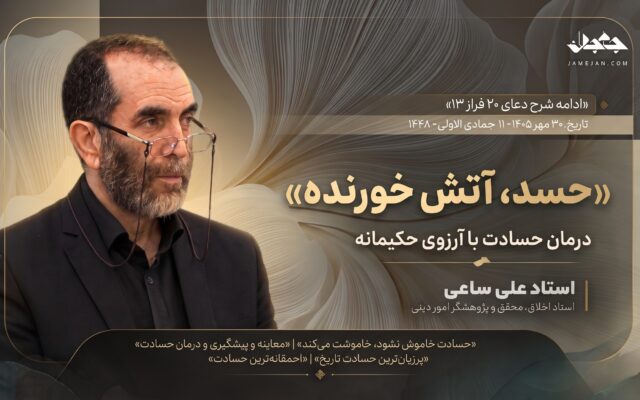
Written transcript of the lecture
The Meshkat-e Noor teachings series🌻🔆🔆🌻
🌼🔆🌼Forbearance, the Banner of Knowledge🌼🔆🌼
🔹Weekly sessions on the commentary and interpretation of al-Sahifa al-Sajjadiyya (Supplication 20)
📅 Date: 1404/08/22 – 22 Jumada al-Ula 1447
✨ Session: Meshkat-e Noor
🎤 Speaker: Master Ali Saei
📝 Some of the topics discussed in the session:
📿 «حِلْیَةِ الصالحین و زینةِ المتقین»
( 10 ) اللَّهُمَّ صَلِّ عَلَى مُحَمَّدٍ وَ آلِهِ ، وَ حَلِّنِي، بِحِلْيَةِ الصَّالِحِينَ ، وَ أَلْبِسْنِي زِينَةَ الْمُتَّقِينَ ، فِي بَسْطِ الْعَدْلِ ، وَ كَظْمِ الغَيْظِ ، وَ إِطْفَاءِ النَّائِرَةِ ، وَ ضَمِّ أَهْلِ الْفُرْقَةِ ، و إِصْلَاحِ ذَاتِ الْبَيْنِ ، وَ إِفْشَاءِ الْعَارِفَةِ ، وَ سَتْرِ الْعَائِبَةِ ، وَ لِينِ الْعَرِيكَةِ ، وَ خَفْضِ الْجَنَاحِ ، وَ حُسْنِ السِّيرَةِ ، وَ سُكُونِ الرِّيحِ ، وَ طِيبِ الْمخَالَقَةِ ، وَ السَّبْقِ إِلَى الْفَضِيلَةِ ، وَ إِيثَارِ التَّفَضُّلِ ، وَ تَرْكِ التَّعْيِيرِ ، وَ الْإِفْضَالِ عَلَى غَيْرِ الْمُسْتَحِقِّ ، وَ الْقَوْلِ بِالْحَقِّ وَ إِنْ عَزَّ ، وَ اسْتِقْلَالِ الْخَيْرِ وَ إِنْ كَثُرَ مِنْ قَوْلِي وَ فِعْلِي ، وَ اسْتِكْثَارِ الشَّرِّ وَ إِنْ قَلَّ مِنْ قَوْلِي وَ فِعْلِي ، وَ أَكْمِلْ ذلك لِي بِدَوَامِ الطَّاعَةِ ، وَ لُزُومِ الْجَمَاعَةِ ، وَ رَفْضِ أَهْلِ الْبِدَعِ ، وَ مُسْتَعْمِلِ الرَّاْيِ الْمُخْتَرَعِ .
My God and Lord, adorn me with the qualities of the virtuous and clothe me in the adornment of the God-fearing. Array me in the finery of the pious: upholding justice and restraining anger; quenching fires and putting an end to discord; reconciling those who have grown estranged and repairing broken hearts—let me be a healer of hearts and a mender of relationships among people. Let me bring goodness to light and conceal failings once they have come to the surface; be gentle in disposition, character and conduct, and lower the wing of humility—bowing low, offering a warm, motherly or fatherly embrace. Adorn me with a beautiful way of life, a calm and settled nature, and gracious manners in my dealings with others. Let me hasten to do what is virtuous, give others precedence in generosity and in times of joy and plenty, and refrain from reproaching or finding fault. Let me give generously even to those who do not deserve it; regard my good deeds as few, however abundant they may be in word and deed, and regard my wrongs as many, however slight they may be in word and deed.
✅ «And bring this to completion for me»
And bring this to completion for me; adorn me with steadfast commitment to the community, with the rejection of those who introduce innovations, and with the adoption of novel, false and heretical opinions.
🌍 «A World Without Noble Virtues»
Yes, a world without noble virtues is a world moving towards extinction and ruin. If these virtues are taken from the soul of the world, it becomes “inverted”—turned upside down. Its course changes, its order falls apart, and it moves towards chaos; injustice engulfs the whole of existence. These virtues permeate our souls and the world—even the heavenly bodies. If those celestial bodies were not endowed with them, they would not follow their ordered courses as they do; they would leave their orbits and disintegrate. Virtues permeate soul and world, and can never be separated from them.
Among these virtues, forbearance gives a distinctive life to existence. It is a mighty virtue that gathers every beauty around itself: all the beauties of the world, drawn from diverse elements, circle around it. Among the virtues, forbearance is the foundation of order and beauty. Without it, there can be no beauty, no justice in existence; the world would not move towards its own flourishing. Forbearance draws the other virtues to itself.
Knowledge is one of the essential foundations of order and beauty in every sphere; justice is what brings beauty to fulfilment. Without justice, there would be neither order nor beauty in existence—no delight, no paradise, no serenity, no intimacy. Why? Because the edifice of faith rests on four pillars: patience, certainty, justice and striving. If one of these pillars is removed from the side of “knowledge/faith,” faith collapses and “security” is undone. The first is patience, the second certainty, the third justice, and the fourth striving.
Of the four, reason itself has four branches. One is justice—and justice itself is “deep insight”: a person’s understanding must reach such depth that it penetrates, probes, searches among truths, and can beautifully weave them together. One must also plunge into knowledge and become “immersed in knowledge.” Whoever wishes to walk the path of justice must be immersed in knowledge, diving like a fish in the sea of learning, until they attain the station of drawing wisdom from within themselves. Once they have reached the depths of knowledge, blossoms of wisdom must spring forth from their soul. The fourth is the firmness and strength of forbearance: when forbearance takes hold and prevails within a person, the pillars of reason—the pillars of justice—are made complete.
The Master says: Whoever attains “understanding” has grasped the depths of knowledge. We must come to understand. To understand means to reach a state in which one can receive divine inspirations that enable one to comprehend matters. This is what is meant by “understanding.”
🏮 “The Lantern of Knowledge and Forbearance”
Whoever understands has grasped the depths of knowledge; and whoever has grasped those depths speaks in wise judgements—becoming a source and wellspring of wisdom. Wisdom flows from their being like a river. And whoever is forbearing does not go to excess in their work, and lives honourably among people.
Yes, if this “justice” is taken away, and among these virtues forbearance is erased from the human soul, human order—human justice—falls apart. If forbearance is separated from knowledge, knowledge becomes “wild”; it no longer shines, but only adds to the darkness. What a remarkable station forbearance holds! It is like a “lantern,” and knowledge like its “oil.” When the lantern is ready, knowledge shines clearly through its wick; otherwise, it becomes a fire that burns souls. If forbearance is removed from “economics,” economic sciences become “wild” and driven by profit—serving only certain people.
✨ “The Ahl al-Bayt: The Central Core of Noble Virtues”
If ḥilm is taken away from “beauty,” beauty becomes “untamed”—a source of trouble. If it is taken away from “management and governance,” governance, too, becomes “untamed.” This ḥilm is “the key to human wisdom”; it is one of the principal instruments of reason. Reason cannot establish its sovereignty in a person’s heart without ḥilm.
So how can we bring this immense power to life within us—so that it wells up, grows, blossoms, takes deep root, becomes firm, and prevails? We need only place ourselves at the “central core of this ḥilm.” To put it briefly: the “Household of Infallibility and Purity” are the “central core of noble virtues” in existence; they are the “foundations of generosity.” The Master—Mawla Amir al-Mu’minin—introduced them as the “life of knowledge”: knowledge made alive. They are the radiance and flourishing of knowledge, and the death of ignorance. They are the “life of knowledge”—that is, the life of every noble virtue, every beauty in the world. Through them, virtues live, are nourished, and come to life. Without them, knowledge dies.
If our Imam of the Age, the Qa’im of the House of Muhammad (AJ)—their supreme blessing—were not on earth, knowledge would depart from the face of the planet all at once, and ignorance would prevail. Now his radiance shines from behind the clouds of occultation, nourishing knowledge and sustaining its life, as it sprouts in the hearts of the Godwary.
The Imam says: For those who have distanced themselves from the Household, “knowledge” has died within them. They imagine themselves learned—but “knowledge” reveals its light and makes itself known only through “noble virtues.” Consider this: their ḥilm, arising from their knowledge—that is, the “medium through which knowledge is conveyed” in the being of these noble ones—is none other than their ḥilm. Ḥilm is the “great medium of the Infallible Ones (AS),” through which their knowledge becomes visible to us. Their outward appearance speaks of their inward reality: their exterior is the medium of their interior. And their silence speaks of the wisdom of their words. That is, without uttering a word, wisdom wells up from their souls and embraces the soul of the world. Why? Because they are the “light of God”: “Its oil would almost shine, even if no fire touched it.”
They never oppose the truth, nor do they ever differ concerning it. They are the “pillars of Islam” and the “refuges of steadfastness”—its strength and firmness. Only through them does what is right return to its rightful place; through them, falsehood is driven from its place and its tongue cut out at the root. In their presence, falsehood is struck dumb; without them, it finds its voice.
They have made “religion” rational: they have understood religion in its fullest rationality and brought it into the world in the form of reason. They are “reason that receives and preserves what it sees”—that is what is meant here—not “reason that hears,” nor “reason that transmits.” For those who transmit knowledge are many, but those who observe and preserve it are few.
Indeed, the particular insights in this profound message of Mawla Amir al-Mu’minin are these: “Ḥilm is the banner of knowledge”; the outward should be the “small banner of the inward”; and silence should be the tongue of wisdom—a river of wisdom flowing through the human soul. Whoever presents themselves as obedient to the Household of the Prophet (AS)—whose words are the supreme banner of “truth and reality”—will see mighty waves of wisdom flow from the treasury of their silence into the world. In their presence, falsehood is dumb and voiceless; in their absence, it finds its voice. Without them, falsehood runs rampant; without them, falsehood holds a wedding feast and makes itself look beautiful.
Indeed, ḥilm is like a crown upon knowledge. We must value the Household and let ourselves be shaped in the “oven of their noble virtues,” reaching full maturity amid the “light of their noble virtues.” Without them, knowledge will die within us, and so will every noble virtue—for they are the “foundations of generosity,” the “source of God’s mercy,” the “treasurers of knowledge,” and the “utmost in ḥilm.” They have reached the heights of ḥilm: they have brought “knowledge” and “noble virtues” to their fullest radiance. They are the “foundations of generosity” and the “leaders of the community.”
Indeed, all that is good—all joy, beauty, and delight—revolves around them. If we place ourselves in their orbit, we will be immersed in every noble virtue, every goodness and every joy. In the truest sense, they are the “constellation of beauty” in all existence. Without them, “knowledge” dies and falls silent. The “Household of Infallibility and Purity”—our Imam of the Age—are the “hardware” and “operating system” of knowledge. In truth, if they were not here, “knowledge” would not appear in this world—in our world, on our earth.
🧭 “Your opinion: عِلم، حِلم، حَزم”
The human world goes dark without this “operating system.” If we connect to this “hardware of knowledge,” we will be in touch with the “truth”; without it, we are plugged into “falsehood”—caught in its spark. Yes, “their word is a decree”: your word is a ruling, a certainty; your word is a command and an instruction, a final decision. Your word is “inevitable”—certain, binding, with no alternative. The whole world must come to this “truth”: the “comprehensive law” on earth can be realized only through the Ahl al-Bayt (AS). The highest law of “humanity, ethics, salvation, progress, the highest law of economics”—by God—can be attained only through the “rule of the Prophet’s family.” What an extraordinary insight: “Your judgment is knowledge, forbearance, and prudence.” In other words, every judgment and opinion must embody these three qualities. Whom should I choose? One who possesses “knowledge and forbearance”—and “prudence”: whose being is “filled with knowledge,” who has attained the full measure of forbearance, and who also possesses prudence—one who thinks ahead and can carry out their mission beautifully, with the utmost discernment and steadfastness. Yes, this is the truth; without it, the world falls prey to the “wicked.” Without “knowledge, forbearance, and prudence,” the hands of the wretched will be at the throats of all beauty and truth in this world of existence.
🤝 “Dealings: God, the self, creation, the world”
When a person attains this “lofty station”—having equipped himself with every noble virtue—he is ready to conclude the greatest transaction of his life. We have come into this world to “make a deal,” to “trade.” A human being is a “trader.” We have come into this world, onto the face of the earth, to trade for the entire universe and make it our own. But even if I were to say that a person could possess the entire universe—from this world to the Hereafter, all the way to the “Lote Tree of the Utmost Boundary”—he would still have lost. The capital God has bestowed on us must be traded for something “higher” than that. What, then, is the bargain? I must trade for “myself” too—I do not own myself; first I must come to possess “myself.” Then I must trade for “the people of the world,” and come to possess them; then I must bargain for “the world itself.” Higher still is “the Lord of the world”: I must “trade for” Him, attain Him. If I lose Him, I have lost everything. I may make these three bargains, but if I lose “the Lord of the world,” I am wretched and utterly ruined. So let me enter into the bargain—with all the capital I have, with every noble virtue.
Imam al-Sadiq (AS) said: “The foundations of human transactions rest on four things: dealing with God, dealing with oneself, dealing with God’s creation, and dealing with the world.” So the “first transaction” is with God; each of these transactions rests on “four pillars.” The principles of dealing with God, the Blessed and Exalted, are built on “seven things.” I’ll name the first; you can work out the rest. The first is “monotheism”: worshipping God as One, affirming His Oneness. This principle of monotheism is like the “straight path” of the Day of Resurrection in one’s dealings with God; if one falls from this path, there is no room left for any other transactions.
Let us list “God’s rights”: first, monotheism; then, keeping “God’s bounds,” not “transgressing” them; being “grateful” for “God’s gifts,” giving thanks for them; being “content” with “God’s decree” and “patient” through “God’s trials”; holding “God’s sacred ordinances” in reverence; and soaring toward Him with heart and soul, longing for Him; seeking out the heart of the night; cherishing the wish to be alone with God; becoming utterly enraptured with love for Him. These are the principles of “dealing with God.” Let me repeat them: fulfilling God’s rights, keeping God’s bounds, giving thanks for God’s gifts, accepting God’s decree, being patient through God’s trials, revering what God has made sacred, and yearning for God.
The principles of “dealing with the self” are also “seven”: “fear,” “striving,” “bearing hardship,” “working and exerting oneself with dedication,” “seeking what is true and right,” “being sincere—attaining sincerity,” and “parting with whatever one loves for God’s sake, giving in charity for God’s sake whatever one loves most.” I am not speaking here of paying khums and zakat—that goes without saying. This calls for “more” than that: “making poverty one’s concern,” reaching out to those in need.
The principles of dealing with God’s creation are likewise seven: “forbearance,” “humility,” “generosity,” “compassion,” “sincere counsel—being a person of good,” “enjoining right and forbidding wrong among God’s creation, never abandoning sincere counsel,” and “upholding justice and acting fairly.”
I want to possess “the world”—what should I do? I must conquer these “seven climes.” I want to take hold of the world, to possess all of it: I must “be content with less.” Ah, what a mystery this is: when I “settle for less,” the world comes flying toward me. To practise “selflessness”—to put someone else before oneself—with immense wealth? No: one must give precedence to others over oneself with whatever one has, with one’s “means,” however meagre they may be. These are the secrets of “becoming wealthy”—no, of attaining “something beyond wealth”; of coming to possess this entire “worldly realm.”
“Do not pursue what is not yours”; do not harbour “empty wishes.” Why should I entertain vain desires? Why should I crave what God has not “decreed” for me? Let me set out on the path of seeking God’s pleasure. What a bargain! What must I pay to possess this world? I must not be “acquisitive”; I must not “amass wealth.” Rather, I must regard it as an “enemy”; I must choose “asceticism”—that is, become “indifferent to the world,” and “unconcerned” with its pleasures. By the Lordship of God, the pleasures of this world will then fly eagerly toward a person.
One must become “familiar” with the world’s afflictions, gain insight into them; drive away, reject, and cast off “worldly desires”; and relinquish worldly “leadership.” When all these qualities are “gathered” in one person, when they take root, what does that person become? A “chosen servant of God.” What an exalted station this is: truly among God’s “near servants,” and indeed among His “saints.” Whoever brings these transactions to completion becomes one of God’s chosen servants.