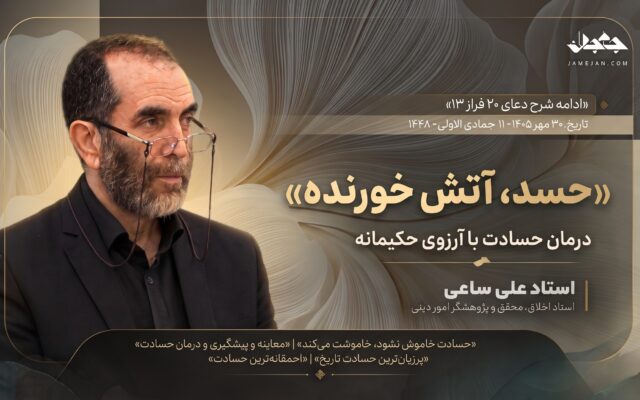
Written transcript of the lecture
The Meshkat-e Noor teachings series🌼🔆🌼The Sweet Secret of Servitude in the Words of Imam Hasan al-Askari (AS)🌼🔆🌼
🌹🔅☘️ بِسْمِ اللَّهِ الرَّحْمنِ الرَّحيمِ ☘️🔅🌹
🔅🌹 “The Mirage of Servitude” “The Secret of Detachment through Connection” “Transcendent Theosis” “The Secret of Imamate in the Words of Imam al-Askari” “The Martyrdom Night of Imam Hasan al-Askari (AS)” and more … An abridged account with an appendix 1405.05.29 Ali Saei (Abdullah Meshkat) 110.141(903) 🌹🔅
Introduction
“The Secret of Transcendent Theosis” traces an existential and intellectual journey from the depths of human need to the heights of loving servitude, grounded in the precious teachings of Imam Hasan al-Askari (AS). Rather than offering a merely lexical or exegetical commentary, this essay seeks to examine in a rigorous, structured way such foundational concepts as “theosis,” “detachment,” “seeking aid,” and “guardianship,” bringing them together within the horizons of mysticism, theology, and Quranic studies.
Drawing on the luminous words of Imam al-Askari (AS), who presents God not through abstract concepts but in terms of “existence,” “love,” “innate disposition,” “the language of utter need,” and “the lived experience of detachment,” this text seeks to unveil a truth: theosis—the yearning for God and ecstatic worship—is an essential, creational attribute of all creatures. Yet its highest and fullest realization depends on a conscious, loving, and sincere choice to attain the station of the “Face of God” and complete detachment from all that is other than Him.
The journey that follows leads from “the secret of servitude” to “the reality of Imamate.” An encyclopedic appendix on etymological research also explores such words as “ilāh,” “qabas,” and “lams,” preparing the ground for a deeper understanding of divine oneness and *wilāya*.
Contents
Part One: Preliminary Matters and General Overview
Publication details and the need for a rigorous approach
The place of Imam Hasan al-Askari’s (AS) words in explaining divine oneness and servitude
Part Two: A Lexical Analysis of “Theosis” and the Imam’s Words
An exegetical perspective on “theosis” based on the Imam’s hadith (AS)
Etymological analysis of the root “ʾ-l-h” and examination of its forms
An account of the three stages of detachment in the Imam’s words: needs, hardships, and the severing of means
Interpretive principles drawn from the hadith: existential definition, innate monotheism, and more
Part Three: Seeking Aid, the Reality of the Basmalah, and the Divine Attributes
An analysis of “بِسْمِ اللَّهِ الرَّحْمنِ الرَّحِيمِ” in the state of utter need
The principle of seeking aid as the essence of the Basmalah
God’s three attributes in the hadith: the Rescuer, the Answerer, and the One worthy of worship
The correspondence between “hardships” and “rescue,” and between “needs” and “answering prayers”
Part Four: A Fresh Perspective on Theosis and Loving Detachment
Theosis as an essential, creational attribute of creatures
The universal race toward theosis and the reality of «اِنّا لله و اِنّا الیه راجعون»
The difference between transactional theosis (mere desperation) and devotional theosis (loving worship)
Voluntary detachment: freedom from the mirage of servitude and arrival at the “Face of God”
Passages from the Imams’ (AS) whispered prayers describing detachment and yearning
Part Five: The Reality of Imamate in the Words of Imam Hasan al-Askari (AS)
Introducing *Kitāb al-Muḥtaḍar* and the Imam’s luminous handwriting (AS)
An explanation of key terms: omission of the definitive principles, the Cupbearer of Kawthar, the Supreme Pinnacle, Prophethood, and *wilāya*
The relationship of the prophets to the lights of the Ahl al-Bayt (AS) and the doctrine of the One Light
God’s Proof and the appearance of the Qa’im (AJ) with an “unsheathed sword”
The Muslim’s Duty to Draw on the Light and Hold Fast to the Firmest Bond
Part Six: Supplement and Appendices (Etymological Studies)
Appendix 1: A Comprehensive Study of the Root «ا ل ه» (A Comparative Review of the Views of Ibn Fāris, Rāghib, al-Zamakhsharī, and Others)
Appendix 2: An Analysis of the Root «قبس» (The Flow of Light and Drawing on the Divine Lights)
Appendix 3: A Study of the Root «لمس» (From Sensory Contact to Spiritual Perception and Seeking Light)
Conclusion: A Ghazal and Salutations to Imam al-Askari (AS)
A ghazal in praise of the Imam and an expression of the text’s themes (the loftiest summit, the beacon of guidance, and so on)
Concluding with blessings and special salutations upon the Imam and the Ahl al-Bayt (AS)
Preface (with a structured summary)
This work is the fruit of a systematic reflection on one of the most important concepts of spiritual knowledge to emerge from the school of the Ahl al-Bayt (AS): the relationship between “existential destitution” and “the perfection of servitude.” In other words, it seeks to answer this fundamental question: How can one move from the human being’s “essential neediness” to “loving servitude,” and from “involuntary turning away from all else in times of hardship” to “a willing turning to God in His constant presence”?
The discussion centres on a hadith from Imam Hasan al-Askari (AS), which portrays the reality of the blessed name «اللّه» through three key elements:
a) needs and hardships (the situation of need),
b) the loss of hope and the severing of worldly means (the turning point),
c) the servant’s utterance (فَیَقُولُ: بِسْمِ اللَّهِ الرَّحْمَنِ الرَّحِيمِ) (the beginning of practical monotheism).
This luminous teaching yields four central principles of interpretation:
1. The existential definition of the majestic name “Allah” here is not an abstract concept, but a reality tasted in the depths of dire need.
2. Innate monotheism lies at the heart of this turning to God; all beings, even at the height of heedlessness, ultimately return to this point.
3. The denial of the independent efficacy of worldly means is one of the main pillars of this definition, pointing to God’s absolute power.
4. Sincerity in seeking help—which, in the interpretation of the basmala, is expressed as “seeking help in all affairs”—is the essence of servitude.
The discussion then extends this structured approach to a wider field, demonstrating that “ta’alluh” (a yearning, rapturous seeking of God) is not merely a response to crises, but an innate and creational quality of all creatures. The culmination of this journey is “loving detachment”: a state in which one turns away from all that is other than God not out of necessity, but out of longing and love, and attains the station of “the Face of God”—the station of perfection and the divine Greatest Name.
It is worth noting that this journey of spiritual knowledge ultimately leads to the reality of the Imamate. Citing the noble handwriting of Imam al-Askari (AS) in Kitāb al-Muḥtaḍar, the text shows that the prophets and friends of God all drew upon the “lights” of the Ahl al-Bayt (AS), and that they are the “loftiest summit” and the “firmest bond.” This section completes the work’s purpose and demonstrates that turning to God, without holding fast to the Rope of God embodied in the persons of the Imams, is not only incomplete but may well lead one astray, chasing a mirage.
Finally, this study is supported by a detailed appendix on the etymology of the words «اله», «قبس» and «لمس», drawing on authoritative lexicons such as Rāghib’s Mufradāt, Ibn Fāris’s Maqāyīs, al-Ṣiḥāḥ and al-Miṣbāḥ. This establishes that the principles derived from these texts have firm, well-documented roots in the depths of language and revelation.
May this carefully structured journey assist those who seek the truth, helping them find a way to the light of truth amid the waves of tribulation and the mirages of our age, and to savour the “sweet secret of servitude” through the words of Imam al-Askari (AS).
And peace be upon those who follow the guidance.
❇️Another Interpretive Perspective on “Ta’alluh”
💫🔆 [قَالَ الْإِمَامُ ع] «اللَّهُ» هُوَ الَّذِي يَتَأَلَّهُ إِلَيْهِ عِنْدَ الْحَوَائِجِ وَ الشَّدَائِدِ- كُلُّ مَخْلُوقٍ [وَ] عِنْدَ انْقِطَاعِ الرَّجَاءِ مِنْ كُلِّ مَنْ دُونَهُ- وَ تُقْطَعُ الْأَسْبَابُ مِنْ جَمِيعِ مَنْ سِوَاهُ[1]
🔆The Imam, peace be upon him, said:
“Allah” is the One toward whom all creatures turn in worshipful awe when they are in need or beset by hardship—especially when all hope in anyone but Him has been lost and every means and recourse besides Him has failed.
A note and reminder: turning to God in worshipful awe is not confined to times of hardship. It is in such moments that the heedless experience this state; the God-fearing remain in it continually, in times of ease as well as adversity!
❇️A closer look at the word «ا ل ه»
1. Lexical and etymological analysis
a) «یَتَأَلَّهُ»
Root: from the root «أ ل ه», meaning worship accompanied by awe and complete attentiveness.
Form: the imperfect verb in Form V (یَتَفَعَّل), which conveys a sense of effort and intensified expression. That is, to bring oneself into a state of *ta’alluh*, or to turn toward someone with utter need and awe.
Specific implication: Here, «یَتَأَلَّهُ إِلَیْهِ» means to take refuge in Him, driven by need born of awe and helplessness, and to choose Him alone as the object of worship and supplication for help.
b) «الْحَوَائِجِ»
The plural of «حاجَة», meaning existential, material, spiritual, psychological, and otherworldly needs.
c) «الشَّدَائِدِ»
The plural of «شِدَّة», meaning hardships, calamities, troubles, and the straits of life.
d) «انْقِطَاعِ الرَّجَاءِ»
The end or severing of hope—that is, when no hope remains in any created being.
e) «تُقْطَعُ الْأَسْبَابُ»
Means, channels, and intermediaries fail and come to an end, one after another.
2. The combined meaning and the Imam’s intended sense
In this statement, the Imam, peace be upon him, offers an existential, monotheistic definition of the blessed name “Allah”—not a lexical or grammatical definition, but one rooted in the lived experience of servitude and utter helplessness. This definition rests on several key points:
First: All creatures turn to God in worshipful awe in times of crisis
All creatures instinctively and innately turn toward “Allah” when they are in need or facing hardship. This turning arises from existential helplessness, not merely from a rational choice. Even those who ordinarily rely on others besides God turn, unbidden, to the Divine Essence when every door has closed. Even the most denying, ignorant, and heedless people turn to Allah in such moments and experience *ta’alluh*!
Second: Losing hope in all besides God
The Imam, peace be upon him, portrays three stages in this definition:
1. Need and hardship (حَوَائِج وَ شَدَائِد)
2. Losing hope in all besides Allah (انقطاع الرجاء من کل من دونه)
3. All means besides God failing (تُقطَعُ الأسباب من جمیع من سواه)
At these three stages, every creature—even one who is heedless, ignorant, or defiant—reaches a point where they can find no way forward except through God. It is then that the reality of Allah’s divinity becomes clear to them.
Third: «فَیَقُولُ»
At this point, a person calls upon and turns toward Allah alone—not through rational argument, but through their very being and the language of the heart. This is the oneness of God born of necessity, or innate monotheism.
3. Theological and philosophical insights contained in this statement
| Theological Point | Expounding |
| The Innate Nature of Tawḥīd | The Imam shows that turning to “Allah” in times of distress is innate and built into human nature, not acquired. This is corroborated by the verse ﴿فَإِذَا رَكِبُوا فِي الْفُلْكِ دَعَوُا اللَّهَ مُخْلِصِينَ لَهُ الدِّينَ﴾ (al-ʿAnkabūt: 65). |
| The Difference Between Ilāh and Allah | “Ilāh” is a concept that can be applied to any object of worship, whereas “Allah” is a proper name to which hearts return only in a state of true distress. That is, Allah is the One to whom the reality of being worthy of worship belongs alone, and before whom all means fail. |
| The Denial of the Independent Causality of Means | The Imam shows that means and intermediaries ultimately have no independent power and fail; |
| The Reality of Supplication | True supplication occurs when a person has ceased to rely on anything apart from God. In this state, turning to God itself is worship and an acknowledgment of His divinity, even if no words are spoken. |
4. Interpretive Principles Derived from This Statement
This brief statement by the Imam, peace be upon him, yields several broad principles for understanding the name “Allah” in the Quran and hadith:
First Principle: An Existential Definition, Not an Abstract Conceptual One
“Allah” should not be defined merely as a philosophical concept or a name devoid of content. Rather, it should be understood through the human experience of distress and innate nature. This is a concrete, experiential definition.
Second Principle: Divinity Is Understood in Relation to Needs and Afflictions
God’s divinity is not a purely theoretical concept, but a reality that the God-fearing experience at all times, and that the heedless experience when seeking relief from their needs and deliverance from afflictions.
Third Principle: Lordship and Divinity Are Inseparably Present, Though the Heedless Recognize Them in Moments of Distress
In ordinary circumstances, a person may accept God’s lordship yet also rely on created means. But in distress, lordship and divinity converge at a single point: where no need is met except by Him, and no hope remains except in Him.
Fourth Principle: “Utterance” in a State of Distress Is the Essence of Religion
What a person says in that state, though it may seem simple on the surface, springs from the depths of innate tawḥīd. This very utterance is the reality of religion and submission: that is, لا إله إلا اللّه in its highest degree of sincerity.
The God-fearing and those of certainty find peace only in God; that is, they are constantly in a state of turning to Him in worship. They are driven by necessity to turn to none but Allah, unlike the heedless, who enter this state only in moments of physical or metaphysical distress!
5. Final Summary
In this statement, the Imam, peace be upon him, lays out a three-part structure:
1. God (Allah)
2. The heedless in a state of utter distress (needs, afflictions, the loss of hope, the failure of all means), and the God-fearing at all times
3. The servant’s response (utterance) بِسْمِ اللَّهِ [الرَّحْمنِ الرَّحِيمِ]
Through this, he depicts a concrete logic of tawḥīd, according to which:
Whoever turns to God in hardship and breaks away from all besides Him has attained the reality of “Allah,” and that person’s response is the very essence of pure tawḥīd.
This definition differs from the lexical definition (“ilāh” meaning an object of worship), because here:
The concept of ilāh is bound up with the servant’s act of turning to God in worship (ta’alluh) and the servant’s state of distress.
“Allah” not only directs attention to His Essence, but also reflects His relation to the servant in distress: God is the one true refuge in the depths of affliction.
💫🔆فَيَقُولُ:
بِسْمِ اللَّهِ [الرَّحْمنِ الرَّحِيمِ] أَيْ أَسْتَعِينُ عَلَى أُمُورِي كُلِّهَا بِاللَّهِ- الَّذِي لَا تَحِقُّ الْعِبَادَةُ إِلَّا لَهُ، الْمُغِيثِ إِذَا اسْتُغِيثَ، وَ الْمُجِيبِ إِذَا دُعِيَ.
🔆Continuing his words, the Imam (peace be upon him) says after «فَیَقُولُ»:
Then [the distressed servant] says:
«بِسْمِ اللَّهِ الرَّحْمنِ الرَّحِيمِ»; that is, I seek Allah’s help in all my affairs—Allah, the only One worthy of and entitled to worship, who comes to the aid of those who cry out to Him and answers those who call upon Him.
Part Two: A Systematic Interpretation
1. Structural Analysis of the Passage
This part of the hadith has three essential components:
| Component | Text | Function |
| 1. Opening statement | «بِسْمِ اللَّهِ الرَّحْمنِ الرَّحِيمِ» | Invoking God’s name and attribute at the outset |
| 2. Inner interpretation of the basmala | «أَيْ أَسْتَعِينُ عَلَى أُمُورِي كُلِّهَا بِاللَّهِ» | Interpreting the basmala as seeking help in every respect |
| 3. God’s three attributes | «الَّذِي لَا تَحِقُّ الْعِبَادَةُ إِلَّا لَهُ، الْمُغِيثِ إِذَا اسْتُغِيثَ، وَ الْمُجِيبِ إِذَا دُعِيَ» | Three fundamental attributes that encompass the whole of tawhid |
2. Key Vocabulary (Lexical and Technical Analysis)
a) «أَسْتَعِينُ»
From the root «ع و ن», meaning to seek help, support, and reliance on a power beyond oneself.
This is the imperfect form of the tenth verb form («اِسْتَفْعَلَ»), which conveys an active and emphatic request: not merely asking for help, but seeking assistance in every aspect of life.
b) «أُمُورِي كُلِّهَا»
This encompasses all affairs: religious and worldly, personal and social, material and spiritual, outward and inward—even matters that, on the surface, are accomplished through means and agencies.
The phrase is universal and unrestricted; it admits no exceptions.
c) «لَا تَحِقُّ الْعِبَادَةُ إِلَّا لَهُ»
«تَحِقُّ» derives from the root «ح ق ق», meaning to be established, worthy, or entitled.
The sentence means that, both in reality and in religious law, worship is due and appropriate to God alone; no other being is inherently entitled to worship or may legitimately be worshipped.
This denial applies both to the idolatrous worship of polytheists and to ostentation and self-centred worship.
A subtle point in the Imam’s words is that no worship has ever been, or can ever be, truly established for anyone—even if others appear to worship them. In other words, no idol has ever rightfully been worshipped.
d) «الْمُغِيثِ إِذَا اسْتُغِيثَ»
«مُغِيث» derives from the root «غ و ث» and means one who comes to the aid of those who cry out—one who rescues the distressed from their predicament.
«اسْتُغِيثَ» is the passive form of the tenth verb form, meaning that aid is called for.
The attribute «مُغِيث» means that God is the One who comes to the aid of others, without any condition limiting this act: whenever anyone cries out, He answers—though in accordance with His wisdom and what is best.
e) «الْمُجِيبِ إِذَا دُعِيَ»
«مُجِيب» derives from the root «ج و ب» and means one who answers.
«دُعِيَ» is the passive form of the verb meaning to call; it means to be called upon.
This description completes the preceding actions: God is present and active both in relieving distress (coming to the rescue) and in answering a plea (responding to prayer).
A subtle point: true cries for help and genuine prayer are accompanied by a response. The very state of truly crying out and praying is itself a sign that the response is coming!
3. A Thematic, Principle-Based Interpretation
First Principle: In a state of desperation, the basmala is a declaration of practical tawḥīd
When all means have failed and hope in anyone besides God has been cut off, saying «بِسْمِ اللَّهِ» is not merely a verbal habit; it is a declaration of absolute existential dependence on God. By saying these words, the servant attributes all their actions to God and disavows any independence, whether in themselves or in anyone besides God.
Second Principle: Seeking help is the essence of the basmala
The Imam, peace be upon him, interprets the basmala as “seeking help.” In other words, the inner meaning of “In the name of God” is not simply to mention God by name, but to seek His help and comprehensive support. This interpretation is profoundly significant because it:
shows that invoking God’s name is incomplete without asking for His help.
shows that seeking help reflects both the servant’s utter existential poverty and God’s absolute riches.
places all matters, great and small, within the scope of seeking help.
Third Principle: Tawḥīd in worship is the basis for seeking help
The Imam makes affirmation of God’s oneness in worship a condition for seeking help:
«الَّذِي لَا تَحِقُّ الْعِبَادَةُ إِلَّا لَهُ»
That is, the only God worthy of worship is also the only one worthy of being asked for help. This yields a broad principle:
Whoever seeks help from anyone besides God has, in effect, assigned worship to that other; for seeking help in all matters is one branch of worship.
This principle is entirely in keeping with verses such as: ﴿إِيَّاكَ نَعْبُدُ وَ إِيَّاكَ نَسْتَعِينُ﴾ (al-Fātiḥa: 5), in which both worship and the seeking of help are directed to one and the same object of worship.
Fourth Principle: Deliverance and response are two active dimensions of divine lordship
The Imam, peace be upon him, names two active attributes of God:
مُغيث: the One who relieves distress and rescues from hardship.
مُجیب: the One who grants what is sought and fulfils needs.
These two attributes correspond to the two preceding conditions—needs and tribulations:
“Tribulations” correspond to “deliverance.”
“Needs” correspond to “response.”
Thus, at both levels, God is the absolute agent, with no intermediary involved. This explicitly rejects reliance on means as though they were independent.
Fifth Principle: Crying out for help and prayer are two degrees of desperation
Crying out for help: seeking relief from an unwelcome calamity and intense distress.
Prayer (calling upon God): seeking to draw in good and attain what one desires.
4. Final Summary and Interpretive and Exegetical Points in the Hadith
This part of the hadith traces a complete circle of tawḥīd:
| Stage | Content |
| Beginning of the hadith | All creatures turn to «اللّه» in their needs and tribulations. |
| Middle of the hadith | Hope in anyone besides God is cut off, and all means fall away. |
| Climax | The servant says: «بِسْمِ اللَّهِ الرَّحْمنِ الرَّحِيمِ». |
| Interpretation of the basmala | Seeking God’s help in all matters. |
| The basis of seeking help | Worshipful oneness (لا تَحِقُّ العبادة إلا له). |
| The fruit of seeking help | Rescue (coming to the aid of one who cries out) and response (answering). |
The final criterion (the overarching principle for understanding the hadith):
In this hadith, “Allah” is known not through abstract philosophical concepts, but through three concrete, existential pillars:
1. The servant’s state of utter need (his needs, hardships, and loss of hope in all means)
2. His wholehearted appeal for help (the basmala as a plea for aid)
3. God’s action (rescue and an immediate response)
From this perspective, knowledge of God comes not through purely rational proofs, but through the lived experience of utter need and the reception of a divine response. This is the innate, existential oneness that the Quran affirms:
﴿أَمَّنْ يُجِيبُ الْمُضْطَرَّ إِذَا دَعَاهُ وَ يَكْشِفُ السُّوءَ﴾ (Naml: 62)
“Is He not the One who answers the distressed when they call upon Him and removes their affliction…?”
In every case, one must turn to the One worshipped in a state of utter need and detachment from all else!
Let us call upon Him with complete detachment—that is the reality of calling. Anything short of this is only like calling!
❇️A fresh perspective on “deification”
Deification is an essential attribute of created beings. They are created in a state of being drawn toward God: to be drawn toward Allah is their very nature!
Created beings are nothing but need and dependence; dependence is inherent in creation. Need is the highest form of richness and wealth, for it is the fullest turning toward Allah!
Deification is the constant state of all created beings, manifesting as innate deification and prescribed deification. The prescribed translates the innate, and knowledge of deification—full recognition of it—is a fixed truth!
The state of prescribed deification gives voice to what has been learned; prescription articulates the felt experience of innate deification!
The state of prescribed deification is turning toward God with the fullest depth of feeling and emotion!
Prescribed deification is to blossom from within; it is calling upon God, interpreting oneself and drawing meaning from oneself!
The human being is a verse among the verses, a name among the Names!
❇️Need is the essence of beings
Need is the height of feeling in every created being!
Created beings are colored by many kinds of need, from emotional need to …
❇️The race of deification
All created beings are racing in deification, from a particle to a galaxy!
A universal race among all created beings has begun and continues!
❇️The secret of “انا لله و انا الیه راجعون”
To move from the initial state of deification to its exalted state
To travel from beginning to end and reach the goal of deification!
❇️Free will and choice: the secret of separation
The obstacle, the cause of severance from God, is the human being’s own choice and free will!
Severance is the navel of connection
One day, the navel of worldly means will be cut;
one day, we will emerge from the womb of worldly means!
Either, having reached the fullness of creation and perfect sincerity, we will be severed from all but Allah in a state of complete detachment, fully formed; or, incomplete in our creation yet completely detached, we will emerge raw and unripe!
One day, the leaf will fall from the tree!
We have experienced the passage from one realm to another; the lament of separation is particular to each realm!
The severing of the navel of worldly means comes with the pain of separation,
❇️ The Most Sacred Need
When the One we need and love is Allah, our need is the holiest of needs: to surrender ourselves wholly in loving devotion!
In the heart of every servant of God is a longing and love to surrender, to lose oneself for the Beloved, to yield completely to Him. But when a person loses the way, they lose themselves not for Allah, but for someone else!
We must relinquish our will; we must lose ourselves!
This is the state of loving devotion to God!
Allah has set everyone on a course toward Him and made them lovers of Him. The Most High Himself has kindled the fire of His love in His creatures; He is the force that moves them to worship!
❇️ Commercial Devotion
Devotion that arises only when needs must be met is transactional devotion! Devotion must be an act of worship! It must be born of love!
A breaking forced upon us has no fragrance of love or affection! Let us break our own ship—let us wreck the ship of our hearts for our God alone, and turn our whole being toward His sacred presence alone: “اللَّهُمَّ إِنِّي أَخْلَصْتُ بِانْقِطَاعِي إِلَيْكَ؛ وَ أَقْبَلْتُ بِكُلِّي عَلَيْكَ”
❇️ Loving Detachment Toward Allah
In freely chosen devotion, a person lovingly removes every obstacle on the way to Allah! Sometimes, through the means available to them, and under compulsion, they come to experience this detachment!
Death is an imposed severance,
absolute death is an all-encompassing, absolute severance!
A person’s orientation toward the Face of Allah is the seal of their detachment toward Him and a clear sign of their devotion to God.
Until we attain the station of the Face of Allah, we have not yet reached the point of losing ourselves in servitude!
The Face of Allah will know no death!
The Face of Allah is the very essence of severance and separation!
The Face of Allah is with Allah without intermediary!
✨🔆 The Merciful: 26 كُلُّ مَنْ عَلَيْها فانٍ
✨🔆 The Merciful: 27 وَ يَبْقى وَجْهُ رَبِّكَ ذُو الْجَلالِ وَ الْإِكْرامِ
❇️ Unity with the Face of Allah
Clinging to the cord of Allah means becoming one with it: becoming a single system, sharing the same time and language, and being of one essence.
❇️ Loving Devotion Through Spiritual Detachment
موتوا قبل ان تموتوا
Loving, God-conscious detachment is the triumph and victory of servitude.
Before the inevitable severance of death, which everyone will one day face, let us intend to choose loving detachment freely!
❇️ The Mirage of Servitude
Breaking away from the mirage of love—the mirage of servitude—is the secret of loving devotion to God!
✨🔆 The Light: 39 وَ الَّذينَ كَفَرُوا أَعْمالُهُمْ كَسَرابٍ بِقيعَةٍ يَحْسَبُهُ الظَّمْآنُ ماءً حَتَّى إِذا جاءَهُ لَمْ يَجِدْهُ شَيْئاً وَ وَجَدَ اللَّهَ عِنْدَهُ فَوَفَّاهُ حِسابَهُ وَ اللَّهُ سَريعُ الْحِسابِ
🔆 As for those who disbelieve, their deeds are like a mirage in a desert: the thirsty person takes it for water from afar, but when they reach it, they find nothing there. Instead, they find Allah, who settles their account in full; and Allah is swift in reckoning!
All are journeying toward the water of servitude! But the heedless mistake the mirage for water!
All will inevitably meet Allah; what matters is the state and nature of that meeting!
✨🔆 The Splitting: 6 أَيُّهَا الْإِنْسانُ إِنَّكَ كادِحٌ إِلى رَبِّكَ كَدْحاً فَمُلاقيهِ
يا
🔆O human being! You journey toward your Lord through toil and hardship, and you will meet Him!
Though the thirsty seek water, if they mistake a mirage for it and run toward it, they will ruin their worship.
❇️Let us be mindful of the many kinds of thirst within us!
The thirst of need, the thirst for affection, the thirst for companionship, the thirst of appetite and desire, the thirst for beauty, the thirst for love, the thirst for the divine, the thirst for worship, and more …
💫🔆سَيِّدِي أَنَا مِنْ حُبِّكَ جَائِعٌ لَا أَشْبَعُ أَنَا مِنْ حُبِّكَ ظَمْآنُ لَا أَرْوَى وَا شَوْقَاهْ إِلَى مَنْ يَرَانِي وَ لَا أَرَاهُ يَا حَبِيبَ مَنْ تَحَبَّبَ إِلَيْه[2]
💫 “My Lord! I hunger for Your love and am never sated;
I thirst for Your love and am never quenched;
O my longing for the One who sees me, though I do not see Him!
O Beloved of the one whose heart is bound to You!”
Seek the divine and the One worthy of worship, not idols, graven images, and arrows of divination!
Learn to distinguish the Beloved from the mirage of the beloved, lest you spend yourself chasing a mirage! Run “toward God,” not “away from God.”
❇️The existential and experiential meaning of ta’alluh
The state of ta’alluh: undivided attention, attention through total detachment, attention that implores help, rapt attention, bewildered attention, loving attention, intensely affectionate attention, the attention of one drowning, complete wakefulness, bashful attention, and more …
Worship joined with wonder and undivided attention
Manifesting the state of servanthood in utmost humility, exertion, and need
Attention that feels nothing for anything beyond its goal, the Beloved, and the One who answers
True severance from all besides God
Absolute insensibility to all besides God
❇️The transcendent goal of ta’alluh:
To sever oneself utterly—even from one’s own need; to detach from every want, from one’s entire being, senses, and very self, until the absolute divine will is manifested!
Ta’alluh is the human being’s name-bearing manifestation: the supreme manifestation of the Name Allah, the radiance of the divine Name through the existence of a created being, until the human being becomes the very locus in which that Name is manifested!
Enter the station of the Face of God: the Face of God is the highest tablet of God, that is, the Greatest Name of God!
❇️The highest goal of ta’alluh
Attention! Ta’alluh is not confined to times of pleading for help, hardship, distress, or need. Rather, in such moments, the state of ta’alluh is easier to perceive and feel!
The highest state of ta’alluh is the ta’alluh of love and affection, and above that, the ta’alluh of servanthood—ultimately freed from every desire!
Ta’alluh at the beginning of creation! The beginning of being the object of divine love; servanthood means travelling the path of being loved by God to its ultimate destination!
Ta’alluh in the station of nearness and encounter (an unveiled meeting, freed from veils)! Surely, this is not a time of need!
Taste the sweetness of detachment in the intimate prayers of the Prophet’s Family!
❇️Perfect severance through perfect connection
💫🔆 أَسْأَلُكَ أَنْ تَجْعَلَنِي مِنْ أَوْفَرِهِمْ مِنْكَ حَظّاً وَ أَعْلَاهُمْ عِنْدَكَ مَنْزِلًا وَ أَجْزَلِهِمْ مِنْ وُدِّكَ قِسْماً وَ أَفْضَلِهِمْ فِي مَعْرِفَتِكَ نَصِيباً فَقَدِ انْقَطَعَتْ إِلَيْكَ هِمَّتِي وَ انْصَرَفَتْ نَحْوَكَ رَغْبَتِي فَأَنْتَ لَا غَيْرُكَ مُرَادِي وَ لَكَ لَا لِسِوَاكَ سَهَرِي وَ سُهَادِي وَ لِقَاؤُكَ قُرَّةُ عَيْنِي وَ وَصْلُكَ مُنَى نَفْسِي وَ إِلَيْكَ شَوْقِي وَ فِي مَحَبَّتِكَ وَلَهِي وَ إِلَى هَوَاكَ صَبَابَتِي وَ رِضَاكَ بُغْيَتِي وَ رُؤْيَتُكَ حَاجَتِي وَ جِوَارُكَ طَلِبَتِي وَ قُرْبُكَ غَايَةُ سُؤْلِي وَ فِي مُنَاجَاتِكَ أُنْسِي وَ رَاحَتِي وَ عِنْدَكَ دَوَاءُ عِلَّتِي وَ شِفَاءُ غُلَّتِي وَ بَرْدُ لَوْعَتِي وَ كَشْفُ كُرْبَتِي فَكُنْ أَنِيسِي فِي وَحْشَتِي وَ مُقِيلَ عَثْرَتِي وَ غَافِرَ زَلَّتِي وَ قَابِلَ تَوْبَتِي وَ مُجِيبَ دَعْوَتِي وَ وَلِيَّ عِصْمَتِي وَ مُغْنِيَ فَاقَتِي وَ لَا تَقْطَعْنِي عَنْكَ وَ لَا تُبْعِدْنِي مِنْكَ يَا نَعِيمِي وَ جَنَّتِي وَ يَا دُنْيَايَ وَ آخِرَتِي[3]
💫 “I ask You to make me the one who receives the greatest benefit from You, holds the highest rank in Your sight, is most abundantly endowed with Your loving kindness, and gains the greatest share of knowledge of You.
My resolve is directed solely toward You,
and my longing turns only to You.
You alone—not anyone else—are my hope,
and it is for You alone—not for anyone else—that I keep vigil and spend the night awake.
To behold You is the delight of my eyes,
and union with You is the longing of my soul.
My yearning is toward You,
and in love for You lies my rapture.
My heart is attached to Your desire,
and Your good pleasure is what I seek.
To see You is my need,
to dwell beside You is my quest,
and nearness to You is the utmost of my longing.
In whispered prayer with You, I find intimacy and peace.
With You lie the cure for my illness,
the quenching of my inner thirst,
the stilling of my heart’s anguish,
and release from my distress.
So be my companion in my solitude,
conceal my slips,
forgive my sins,
accept my repentance,
answer my prayer,
and be the guardian of my protection from sin.
Free me from my poverty,
do not sever me from You,
and do not keep me far from You—
O my blessing and my paradise,
O my world and my Hereafter.”
❇️The Taste of Detachment
💫🔆 بِسْمِ اللَّهِ الرَّحْمَنِ الرَّحِيمِ إِلَهِي مَنْ ذَا الَّذِي ذَاقَ حَلَاوَةَ مَحَبَّتِكَ فَرَامَ مِنْكَ بَدَلًا وَ مَنْ ذَا الَّذِي آنس [أَنِسَ] بِقُرْبِكَ فَابْتَغَى عَنْكَ حِوَلًا إِلَهِي فَاجْعَلْنَا مِمَّنِ اصْطَفَيْتَهُ لِقُرْبِكَ وَ وَلَايَتِكَ وَ أَخْلَصْتَهُ لِوُدِّكَ وَ مَحَبَّتِكَ وَ شَوَّقْتَهُ إِلَى لِقَائِكَ وَ رَضَّيْتَهُ بِقَضَائِكَ وَ مَنَحْتَهُ بِالنَّظَرِ إِلَى وَجْهِكَ وَ حَبَوْتَهُ بِرِضَاكَ وَ أَعَذْتَهُ مِنْ هَجْرِكَ وَ قِلَاك وَ بَوَّأْتَهُ مَقْعَدَ الصِّدْقِ فِي جِوَارِكَ وَ خَصَصْتَهُ بِمَعْرِفَتِك[4]
💫 “In the name of God, the Most Compassionate, the Most Merciful.”
O God, who has tasted the sweetness of Your love and then sought another in Your place?
And who has found solace in nearness to You and then turned away from You?
O God, make us among those whom You have chosen for nearness to You and Your friendship,
whom You have purified for Your friendship and love,
whom You have made eager to meet You,
whom You have made content with Your decree,
whom You have granted the vision of Your face,
whom You have graced with Your good pleasure,
and whom You have sheltered from separation and Your displeasure;
whom You have settled in Your neighbourhood, in the abode of truth,
and whom You have singled out for knowledge of You.”
❇️The Originator and the One who brings into being
At the origin, all creatures’ hearts were seized with longing for the Divine
❇️ إِلَهُ كُلِّ مَأْلُوهٍ,
💫🔆 اللَّهُمَّ لَكَ الْحَمْدُ بَدِيعَ السَّمَاوَاتِ وَ الْأَرْضِ، ذَا الْجَلَالِ وَ الْإِكْرَامِ، رَبَّ الْأَرْبَابِ، وَ إِلَهَ كُلِّ مَأْلُوهٍ، وَ خَالِقَ كُلِّ مَخْلُوقٍ، وَ وَارِثَ كُلِّ شَيْءٍ، لَيْسَ كَمِثْلِهِ شَيْءٌ، وَ لَا يَعْزُبُ عَنْهُ عِلْمُ شَيْءٍ، وَ هُوَ بِكُلِّ شَيْءٍ مُحِيطٌ، وَ هُوَ عَلَى كُلِّ شَيْءٍ رَقِيبٌ.[5]
💫 “O God, praise belongs to You,
O Originator of the heavens and the earth,
Lord of majesty and generosity,
Lord of lords,
God of all who are worshipped,
Creator of every created thing,
and inheritor of all things.
Nothing is like unto You,
nothing is hidden from Your knowledge,
You encompass all things,
and You watch over all things.”
❇️Sincere detachment
🔆 💫 اللَّهُمَّ إِنِّي أَخْلَصْتُ بِانْقِطَاعِي إِلَيْكَ
💫 “O God, I have turned to You with complete detachment, sincerely devoted to You.”
☘️Rather, You alone, take charge of my need and see to my sufficiency.
Look upon me, and arrange all my affairs Yourself.”
O God, by giving up hope in all but You and turning towards You, I have made my intention pure.
Keeping company with those who have detached themselves for God is the shortest path to detachment for God: detachment from every impurity and stain, and turning towards God with the whole territory of one’s being, not merely a part of it.
🔆 💫 وَ أَقْبَلْتُ بِكُلِّي عَلَيْكَ
💫 With my whole being, I have turned towards You.
🔆 💫 وَ لَا تَكِلْنِي إِلَى خَلْقِكَ، بَلْ تَفَرَّدْ بِحَاجَتِي، وَ تَوَلَّ كِفَايَتِي. وَ انْظُرْ إِلَيَّ وَ انْظُرْ لِي فِي جَمِيعِ أُمُورِي,
💫 “Do not leave me to Your creatures;
rather, You alone, take charge of my need and see to my sufficiency.
“Look upon me, and take charge of all my affairs.”
☘️That is, You Yourself must sever me from all but You! Take me into Your care!
🌸وَ لَا تَكِلْنِي إِلَى حَوْلِي وَ قُوَّتِي دُونَ حَوْلِكَ وَ قُوَّتِك[6]
🌸وَ لَا تَكِلْنِي إِلَى نَفْسِي وَ لَا إِلَى أَحَدٍ مِنْ خَلْقِك[7]
🌸وَ قَالَ عَلَيْهِ السَّلَامُ: مَنْ آنَسَ بِاللَّهِ اسْتَوْحَشَ مِنَ النَّاس[8]
💫 “Do not leave me to my own strength and power, in the face of Your strength and power;
do not leave me to myself, or to any of Your creatures.”
The Imam (AS) said: “Whoever finds intimacy with God becomes a stranger to people.”
☘️To be severed from every other intimacy is to be severed from every kind of contentment with anything besides God!
🌸إِلَهِي تَرَدُّدِي فِي الْآثَارِ يُوجِبُ بُعْدَ الْمَزَارِ فَاجْمَعْنِي عَلَيْكَ بِخِدْمَةٍ تُوصِلُنِي إِلَيْك[9]
💫 “O God! My wandering among the traces—that is, my lingering and tarrying in what is other than You—makes the place of [union] seem farther away.
So gather me unto Yourself through a service that brings me to You, and draw me near.”
☘️“Wandering among the traces” means the heart’s bewilderment among all that is other than God, and its lingering among created things and the material world—things that lead a person away from the true destination: God.
“The distant place of visitation” means the remoteness of the place of union and encounter with God.
“فَاجْمَعْنِي عَلَيْكَ”: “Gather me unto Yourself”—that is, turn my scattered heart toward You, and save me from scattered thoughts and attachments.
“بِخِدْمَةٍ تُوصِلُنِي إِلَيْكَ”: Through a service that brings me to You—not one that keeps me occupied with anything other than You.
To be severed from all traces! Let us carry the means and traces to the place of visitation.
🌸وَ كَمَالُ الْإِخْلَاصِ لَهُ نَفْيُ الصِّفَاتِ عَنْه[10]
💫 “The perfection of sincerity toward Him lies in denying every attribute of Him.”
☘️To be severed from every attribute!
🔆 قَالَ الصَّادِقُ ع الْعَارِفُ شَخْصُهُ مَعَ الْخَلْقِ وَ قَلْبُهُ مَعَ اللَّهِ
🔆 Imam al-Sadiq (AS) said: “The gnostic’s body is with creation, but his heart is with God.”
☘️The root of my soul belongs exclusively to Him, as do all the remaining traces of my being! When the root is with Him, all my limbs turn toward Him!
🌻🔆Fāṭir: 15 يا أَيُّهَا النَّاسُ أَنْتُمُ الْفُقَراءُ إِلَى اللَّهِ وَ اللَّهُ هُوَ الْغَنِيُّ الْحَميدُ
🔆O people, you are the ones in need of God; God alone is the Self-Sufficient, the Praiseworthy.
☘️To be severed from God’s creatures and turn toward God!
To be severed from obstacles—that is the journey toward God!
❇️Death breaks every bond.
Reach certainty before certainty reaches you.
🔆Al-Ḥijr: 99 وَ اعْبُدْ رَبَّكَ حَتَّى يَأْتِيَكَ الْيَقينُ
🔆Al-Muddaththir: 46 وَ كُنَّا نُكَذِّبُ بِيَوْمِ الدِّينِ
🔆Al-Muddaththir: 47 حَتَّى أَتانَا الْيَقينُ
“Worship your Lord until certainty—the certainty of death—comes to you.”
“And we used to deny the Day of Judgment,
until certainty—the certainty of death—came to us.”
☘️Death is the inevitable end of every human being, and for believers, the doorway to meeting their Lord;
firm certainty is the strongest of all bonds, removing the obstacles to worship;
death severs every vein that is not connected to God!
A mystic, passionate, rapturous turning toward Allah!
Part Two:
❇️The Reality of the Imam, in the Words of Imam Hasan al-Askari (AS)
🔅🌼 Erasing the clear verses is erasing divine wisdom 🌼🔅
🌷🔆كِتَابُ الْمُحْتَضَرِ لِلْحَسَنِ بْنِ سُلَيْمَانَ، رُوِيَ أَنَّهُ وَجَدَ بِخَطِّ مَوْلَانَا أَبِي مُحَمَّدٍ الْعَسْكَرِيِّ ع أَعُوذُ بِاللَّهِ مِنْ قَوْمٍ حَذَفُوا مُحْكَمَاتِ الْكِتَابِ وَ نَسُوا اللَّهَ رَبَّ الْأَرْبَابِ وَ النَّبِيَّ وَ سَاقِيَ الْكَوْثَرِ فِي مَوَاقِفِ الْحِسَابِ وَ لَظَى وَ الطَّامَّةَ الْكُبْرَى وَ نَعِيمَ دَارِ الثَّوَابِ فَنَحْنُ السَّنَامُ الْأَعْظَمُ وَ فِينَا النُّبُوَّةُ وَ الْوَلَايَةُ وَ الْكَرَمُ وَ نَحْنُ مَنَارُ الْهُدَى وَ الْعُرْوَةُ الْوُثْقَى وَ الْأَنْبِيَاءُ كَانُوا يَقْتَبِسُونَ مِنْ أَنْوَارِنَا وَ يَقْتَفُونَ آثَارَنَا وَ سَيَظْهَرُ حُجَّةُ اللَّهِ عَلَى الْخَلْقِ بِالسَّيْفِ الْمَسْلُولِ لِإِظْهَارِ الْحَقِّ وَ هَذَا خَطُّ الْحَسَنِ بْنِ عَلِيِّ بْنِ مُحَمَّدِ بْنِ عَلِيِّ بْنِ مُوسَى بْنِ جَعْفَرِ بْنِ مُحَمَّدِ بْنِ عَلِيِّ بْنِ الْحُسَيْنِ بْنَ عَلِيٍّ أَمِيرِ الْمُؤْمِنِينَ.[11]
🔆It is narrated in the book *al-Muḥtaḍar*, written by Hasan ibn Sulayman, that he found this text in the handwriting of our master and lord, Abu Muhammad al-Askari (AS):
“I seek refuge in God from a people who erased the clear verses of the [divine] Book and forgot God, Lord of lords, and the Prophet (PBUH), who gives drink from the Pool of Kawthar at the stations of reckoning [on the Day of Resurrection], in Hell, at the Great Calamity, and amid the blessings of the everlasting Garden. We [the Household] are the highest summit, and within us are prophethood, authority, and nobility. We are the lamps of guidance and the firm handhold [of faith]. The prophets drew light from our radiance and followed in our footsteps. Soon God’s proof against creation will appear, sword unsheathed, to make the truth manifest. This is the handwriting of Hasan ibn Ali ibn Muhammad ibn Ali ibn Musa ibn Ja‘far ibn Muhammad ibn Ali ibn al-Husayn ibn Ali, Commander of the Faithful.”
❇️A Brief Explanation of the Book *al-Muḥtaḍar*
1. كِتَابُ الْمُحْتَضَرِ
Specialist analysis: This title suggests a text composed for a gathering or in response to contemporary objections. In hadith terminology, it is sometimes used for books written to address the jurisprudential and theological needs of particular audiences.
2. حَذَفُوا مُحْکَمَاتِ الْکِتَابِ
Root: «ح ذ ف» means to cut off or shorten. «مُحْکَمات» derives from «ح ک م», meaning firm and not open to interpretation.
Technical meaning: They distorted the clear verses of the Quran—those explicit about authority and the Imamate—either verbally or in meaning.
Specialist analysis: This phrase refers to those who distorted the meaning, not necessarily the wording, of the Quran: that is, those who, through false interpretations, disregarded the import of verses such as “those vested with authority” or “authority.” In Shi‘i theology, this accusation is directed at groups opposed to the Household of the Prophet, such as the Nawāṣib.
3. سَاقِیَ الْکَوْثَرِ
Root: «س ق ی» means to give someone a drink. «کَوْثَر» means abundant goodness and, in the Quran, is the name of a pool in Paradise.
Specialist analysis: In Shi‘i reports, “the one who gives drink from Kawthar” is an exclusive title of the Commander of the Faithful, Ali (AS). The phrase indicates his status at the Resurrection and his role as an intercessor. Its use alongside «النبی» points to the spiritual parity of divinely granted authority with prophethood.
4. لَظَى وَ الطَّامَّةَ الْکُبْرَى
Root: «ل ظ ی» means the blazing fire of Hell. «ط م م» means to cover and engulf; «طامّه» refers to the great event, the Resurrection.
Specialist analysis: These two are symbols of the Hereafter and divine severity. Their mention after “the stations of reckoning” serves as an ethical and theological warning, drawing attention to the fate of those who were attached to worldly life and concealed the truth.
5. الْسَّنَامُ الْأَعْظَمُ
Root: “س ن م,” meaning a camel’s hump; figuratively, the loftiest station.
Specialist analysis: In the narrations, this epithet is used for the Ahl al-Bayt (AS): they are the summit of guidance and the highest point of religion. This phrase is an answer to those who attributed the caliphate to others.
6. النُّبُوَّةُ وَ الْوَلَایَةُ
Root: “ن ب أ,” meaning to give news; “و ل ی,” meaning closeness and authority over affairs.
Specialist analysis: The inseparable connection between prophethood and wilayah is a foundational principle of Shiism. Here, wilayah does not mean mere friendship, but rather authority over both the created order and religious law. The phrase «فینا النبوة و الولایة» means that we are heirs to the knowledge of the prophets and possess divine authority to guide.
7. مَنَارُ الْهُدَى وَ الْعُرْوَةُ الْوُثْقَى
Root: “ن و ر,” meaning light; “ع ر و,” meaning a firm handhold.
Specialist analysis:
«منار الهدی»: guiding beacons (the plural of «مناره»), referring to the infallible Imams as lamps of guidance amid the darkness of tribulation.
«عروة الوثقی»: meaning firm, unbreakable faith. In Shiite exegesis, its fullest embodiment is identified as the wilayah of the Ahl al-Bayt.
8. یَقْتَبِسُونَ مِنْ أَنْوَارِنَا
Root: “ق ب س,” meaning to take a flame from another.
Specialist analysis: This phrase evokes the doctrine of a single light in the Imamate: all the prophets and saints received their knowledge and insight from the luminous source of the Ahl al-Bayt—that is, the Muhammadan Reality. This is the highest rank ascribed to the Imams.
9. حُجَّةُ اللَّهِ عَلَى الْخَلْقِ
Root: “ح ج ج,” meaning to intend or to provide proof.
Specialist analysis: In Imami terminology, “God’s Proof” is the infallible Imam, whose very existence is proof of the truth of religion and who will stand as a proof against all God’s servants on the Day of Resurrection. Here, the emphasis is on the Qāʾim of the House of Muhammad (AJ), who will make the truth manifest by the sword.
10. بِالسَّیْفِ الْمَسْلُولِ
Root: “س ل ل,” meaning to draw a sword from its sheath.
Specialist analysis: This phrase refers to Imam Mahdi’s (AJ) armed uprising to establish global justice. In Shiite theology, this is not a war of conquest, but one to «اظهار الحق» (make manifest the truth that had been concealed through distortion).
11. Closing genealogy (Hasan son of Ali son of Muhammad … son of Ali, Commander of the Faithful)
Specialist analysis: This genealogy carefully lists the infallible Imams, from Imam Hasan al-Askari (AS) back to the Commander of the Faithful (AS). The repetition of these lineages underscores their Alid and Hashimite ancestry and the unbroken bond among the Imams. This section also serves as evidence of the letter’s authenticity, confirming that it is handwritten.
Final summary (discourse analysis):
This text is a doctrinal and political statement, presented in the form of a handwritten document (or an account of one). Its key terms operate on three levels:
The Quranic level (the unequivocal verses, Kawthar, the firm handhold)
The theological level (prophethood, wilayah, divine proof, the greatest summit)
The Mahdist level (the unsheathed sword, making the truth manifest)
Its principal aim is to draw a clear boundary against those who distort the truth and to establish that, after the Prophet (PBUH), only his family are the religious and political authorities. This authority reaches its full realization in the age of occultation with the appearance of the Qāʾim (AS).
❇️Types of unequivocal and ambiguous verses:
Qur’anic, transmitted, ethical, doctrinal, scholarly, chivalrous, political, economic, cultural, and other foundational principles
Every person’s duty is to draw upon the light, beseech the light, and seek illumination from the light.
The light of wilayah moves with such speed that if we fail to draw upon it, we will remain in darkness!
Without the Ahl al-Bayt (AS), every interpretation of the Qur’an is an interpretation based on personal opinion!
If foundational principles are removed, people will be plunged into ignorance. Removing them is tantamount to being imprisoned within the realm of the ambiguous and sinking into the quagmire of doubt!
The prophets kindled the lamp of their being with the light of the Atrat!
Their conquering lights know no bounds of time, place, or history!
Comprehensive Conclusion
On the basis of the text presented, “ta’alluh” is the essence of creation: all beings are, by virtue of their very nature, moving toward and turning to God. Yet through their own “free will,” human beings can elevate this ta’alluh from a state of compulsion and necessity to the heights of loving servitude and voluntary detachment. In this view, the reality of the Name “Allah” is known through three tangible elements: 1. the servant’s state of need (needs, afflictions, and the loss of hope in worldly means); 2. seeking help in every way (the basmala as a plea for assistance); 3. God’s action (immediate succour and response). Imam al-Askari (AS) charts this path from the “secret of servitude” to the “reality of wilayah,” demonstrating that turning wholly to God without holding fast to the “rope of God”—embodied in the Ahl al-Bayt (AS)—is not merely incomplete, but leads to the mirage of delusion. The culmination of this path is reaching the station of the “Face of God” and the “highest summit,” a station that attains its fullest realization with the advent of God’s Proof (AJ).
Final Summary
This essay takes a systematic approach to deriving four overarching principles from the words of Imam al-Askari (AS):
First: “Allah” must be known through the language of passionate, mystical turning away from all else, of utter need and primordial nature—not merely through philosophical concepts.
Second: “Ta’alluh” is an innate, creational quality, and the God-conscious remain in this state continually, unlike the heedless, who turn to God only in times of crisis.
Third: At the height of utter need, the “basmala” proclaims practical monotheism and absolute existential dependence on God, for its essence is seeking His help in all things.
Fourth: No path to perfect detachment and transcendent ta’alluh lies outside the wilayah of the Ahl al-Bayt (AS), for they are the “beacons of guidance” and the “firmest handhold,” and the prophets drew upon their light.
Ultimately, the text stresses that the final aim of “detachment” is voluntary death (موتوا قبل ان تموتوا) and freedom from every attachment to anything other than God, so that a person may be joined to the “Face of God”—the Greatest Name and the Supreme Tablet of the Divine.
Explanations of Important Terms and Key Expressions
Important Terms:
| Term | Explanation (based on the text) |
| Ta’alluh | “Worship accompanied by awe and complete attentiveness”; “bringing oneself into a state of need born of awe”; and “turning toward God while expressing an intense need.” It is an innate, creational quality of all creatures. |
| Inqita‘ | “Severing oneself from everything other than God.” It has two forms: compelled (the necessity experienced in crises and at death) and voluntary (loving detachment, in which a person removes the obstacles of their own accord). Its perfection lies in “losing hope in everything besides Allah” and “severing reliance on worldly means.” |
| Isti‘anat | In the interpretation of the basmala, this means “seeking comprehensive help and support from God in all affairs.” It is described as the essence of the basmala and a condition of its validity: devotional monotheism (لا تَحِقُّ العبادة إلا له). |
| Ighatha | This means “God’s succour in response to an appeal for help.” In the text, it is set against “afflictions” and describes an act of God performed without any intermediary. |
| Ijabat | This means “God’s response to supplication.” In the text, it is set against “needs” and demonstrates God’s absolute agency. |
| وَجْه اللّه | “The station of complete detachment,” “the supreme divine Tablet,” and “the Greatest Name”: to attain this station means surrendering oneself in servitude and becoming one with the rope of God. |
| حَذْفُ مُحْکَمَات | This is described as “distorting the explicit verses of the Qur’an, verbally or in meaning (such as those concerning wilayah),” and as equivalent to “being captive to the ambiguous verses and drowning in ignorance.” |
| سَنَام أَعْظَم | In the text, this is a title of the Ahl al-Bayt (AS), meaning “the highest summit and loftiest point of religion,” whose lights have illumined the prophets. |
Key phrases:
| “اللّه» هُوَ الَّذِي يَتَأَلَّهُ إِلَيْهِ عِنْدَ الْحَوَائِجِ وَ الشَّدَائِدِ” | Here, the Imam (AS) defines “Allah” in the language of utter need: the reality of divinity becomes manifest when all means fail and hope in anyone other than God is lost. |
| “فَيَقُولُ: بِسْمِ اللَّهِ الرَّحْمنِ الرَّحِيمِ” | Uttered at the height of utter need, this statement is a “declaration of practical tawhid.” The Imam (AS) interprets it as “أستعین علی اموری کلّها بالله”: seeking comprehensive help from God, the only one worthy of worship. |
| “إِنِّي أَخْلَصْتُ بِانْقِطَاعِي إِلَيْكَ وَ أَقْبَلْتُ بِكُلِّي عَلَيْكَ” | This passage from the intimate prayer expresses “sincerity in turning wholly to God”: a person breaks with everything besides God with their whole being, turns towards Him, and asks Him not to leave them to their own devices. |
| “فَقَدِ انْقَطَعَتْ إِلَيْكَ هِمَّتِي وَ انْصَرَفَتْ نَحْوَكَ رَغْبَتِي” | This prayer depicts “complete detachment as complete connection”: a person’s whole aspiration is directed solely to God, and their only desire is to behold Him and draw near to Him. |
| “نَحْنُ السَّنَامُ الْأَعْظَمُ وَ فِينَا النُّبُوَّةُ وَ الْوَلَايَةُ” | In this passage, Imam al-Askari (AS) presents the Ahl al-Bayt as “the summit of religion,” in whom prophethood and wilayah converge, and from whose lights the prophets have drawn. |
| “انْظُرُونَا نَقْتَبِسْ مِنْ نُورِكُمْ” | In the text, this verse (al-Hadid 57:13) points to “drawing upon light”—that is, partaking of the spiritual light of the believers. This light cannot be transferred; it must be attained in this world. |
Conceptual summary
“Ta’alluh” (ardent yearning for God) is the innate essence of all created beings and draws them towards God. For human beings, this movement takes two paths: the path of heedlessness, in which ta’alluh is experienced only in times of crisis (when need becomes irresistible), and the path of guidance, in which conscious, loving choice leads to “voluntary detachment” and “comprehensive reliance” on God. The culmination of this journey is attaining the station of “the Face of God,” made possible through holding fast to the Ahl al-Bayt (AS) and their wilayah—for they are “the greatest summit” and “the beacon of guidance.” Imam al-Askari (AS) traces this path in three stages: need and hardship → losing hope in all besides God and in worldly means → uttering “بسم الله,” whose true meaning is seeking help from God, the Reliever and Responder. In this perspective, sincere worship is bound up with “the bewilderment of the intellect” and “loving rapture,” and rises above every transactional form of ta’alluh (seeking merely to have one’s needs met).
Comparative tables
Table 1: Comparing “ta’alluh in times of need” with “loving ta’alluh”
| Feature | Ta’alluh in times of need (transactional / compelled) | Loving ta’alluh (devotional / voluntary) |
| Motivation | Sudden need and hardship (dire necessity) | Love, affection, and an inward longing for God |
| When it occurs | Only in crises and when seeking relief | Continually, in ease and hardship |
| Quality | Accompanied by fear and desperation | Accompanied by intimacy, rapture, and loving abandon |
| Aim | Meeting a need and dispelling distress | Drawing near to God and beholding Him |
| Result | If the need is met, one may lapse back into heedlessness | It leads to “complete detachment” and “the Face of God” |
| Example from the text | “Those who are heedless fall into this state in moments of physical and metaphysical distress” | “Those who are mindful of God remain in these states continually” and “loving detachment is distinct from mystical detachment” |
Table 2: Comparing “involuntary detachment” with “voluntary detachment”
| Feature | Involuntary detachment (forced) | Voluntary detachment (loving) |
| Kind of severance | Separation from the means through external circumstances (such as death or crisis) | A conscious, freely chosen separation from everything other than God |
| Intention | Unchosen, and sometimes born of necessity | Accompanied by pure intention and love for God |
| Result | “Absolute death” is total involuntary detachment | «موتوا قبل ان تموتوا» means attaining the fullness of servanthood before death |
| Quality | Usually accompanied by the pain of separation and lamentation | Accompanied by the delight of detachment and the sweetness of love |
| Example from the text | “Death is involuntary detachment” and “one day the navel of all means will be severed” | “Loving, God-conscious detachment is the triumph and victory of servanthood” and “let us intend to detach voluntarily before involuntary detachment comes” |
Table 3: The progression of deification in the text
| Stage | Title | Characteristic | Result |
| 1 | Innate deification | All creatures, by their very nature and primordial disposition, move toward God (even inanimate things) | Laying the groundwork for choice |
| 2 | Deification through necessity | The heedless turn to God in times of crisis and hardship | A momentary experience of the truth |
| 3 | Voluntary/legislated deification | Through conscious choice, the believer brings themself into a state of deification | Loving and enduring servanthood |
| 4 | Transcendent deification | Attaining the station of “the Face of God” and becoming one with the Greatest Name | Complete detachment and connection at once |
| 5 | Mahdist deification | The appearance of God’s Proof, with “sheathed sword,” to make the truth manifest | The implementation of divine unity in society |
Conclusion: Drawing on the words of Imam al-Askari (AS), this essay shows that the only way to escape the mirage of worldly servitude is through “loving detachment” and “holding fast to the firmest handhold.” This is the path that, by drawing on the light of the Ahl al-Bayt (AS) and awaiting the appearance of God’s Proof, carries a person from “commercial deification” to “the station of the Face of God” and “the Greatest Summit.”
Appendix 1:
❇️A study of the word «ا ل ه»
أله
Root: [إلوه] [الوهیم] اللّه.
Al-Miṣbāḥ: أله، یأله، إلاهة (following the pattern of تعب): to worship, to serve. تألّه: to engage in worship. الإلاه means the object of worship, namely God, سبحانه و تعالی. Later, polytheists used this word for the things they worshipped in place of God; its plural is آلهة. Thus, «إلاه», on the pattern of «فعال», means «مفعول», just as «کتاب» means «مکتوب» and «بساط» means «مبسوط».
As for «اللّه», it is said not to derive from any other word, but to be a proper name to which the «الف و لام» are inseparably attached. Sibawayh, however, held that it is derived, and that its original form was «إلاه». The «الف و لام» were then prefixed, leaving «إلاه»; the hamza was dropped, the two lams assimilated, and the word was pronounced with emphasis as an expression of reverence. When the preceding letter is kasra, it is pronounced lightly.
Ṣaḥā—alah (with fatḥa), ilāhah: he worshipped, adored. From this comes our word «اللّه», whose root is «إلاه», on the pattern «فعال», meaning «مألوه»—that is, one who is worshipped—just as «إمام» means «مأموم به» (one who is followed). When the «الف و لام» were prefixed to it, the hamza was eased and dropped because of the word’s frequent use in speech; in direct address, however, the hamza is retained as a hamza of separation (fully pronounced), in reverence for this name. «آلهة» means idols, so called because people believed that they deserved to be worshipped.
Mufarr—اللّه: It is said that its root is «إله», and that it came to be reserved for the Divine Essence. Because of this exclusive use, God says: «هَلْ تَعْلَمُ لَهُ سَمِیًّا» (Do you know of any equal to Him?). «إله» was also used for any object of worship. «أله فلان یأله» means “so-and-so worshipped.” It is also said to derive from «أله», meaning bewilderment, because when a servant reflects on His attributes, he is left bewildered by them. Another explanation is that its original form was «ولاه», with the wāw changed to a hamza, since every created thing is drawn to Him and turns toward Him—whether through sheer compulsion, as in the case of inanimate things and plants, or through both compulsion and will, as with some human beings. It is also said to derive from «لاه یلوه لیاها», meaning to be hidden and concealed.
Verification:
Indeed, «إلاهة» means worship. The difference between these two roots is that worship entails humility, whereas «إله» carries the sense of bewilderment.
It is also clear that the word «اللّه» derives from «أله یأله», as indicated by Hebrew and because this derivation requires no strained explanation, as well as by the widespread use of «إله» with this meaning. The «الف و لام» were then prefixed, and, through its preponderant and frequent use for the Exalted God, the word became a proper name, to the point that it is said: «لا إله إلا اللّه».
As for claiming that a verbal noun can literally mean either the active or the passive participle, this is far from sound, since the form of a verbal noun differs from that of an active or passive participle. How, then, could their meanings be identical? A verbal noun may, of course, be attributed to an agent, in which case it refers to the agent; or to an object, in which case it refers to the object—just as a verb may be active or passive, as when, in «ضرب زید عمراً», we say «ضرب زید» or «ضرب عمرو».
Sometimes, for emphasis, a verbal noun is applied to the agent, as in «زید عدل» (Zayd is justice). As for «خلق», «بساط», «کتاب» and «صنع», which are used to mean “created,” “spread out,” “written” and “made,” this is a matter of their corresponding in reference: if their verbal-noun meaning is considered in itself, without reference to an agent, it means either the noun of action or the passive participle. In such cases, the two concepts coincide in their referent, but this does not apply to all verbal nouns.
Thus «إله» means worship and bewilderment, and is generally used of that which is worshipped, toward which one turns, and before which one humbles oneself.
«لا إِلهَ إِلَّا هُوَ»؛ «إِنَّمَا اللَّهُ إِلهٌ وَاحِدٌ»؛ «مَنْ إِلهٌ غَیْرُ اللَّهِ»؛ «لا تَتَّخِذُوا إِلهَیْنِ اثْنَیْنِ»؛ «إِذًا لَذَهَبَ کُلُّ إِلهٍ بِما خَلَقَ»؛ «فَأَطَّلِعَ إِلى إِلهِ مُوسى»؛ «نَعْبُدُ إِلهَکَ وَ إِلهَ آبائِکَ إِبْراهِیمَ وَ إِسْماعِیلَ»؛ «أَ رَأَیْتَ مَنِ اتَّخَذَ إِلهَهُ هَواهُ»؛ «وَ ما نَحْنُ بِتارِکِی آلِهَتِنا»؛ «أَ أَنْتَ فَعَلْتَ هذا بِآلِهَتِنا».
In these verses, then, «إله» is applied to anyone who is worshipped and before whom people humble themselves—rightly or wrongly, whether a rational being or not.
As for «اللّه», this word is applied only to God, the Mighty and Exalted, for He is the one truly worthy of worship, before whose majesty and greatness minds are rightly bewildered. It is therefore the most particular and highest of His Most Beautiful Names in Islam. Whenever it is used, it denotes His Essence, which encompasses all His transcendent attributes of majesty and beauty.
«هُوَ اللَّهُ الْخالِقُ الْبارِئُ الْمُصَوِّرُ لَهُ الْأَسْماءُ الْحُسْنى»؛ «اللَّهُ الصَّمَدُ»؛ «اللَّهُ لا إِلهَ إِلَّا هُوَ»؛ «وَ اللَّهُ غَفُورٌ رَحِیمٌ»؛ «لَقَدْ کَفَرَ الَّذِینَ قالُوا إِنَّ اللَّهَ هُوَ الْمَسِیحُ ابْنُ مَرْیَمَ»؛ «وَ مِنَ النَّاسِ مَنْ یَعْبُدُ اللَّهَ عَلى حَرْفٍ».
This noble word occurs 2,697 times in the Holy Qur’an, as noted in the lexicon.
As for «اللَّهُمَّ», it occurs in five places:
«اللَّهُمَّ مالِکَ الْمُلْکِ»؛ «اللَّهُمَّ رَبَّنا أَنْزِلْ عَلَیْنا»؛ «اللَّهُمَّ إِنْ کانَ هذا هُوَ الْحَقَّ»؛ «اللَّهُمَّ وَ تَحِیَّتُهُمْ فِیها»؛ «اللَّهُمَّ فاطِرَ السَّماواتِ».
In this word, then, the vocative particle has been omitted and a stressed fatḥah-bearing mīm has been added at the end. The word is used to express a particular quality and to draw special attention and care. It is quite possible that this stressed mīm derives from the root «أمّ یؤمّ» (like «مدّ یمدّ»), and that the word was originally the imperative «أمّ», meaning “intend” or “turn your attention to.” The vocative particle was then dropped, and the word «اللّه» joined with «أمّ»; the hamza was elided for ease of pronunciation and to link the two words.
In any case, the word is used as a special form of address.
Other explanations may also have been offered for the derivation of these words [إله، اللّه، اللَّهُمَّ], but they are not supported by evidence, and there is no benefit in discussing or citing them.[12]
❇️A Systematic Presentation of «ا ل ه» from al-Taḥqīq (Moṣṭafavī)
Level One: Textual Structure (Overview)
| Component | Explanation |
| Main title | «أله» — An examination of the basic triliteral root |
| Lexical sources | Three principal sources: «فر» (Farhang?), «مصبا» (al-Miṣbāḥ al-Munīr), «صحا» (al-Ṣiḥāḥ), «مفر» (Mufradāt Alfāẓ al-Qurʾān) |
| Central subject | The etymology of three key words: إله، اللّه، اللَّهُمَّ |
| Research method | Comparing lexicographers’ views critically and selecting the preferred theory |
| Final conclusion | «إله» means worship accompanied by bewilderment, while «اللّه» is a proper name that, through common usage, came to designate the Essence encompassing all the attributes of |
majesty and beauty
Level Two: Lexical and Etymological Analysis (in Tabular Form)
A) The root «أله» in dictionaries
| Source | Lexicographer’s view | Explanation |
| Miṣbāḥ | «ألهَ یألَهُ إلاهةً» means “he worshipped.” «تألّه» means sincere worship. | «إلاه» follows the pattern «فَعال» and has a passive meaning (as in: kitāb = maktūb, bisāṭ = mabsūṭ). |
| Ṣiḥāḥ | As in Miṣbāḥ, except that «إلاه» is taken to mean «مألوه» (worshipped). | «اللّه» originally was «إلاه»; the hamza was dropped because of frequent use, and the lām was assimilated. |
| Mufradāt | Four views: 1. The original form is «إله», used exclusively for the Creator. 2. It derives from «أله», meaning bewilderment. 3. Its original form is «ولاه» (being drawn toward God). 4. It derives from «لاهَ یلوهُ», meaning to be veiled or hidden. | It accepts the first view and rejects the others as strained. |
B) The study’s preferred theory
| Component | Preferred view |
| Meaning of إلاهة | Worship, qualified by bewilderment (unlike worship in its unqualified sense, which is marked by submission). |
| Origin of اللّه | From «ألهَ یألَهُ» in Hebrew (as supported by the Hebrew cognate), with the addition of the definite article «الف و لام», followed by the elision of the hamza and assimilation of the lām. |
| Type of «اللّه» | A proper name established through common usage, which became the distinctive name of God through frequent use in reference to the Exalted. |
Level Three: Theological and Conceptual Analysis (A Critical Approach)
A) Critique of the theory that the verbal noun means either the agent or the patient
| The theory under critique | Reason for rejecting it |
| The claim that «إله» follows the pattern «فَعال» with the meaning of a passive participle (like کتاب and بساط) | 1. The form of a verbal noun differs from the forms of the active and passive participles, and their meanings cannot be treated as identical. 2. When a verbal noun is used to refer to an agent or patient, this is because they coincide in the referent, not because their meanings are identical. 3. This coincidence does not apply to all verbal nouns. |
Counterexample: «زید عدل» (a verbal noun used in the sense of an agent for emphasis). This is exceptional and does not establish a general rule.
B) The conceptual distinction between «عبادت» and «إله»
| Concept | Defining element | Example |
| عبادت | Submission (humility accompanied by abasement) | Worshipping God with reverence |
| إله | Amazement (the intellect’s bewilderment before majesty) | Turning to the object of worship with awe and wonder |
Conclusion: «إله» has a broader meaning than worship and also encompasses the intellect’s amazement before the status of the one worshipped.
Level Four: Quranic usage and statistical count
A) Occurrences of «إله» in the Quran
Verses cited in the text:
﴿لا إِلهَ إِلَّا هُوَ﴾
﴿إِنَّمَا اللَّهُ إِلهٌ واحِدٌ﴾
﴿مَنْ إِلهٌ غَيْرُ اللَّهِ﴾
﴿لا تَتَّخِذُوا إِلهَيْنِ اثْنَيْنِ﴾
﴿إِذاً لَذَهَبَ كُلُّ إِلهٍ بِما خَلَقَ﴾
﴿فَأَطَّلِعَ إِلى إِلهِ مُوسى﴾
﴿نَعْبُدُ إِلهَكَ وَ إِلهَ آبائِكَ﴾
﴿أَ رَأَيْتَ مَنِ اتَّخَذَ إِلهَهُ هَواهُ﴾
﴿وَ ما نَحْنُ بِتارِكِي آلِهَتِنا﴾
﴿أَ أَنْتَ فَعَلْتَ هذا بِآلِهَتِنا﴾
Conclusion: In the Quran, «إله» is applied to any object of worship—whether true (God) or false (an idol, one’s desires, or Pharaoh).
B) Occurrences of «اللّه» in the Quran
Number: 2,697 occurrences throughout the Quran (according to the concordance).
Feature: This word is applied only to God, the Mighty and Exalted, and is the most particular and supreme of the Most Beautiful Names.
Significance: It denotes the Essence encompassing all the attributes of majesty (might, greatness, sublimity) and beauty (gentleness, mercy, beauty).
Verses cited as evidence in the text:
﴿هُوَ اللَّهُ الْخالِقُ الْبارِئُ الْمُصَوِّرُ﴾
﴿اللَّهُ الصَّمَدُ﴾
﴿اللَّهُ لا إِلهَ إِلَّا هُوَ﴾
﴿وَ اللَّهُ غَفُورٌ رَحِيمٌ﴾
﴿لَقَدْ كَفَرَ الَّذِينَ قالُوا إِنَّ اللَّهَ هُوَ الْمَسِيحُ﴾
﴿وَ مِنَ النَّاسِ مَنْ يَعْبُدُ اللَّهَ عَلى حَرْفٍ﴾
C) Occurrences of «اللَّهُمَّ»
Number: 5 occurrences in the Quran.
Occurrences:
1. ﴿اللَّهُمَّ مالِكَ الْمُلْكِ﴾ (Āl ʿImrān: 26)
2. ﴿اللَّهُمَّ رَبَّنا أَنْزِلْ عَلَيْنا﴾ (al-Māʾidah: 114)
3. ﴿اللَّهُمَّ إِنْ كانَ هذا هُوَ الْحَقَّ﴾ (al-Anfāl: 32)
4. ﴿اللَّهُمَّ وَ تَحِيَّتُهُمْ فِيها﴾ (Al-Baqarah? Or an allusion to the greeting in Paradise)
5. ﴿اللَّهُمَّ فاطِرَ السَّماواتِ﴾ (Al-Zumar? Or an allusion to the Prophet’s supplication)
Morphological and semantic analysis:
| Element | Explanation |
| Structure | The vocative particle «يا» has been omitted, and a fatḥah-marked, doubled mīm has been added at the end instead. |
| Meaning | This word is used for a particular form of address, to draw special attention and to express distinction. |
| Possible etymology | The mīm may derive from «أمَّ یؤمُّ», meaning to intend and turn one’s attention toward something. |
Level Five: Principles Inferred from the Text (Methodological Conclusions)
Taken together, this study yields five broad principles for understanding the words «إله», «اللّه» and «اللَّهُمَّ»:
| Principle | Explanation |
| Principle 1: Distinguishing the meanings of worship and إله | Worship = submission; إله = submission + bewilderment. Thus, إله has a broader meaning. |
| Principle 2: Rejecting the theory that a verbal noun denotes an agent or patient | When a verbal noun is applied to an agent or patient, this is because they coincide in the referent, not because their concepts are identical. This rule does not apply to all verbal nouns. |
| Principle 3: «اللّه» as a proper name acquired through common usage | «اللّه» was initially an attribute, meaning مألوه, and then, through frequent use in reference to God, became a proper name. |
| Principle 4: The particularity of the name «اللّه» | «اللّه» is the most particular and exalted of the Most Beautiful Names, and denotes the Essence encompassing all the attributes of majesty and beauty. |
| Principle 5: «اللَّهُمَّ» as a special form of address | This word is used in supplication to express distinction and draw special attention: the vocative particle is omitted and a doubled mīm is added. |
Final summary (based on the text)
1. إله = an object of worship whose worship is accompanied by the bewilderment of reason; the term applies to any object of worship, true or false.
2. اللّه = the proper name of God’s Essence, encompassing all attributes of perfection; it applies to Him alone and is mentioned 2,697 times in the Quran.
3. اللَّهُمَّ = a special form of address to God, formed by omitting the vocative particle and adding a doubled mīm to express distinction and draw attention.
❇️Appendix: A Critical and Comparative Analysis of the Root «أله» Based on the Views of Leading Lexicographers
Level One: The Views of Ibn Fāris (مقاييس اللغة)
In مقاييس اللغة, Ibn Fāris follows an etymological, analogical method. On the root «أ ل ه»:
| Aspect | Ibn Fāris’s View |
| Root meaning | «أله» denotes bewilderment and ardent devotion. |
| Central meaning | «ألَهَ إِلَیْهِ» means that someone turned toward him and, because of his greatness and majesty, became bewildered by him. |
| Comparative note on the study | This view accords with—and indeed reinforces—the study’s preferred theory that «إله» includes the qualification of bewilderment. Ibn Fāris, too, treats bewilderment as intrinsic to the meaning of إله, describing it in terms of ardent devotion and humble fervor. |
Conclusion: In treating “bewilderment” as an essential qualification of «إله», the study agrees with Ibn Fāris. However, it applies bewilderment not only in the lexical sense but also in a theological and ontological sense, extending it to the bewilderment of intellects before God’s Essence.
Level Two: Al-Zamakhsharī’s View in أساس البلاغة
In *Asās al-Balāgha*, al-Zamakhsharī pays particular attention to the figurative and rhetorical meanings of words, citing Quranic verses and poetry for both their literal and figurative uses.
On «أله»:
| Category | Al-Zamakhsharī’s view |
| Literal meaning | Worship and devotion accompanied by humility. |
| Figurative meaning | *Ta’alluh* means turning the heart towards the object of worship, and the thoughtful perplexity experienced before it. |
| Figurative use in the Quran | Verse ﴿وَ اتَّخَذُوا مِنْ دُونِهِ آلِهَةً﴾ He regards the verse (al-Kahf: 15) as an instance of extended metaphor: in the polytheists’ view, idols are worthy of *ta’alluh*, though in reality they are not. |
Critical and comparative note:
The present study understands «إله» to mean worship and perplexity, a reading consistent with al-Zamakhsharī’s, since he too describes *ta’alluh* in terms of “turning the heart” and a kind of perplexity.
But unlike al-Zamakhsharī, the study rejects the interpretation of «إله» as a verbal noun used in the sense of a passive participle (*ma’lūh* = worshipped), on the grounds that its morphological form differs. This is the fundamental point of disagreement:
Al-Zamakhsharī: «إله», on the pattern «فَعال», has the meaning of a passive participle (as in *kitāb* and *bisāṭ*).
The study: This interpretation rests on a correspondence in reference, not an identity of meaning, and does not apply in every case.
Level Three: al-Rāghib al-Iṣfahānī’s view in *Mufradāt Alfāẓ al-Qurʾān*
Al-Rāghib al-Iṣfahānī takes a comprehensive, synthetic approach: he first gives the root’s literal meaning, then discusses its derivatives and figurative senses, explaining the relation between literal and figurative usage, and adducing evidence from the Quran, hadith and poetry.
On the root «أله», al-Rāghib writes:
| Category | Al-Rāghib’s view |
| Literal meaning | «ألهَ یألَهُ» means to be perplexed, ardently attached, and to turn one’s heart towards something with passionate devotion. |
| Quranic usage | In the Quran, «إله» applies to any object of worship, true or false, because people turn towards such objects and stand before them in perplexity and humility. |
| The difference between «إله» and «ربّ» | «ربّ» denotes nurturing and governing, whereas «إله» denotes perplexity and humble worship. |
| The derivation of «اللّه» | The original form of «اللّه» is «إله». With the addition of «الف و لام» and the elision of the hamza, it became «اللّه»; through frequent use, it came to serve as the proper name of the Divine Essence. |
Comparative note:
The present study follows precisely the same line of reasoning as al-Rāghib, accepting perplexity as an intrinsic qualification of «إله».
Unlike certain other interpretations, the study applies perplexity not only to the word’s lexical meaning but also to the theological and mystical register, extending it to the bewilderment of human reason before God’s Essence.
The study also agrees with al-Rāghib that, through frequent use, «اللّه» changed from an attribute into a proper name.
Level Four: Comparative table of the lexicographers’ views
| Lexicographer | Meaning of «إله» | Key qualification | View on«اللّه» | Distinctive point |
| *Miṣbāḥ* | Worship | Humility | Its original form is «إلاه», on the pattern «فَعال», with the meaning of a passive participle | Emphasis on worship-worthiness alone |
| Worship | Submission | Like *miṣbāḥ*, with the hamza omitted for ease of pronunciation | The hamza is pronounced distinctly in direct address for emphasis | *Mufradāt* (al-Rāghib) |
| Worship + bewilderment | Bewilderment | Originally *ilāh*, used exclusively of the Creator; the definite article is added and the hamza omitted | Bewilderment is the essential qualification; *rabb* differs from it. | Ibn Fāris |
| Turning toward in a state of bewilderment | Bewilderment and intense longing | From *aliha*, meaning to be bewildered | He describes bewilderment in terms of intense longing and passionate devotion. | al-Zamakhsharī |
| Worship, with bewilderment used figuratively | Submission + figurative bewilderment | *Ilāh* follows the pattern *faʿāl* in the sense of a passive participle | He gives particular attention to figurative and rhetorical meanings. | The present study |
| Worship + bewilderment (both intrinsic) | Submission + bewilderment | Originally *aliha*, as indicated by the Hebrew cognate; it became a proper name through common usage. | He criticizes the theory that a verbal noun can denote a passive participle, arguing instead that the two coincide in their referent. | Level Five: Principles Derived from Comparing the Views |
A synthesis of the views above yields several broad principles for analyzing the root *ʾ-l-h* and its derivatives:
Principle
| Explanation | Principle 1: Bewilderment is an intrinsic qualification of *ilāh* |
| Al-Rāghib, Ibn Fāris, and the present study all regard bewilderment as integral to the meaning of *ilāh*. Thus, *ilāh* does not simply mean an object of worship; it is an object of worship before whom the intellect stands bewildered. | Principle 2: Distinguishing *ilāh* from *rabb* |
| *Rabb* denotes governance and nurture, whereas *ilāh* denotes worship and bewilderment. The two names therefore point to distinct aspects of God’s being. | Principle 3: *Allāh* is a proper name established through common usage |
| All (apart from some who hold that the name is not derived from another word) maintain that *Allāh* was originally *ilāh* and, through frequent use in reference to the Exalted, became a proper name. | Principle 4: Rejecting the unrestricted application of a verbal noun to an agent or patient |
| Unlike al-Zamakhsharī and *Miṣbāḥ*, the present study holds that such usage depends on the two coinciding in their referent; it does not recognize it as a general rule. This approach is also closer to al-Rāghib’s method in *al-Mufradāt*, where he relates verbal-noun meanings to Quranic usage rather than relying solely on morphological rules. | Final Comparative Summary |
Among the views of the lexicographers, the present study is closest to that of al-Rāghib al-Iṣfahānī and is indebted to him on two main points:
1. Accepting bewilderment as an intrinsic qualification of *ilāh*.
2. Accepting that *ilāh* became *Allāh* through the addition of the definite article and frequent use.
However, by criticizing the theory that a verbal noun can mean a passive participle, the present study departs from al-Zamakhsharī and *Miṣbāḥ*. On morphological and semantic grounds, it finds the theory inadequate and reduces it to cases where the two coincide in their referent—a condition that does not apply universally.
❇️You alone are You, O You
💫🔆
…💫وَ كَيْفَ أَدْعُوكَ وَ أَنَا الْعَاصِي وَ كَيْفَ لَا أَدْعُوكَ وَ أَنْتَ الْكَرِيمُ وَ كَيْفَ أَفْرَحُ وَ أَنَا الْعَاصِي وَ كَيْفَ أَحْزَنُ وَ أَنْتَ الْكَرِيمُ وَ كَيْفَ أَدْعُوكَ وَ أَنَا أَنَا وَ كَيْفَ لَا أَدْعُوكَ وَ أَنْتَ أَنْتَ
“How can I call upon You when I am sinful? And how can I not call upon You when You are Generous?
How can I rejoice when I am sinful?
And how can I grieve when You are Generous?
How can I call upon You when I am ‘I’ (with all my shortcomings)?
And how could I not call upon You, when You are «You» (with all this perfection and mercy)?»
❇️Beyond desire and supplication
💫🔆 يَا أَمَلِي وَ بُغْيَتِي وَ يَا سُؤْلِي وَ مُنْيَتِي
💫 “O my longing, and O my desire,
O my yearning, and O my ideal!”
Appendix 2
❇️“Qabas” in al-Taḥqīq
Level One: Textual Structure (Overview)
| Component | Explanation |
| Entry title | “Qabas” |
| Lexical sources | “Miṣbā” (al-Miṣbāḥ al-Munīr), “Maqā” (Muʿjam Maqāyīs al-Lugha), and al-Ishtiqāq (Ibn Durayd’s Kitāb al-Ishtiqāq) |
| Central topic | Tracing the root of the word “qabas” and its derivatives: qabas, qabās, miqbās, miqbas, Abū Qubays, Qābūs, and iqtibās |
| Research method | First, surveying lexicographers’ views; then evaluating them and selecting the preferred interpretation, with particular attention to Quranic usage |
| Final conclusion | The single underlying meaning of the root “qabas”: “the flow of something luminous,” with broad applications to spiritual and metaphysical meanings |
Level Two: Lexical and Etymological Analysis (in tabular form)
A) Lexicographers’ views on “qabas”
| Source | Lexicographer’s view | Explanation |
| Miṣbā | “قبسَ ناراً یَقبِسُها”: He took fire from its source. It also means acquiring knowledge. | “Qabas”: a flame taken from a fire. Miqbās and miqbas have the same meaning. “Abū Qubays”: the name of a mountain east of Mecca. |
| Maqā | A single underlying meaning: “a characteristic of fire,” which was later used metaphorically. | “Qabas”: a flame. “Iqtibās”: acquiring knowledge. “A virile qabīs camel”: a male camel that sires offspring quickly, likened to a flame. |
| Al-Ishtiqāq | “Qābūs” is a foreign name (Kāwūs); if considered Arabic, it derives from “qabas” on the pattern fāʿūl. | “Qābis”: one who kindles a fire. |
B) The study’s preferred interpretation
| Component | Preferred interpretation |
| Root’s single underlying meaning | “The flow of something luminous” |
| Primary usage | The flow of light and radiance, whether material (fire) or spiritual (the light of knowledge and guidance) |
| Secondary usage | When “qabas” is used for fire (nār), it refers to the heat it produces, which reaches the body’s interior—unless the word is being used metaphorically. |
| Critical note | Using “qabas” to mean fire (nār) is, strictly speaking, metaphorical. The word’s true meaning is the flow of luminosity, not mere heat. |
Level Three: Analysis of the Quranic Usage of “Qabas” and Its Derivatives
A) First verse: ﴿یَوْمَ یَقُولُ الْمُنافِقُونَ وَ الْمُنافِقاتُ لِلَّذِینَ آمَنُوا انْظُرُونَا نَقْتَبِسْ مِنْ نُورِکُمْ﴾ (al-Ḥadīd: 12)
| Element | Analysis |
| Derived form | نَقْتَبِسْ – an imperfect verb in Form VIII (افتعال, اقتباس), meaning to draw from and benefit from |
| Object | “Light”—not visible, material light, but the spiritual light of faith and righteous deeds |
| Contextual clue | The following verse: ﴿قِیلَ ارْجِعُوا وَراءَکُمْ فَالْتَمِسُوا نُوراً﴾ – shows that this light is spiritual and can be carried into the Hereafter. |
| Conclusion | Here, «اقتباس» means drawing on and benefiting from the spiritual light of the believers, not sharing visible light between believers and hypocrites. |
B) The second verse: ﴿إِنِّی آنَسْتُ ناراً سَآتِیکُمْ مِنْها بِخَبَرٍ أَوْ آتِیکُمْ بِشِهابٍ قَبَسٍ لَعَلَّکُمْ تَصْطَلُونَ﴾ (al-Naml: 7)
| Element | Analysis |
| Derived form | قَبَسٍ – an adjective describing «شهاب», meaning a flame from which light and heat may be drawn. |
| Rhetorical point | In this verse, Moses (peace be upon him) describes the «نار» with qualities including «إِنس» (familiarity), «قبس» (something from which light may be drawn), «صلی» (being warmed), and guidance. |
| Detailed analysis | These expressions suggest that this «نار» was in fact of a spiritual, luminous nature, rather than mere material |
fire, because: 1. It is associated with «إِنس» (an inward manifestation and spiritual attraction). 2. «قبس» is used in spiritual senses. 3. Here, «اصطلاء» denotes a kind of spiritual closeness and warmth, not physical burning.
C) The third verse: ﴿لَعَلِّی آتِیکُمْ مِنْها بِقَبَسٍ أَوْ أَجِدُ عَلَى النَّارِ هُدىً﴾ (Ta Ha: 10)
| Element | Analysis |
| Derived form | بِقَبَسٍ – a flame that can be carried and conveyed. |
| Distinction | Moses (peace be upon him) combines «قبس» (portable light) with «هدایت» (spiritual guidance), indicating that this «نار» has a dual aspect: it can be perceived by the senses and apprehended inwardly. |
Level Four: A comparative and critical analysis of «قبس» in relation to «نار» and «نور»
Concept Characteristics; difference from «قبس»
| نار (fire) | 1. Material and perceptible 2. Possesses heat and visible radiance 3. Can be physically touched and transferred | «قبس» is essentially of the nature of luminosity, not mere fire; its use for fire is figurative, or refers to the heat it produces. |
| نور | 1. Encompasses both material and spiritual meanings 2. In the Quran, it is more often used to mean divine guidance and faith. | «قبس» means a flame from which light wells up and which can be carried and drawn upon. Thus, «قبس» belongs to the category of “flowing, transmissible light.” |
Research conclusion:
At its root, «قبس» means a luminous flow from which one can draw and benefit; in the Quran, it is used mainly with reference to spiritual and immaterial light, rather than material fire.
Level Five: Principles derived from the text (methodological conclusions)
Taken together, this inquiry yields five broad principles for understanding the root «قبس» and its derived forms:
| Principle | Explanation |
| Principle 1: The root’s core meaning is “a flow of light” | «قبس» means not merely fire, but a flow of light that may be material or spiritual. |
| Rule 2: In the Qur’an, “qabasa” is used chiefly in a spiritual sense | In the verses cited, “qabasa” is interpreted as the light of guidance, faith and knowledge. |
| Rule 3: The distinction between “nār” and “nūr” | “Nār” denotes material fire, whereas “qabasa” belongs to the category of flowing light and is applied to fire only because of its heat or outward radiance. |
| Rule 4: Iqtibās means receiving and selectively benefiting | The form iftiʿāl in “iqtibās” (نَقْتَبِسْ) conveys the choice and desire of the one who seeks to receive, showing that divine light is granted to anyone who is prepared and eager for it. |
| Rule 5: The distinction between a flame of fire and a flame of light | A flame of light has a spiritual attraction and influence that affects the heart, unlike a flame of fire, which has only heat and outward radiance. |
Final summary (based on the text)
1. The root meaning of “qabasa” = the flow or streaming of something that possesses light, whether material or spiritual.
2. Literal usage = in luminous and spiritual senses (knowledge, guidance, faith).
3. Figurative usage = for material fire, by comparison with light or because of the heat it produces.
4. Iqtibās = consciously and eagerly drawing light from its source; in the Qur’an, it means benefiting from the light of the believers or the prophets.
5. Rhetorical and theological point = At the event at Ṭūr, Moses, peace be upon him, spoke to his people using the word “nār” (to make himself understood in ordinary terms). In reality, however, what he saw was divine light, manifested to him as a radiant flame with spiritual allure.
Comparative footnote on the views of other lexicographers
For further discussion, the following views may also be noted:
| Lexicographer | View | Comparison with the present inquiry |
| Fīrūzābādī (al-Qāmūs) | “Qabasa” = a flame of fire; “iqtibās” = acquiring knowledge. | This is consistent with the present inquiry, though the inquiry places greater emphasis on the root’s inherent luminosity. |
| Zabīdī (Tāj al-ʿArūs) | “Qabasa” originally means the light of fire, and was later extended to knowledge and guidance. | This accords with the present inquiry and supports the primacy of the luminous sense. |
| Ibn Fāris (Maqāyīs) | The root meaning of “qabasa”: a quality of fire associated with flaring and flowing. | The present inquiry develops this view by emphasizing “the flow of light.” |
❇️A systematic presentation of the entry “lams” in al-Taḥqīq
Level One: Analysis of the text’s structure (overview)
| Component | Description |
| Entry title | “Lams” |
| Lexical sources | “Maqā” (Muʿjam Maqāyīs al-Lugha), “Miṣbā” (al-Miṣbāḥ al-Munīr), “Ṣiḥā” (al-Ṣiḥāḥ) |
| Central subject | Tracing the root “lams” and its derivatives: lams, mulāmasa, iltimās, talammus |
| Method | First reviewing the lexicographers’ views, then assessing them and selecting the preferred theory, with particular attention to Qur’anic usage |
| Final conclusion | The single root meaning of “lams” is “touching with the outer surface of the body” (physical touch), extended semantically to seeking and searching (iltimās) and used euphemistically for sexual intercourse. |
Level Two: Lexical and etymological analysis (in tabular form)
A) Lexicographers’ views on “lams”
| Source | Lexical view | Description |
| The root meaning: seeking something and touching it. | «تلمّستُ الشیءَ»: I searched for something with my hand. «لمستُ»: I touched. «لماسه»: touching and contact. Some have taken «لمس» to mean sexual intercourse, while others understand it as touch in the general sense (without intercourse). «لماسه»: seeking and need. | |
| مصبا | «لمسَه لَمساً»: he reached something with his hand. | «لمس امرأته»: an allusion to sexual intercourse. «لامسَه مُلامَسَةً و لِماساً»: bodily touching and contact. |
| صحا | «لمس»: touching with the hand. | It is also used figuratively to mean sexual intercourse. «التماس» and «تلمّس»: repeated searching and seeking. «بیع ملامسه»: a type of pre-Islamic sale in which merely touching the goods made the transaction binding. |
B) The Preferred Conclusion of the Study
| Component | Preferred view |
| The single core meaning of the root | “Touching with the external surface of the body” (external, sensory touch) |
| Essential qualifications | 1. Touch (physical contact) 2. The external surface of the body (not the interior) |
| Distinction from «مسّ» | «مسّ» has a broader scope: it includes both the external and the interior, and both the material and the spiritual. «لمس», however, is specific to the external surface of the body. |
| Figurative usage | «لامَسْتُمُ النِّساءَ»: an allusion to sexual intercourse or relations, understood as contact between the external surfaces of two bodies. |
| Spiritual usage | «لَمَسْنَا السَّماءَ» (جنّ): spiritual and otherworldly touch, not physical contact with the perceptible sky. |
Level Three: Analysis of the Quranic Usage of «لمس» and Its Derivatives
A) First verse: ﴿وَ لَوْ نَزَّلْنا عَلَيْكَ كِتاباً فِي قِرْطاسٍ فَلَمَسُوهُ بِأَيْدِيهِمْ﴾ (Al-An‘am: 7)
| Element | Analysis |
| Derivative | فَلَمَسُوهُ – a past-tense verb from the root «لمس», meaning to touch with the hand |
| Exegetical note | The explicit mention of «أیدیهم» (their hands) shows that «لمس» here refers to sensory, external touch; the word “hands” is included to emphasise the external surface of the body. |
| Conclusion | This verse supports the study’s preferred view that «لمس» is specific to the external surface of the body. |
B) Second verse: ﴿أَوْ لامَسْتُمُ النِّساءَ فَلَمْ تَجِدُوا ماءً﴾ (Al-Ma’idah: 43 / Al-Nisa’: 43)
| Element | Analysis |
| Derivative | لامَسْتُمُ – a past-tense verb in the reciprocal form (مُلامَسَه), meaning mutual bodily contact |
| Figurative usage | In jurisprudence and exegesis, this expression is an allusion to sexual intercourse or relations, which necessitate ablution or ritual bathing. |
| Linguistic–and jurisprudential note | The study regards this usage as figurative, not literal. «لمس» originally means contact between the external surfaces of bodies, while intercourse is one of its implications. |
| Difference of opinion | Some exegetes have taken «لامس» to mean touching with the hand (without intercourse), while others understand it to mean intercourse. The study considers both interpretations possible, but based on the context, regards an allusion to intercourse as the more likely Quranic usage. |
C) Third verse: ﴿وَ أَنَّا لَمَسْنَا السَّماءَ فَوَجَدْناها مُلِئَتْ حَرَساً شَدِيداً وَ شُهُباً﴾ (جنّ: 8)
| Element | Analysis |
| Derivative | لَمَسْنَا – a past-tense verb from the root «لمس» |
| Key exegetical point | In this verse, “touch” means spiritual and unseen contact, not physical contact with the perceptible sky. This is because: 1. The jinn belong to the lower unseen realm and have no physical contact with our material sky. 2. What the jinn “touch” is the higher unseen realm—the realm of the angels and spiritual powers. 3. The “guards” and “flames” mentioned here are penetrating, thunderbolt-like spiritual powers that prevent the jinn from entering the highest unseen realm. |
| Conclusion | In this verse, “touch” refers to inward perception and spiritual contact, not outward sensory touch. This illustrates how the Quran extends the meaning of “touch.” |
D) Fourth verse: ﴿انْظُرُونا نَقْتَبِسْ مِنْ نُورِكُمْ قِيلَ ارْجِعُوا وَراءَكُمْ فَالْتَمِسُوا نُوراً فَضُرِبَ بَيْنَهُمْ بِسُورٍ﴾ (al-Hadid: 13)
| Element | Analysis |
| Derivative | فَالْتَمِسُوا – an imperative verb in Form VIII (iltimās), meaning to search and strive to obtain |
| Connection with “touch” | “Iltimās” derives from the root “touch” and means seeking contact with, or access to, something. Here, the hypocrites ask the believers for light, and are told: “Go back and seek the light.” |
| Spiritualinsight | The study regards this verse as evidence for a spiritual meaning of “touch,” because: 1. The light in question is the spiritual light of faith and righteous action, not physical light. 2. “Seeking the light” means seeking nearness to God and touching the truth of faith through purification and righteous action. 3. This light can be attained only in this world, through purifying the heart and reforming one’s deeds; in the Hereafter, it cannot be acquired. |
Level Four: A comparative-critical analysis of “touch” in relation to “contact” and “touch”
| Concept | Features | Difference from “touch” |
| مَسّ (with or without a doubled consonant) | 1. Encompasses both outward and inward contact 2. Applies to both material and spiritual contact 3. Includes physical contact and spiritual perception | “Touch” is limited to the body’s exterior, whereas “contact” is broader. |
| Touch | 1. Limited to the body’s exterior 2. Sensory and physical contact 3. In the Quran, sometimes used euphemistically for sexual intercourse, and sometimes for spiritual perception (in reference to the jinn) | “Touch” carries the qualification “outward,” whereas “contact” does not. |
| Seeking | 1. Form VIII 2. Conveys deliberate choice and active seeking 3. Means seeking contact with, and access to, what one desires | “Seeking” extends the meaning of “touch” into the domain of pursuit and search. |
Study conclusion:
“Touch” originally means contact between the body’s exterior and something else. In the Quran, however, it is sometimes used euphemistically for sexual intercourse, sometimes to mean spiritual perception (in reference to the jinn), and sometimes to mean spiritual seeking (“seeking the light”).
Level Five: Principles derived from the text (methodological conclusions)
Taken together, this study yields five general principles for understanding the root “touch” and its derivatives:
| Principle | Explanation |
| Principle 1: The root’s basic meaning is “contact with the body’s exterior” | “Touch” is limited to outward bodily contact and differs from the broader term “contact.” |
| Principle 2: The euphemistic use of “touch” in reference to women | “لامَسْتُمُ النِّساءَ” is a euphemism for sexual intercourse, since intercourse necessarily involves contact between the body’s exterior and another’s. |
| Principle 3: The extension of “touch” to spiritual perception | In the verse about the jinn, “touch” means spiritual contact and inward perception of the unseen realm, not physical touch. |
| Principle 4: “Iltimās” as the determined, deliberate seeking | The *iftiʿāl* form in “iltimās” conveys choice, desire, and repeated seeking; it means to search for contact with, and attain, what one seeks. |
| Principle 5: Distinguishing sensory touch from spiritual touch on the basis of contextual clues | In the Qur’an, distinguishing sensory touch from spiritual touch requires attention to verbal and semantic clues, such as “بِأَیْدیهِمْ”, “السَّماءَ”, and “نور”. |
Final summary (based on the text)
1. The basic meaning of the root *l-m-s* is the contact of the body’s outer surface with something (outward, sensory touch).
2. Literal usage: touching with the hand or any other external part of the body.
3. Figurative usage: sexual intercourse and intimacy, by association with bodily contact.
4. Spiritual usage: inward perception and spiritual contact with the realm of the unseen, as in the verse about the jinn.
5. Semantic extension: “iltimās” means the determined, deliberate seeking of contact with, and attainment of, what one desires—light, guidance, or knowledge.
6. Theological and spiritual point: divine and spiritual light can be sought and attained only in this world, through purification of the heart and reform of one’s deeds; it cannot be transferred in the Hereafter.
Comparative notes on the views of other lexicographers
For further elaboration, the following views may also be noted:
| Lexicographer | View | Comparison with this study |
| Rāghib al-Iṣfahānī (*al-Mufradāt*) | “Lams” means touching with the hand; “iltimās” means seeking with effort; and “lāmāsahu” means mutual bodily contact. | This accords with the present study and emphasizes the qualification “the body’s outer surface.” |
| Fīrūzābādī (*al-Qāmūs*) | “Lams” means touching and contact; “lāmisa” refers to someone who has bodily contact with another. | This is consistent with the present study. |
| Zabīdī (*Tāj al-ʿArūs*) | “Lams” originally means seeking something with the hand, then came to be extended to seeking in general. | This accords with the present study and confirms the semantic extension. |
| IbnFāris (*Maqāyīs*) | The root meaning of “lams” is seeking and touching; both meanings come together in the same root. | The present study complements this view by distinguishing “touching” from “lams” and specifying the body’s outer surface. |
🌹 A ghazal in praise of Imam Hasan al-Askari (AS)
Inspired by a passage from *Kitāb al-Muḥtaḍar* 🌹
O line of al-Askari, O heavenly testament,
O proof of God, O summit beyond all doubt!
I seek refuge from a people who shattered the clear ordinances,
Who turned from God, the Prophet, and all meaning.
You are the cupbearer of Kawthar on the Day of Reckoning,
And shelter everlasting from the Blaze and the Overwhelming Calamity.
In you, prophethood and guardianship are two kindred jewels;
In you, nobility and knowledge are boundless.
You are our beacon of guidance, our firmest handhold,
The watchful eye of the saints, in every time and place.
By our light, the lamps of the prophets shine;
By our path, every wayfarer and sage finds direction.
With a drawn sword, truth is made manifest through proof,
By the one who is master of time and place.
Hasan ibn Ali ibn Muhammad, scion of the Prophet’s household,
The light of Mustafa’s eyes, sheltered in the heart.
O seal of the successors, O eleventh proof of God,
Lead us to Your light, O Most Compassionate One!
Upon our souls, our eyes, and our hearts,
endless blessings be upon you and your forebears, O so-and-so!
🌸 Closing words, with a special salutation:
“اَللّهُمَّ صَلِّ عَلَی الْحَسَنِ بْنِ عَلِیٍّ الْعَسْکَرِیِّ,
وَ عَلَی آبَائِهِ الطَّاهِرِینَ,
وَ عَلَی وُلْدِهِ الْمُنْتَظَرِ,
وَ اجْعَلْنَا مِنَ الْمُقْتَدِینَ بِآثَارِهِ,
وَ الْمُسْتَمْسِکِینَ بِعُرْوَتِهِ,
وَ الْمُنْتَظِرِینَ لِظُهُورِ حُجَّتِهِ,
بِالسَّیْفِ الْمَسْلُولِ لِإِظْهَارِ الْحَقِّ.”
🌸 وَ السَّلَامُ عَلَی الْإِمَامِ الْعَسْکَرِیِّ,
وَ رَحْمَةُ اللَّهِ وَ بَرَکَاتُهُ. 🌸
✨ This ghazal draws on that same radiant line of Imam al-Askari (AS),
in which prophethood and divinely appointed leadership are woven together,
and the “Loftiest Pinnacle,” the “Beacon of Guidance,” and the “Surest Handhold” are cast in verse.
May we, too, be true followers of that Imam and await the appearance of God’s Proof.
🌼Ali Saei (Abdullah Mishkat) 110.141(903)🌼
[1] التفسير المنسوب إلى الإمام الحسن العسكري عليه السلام ؛ ؛ ص21 مدرسة الإمام المهدي عجل الله تعالى فرجه الشريف – Iran; Qom, first edition, 1409 AH.
[2] إقبال الأعمال (ط – القديمة) ؛ ج1 ؛ ص56 Ibn Tawus, Ali ibn Musa, Dar al-Kutub al-Islamiyya – Tehran, second edition, 1409 AH.
[3] بحار الأنوار (ط – بيروت) ؛ ج91 ؛ ص148 Majlisi, Muhammad Baqir ibn Muhammad Taqi, Dar Ihya al-Turath al-Arabi – Beirut, second edition, 1403 AH.
[4] بحار الأنوار (ط – بيروت) ؛ ج91 ؛ ص148 Majlisi, Muhammad Baqir ibn Muhammad Taqi, Dar Ihya al-Turath al-Arabi – Beirut, second edition, 1403 AH.
[5] الصحيفة السجادية ؛ ؛ ص210
[6] الصحيفة السجادية ؛ ؛ ص228 Ali ibn al-Husayn (AS), the fourth Imam, Daftar-e Nashr al-Hadi – Qom, first edition, 1376 SH.
[7] تهذيب الأحكام (تحقيق خرسان) ؛ ج6 ؛ ص63 Tusi, Muhammad ibn al-Hasan, Dar al-Kutub al-Islamiyya – Tehran, fourth edition, 1407 AH.
[8] نزهة الناظر و تنبيه الخاطر ؛ ؛ ص145 Halwani, Husayn ibn Muhammad ibn Hasan ibn Nasr, Imam al-Mahdi School (may God hasten his noble reappearance) – Qom, first edition, 1408 AH.
[9] إقبال الأعمال (ط – القديمة) ؛ ج1 ؛ ص348 Ibn Tawus, Ali ibn Musa, Dar al-Kutub al-Islamiyya – Tehran, second edition, 1409 AH.
[10] نهج البلاغة (للصبحي صالح) ؛ ؛ ص39 Sharif al-Radi, Muhammad ibn Husayn, Hijrat – Qom, first edition, 1414 AH.
[11] بحار الأنوار (ط – بيروت) ؛ ج26 ؛ ص264 Majlisi, Dar Ihya al-Turath al-Arabi – Beirut, second edition, 1403 AH.
[12] Al-Taḥqīq fī Kalimāt al-Qurʾān al-Karīm Vol. 1 118