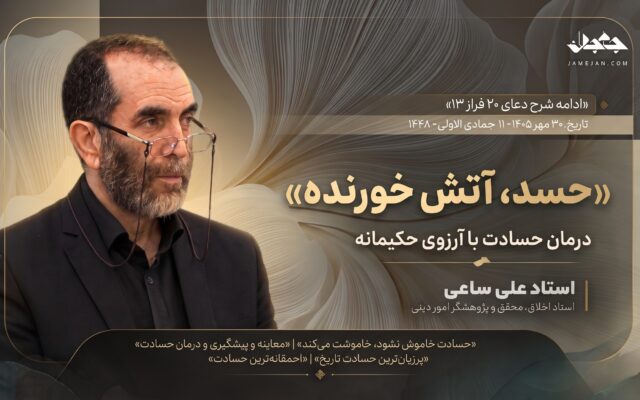
Written transcript of the lecture
The Meshkat-e Noor teachings series🌼🔆🌼Husayn Behind the Veil of the Verse of the Niche🌼🔆🌼
🌹🔅☘️ بِسْمِ اللَّهِ الرَّحْمنِ الرَّحيمِ ☘️🔅🌹
🔅🌹 “A Journey Through the Niche in the Verse of Light” “The Reality of the Niche” “The Condition of Wilayah” “Love in Its Raw, Unrefined Form” “The Second Night of Muharram” and … Abstract with Supplement 1405.03.27 Ali Sa‘i (Abdullah Meshkat) 110.141(903) 🌹🔅
💫🌹A Journey Through the Known and Unknown World of Husayn🌹💫
✳️Part One!
An effort to uncover the greatness of Husayn!
The niche in the Verse of Light:
✨🔆النور : 35 اللَّهُ نُورُ السَّماواتِ وَ الْأَرْضِ مَثَلُ نُورِهِ كَمِشْكاةٍ فيها مِصْباحٌ الْمِصْباحُ في زُجاجَةٍ الزُّجاجَةُ كَأَنَّها كَوْكَبٌ دُرِّيٌّ يُوقَدُ مِنْ شَجَرَةٍ مُبارَكَةٍ زَيْتُونَةٍ لا شَرْقِيَّةٍ وَ لا غَرْبِيَّةٍ يَكادُ زَيْتُها يُضيءُ وَ لَوْ لَمْ تَمْسَسْهُ نارٌ نُورٌ عَلى نُورٍ يَهْدِي اللَّهُ لِنُورِهِ مَنْ يَشاءُ وَ يَضْرِبُ اللَّهُ الْأَمْثالَ لِلنَّاسِ وَ اللَّهُ بِكُلِّ شَيْءٍ عَليمٌ
❇️ Introduction
A comprehensive definition of “niche” in this text
Conceptual definition (essence and reality)
The niche is a perfectly clear and complete existent that receives and reflects divine light without obscurity, distortion or diminution, and makes it perceptible to contingent beings.
In other words:
The niche is a divine means and bond for the “limited capacity of perception in created beings.”
Examples of the niche (its instances in the text)
According to the text, “niche” applies to several concrete and epistemic instances:
| No. | Instance | Its role as a niche |
| 1 | Imam Husayn (AS) | The most perfect and comprehensive niche, containing divine light within himself. |
| 2 | The Noble Qur’an | The niche of God’s speech: that is, a clear vessel that conveys divine speech to humankind. |
| 3 | The Ahl al-Bayt (AS) (the Speaking Qur’an) | The niche of the Silent Qur’an; the true interpreters of its verses. |
| 4 | Each of God’s Most Beautiful Names | Each name is a niche through which one of the divine attributes is manifested. |
| 5 | The Qur’anic verses | Each verse is a niche for a particular subtle truth. |
| 6 | A purified human being | Anyone who has attained purification and piety can become a niche reflecting divine light. |
Functional definition (the roles and duties of the niche)
According to the text, the niche has six essential functions:
| No. | Function | Explanation |
| 1 | Receiving light | It receives God’s raw, absolute light. |
| 2 | Clarifying | It lets the light pass through without obscurity or distortion. |
| 3 | Bringing to maturity | It turns raw light into mature, sustaining love (it cooks love). |
| 4 | Dissemination | It spreads and reflects light throughout the whole universe. |
| 5 | Interpretation | Interprets the reality of light in terms that created beings can understand. |
| 6 | Introduction | Makes God’s names and attributes known to created beings. |
Ontological definition (the levels of the glass vessel)
According to the text, the glass vessel has three levels of existence:
| Level | Name | Description |
| First | Eternal glass vessel (luminous reality) | Luminous and Throne-related existence |
| Second | Historical glass vessel (concrete existence) | The embodiment of that reality on earth in the person of Imam Husayn (AS). |
| Third | Epistemic glass vessel (instrument of knowledge) | The Qur’an, verses, divine names, and the purified human heart, through which the Light is known. |
Comprehensive definition (one paragraph)
In this text, “glass vessel” is a term for any “clear and perfect existence” that receives divine Light without obscuring it, ripens it into something wholesome and palatable, and then spreads it throughout all existence. Its fullest embodiment is Imam Husayn (AS), who encompasses all the divine lights within himself. The Qur’an, verses, the Most Beautiful Names, and the purified human heart are examples of lesser glass vessels. The glass vessel is neither the Light itself nor darkness; rather, it is the “conduit, interpreter, and herald of the Light” in the realm of created existence.
Comprehensive table of the glass vessel’s attributes
| Attribute | Description |
| Clarity | It admits no obscurity, distortion, or deficiency. |
| Receptivity | It is capable of receiving the absolute divine Light. |
| Reflection | It reflects the Light without alteration. |
| Interpretability | It renders the absolute Light in terms that created beings can understand. |
| Ripening | It transforms raw Light into a mature, wholesome love. |
| Universal dissemination | It spreads the Light throughout every particle of existence. |
| Unveiling | A reflection of the Unseen of the Unseen |
| Mediation | It is the bond between “pure Light” and “the perception of created beings.” |
How the glass vessel differs from related concepts
To avoid confusion, I will clarify how the glass vessel differs from three related concepts:
| Concept | Difference from the glass vessel |
| Light | Light is the reality itself; the glass vessel is its receptacle and conduit. |
| Mirror | A mirror merely reflects; the glass vessel not only reflects the Light but also interprets and ripens it. |
| The rope of God | A mediator merely conveys; the glass vessel transforms the Light into wholesome love. |
✨ Final summary
In this text, the glass vessel is a “perfect, clear existence” with the following four functions:
Receiving the divine Light without distortion
Ripening it and making it wholesome (transforming raw Light into mature love)
Interpreting and rendering it in terms that created beings can understand
Spreading it throughout all existence (universal reflection)
Its fullest embodiment is Imam Husayn (AS); other examples include the Qur’an, verses, divine names, and the purified heart.
| Row | Topic | Commentary |
| 1 | Profound mystical insight | The text offers a fresh perspective on the reality of Imam Husayn (AS), presenting him not merely as a historical figure but as an “ontological reality.” |
| 2 | Bringing the Qur’an and mysticism together | Its use of the Light Verse and its association with Imam Husayn (AS) reflect a profound interpretive vision rooted in the Islamic mystical tradition. |
| 3 | Emphasis on purification and piety | The text rightly portrays love without purification as incomplete and even dangerous, and cautions against self-praise. |
| 4 | Poetic and evocative language | The prose is rich in mystery and emotion, and can speak deeply to readers drawn to mysticism. |
| 5 | A comprehensive perspective | It explores the subject through epistemological, ontological, spiritual and Qur’anic dimensions, and in a sense resembles an “encyclopedia of Husayni mysticism.” |
| 6 | Avoiding mere exaggeration | Despite its exalted language, the text states explicitly that claiming an association with Husayn without self-purification is a grave falsehood. This serves as an important “ethical brake.” |
1-1 A journey through the Light Verse: the beauty of Husayn framed by the glass
💫🌸 مَثَلُ نُورِهِ كَمِشْكاةٍ فيها مِصْباحٌ الْمِصْباحُ في زُجاجَةٍ الزُّجاجَةُ 🌸💫
✳️ The glass vessel of God’s light: Reflections on the Light Verse and the reality of Imam Husayn (AS)
✅Visiting the glass vessel is visiting the light
If only, when we set out for Karbala, we also set our hearts on reaching the shrine of the “Light Verse,” and on beholding His beauty there.
How can one visit the glass vessel of the Light Verse?
The answer: “With a sound heart.”
In truth, Husayn (AS) is the glass vessel of light—the vessel of knowledge, wisdom and divine grandeur.
“Imam Husayn is the glass vessel of light” means that the cup of the spirit is light. Husayn is the highest interpretation of the reality of light!
All the lights of the world point to that true light. Whatever we see is only an interpretation, a beauty veiled from us. We look through the veil to reach our destination, behold the true beauty of the light—and “Husayn” is the supreme manifestation of its reality!
If the veil were lifted from the beauty of the light of earth and heaven, the beauty of Imam Husayn (AS) would be revealed; the essence of light would appear!
Can a veil be drawn over the beauty of light? Yes. We imagine that we are gazing upon the light, yet we are still witnessing the “veil of light.” We have yet to pass beyond it and see that true beauty.
1-2 Husayn (AS): the revealer of reality
When we say “flower,” we mean that which reflects the light of the sun in a particular way.
Imam Husayn (AS), too, reveals that hidden reality in a particular way.
When will we find the vision that sees through Husayn?
That glass vessel, perfectly transparent, is a tablet embracing the light and the source from which God’s lights shine forth.
Without the glass vessel, the world would be plunged into darkness. Without light, a human being could have no sense of love.
1-3 One who ripens love
Without the glass vessel, love remains raw, not ripe. Raw love stirs nothing in the soul. The grace that reaches us through the vessel is the ripeness of light.
Husayn is the glass vessel that cooks love and brings its flavour to the palate.
The interpretation of the *zujāja* is vast. If only our hearts could bear its unveiling!
1-4 The Heart: A Husayni Stronghold
Our hearts have a stronghold called the “Husayni stronghold.”
A heedless heart is a prison for the light of Husayn; it has imprisoned that light. If the heart would only allow it, the furnace of love for Husayn would consume everything.
The *zujāja* of Husayn, in other words, is the one who encompasses God’s light: it encompasses knowledge and wisdom, and reflects the full measure of that light across the world.
1-5 The *Zujāja*: A Vessel for the Divine Names and Attributes
The *zujāja* is, in a sense, a manifestation of God’s Names and Attributes, and shines with their light.
It spreads God’s Most Beautiful Names throughout all existence, and our hearts are more familiar with this light than any land.
1-6 A World Without Husayn Is a Silent World (The *Zujāja* of Hearing)
Husayn is the sum of beautiful servanthood to God; he is the translation of God’s light and knowledge; he is the very truth of hearing.
Unless hearing is framed by the *zujāja*, we cannot truly understand what it means to hear. Just as visual light depends on the *zujāja*, so too does the light of hearing: without the *zujāja*, we would be deaf in the truest sense.
Our sense of taste is the same: without the *zujāja*, it would have no flavour.
Now, if we raise our gaze and contemplate the lights, sounds and tastes of the celestial realm, we will begin to grasp the Imam’s greatness. Let us raise our love.
1-7 Husayn: The Secret Behind Truth’s Power to Attract
The *zujāja* is the exalted greatness of the life-sense of the universe: Husayn.
Husayn is the secret behind truth’s power to attract. Each of God’s Most Beautiful Names is a *zujāja* of His majesty and power.
So let us open our eyes wider.
1-8 The Qur’an: The *Zujāja* of God’s Speech
The Speaking Qur’an is the *zujāja* of the Silent Qur’an, revealing its truth.
Each verse has its own *zujāja*:
The Qur’an’s wording is the *zujāja* of its allusions.
The Qur’an’s allusions are the *zujāja* of its subtleties.
The Qur’an’s subtleties are the *zujāja* of its truths.
And Husayn is the *zujāja* of them all.
Husayn is the *zujāja* of the Mother of the Book, the *zujāja* of Muhammad and the Family of Muhammad (PBUH).
✳️ Part Two
2-1 Husayn in the Eyes of the Messenger of God (PBUH)
“مَرْحَباً بِکَ یَا أَبَا عَبْدِاللَّه”
💫🔆 عَنِ ابْنِ بَابَوَيْهِ بِإِسْنَادِهِ عَنِ الْحُسَيْنِ ع قَالَ دَخَلْتُ عَلَى رَسُولِ اللَّهِ ص وَ عِنْدَهُ أُبَيُّ بْنُ كَعْبٍ فَقَالَ لِي رَسُولُ اللَّهِ ص مَرْحَباً بِكَ يَا أَبَا عَبْدِ اللَّهِ يَا زَيْنَ السَّمَاوَاتِ وَ الْأَرْضِ قَالَ أُبَيٌّ كَيْفَ يَكُونُ غَيْرُكَ يَا رَسُولَ اللَّهِ زَيْنَ السَّمَاوَاتِ وَ الْأَرْضِ فَقَالَ ص إِنَّ الْحُسَيْنَ فِي السَّمَاءِ أَكْبَرُ مِنْهُ فِي الْأَرْض[1]
🔆 Ibn Babawayh (Shaykh al-Saduq) relates, with his chain of transmission, from Imam Husayn (AS), who said: I went in to see the Messenger of God (PBUH), while Ubayy ibn Ka‘b was with him. The Messenger of God (PBUH) said to me, “Welcome, Abu Abdillah, adornment of the heavens and the earth!” Ubayy said, “How can anyone other than you, O Messenger of God, be the adornment of the heavens and the earth?” He replied, “Indeed, Husayn is greater—and loftier—in heaven than on earth.”
Why was the Messenger of God (PBUH) so overjoyed whenever he saw Husayn? The Messenger of God saw in Husayn, through God, what others were denied the sight of: a spirit and a beauty in Husayn that others had not seen and never would.
We must bear witness to the extent of our capacity.
2-2 Husayn: The Adornment of the Heavens and the Earth
The adornment of the heavens and the earth! Every beauty on earth and in the heavens bears the imprint of Husayn; it is a reflection of Husayn.
The Messenger of God (PBUH) could see; but we have yet to behold even a single page of the earth. Which one have we studied?
We have not yet lifted our heads from the dust; we are buried beneath it. When will we come to witness the earth and see its beauties, so that we may take in a glimpse of Husayn’s beauty?
Then let us turn our gaze to the heavens and witness their adornments, so that we may arrange the manifestations of Husayn’s beauty before us and behold an image of that exalted beauty.
2-3 The Prophet’s (PBUH) Oath Reveals Husayn’s (AS) Greatness
By the One who sent me as a prophet, I swear that Husayn ibn Ali (AS) is greater in the heavens (as seen from the perspective of the heavenly beings) than he is among the people of the earth (as seen from the perspective of those on earth). That is, his greatness is more apparent in the heavens than on earth. It is more hidden on earth; the heavenly beings know Husayn better and more fully than those on earth.
The vision of Husayn’s exalted stature is such that the tablet of the earth cannot bear to reflect his greatness. An earthly mirror cannot reflect Husayn’s countenance; a more expansive tablet is needed—one that reaches into the heavens and can reflect larger images of Husayn.
These are the words of the Messenger of God, swearing by God as he introduces Husayn to the world.
How, then, can I understand Husayn? I am still at the very first threshold of understanding him. However much I search, I cannot free myself from a single word of Husayn’s words—a word that is a lamp of light.
2-4 Gazing upon Husayn Requires a Vision as Boundless as the Infinite
We have yet to draw from Husayn; we merely watch from afar and are content with that.
We must reach the heart of the lamp. Through this lamp, God unveils His mysteries.
✳️ Part Three
3-1 One Heart; One Love
Al-Ahzab: 4 Ma جَعَلَ اللَّهُ لِرَجُلٍ مِنْ قَلْبَيْنِ في جَوْفِهِ …
Allah has not placed two hearts within any person’s breast!
God has not placed two hearts in one breast, so that with one heart we might love Husayn and with another love sin.
When I, in my ignorance, engage in sin, Husayn is no longer in my heart.
No impurity can draw near to Husayn unless that heart is purified.
This is the secret of being Husayni.
3-2 Love Is Not a Matter of Claim
We must be clear about our own responsibility:
Purification and piety are prerequisites for loving Husayn.
Piety is the first step toward purification.
Love brings obligations; it is not the other way around.
Self-praise is a sign of hypocrisy. Anyone who claims a connection to Husayn without deserving it is claiming to be purified.
Those who love Husayn and are truly free make their way to Husayn’s welcoming threshold and find peace; they do not sell themselves for Paradise or Hell.
Al-Najm: 32 … فَلا تُزَكُّوا أَنْفُسَكُمْ هُوَ أَعْلَمُ بِمَنِ اتَّقى
So do not claim purity for yourselves; He knows best who is mindful of Him!
✳️ Part Four
📜 A Compendium of the Philosophical and Mystical Wisdom of the Niche of Light
🔹 A) On “Light, Veils, and Reality”
1. Everything we see is an interpretation of light, not the true Light itself.
2. We always behold the light from behind a veil; the aim is to reach beyond it.
3. The true Light can be seen only through a clear niche.
4. Veils were created not to conceal, but to allow perception to unfold gradually.
5. Every manifestation of beauty bears a veil of majesty.
6. To witness reality, we must move beyond the mind’s interpretations of light.
7. What we take to be “seeing the light” is often seeing “a translation of the light.”
🔹 B) On “Imam Husayn (AS) as the Niche of Light”
8. Imam Husayn (AS) is the all-encompassing niche of all divine lights.
9. Husayn (AS) is the locus in which God’s names and attributes are manifested in the realm of possibility.
10. Without Husayn, the world of existence would be utter darkness and absolute silence.
11. Husayn means “the sum of beautiful servitude to God”—the full beauty of worshipful devotion.
12. The Husayni niche transforms raw light into love that is ripe and sweet.
13. Husayn is the secret behind truth’s power to draw all creation to itself.
14. Husayn is the translation of God’s light and knowledge into the language of existence.
🔹 C) On “Perception, Hearing, Taste, and the Means of Knowing”
15. True hearing takes shape within the framework of the niche; otherwise, it is a kind of epistemic deafness.
16. The Husayn-seeing gaze is another kind of vision we must acquire.
17. Without the niche, the palate cannot taste the flavor of truth.
18. Our faculties of perception are not reality itself; they are its mirrors.
19. Intuitive knowledge does not come by way of the ordinary senses.
20. Unless we open the eye of the soul, we will not see the beauty of the celestial realm.
🔹 D) On “The Heart, Light’s Confinement, and the Freedom of Love”
21. At times the heart is a prison for light, not its dwelling place.
22. Raw love does not settle in the heart; it must be refined in the niche of love.
23. Husayni love is a furnace that burns away every impurity and tempers every essence.
24. God has not placed two opposing hearts within a single being.
25. True love and sin cannot dwell under the same roof.
26. If the human heart is grounded in Husayn, it will shun every impurity.
🔹 E) On “Beauty, Adornment, and Husayni Ontology”
27. All the beauties of the earth and adornments of the heavens are manifestations of Husayn.
28. The world is an inadequate mirror for reflecting the full majesty of Husayn.
29. The heavens are a vaster canvas on which Husayn’s beauty is reflected.
30. Without Husayn, existence is a silent, tuneless world.
31. The adornment of the celestial realm is a ray of Husayn’s beauty.
🔹 F) On “Earth, Dust, and the Vision of the Unseen”
32. We are still buried beneath the earth, entombed in our own imaginings.
33. Until we rise above the dust of the body, we will not attain a vision of heaven.
34. We have not studied the page of the earth, let alone the page of the heavens.
35. The greatness of Husayn is beyond what our earthly mirror can contain.
🔹 H) On “the Reality of the Qur’an, the Word, and Its Relation to Husayn”
36. The Qur’an is the vessel of God’s Word, but the vessel is not itself the content.
37. The Speaking Qur’an (the Ahl al-Bayt) is the vessel of the Silent Qur’an.
38. Every verse is a vessel for a subtle truth.
39. Husayn is the vessel of the Mother of the Book.
40. Without a vessel, the Word remains silent; the vessel makes it speak.
🔹 Kh) On “Spiritual Wayfaring, Worthiness, and the Obligation of Love”
41. Love for Husayn brings obligations; it is not merely a source of pride.
42. God-consciousness is the prelude to purification, and purification is a condition for entering Husayn’s sanctuary.
43. No impurity may draw near to Husayn without first being purified.
44. To claim love without purifying oneself is self-praise, and self-praise is a sign of hypocrisy.
45. The salvation of those who love Husayn depends on righteous deeds, not mere affiliation.
46. Those who are free in the way of Husayn do not sell themselves for Paradise or Hell; they find peace only at Husayn’s threshold.
47. The capacity of our being determines the degree to which we behold Husayn’s beauty.
🔹 D) On “The Prophet’s Oath and the Mystery of Greatness”
48. The Prophet (PBUH) swore that Husayn is greater in heaven than all who dwell on earth.
49. What the Prophet saw of Husayn’s beauty, others neither saw nor ever will see.
50. The earth cannot bear the full reflection of Husayn’s greatness; the heavens are needed.
🔹 Dh) On “The Furthest Reach of the Lover’s Spiritual Journey”
51. The goal is to reach “the Reality of Husayn,” not to stop at the outward form of his name.
52. We must reach the heart of the vessel, rather than merely gaze at it from afar.
53. If only our hearts had the capacity to bear the unveiling of the vessel.
54. Let us elevate our love until we taste the flavor of the celestial realm.
55. To behold Husayn is to behold all the realities of existence.
✳️ Part Five
✳️Explaining the Place and Reality of Shiism and Wilayah
1. What It Truly Means to Be of Husayn
Being of Husayn is not merely a claim; it requires purification of the soul and God-consciousness.
The qualities of Imam Husayn’s companions are a model for his true followers.
“O, if only I had been with you” is a longing to accompany the Imam that must be fulfilled in action.
2. Purification and God-Consciousness: Conditions for Affiliation with Husayn
Self-praise (purifying oneself) is not permissible; God knows best who is God-conscious.
God-consciousness is the prelude to purification, and those who are God-conscious belong to Husayn.
Love for the Ahl al-Bayt entails obligations and is incompatible with every kind of conduct.
🔹 Verse: “قَدْ أَفْلَحَ مَنْ تَزَكَّى” (Those who purify themselves are successful)
3. Wilayah: The Great Divine Blessing
The Ahl al-Bayt (AS) are an embodiment of God’s “blessing” upon His servants.
It is forbidden to turn the blessing of wilayah into disbelief—through denial, distortion, neglect, or excess.
The blessing of wilayah should lead to growth and elevation, not corruption and deviation.
🔹 Verse: “أَلَمْ تَرَ إِلَى الَّذِينَ بَدَّلُوا نِعْمَتَ اللَّهِ كُفْرًا”
4. The Meaning of Shi‘a in the Narrations
A Shi‘a is one who follows the Imams in practice, not merely one who professes love for them
A narration from Imam al-‘Askari (AS): True Shi‘a are those who follow the Imams’ example and deeds
Sinful devotees may suffer temporary punishment despite their love for the Ahl al-Bayt; they are not called Shi‘a until they have been purified
5. The Danger of Exaggeration and the Misuse of Love
The worst misuse of the blessing of wilayah comes from devotees who see only its outward forms
Falsely claiming a connection to wilayah prevents society from growing and attaining purity
Impurity and defilement have no affinity with wilayah; shirk and habitual sin destroy one’s deeds
6. The Need for Gratitude and Avoiding Ingratitude
Ingratitude for a blessing leads to its loss
True gratitude for the blessing of wilayah is expressed through righteous deeds and following the way of the Infallibles
People will be questioned about their blessings on the Day of Resurrection (Surah al-Takathur: «لَتُسْأَلُنَّ یَوْمَئِذٍ عَنِ النَّعِیمِ»)
Love for the Ahl al-Bayt must not be commercialised or exploited
The text’s overall message:
Being admitted to the school of Husayn and wilayah is a great honour, but one that depends on purification, piety and action. Claiming love without putting it into practice is not only worthless; it can also cause the greatest harm to the individual and the religious community.
✳️ Part Six
📜 A List of the Text’s Wise and Philosophical Sayings
1. Striving to become like Husayn is to take on the spirit of Husayn—not merely to wear mourning clothes.
2. Not everyone has the right to claim a connection to Husayn; this honour is not won by claims, but attained through purification.
3. Self-praise (self-purification) is a sign of hypocrisy; God knows best who is truly pious.
4. The first step in purification is to avoid anything that might taint the soul with shirk and doubt.
5. Love for Husayn (AS) carries obligations and admits of no conduct or thought whatsoever.
6. Wilayah is a crown upon the head, greater than Solomon’s kingdom—but not everyone is worthy of it.
7. One who claims a connection to wilayah must reflect its light, not merely claim it.
8. The blessing of wilayah is turned into ingratitude either by denying it, exaggerating it, or distorting it.
9. The blessing of wilayah must not become a burden on people’s lives; it should instead adorn the world.
10. Love for the Ahl al-Bayt is not a commodity to be misused in trade; those who are free in the way of Husayn do not sell their love.
11. If the blessing of wilayah has not changed our character or left its flavour in us, we are guilty of ingratitude.
12. The worst affliction to befall wilayah comes not from its open enemies, but from devotees who see only its outward forms.
13. A true Shi‘a is recognised by practical deeds, not merely by verbally disavowing the enemies.
14. Whoever claims a rank for which they are unqualified holds back not only their own growth and purification, but society’s as well.
15. Salvation is granted only to one who cleanses the heart of the defilement of shirk and sin, and comes before the Real with a sound heart.
🌼Ali Sa‘i (Abdullah Meshkat) 110.141(903)🌼
[1] *Al-Kharāʾij wa-l-Jarāʾiḥ*, vol. 2, p. 550 Quṭb al-Dīn Rāwandī, Saʿīd ibn Hibat Allāh, Imam Mahdi Institute (may God hasten his noble return), Qom, first edition, 1409 AH.